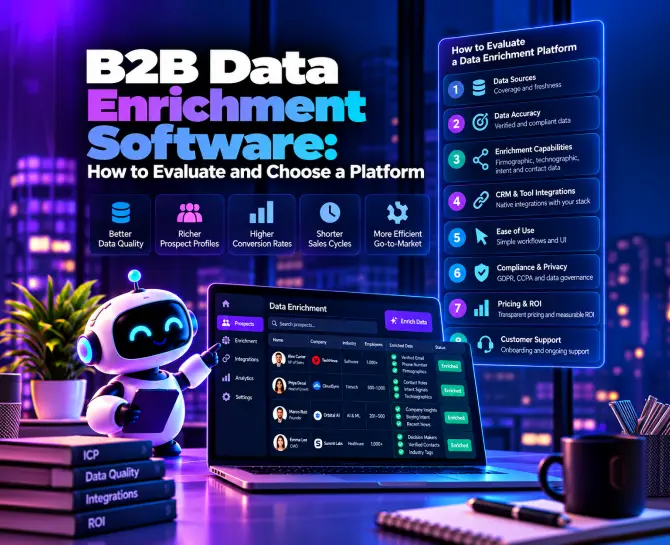
How to Evaluate and Compare B2B Data Enrichment Software
B2B data enrichment software adds missing or updated information to contact and company records. This guide covers the data enrichment teams need, the main types of platforms, key buying criteria, vendor testing, leading options, and how to measure the value of an enrichment investment.
Two B2B data enrichment platforms can promise similar coverage yet deliver different results in your CRM. One can accurately identify the contacts and accounts you care about, while another can return more matches but less usable data. When enrichment is inaccurate or outdated, teams can end up targeting the wrong accounts, routing leads incorrectly, or personalizing outreach with unreliable information.
Choosing the right B2B data enrichment software therefore requires looking beyond database size. Vendors vary in coverage, accuracy, freshness, data depth, integrations, automation, and workflow capabilities. A platform with the largest database or longest feature list is not automatically the right choice for your team.
The right software provides the data your team needs for the decisions and workflows that matter.
That makes evaluation a matter of fit, not feature count. The strongest choice is one that performs reliably against your actual records, supports the way your team works, and delivers enough usable data to justify its cost.
Key Takeaways
- Evaluate coverage against your ICP, not the size of a vendor’s overall database.
- Check important fields for accuracy and freshness, because a matched record can still contain outdated or incorrect information.
- Choose the type of enrichment software based on the data problem you need to solve.
- Test shortlisted platforms using a representative sample of your own records before committing.
- Compare vendors using total cost and usable output, not subscription price alone.
What B2B Data Enrichment Software Actually Does
B2B data enrichment software enhances existing contact, lead, and company records by adding missing information, updating outdated fields, and supplementing records with additional business data. It enables sales, marketing, and RevOps teams to work with complete records and make decisions based on current account and contact information.
The software typically identifies records, matches them against one or more data sources, and appends relevant information such as job title, seniority, company size, industry, revenue, technology stack, or business signals. Depending on the platform, it can also verify existing information, update stale fields, identify relevant contacts, and automate enrichment across CRM and other GTM systems.
For example, your CRM may only show:
Acme Technologies | Jane Smith | VP Marketing
An enrichment tool can add useful details such as:
500 employees | SaaS | North America | Salesforce | Verified work email
This gives sales, marketing, and RevOps teams more information to understand accounts, find the right contacts, and take the next action.
Common applications include:
- ICP Qualification: Check whether an account matches your target profile.
- Lead and Account Routing: Use attributes such as geography, company size, or industry to determine ownership.
- Segmentation: Build more relevant sales and marketing audiences.
- Account Prioritization: Identify which accounts deserve attention.
- Personalization: Give teams more context for relevant messaging.
- Sales Research: Reduce the time spent manually gathering company and contact information.
The important distinction is between adding data and creating value from data. Enrichment is useful when the information added to a record improves a decision, reduces manual work, or makes a GTM activity more precise.
What Data Should Your Enrichment Software Provide?
The data you need depends on your ICP, sales process, and enrichment goals. Instead of comparing vendors by total field count, identify the fields your team actually needs.
Contact Data
Contact data helps sales teams identify the people who matter within target accounts.
Common fields include:
- Job title
- Seniority
- Department
- Work email and phone information, where relevant
- Current employer
- Role changes
For instance, an account may already exist in your CRM, but the record may not identify its current VP of Marketing. Contact enrichment can fill that gap and improve buyer-level coverage.
Company and Firmographic Data
Firmographic information provides context for evaluating and segmenting accounts.
Useful fields include:
- Industry
- Employee count
- Revenue
- Geography
- Funding
- Company structure
- Relevant business events
These attributes can feed qualification rules, territory planning, segmentation, and account prioritization.
Technographic and Business Signals
Technographic data shows the technologies an organization uses. Business signals add context about changes that may affect its priorities.
Depending on the provider, these can include:
- Technology stack
- Hiring and growth indicators
- Leadership changes
- Funding events
- Organizational changes
- Intent or behavioral signals
The best dataset is not necessarily the one with the most fields. Prioritize the information that changes what your team does with a record.
The Main Types of B2B Data Enrichment Software
Enrichment software can occupy different positions in a company’s GTM data stack.
| Software Type | Primary Role | Best Suited to |
|---|---|---|
| CRM enrichment | Keep existing records complete and current | RevOps and CRM teams |
| Contact enrichment | Improve buyer-level coverage | Sales and outbound teams |
| Enrichment orchestration | Combine and manage multiple data sources | Data-heavy GTM teams |
| API/data infrastructure | Deliver enrichment into custom systems | Engineering and data teams |
| CRM-native enrichment | Enrich records within a specific CRM | HubSpot or Salesforce-centric teams |
| Account intelligence + enrichment | Connect data with targeting and activation | ABM and account-based GTM |
8 Things to Evaluate Before Buying B2B Data Enrichment Software
Once you know what you need from an enrichment platform, compare vendors based on the factors that affect data quality, usability, and cost.
1. Match Rate for Your Target Accounts
Vendor-wide coverage does not show how well a platform performs against your ICP. Test its match rate across the segments that matter most:
- Industry
- Geography
- Company size
- Revenue
- Persona
- Seniority
A smaller database can deliver more value if it has stronger coverage of your priority segments.
2. Accuracy and Verification
A matched record is not necessarily an accurate record. Test the fields your team relies on, such as job title, employer, email, employee count, industry, and technology.
Also check how the vendor sources and verifies its data. Match rate and accuracy should be evaluated separately.
3. Data Freshness
B2B data changes frequently as people move roles, companies grow, and technology stacks evolve.
Check:
- Refresh frequency
- Fields that are refreshed
- Real-time vs. scheduled updates
- Stale-data detection
- Controls for updating CRM records
If your data needs ongoing maintenance, a one-time enrichment process may not be enough.
4. Data Depth and Coverage
Assess whether the platform provides enough relevant attributes to support the qualification, segmentation, and targeting decisions your team actually makes.
Do not choose based on field count alone. A smaller set of reliable, relevant fields is more useful than a long list of poorly covered attributes.
5. CRM and System Integrations
Evaluate how easily enriched data fits into your existing systems.
Check for:
- Native integrations
- API access
- Field mapping
- Record matching
- Write-back controls
- Rules for handling existing values
A connector is only useful if it gives your team the control needed to manage enriched data effectively.
6. Automation and Control
Look for the level of automation that fits your workflow, including:
- Batch enrichment
- Real-time enrichment
- Scheduled updates
- Trigger-based enrichment
- Record- and field-level controls
- Fill or overwrite rules
New inbound leads may benefit from real-time updates, while established CRM records may require more controlled changes.
7. Compliance and Governance
Review how the provider handles data sourcing, privacy, permissions, and regional requirements.
Also consider:
- Auditability
- Data retention
- Governance controls
These become especially important when enriched data feeds automated outreach, routing, or lead-scoring processes.
8. Total Cost of Ownership
Look beyond the subscription price. Consider:
- Seats
- Credits
- API usage
- Overages
- Implementation
- Maintenance
- Additional data costs
A useful measure is cost per usable enriched record. If only 6,000 of 10,000 enriched records contain the information your team needs, evaluate the cost against the 6,000 usable records.
Pro Tip- Don’t rely on one aggregate match-rate number. Break your test results down by the segments that matter most to your ICP, such as industry, company size, geography, and seniority. A provider with weaker overall coverage may still outperform competitors in your highest-value segments.
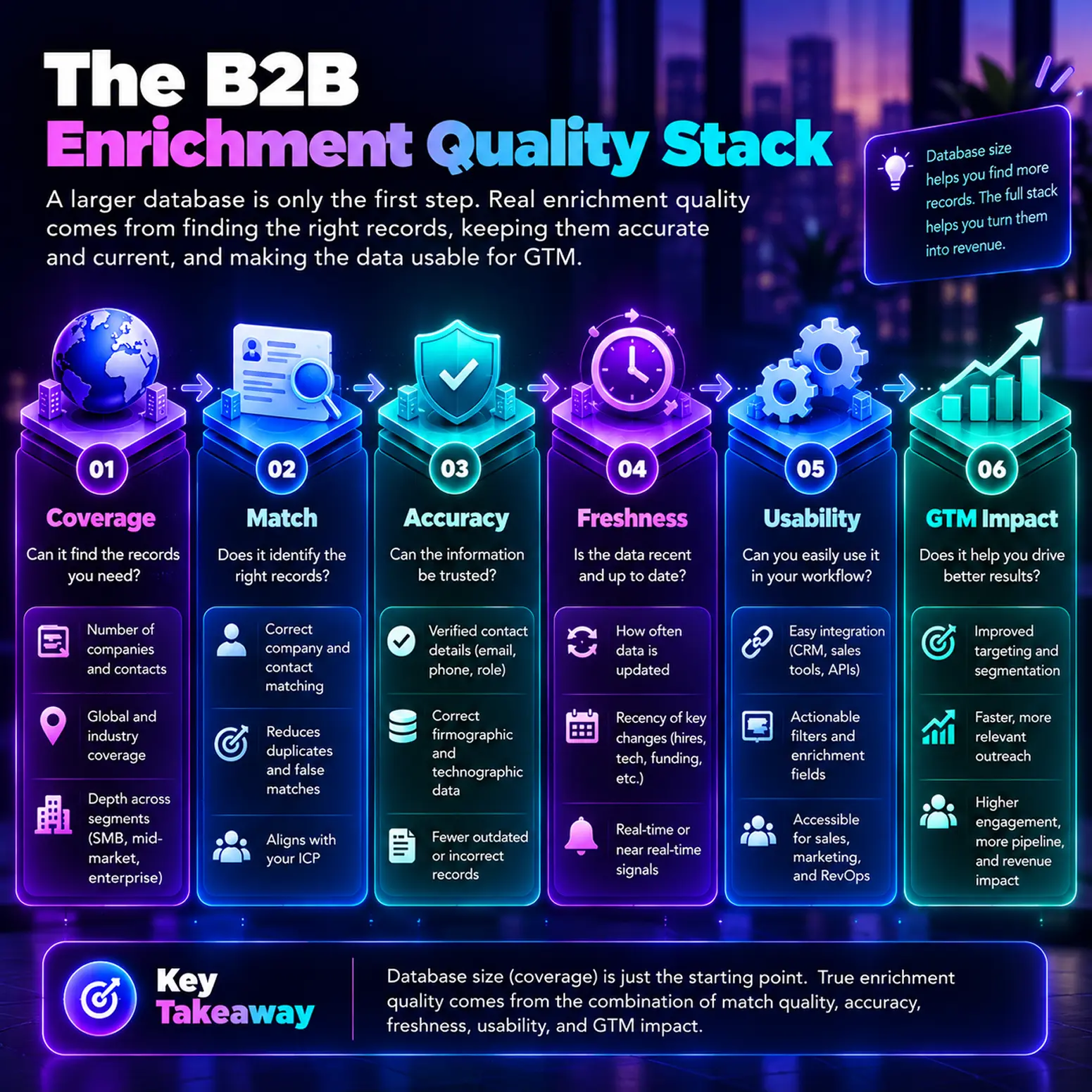
How to Test an Enrichment Platform Before You Buy
A vendor pilot should show how an enrichment platform performs under the conditions your team will actually use it. Rather than relying on a vendor’s database statistics or product demonstration, run a controlled test using a sample of your own records.
Start by creating a test set that reflects the range of data conditions in your database. Include:
- Complete records
- Partially populated records
- Records with known stale information
- Difficult-to-match records
- Records from different industries and company sizes
- Multiple geographies and personas
Then give each shortlisted vendor the same inputs and define the test rules in advance. Specify which fields should be enriched, what qualifies as an acceptable result, how existing values should be handled, and how results will be reviewed.
Use the same test conditions for every platform and record the outcomes consistently:
| Test Measure | What to Check |
|---|---|
| Match success | Whether the platform identifies the intended record |
| Field correctness | Whether enriched values meet your acceptance criteria |
| Update success | Whether stale or missing information is updated as expected |
| Requirement pass rate | Whether the resulting record meets the minimum standard you defined |
| Processing experience | Whether the enrichment workflow performs as expected |
| Cost of test output | What you would pay to produce the usable results |
Review the results by segment rather than relying on one overall score. This can reveal where a platform performs particularly well or poorly within the markets, personas, or record types that matter to your business.
The goal of a pilot is not to determine which vendor produces the most data. It is to determine which platform consistently produces acceptable results under your actual operating conditions.
Pro Tip- Define your acceptance criteria before running the pilot. Decide in advance which fields must be correct, which records count as usable, and what level of performance would justify purchase. This prevents vendor claims or favorable results in one area from influencing how you judge the overall test.
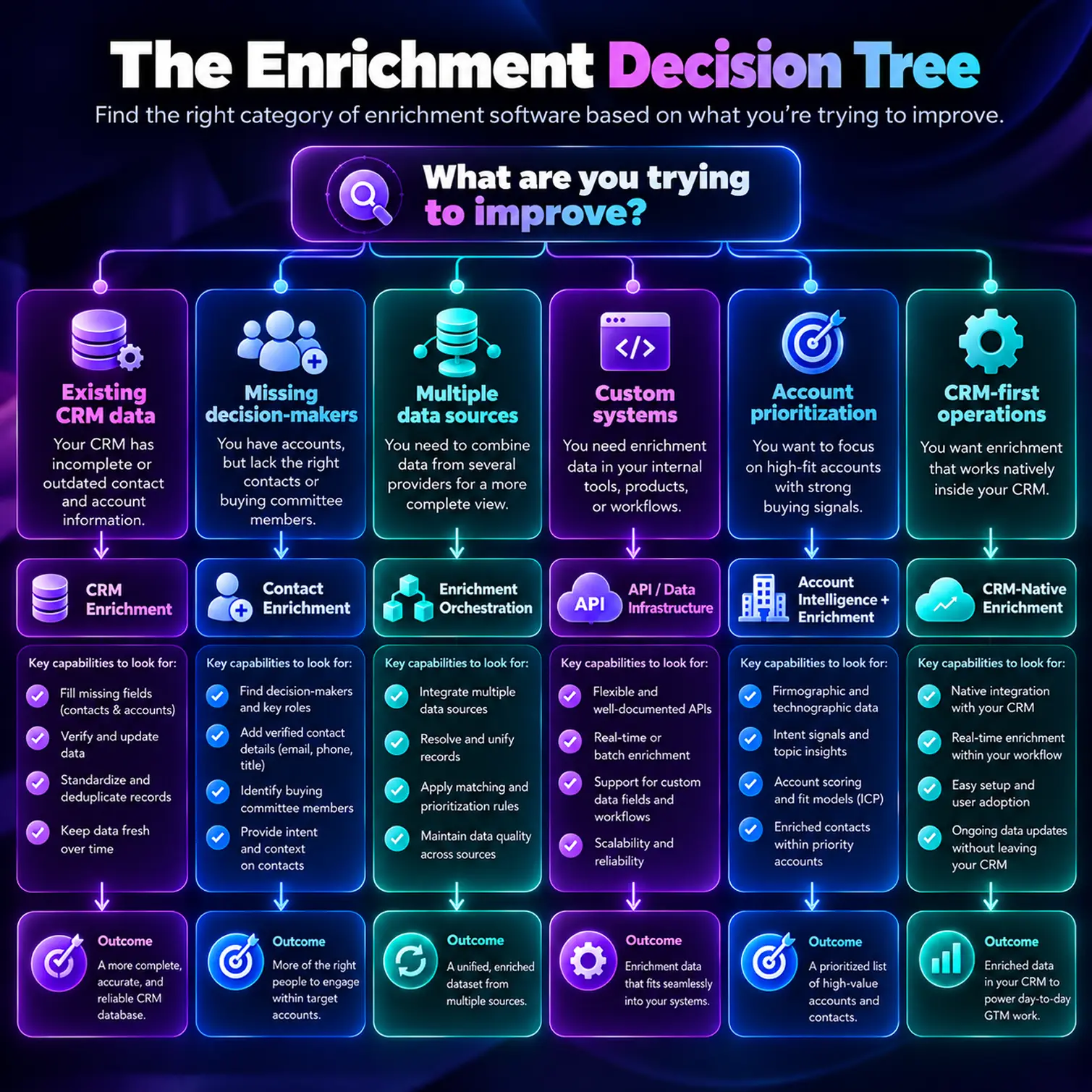
Which Enrichment Approach Fits Your GTM Use Case?
Different enrichment approaches solve different operational problems. Start with the data challenge your team needs to address, then select the platform type that best matches it.
| Primary Problem | Platform Type to Consider |
|---|---|
| Keeping existing CRM records updated | CRM enrichment |
| Finding missing decision-makers | Contact enrichment |
| Updating new leads as they enter the CRM | Real-time or CRM-native enrichment |
| Combining data from multiple providers | Enrichment orchestration |
| Delivering enrichment into custom applications or databases | API/data infrastructure |
| Connecting account data with prioritization and targeting | Account intelligence + enrichment |
| Managing enrichment directly within a CRM | CRM-native enrichment |
The distinction is based on the problem being solved, not on rigid product categories. For example, a team focused on outbound prospecting may need contact enrichment, while a RevOps team managing a complex data stack may require orchestration or API capabilities.
Choose the approach that addresses the specific gap in your current workflow. This keeps the buying decision focused on operational need rather than the breadth of a vendor’s feature set.
7 B2B Data Enrichment Software Platforms to Consider
The following platforms represent different approaches to B2B enrichment. They are not ranked because the right choice depends on the problem, data requirements, and systems involved.
| Platform | Best For | Key Strength | Potential Limitation |
|---|---|---|---|
| ReachGen | Account intelligence + enrichment | Connects enrichment with ICP discovery and GTM activation | May be broader than teams seeking only basic data append |
| Clay | Multi-source enrichment | Flexible source orchestration | Can require more configuration |
| Apollo | Prospecting + enrichment | Combines data, enrichment, and sales workflows | Broader sales platform than dedicated CRM governance |
| Cognism | CRM enrichment, particularly for EMEA | Verified B2B data and controlled CRM enrichment | Regional fit should be evaluated |
| People Data Labs | API/data infrastructure | Developer-oriented data delivery | Requires greater implementation ownership |
| HubSpot Breeze Intelligence | HubSpot-centric enrichment | Native HubSpot context | Best suited to HubSpot environments |
| ZoomInfo OperationsOS Enrich | Enterprise RevOps | Large-scale enrichment and operational controls | May be more platform than smaller teams need |
ReachGen
ReachGen is relevant to teams that want enrichment connected with account intelligence, ICP discovery, and GTM targeting. It is a broader proposition than basic data append.
Clay
Clay is suited to teams that want to combine data from multiple providers and create customized enrichment processes. Its platform supports multi-provider enrichment and data orchestration.
Apollo
Apollo combines prospecting, enrichment, and sales engagement. Its enrichment capabilities are relevant to teams that want data improvement within a broader outbound sales platform.
Cognism
Cognism is a strong consideration for teams focused on B2B contact data and CRM enrichment, particularly when European coverage is important.
People Data Labs
People Data Labs takes an API-oriented approach to people and company data. It is more naturally suited to technical teams that want to integrate enrichment into their own applications or data infrastructure.
HubSpot Breeze Intelligence
HubSpot Breeze Intelligence is particularly relevant to organizations already centered on HubSpot. Its enrichment capabilities operate within the broader HubSpot environment.
ZoomInfo OperationsOS Enrich
ZoomInfo OperationsOS Enrich is designed for enterprise data operations and supports enrichment, cleansing, matching, and data management at scale.
Where ReachGen Fits in a B2B Enrichment Strategy
B2B enrichment and account intelligence overlap, but they are not identical.
Traditional enrichment typically focuses on improving an existing record:
What information is missing or outdated?
Account intelligence extends that question:
Does this account fit our ICP, which people matter, and what should the team know before engaging?
How ReachGen Extends Data Enrichment
ReachGen combines contact and account enrichment with capabilities for account discovery and GTM targeting. Its product positioning includes firmographic and technographic data, real-time verification, ICP discovery, dynamic list building, segmentation, and personalized outreach. It also connects with Salesforce and HubSpot and includes DiGGi-GPT account intelligence.
This approach is useful when enriched information needs to contribute to decisions around:
- Account discovery
- ICP qualification
- Account prioritization
- Segmentation
- Contact identification
- Personalized outreach
The distinction matters because an enriched record is an input. The business value comes from what the team can determine and do with that information.
When ReachGen Is a Stronger Fit
ReachGen is particularly relevant when enrichment forms part of a broader account-based GTM strategy.
It can be a stronger fit for teams looking to connect data with:
- Account discovery
- ICP analysis
- Qualification
- Prioritization
- Segmentation
- Personalized engagement
It is not necessarily the right option for every enrichment requirement. Teams looking for a highly specialized API, CRM-only solution, or narrowly focused regional data provider may prefer a specialist.
For organizations that want enrichment and account intelligence in the same process, ReachGen provides a broader approach.
Common Mistakes When Choosing Enrichment Software
Good vendor evaluation can still lead to a poor purchase if the buying process starts with the wrong assumptions.
1. Choosing Database Size Over ICP Coverage
A large database does not help if the provider has weak coverage in your priority segments.
2. Treating Match Rate as Proof of Accuracy
Matching a record and providing correct information are separate measures.
3. Paying for Capabilities the Team Will Not Use
Extra functionality can increase cost and complexity without improving the outcomes you care about.
4. Automating Before Defining the Required Data
Automating every possible enrichment field can create unnecessary data and increase CRM maintenance.
5. Relying Entirely on Vendor Demonstrations
A controlled demo can show product functionality, but it cannot establish how well the platform performs against your market.
6. Measuring Enrichment Volume Instead of Business Value
Records processed, credits consumed, or fields populated do not tell you whether the investment improved GTM performance.
The best purchasing decisions align software with a defined business requirement before comparing vendors.
How to Measure the ROI of Data Enrichment Software
ROI should reflect the problem the enrichment platform was purchased to address.
For data quality, useful measures include:
- Priority-record completeness
- Verified contact coverage
- Field accuracy
- Manual research time
- Cost per usable enriched record
For GTM performance, teams can also track:
- Email bounce rate
- Routing accuracy
- Qualified accounts
- Sales acceptance rate
- Speed-to-lead
- Conversion rates
Establish a baseline before implementation. If the original problem was incomplete account data, measure completeness before and after enrichment. If the problem was manual research, measure the time spent before and after.
This keeps ROI tied to a measurable change rather than the number of records processed.
Conclusion
The right B2B data enrichment software should be selected based on your GTM requirements, not database size alone.
Start with the data your team needs, then evaluate ICP coverage, match rate, accuracy, freshness, integrations, automation, governance, and total cost. Test shortlisted vendors against representative records before committing.
The strongest enrichment platform is not necessarily the one that adds the most data. It is the one that provides reliable information teams can use to identify, qualify, prioritize, and engage the right accounts and contacts.
If your team needs more than basic data append and wants to connect enrichment with ICP discovery, account qualification, prioritization, segmentation, and personalized outreach, ReachGen is worth evaluating alongside specialist enrichment platforms.
Ready to improve your B2B data quality and sharpen GTM targeting? Let’s connect! Talk to Us!
Build sharper account intelligence and ICP targeting with enriched data and DiGGrowth. Email info@diggrowth.com.
Ready to get started?
Increase your marketing ROI by 30% with custom dashboards & reports that present a clear picture of marketing effectiveness
Start Free Trial
Experience Premium Marketing Analytics At Budget-Friendly Pricing.

Learn how you can accurately measure return on marketing investment.
Lookalike Account Modeling for B2B Revenue Teams
Lookalike account modeling takes a different approach. It studies the attributes and outcomes of successful customers,...
Read full post post
You’re Targeting Your Ideal Customer. So Why Aren’t They Buying?
Your best customers reveal the traits associated with success. Your lost opportunities reveal where fit breaks...
Read full post post
How Predictive AI Will Transform Paid Media Strategy in 2026
Paid media isn’t a channel game anymore, it’s a chessboard. Search, social, programmatic, video, influencer, native,...
Read full post postFAQ's
B2B data enrichment software adds missing, updated, or additional information to existing contact and company records. It helps sales, marketing, and RevOps teams improve data quality for qualification, segmentation, routing, and targeting.
Enrichment adds missing information or context to a record. Data cleansing corrects, standardizes, deduplicates, or removes inaccurate information. Some platforms provide both capabilities.
Accuracy varies by provider, field, geography, persona, and record. A platform may perform well for company information but less consistently for certain contact fields. Testing representative records from your own database provides a more useful assessment.
Neither is universally better. Real-time enrichment suits new records that need immediate updates, while batch enrichment works well for periodic database maintenance. The right approach depends on your workflow.
Pricing varies according to seats, credits, API usage, enrichment frequency, data sources, and additional capabilities. Compare total cost of ownership and cost per usable enriched record rather than subscription price alone.
Many platforms integrate with Salesforce, HubSpot, or both, but integration depth varies. Evaluate field mapping, record matching, write-back rules, overwrite controls, automation, and API access.