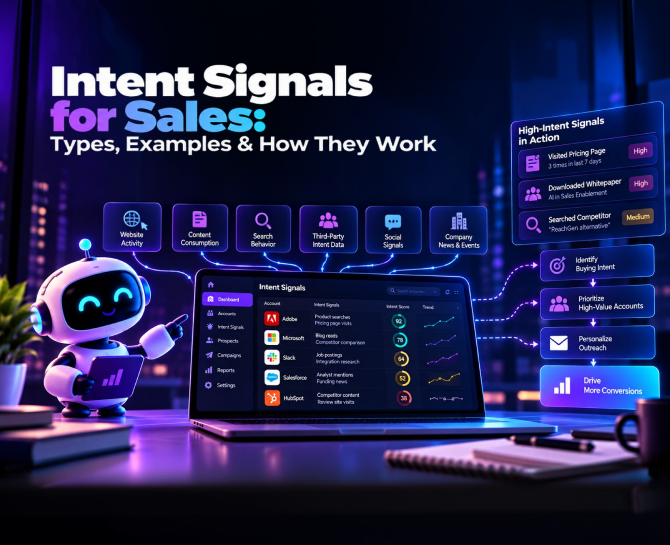
Intent Signals for B2B Marketing: Types, Examples, and How to Use Them
See how research, engagement, technology changes, and organizational events can indicate potential B2B interest, and how to evaluate those signals in context.
B2B buyers research problems, categories, vendors, and technologies before speaking with sales. Intent signals can reveal some of this activity and help teams identify accounts that may be moving toward a purchase.
Intent signals are behavioral or contextual clues that indicate possible interest in a product, category, problem, solution, or vendor. Intent signals for sales teams can come from website activity, external research, technology changes, hiring activity, and other account-level events.
The important part is interpretation. A single page visit rarely says much about an account. A pattern of relevant research from an ICP-fit company, combined with recent engagement and account context, provides a stronger basis for prioritization.
The sections below explain intent signals, where they come from, and how teams can use them.
Key Takeaways
- Intent signals indicate potential buyer interest, not confirmed purchase readiness.
- Engagement, external research, organizational changes, and technographic activity reveal different aspects of account intent.
- Signal strength depends on relevance, recency, frequency, ICP fit, and buying-group breadth.
- Combining intent signals with firmographic, technographic, and verified contact data helps teams prioritize accounts and personalize outreach.
- Effective intent programs measure signal quality by tying it to qualified meetings, opportunities, pipeline, and revenue.
What are Intent Signals in B2B Marketing?
Intent signals are behavioral or contextual indicators that suggest a company may be researching a problem, category, solution, vendor, or technology.
Examples include repeated visits to pricing pages, competitor research, technology adoption, or hiring linked to a business need.
These signals do not confirm buying readiness. Their value depends on context. A single product-page visit may be casual research, while repeated product and pricing activity from multiple people at the same target account suggests stronger evaluation intent.
How Intent Signals Differ from Ordinary Engagement
Context, relevance, and consistency determine an interaction’s usefulness. One engagement may show awareness, while repeated research around a relevant problem can suggest stronger interest. Multiple related behaviors provide more useful account-level evidence than an isolated event.
| Activity | What it May Indicate |
|---|---|
| General engagement | Awareness or early interest |
| Relevant research | Interest in a particular problem or category |
| High-intent behavior | More specific or repeated evaluation activity |
| Account-level buying signals | Several relevant indicators pointing to a potential opportunity |
What are the Main Types of Intent Signals?
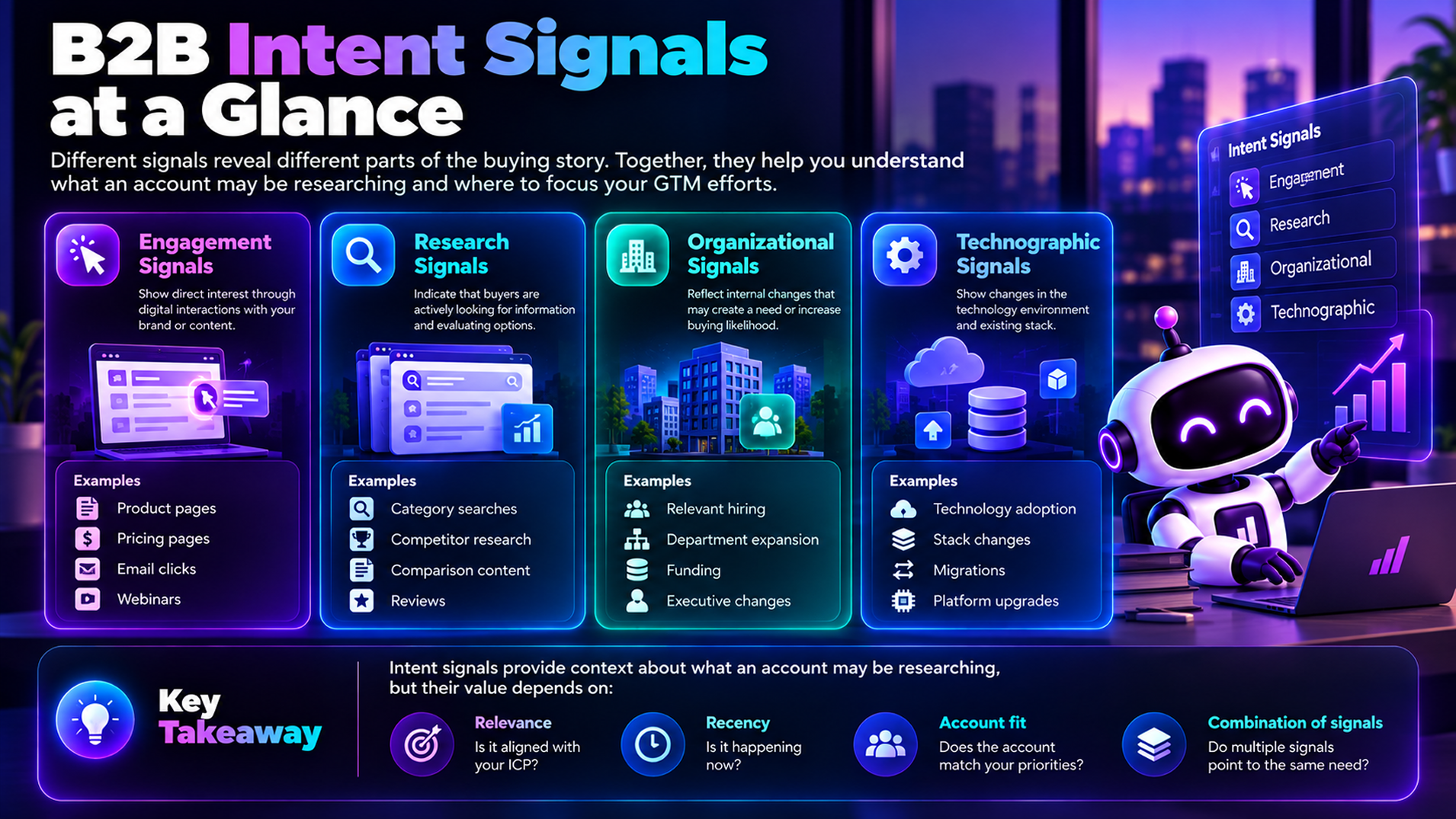
B2B intent signals come in several forms. Some come from your own channels, while others reveal activity outside your ecosystem or changes within the company.
Engagement Intent Signals
Engagement intent signals come from interactions with your owned channels or products.
Examples include:
- Product-page visits
- Pricing-page visits
- Demo-page visits
- Repeat website visits
- Content downloads
- Webinar attendance
- Email clicks
- Product engagement
- Multiple stakeholders engaging from one account
They provide direct visibility into how an account interacts with your brand and which parts of the buying journey it may be exploring.
Activity across high-value pages or from multiple stakeholders can provide useful context for prioritization.
Research Intent Signals
Research intent signals come from activity outside your owned properties. They can show what a company is investigating before it identifies itself as a lead.
Examples include:
- Topic searches
- Category research
- Competitor research
- Comparison content
- Review-site activity
- Publisher content consumption
- Forum and community discussions
This activity can help teams discover accounts that have not filled out a form or booked a meeting. An account researching “best CRM for SaaS companies” provides more specific context than someone searching for a general definition of CRM software.
Hiring and Organizational Intent Signals
Internal changes can signal emerging business needs.
Examples include:
- Hiring for relevant roles
- Department expansion
- New executive appointments
- Geographic expansion
- Funding or major growth events
- New strategic initiatives
These are contextual signals, not proof of active buying. A company hiring a large sales team may eventually need additional sales technology, but the hiring event alone doesn’t show a purchase is underway.
Technographic Intent Signals
Technographic signals reveal changes in a company’s technology environment.
Examples include:
- New technology adoption
- Technology replacement
- Stack changes
- Platform upgrades
- New integrations
- Migration activity
Technographic data provides context that behavioral signals cannot provide on their own. An account researching marketing analytics may become more relevant if its technology stack suggests a need for integration, migration, or replacement.
How are B2B Intent Signals Generated?
B2B intent signals come from first-party activity on your properties, external research sources, and company or technology changes that add context.
Website and Owned-channel Activity
Your own digital properties provide direct visibility into how identifiable accounts interact with your company.
Sources include:
- Website visits
- Product and pricing pages
- Forms and landing pages
- Email engagement
- Webinars
- Product usage
- CRM activity
These signals can reveal which accounts are engaging, what they are exploring, and whether activity is increasing.
Their limitation is that they cannot reveal what an account is researching before it interacts with your brand.
External Research and Content Activity
External research activity can reveal which accounts are being investigated across the broader B2B ecosystem.
Sources include:
- Search and research activity
- Publisher content
- Review sites
- Comparison content
- Forums and communities
- Partner and syndication platforms
- B2B data providers
This activity can expose category, competitor, and solution research before an account becomes a known lead.
Company and Organizational Changes
Company-level events provide context around potential business needs.
Sources include:
- Relevant hiring
- Department expansion
- Executive appointments
- Funding or major growth events
- Geographic expansion
- Strategic initiatives
- Technology adoption or replacement
These events can explain why an account may have a particular need, but they should not be confused with direct evidence of an active buying process.
How to Combine Signals from Different Sources
No individual source provides a complete view of buyer intent. For example, external research may reveal a topic an account is exploring, ICP and technology data can show whether the account is relevant to your business, and later product-page engagement can add evidence of direct interest. The value comes from interpreting these signals together.
Pro Tip- Keep a short evidence trail for each prioritized account: record the signal source, observed behavior, date, and business context. This helps sales understand why an account was flagged without treating inferred interest as confirmed buying intent.
How to Evaluate the Strength of an Intent Signal
Not every signal deserves an immediate sales response. Evaluate activity consistently to distinguish meaningful patterns from background noise.
Intent Strength
Repeated activity around related topics provides more context than an isolated or unrelated event.
Topic Relevance
The subject of the research matters.
- “What is CRM software?” may represent general education.
- “Best CRM for SaaS companies” shows more specific research.
- The phrase “Competitor alternatives” suggests a vendor.
evaluation.
Evaluate what an account is researching, not just how much activity it generates.
Recency and Momentum
Recent activity is generally more useful for current prioritization than old research. For example, an account showing increased relevant activity over the past two weeks may deserve more attention than one whose last signal was six months ago.
Account Fit
Intent should be evaluated against your ICP. A company can show strong interest in a category and still be a poor prospect because it is too small, operates in an unsupported market, uses an incompatible technology environment, or doesn’t match your business model.
Buying-group Breadth
B2B purchases often involve several stakeholders. Activity from a functional leader, technical evaluator, and potential economic buyer provides more account-level context than activity from a single unknown visitor.
Negative Signals
Also account for negative or misleading signals, such as:
- Poor ICP fit
- Irrelevant research topics
- Old activity
- One-off engagement
- Student, recruitment, or job-seeker traffic
- Existing customer activity unrelated to expansion
Pro Tip- Build an intent threshold instead of relying on a single intent score. For example, require a minimum ICP-fit level plus two relevant signals within a defined period before escalating an account to sales.
How to Turn Intent Signals into Actionable Account Intelligence
An intent signal alone does not identify the right person to contact or provide enough context for a useful sales conversation. Teams need to qualify the account and add relevant data before acting.
Start with ICP Fit
The first question should be whether the account is worth pursuing.
Relevant criteria may include:
- Industry
- Company size
- Revenue
- Geography
- Growth stage
- Business model
- Technology environment
- Business priorities
A strong ICP prevents sales teams from spending time on accounts that show interesting activity but have little potential to become successful customers.
Add Firmographic and Technographic Context
For qualifying accounts, add context such as:
- Company size
- Industry
- Revenue or funding
- Growth stage
- Technology stack
- Geography
- Existing tools
For example, “a company researching marketing analytics” offers limited context. Knowing that it is a high-fit SaaS business with rapid growth and a relevant technology environment gives sales a clearer reason to investigate.
Identify the Relevant Buying Roles
Connect intent to people who may influence the purchase.
Potential stakeholders include:
- Economic buyers
- Functional owners
- Technical evaluators
- Influencers
- Champions
The relevant role depends on the problem being researched and the way the company makes purchasing decisions.
Enrich Incomplete Account and Contact Records
Even relevant account signals are difficult to act on when contact records are incomplete.
Common gaps include:
- Missing job titles
- Missing company information
- Outdated contact details
- Unverified records
- Missing technology information
Enrichment makes it easier for sales teams to act while the intent is still relevant.
Segment Accounts Based on Combined Signals
Combine account fit and intent to determine the appropriate level of attention.
| Account Pattern | Recommended Focus |
|---|---|
| High ICP fit + high intent | Prioritize for sales and marketing attention |
| High ICP fit + emerging intent | Monitor closely and prepare relevant content |
| High intent + low ICP fit | Qualify before committing sales resources |
| Existing customer + expansion signals | Assess for a potential expansion conversation |
| Competitor research + high ICP fit | Consider competitive sales engagement |
How to Use Intent Signals for B2B Marketing and Sales
Once intent has been evaluated and account context added, teams can apply it across GTM activities.
Prioritize High-intent Accounts
Prioritize ICP-fit accounts with recent, relevant activity instead of working through a static target list in the same order.
Build More Focused ABM Campaigns
Intent can help determine which accounts should receive different levels of campaign investment:
- 1:1 campaigns for high-fit accounts with strong, specific intent
- 1:few campaigns for groups of accounts researching a shared topic
- Retargeting for accounts showing relevant digital activity
- Industry-specific content for accounts researching problems tied to their industry
- Sales-assisted campaigns for accounts showing several aligned signals
Personalize Content Around Active Research
Research topics can inform:
- Email content
- Landing pages
- Ads
- Webinars
- Sales collateral
Use the likely business problem to make content more relevant instead of relying on generic product messaging.
Trigger Relevant Sales Outreach
Combine ICP fit, account context, and reliable contact information to decide whether outreach makes sense. Intent signals for sales teams should inform a relevant business conversation rather than become the sole reason for contacting someone.
Find Expansion and Competitive Opportunities
For existing customers, relevant research, new teams, or technology changes can prompt an expansion review. Competitor research may also justify a carefully tailored conversation when account fit and supporting context are strong.
How ReachGen Helps Turn Intent Signals Into Targeted Outreach
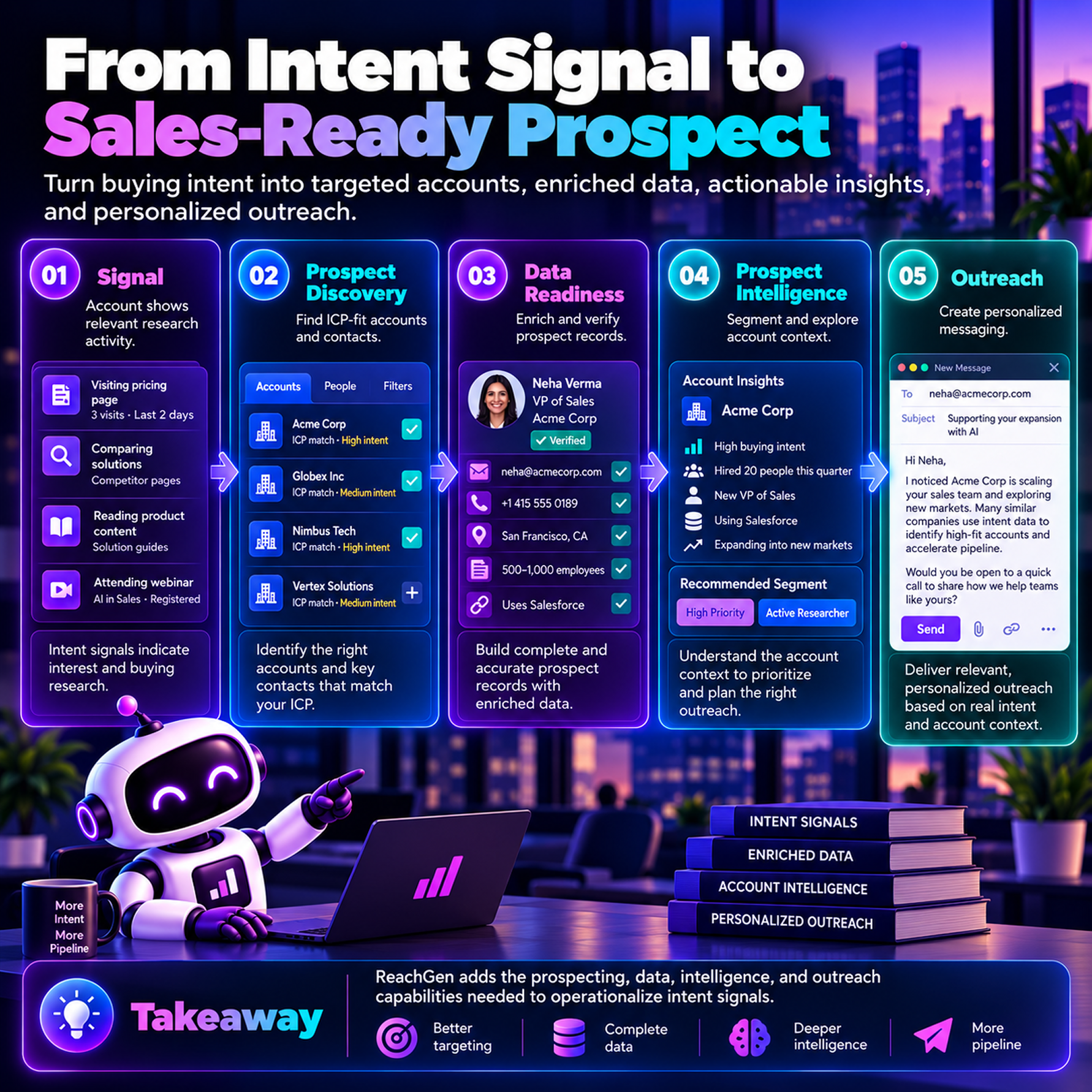
Intent signals become more useful when teams can connect them to practical next steps. ReachGen supports the prospecting process by helping teams move from ICP and account context to relevant prospects, enriched data, and personalized outreach.
Discover and Enrich ICP-fit Prospects
ReachGen helps teams discover ICP-fit accounts and decision-makers, then enrich records with firmographic and technographic context such as company size, funding status, job titles, and technology stacks.
Verify and Organize Prospect Data
ReachGen supports verifying enriched account and contact records and dynamically segmenting by attributes such as industry, company size, and technology stack, helping teams keep prospect lists aligned with changing targeting needs.
Turn Account Context Into Personalized Outreach
ReachGen uses account information, company news, industry insights, and recent events to support contextual email drafts. DiGGi-GPT also lets teams query prospect data in natural language to find relevant contacts and develop targeted messaging.
Connect Prospect Intelligence to Existing GTM Workflows
ReachGen integrates with Salesforce and HubSpot, allowing enriched prospect information and account intelligence to fit into existing sales and marketing workflows.
Pro Tip- Review false positives with sales representatives, not just dashboard metrics. Their feedback can reveal whether irrelevant topics, poor account matches, or misleading activity patterns are triggering alerts that look promising in reports but rarely lead to qualified conversations.
Review Performance Regularly
Track how intent programs perform against measurable outcomes, including:
- Intent-sourced opportunities
- Conversion by signal type or intent tier
- Meeting rate
- Opportunity rate
- Win rate
- Sales-cycle length
- Pipeline and revenue influenced by intent
Use these measures to identify which signals and workflows contribute to qualified pipeline and which create activity without results.
Refine Rules Based on Pipeline Results
Use performance data to refine thresholds, response times, and signal weights. Give more priority to patterns associated with qualified pipeline, and reduce or remove those that do not contribute. Review the rules regularly rather than treating setup as a one-time task.
Pro Tip- Compare conversion and opportunity rates by signal type before changing thresholds. This helps you identify which signals deserve more weight instead of optimizing for activity volume alone.
Common Mistakes When Interpreting and Activating Intent Signals
Intent signals are most useful when interpreted in context and matched to an appropriate action. Avoid these common mistakes:
Treating Every Signal as Buying Intent
A website visit, content download, or search may show interest without indicating an active purchase. Teams should consider the signal’s relevance, recency, and context before treating it as a buying indicator.
Ignoring ICP Fit When Interpreting Intent
Strong research activity does not make every account a good prospect. Still evaluate an account against factors such as industry, company size, geography, business model, and technology environment.
Reacting to Stale or Isolated Signals
A single signal or outdated research may provide little insight into current priorities. Teams should look for recent activity and patterns across multiple relevant signals before increasing account priority.
Relying on One Signal or Data Source
First-party engagement, external research, organizational changes, and technographic data reveal different aspects of an account. Relying on a single source can leave out important context.
Sending Intent Alerts Without Account Context
A “high-intent” alert does not explain why the account matters or what sales should do next. Connect it with ICP fit, research topics, relevant stakeholders, and account context.
Personalizing Outreach Around the Signal Alone
Relevant outreach connects research context to the company’s business situation, priorities, technology environment, or recent developments.
Failing to Match the Action to the Intent
Match the response to the signal: early research may call for educational content or monitoring, while repeated competitor research from a high-fit account may warrant direct engagement.
Measuring Signal Volume Instead of Business Impact
Measure whether signals contribute to meetings, opportunities, pipeline, and revenue rather than treating activity volume as success.
Conclusion
Intent signals can indicate where relevant research may be happening, but their value depends on how teams interpret and act on that information.
The strongest GTM programs connect intent with ICP fit, account intelligence, accurate contact data, and relevant outreach. By pairing intent signals for sales teams alongside this context, organizations can prioritize accounts more effectively and give sales representatives a stronger basis for starting useful conversations.
ReachGen helps DiGGrowth customers act on ICP and account context through prospect discovery, enriched and verified contact data, segmentation, and personalized outbound engagement.
Want to turn account intent and ICP intelligence into more focused prospecting? Talk to Us!
Email info@diggrowth.com to learn how ReachGen can help your team identify high-fit accounts and contacts, enrich prospect data, and create more relevant outbound outreach.
Ready to get started?
Increase your marketing ROI by 30% with custom dashboards & reports that present a clear picture of marketing effectiveness
Start Free Trial
Experience Premium Marketing Analytics At Budget-Friendly Pricing.

Learn how you can accurately measure return on marketing investment.
Lookalike Account Modeling for B2B Revenue Teams
Lookalike account modeling takes a different approach. It studies the attributes and outcomes of successful customers,...
Read full post post
You’re Targeting Your Ideal Customer. So Why Aren’t They Buying?
Your best customers reveal the traits associated with success. Your lost opportunities reveal where fit breaks...
Read full post post
How Predictive AI Will Transform Paid Media Strategy in 2026
Paid media isn’t a channel game anymore, it’s a chessboard. Search, social, programmatic, video, influencer, native,...
Read full post postFAQ's
An intent signal is a behavioral or contextual indicator that suggests an account may be researching a problem, solution, vendor, category, or technology. Examples include website activity, external research, competitor comparisons, technology changes, and organizational events.
Examples include pricing-page visits, repeat website engagement, category or competitor research, review-site activity, relevant hiring, funding or expansion, technology changes, and multi-stakeholder engagement.
An intent signal is a sign of possible interest, such as competitor research or repeated product-page visits. Intent data is the broader dataset created by collecting and analyzing multiple signals.
Intent signals show that a company may be interested, but they don't confirm buying readiness. Their value increases when assessed alongside ICP fit, relevance, recency, frequency, buying-group breadth, and account context.
Sales teams should validate account fit, understand the research context, identify relevant stakeholders, and verify contact data. This helps determine whether outreach is appropriate and what to discuss.
Teams can use intent context alongside ICP and account intelligence to guide prospect discovery with ReachGen. It supports enrichment, verification, segmentation, and personalized outreach, helping turn account-level context into actionable prospecting.