Measuring ROI in Paid Media to Strengthen Your Marketing Strategy
Measuring ROI in Paid Media goes beyond clicks and impressions. This article explains how to evaluate campaign performance, track key metrics, and use actionable insights to improve profitability. From tools and examples to best practices, it provides a clear framework for making every marketing dollar count.
Measuring ROI in Paid Media exposes what every marketer secretly worries about. Are your campaigns actually making money, or are they just burning through your budget while looking good on the surface? Many teams celebrate high impressions, viral engagement, and low click costs, but the moment real revenue numbers appear, the excitement fades. That is exactly where the truth hides.
Here is the reality no one likes to admit. A campaign can look incredibly successful and still deliver almost nothing in return. A flashy social ad might rack up views, but if customers do not buy, it is not a win. On the other hand, a simple, unglamorous paid search campaign can quietly drive profitable conversions day after day. Without Measuring ROI in Paid Media, most brands reward the wrong campaigns and neglect the ones that actually fuel growth.
This is why Measuring ROI in Paid Media is not optional anymore. It reveals which channels genuinely generate profit, which audiences are worth your attention, and which creatives bring real value instead of vanity metrics. Once you see the numbers clearly, you stop guessing. You stop overspending. You start directing budget toward campaigns that build revenue instead of noise.
Key Takeaways
- Measuring ROI in Paid Media helps identify which campaigns generate real revenue versus vanity metrics.
- Tracking performance consistently across all channels provides a clear view of marketing effectiveness.
- Using tools like DiGGrowth, Google Analytics, and HubSpot simplifies analysis and reveals actionable insights.
- Calculating ROI accurately ensures budgets are allocated to campaigns that deliver measurable business impact.
- Systematic testing of creatives and audience segments improves performance and maximizes returns.
Understanding ROI in Paid Media
Measuring ROI in Paid Media helps determine whether your advertising spend leads to real business outcomes, not just surface level engagement. High impressions or clicks may look promising, but ROI shows which campaigns actually drive revenue, conversions, or qualified leads.
A simple example explains the difference. One campaign may have heavy traffic with little action. Another may bring fewer visitors who consistently convert. ROI makes it clear which campaign delivers true value.
Different brands define return differently. Ecommerce teams focus on revenue, B2B teams focus on lead quality, and subscription brands look at customer lifetime value. Aligning ROI with the right goal ensures accurate evaluation.
By measuring ROI in Paid Media across channels, you can see which platforms deliver direct results and which support the customer journey. This clarity helps you optimize budgets and prioritize campaigns that consistently generate meaningful outcomes.
Why Measuring ROI in Paid Media Strengthens Your Marketing Strategy
Measuring ROI in Paid Media shows you exactly which campaigns deserve your investment and which ones need to be paused, fixed, or replaced. Instead of reacting to high impressions or low click costs, you make decisions based on real performance outcomes.
For example, a brand may discover that its highest spending social campaign drives attention but not conversions, while a smaller search campaign consistently brings high intent buyers. Without ROI analysis, this insight stays hidden and budget continues to flow to the wrong place.
ROI also strengthens your strategy by revealing audience behavior. You can identify which segments convert, which creatives influence decisions, and which platforms consistently drive profitable actions. This helps you refine targeting, messaging, and budget distribution.
Most importantly, ROI creates a predictable system. When you know what generates measurable value, your marketing decisions become clearer, faster, and focused on outcomes that support long term growth rather than short term activity.
Key Metrics Essential for Measuring ROI in Paid Media
Measuring ROI in Paid Media depends on a set of metrics that reveal how well your campaigns turn spend into meaningful outcomes. Each metric serves a different purpose and helps you understand performance from multiple angles.
Cost Per Acquisition: This metric shows how much you spend to acquire a single customer or lead. When the cost rises without an increase in conversions, it signals that targeting, creatives, or landing pages need refinement.
Example: A campaign that drops its cost per acquisition after switching to a more specific audience segment.
Customer Lifetime Value: This metric focuses on long term value. If customers from one channel continue buying over time, that channel becomes more valuable than a campaign that produces only one time purchases.
Example: Paid search may deliver fewer customers than paid social, but those customers may buy repeatedly.
Conversion Rate: This metric helps evaluate how effectively your landing page and ad message turn visitors into buyers or leads. A good conversion rate signals strong intent and relevance.
Example: Updating the product page layout increases conversion rate despite the same traffic volume.
Return On Ad Spend: This metric measures revenue generated for each unit of currency spent. It highlights which campaigns deliver direct returns and which ones need optimization.
Example: A retargeting ad showing a higher return on ad spend compared to a cold audience campaign.
Tools That Help in Measuring ROI in Paid Media
DiGGrowth
DiGGrowth is a powerful tool for marketers who want a consolidated view of their paid media performance across multiple platforms. By combining data from Google, Meta, LinkedIn, and programmatic networks, DiGGrowth tracks every touchpoint in the customer journey and accurately attributes revenue to the channels that drive results.
This level of insight helps organizations eliminate data silos and make smarter budget decisions. For instance, a marketing team may discover that mid-funnel retargeting campaigns contribute more to revenue than top-funnel awareness campaigns, even if the latter generate higher impressions.
Google Analytics
Google Analytics remains essential for understanding how paid channels influence user behavior and conversions. Beyond tracking clicks and sessions, it provides insights into assisted conversions, multi-touch interactions, and overall campaign performance.
With features like channel grouping and attribution comparison, marketers can see how different campaigns contribute to results across the entire customer journey. For example, paid social campaigns may not directly convert users but can play a significant role in moving them toward purchase consideration.
Google Ads Conversion Tracking
For campaigns running on Google’s ecosystem, Google Ads Conversion Tracking offers detailed performance insights at the keyword, ad group, and audience levels. It allows marketers to evaluate the effectiveness of search, display, shopping, and YouTube campaigns.
While its scope is limited to Google platforms, the tool helps optimize bidding, targeting, and ad creatives to reduce wasted spend. A team may notice that a slight adjustment in audience targeting can significantly lower the cost per acquisition without affecting conversion volume.
Meta Ads Manager
Meta Ads Manager is designed to measure the performance of Facebook and Instagram campaigns with precision. It provides detailed reporting at the creative and audience level, showing which ads generate the most conversions and engagement. Marketers can use these insights to refine messaging and targeting strategies.
For instance, a brand might discover that static image ads convert better for a high-intent audience than video ads within the same demographic, allowing them to allocate budget more efficiently.
HubSpot Marketing Hub
HubSpot Marketing Hub connects paid media campaigns directly to CRM outcomes, providing visibility into which ads generate leads that progress through the sales pipeline. It tracks lead quality, scoring, and deal progression, offering marketers insight into the real impact of paid campaigns on revenue.
A SaaS company, for example, may find that paid search leads convert into customers faster and more reliably than paid social leads, demonstrating which channel truly drives business growth.
How To Calculate ROI in Paid Media
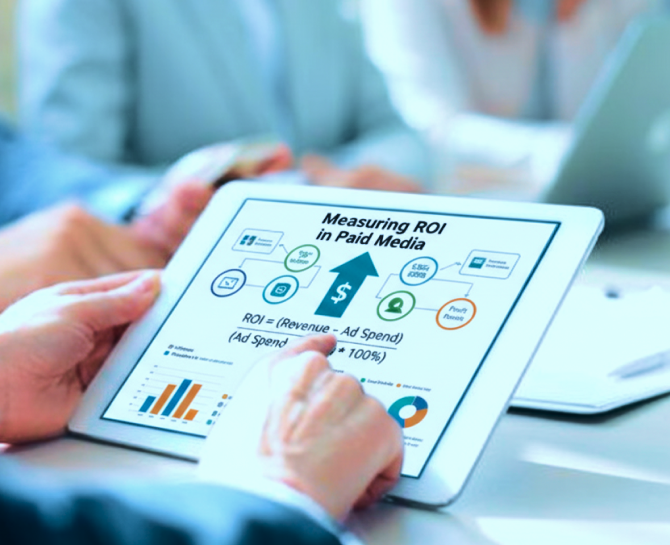
Calculating ROI in Paid Media is straightforward once you define the return you want to measure. The basic formula is simple: subtract your total campaign spend from the revenue generated by that campaign, then divide the result by the campaign spend. This gives a clear percentage that reflects how much profit your investment is delivering.
For example, imagine a campaign with a spend of 5,000 that generates 15,000 in revenue. Using the formula, (15,000 – 5,000) ÷ 5,000, the ROI comes out to 200 percent. This shows that for every unit of currency spent, the campaign returned twice the investment.
It is important to note that ROI can be calculated for different outcomes depending on your business objectives. Ecommerce businesses typically focus on direct revenue, while B2B companies may consider lead quality or closed deals. Subscription-based brands often factor in customer lifetime value, capturing the long-term returns from retained customers.
Tracking ROI consistently across channels allows marketers to compare performance objectively. Paid search, social ads, and display campaigns can be evaluated not just on clicks or impressions but on the actual financial impact they deliver. This clarity makes it easier to reallocate budgets, optimize campaigns, and invest in strategies that maximize growth.
With a solid ROI calculation process, you can move from guessing which campaigns work to knowing which campaigns are driving measurable value for your business.
Practical Examples of ROI Measurement in Action
Measuring ROI becomes meaningful when applied to real-world campaigns. Consider an e-commerce brand that initially invested heavily in a video campaign on social media. Although the campaign generated high impressions, it resulted in very few conversions. In contrast, a smaller paid search campaign consistently delivered high-intent buyers who completed purchases. By shifting part of the budget from social to search, the brand improved overall ROI without increasing total spend.
A SaaS company faced a similar scenario. Their paid social campaigns generated plenty of traffic, but leads from paid search converted into paying customers more efficiently. Tracking ROI revealed this difference, allowing the team to prioritize search campaigns, optimize creatives, and increase revenue from paid marketing efforts.
Local businesses can also benefit from ROI-focused evaluation. For a service-based company, tracking phone call conversions rather than clicks provided a clearer picture of campaign effectiveness. Using this insight, the company adjusted budgets and optimized campaigns for actual revenue impact rather than vanity metrics.
Pro Tip : These cases demonstrate that measuring ROI is not just a numbers exercise. It transforms how marketing decisions are made, enabling data-driven optimization, better budget allocation, and strategies that deliver measurable results.
Best Practices To Strengthen Your Marketing Strategy With ROI Insights
1. Build a Consistent Reporting Framework
A strong reporting system is the backbone of ROI-driven marketing. By standardizing how metrics are tracked and reported across campaigns, you ensure that decisions are based on accurate and comparable data. Consistency in reporting helps identify trends, spot inefficiencies, and measure improvements over time.
2. Track Metrics Across All Channels
Monitoring performance across paid search, social, display, and other channels provides a complete view of your marketing impact. Tracking every touchpoint allows you to see which channels drive direct conversions and which support the broader customer journey. This holistic approach prevents budget misallocation and uncovers hidden opportunities.
3. Test Creatives and Audience Segments Systematically
Experimentation is key to understanding what works. Conduct A/B tests on ad creatives, test different messaging approaches, and explore new audience segments. Systematic testing generates insights that improve engagement and conversion rates, ultimately boosting ROI across campaigns.
4. Apply Insights to Budget Allocation
Data-driven adjustments to your budget ensure that every dollar spent works harder. Shift resources toward high-performing campaigns, optimize underperforming ones, and pause initiatives that do not deliver measurable value. This practice not only maximizes ROI but also strengthens your overall marketing strategy.
Conclusion
Understanding ROI in Paid Media transforms how you approach marketing. It allows you to see beyond surface metrics, uncover what truly drives conversions, and make strategic decisions that directly impact revenue. When campaigns are measured accurately, marketing becomes a precise tool for growth rather than a guessing game.
Are you ready to take your paid media campaigns to the next level? Let’s Talk!
Our experts at DiGGrowth can help you track, analyze, and optimize every campaign to ensure maximum ROI and measurable business growth. Reach out to us at info@diggrowth.com.
Ready to get started?
Increase your marketing ROI by 30% with custom dashboards & reports that present a clear picture of marketing effectiveness
Start Free Trial
Experience Premium Marketing Analytics At Budget-Friendly Pricing.

Learn how you can accurately measure return on marketing investment.

How Predictive AI Will Transform Paid Media Strategy in 2026
Paid media isn’t a channel game anymore, it’s a chessboard. Search, social, programmatic, video, influencer, native,...
Read full post post
Don’t Let AI Break Your Brand: What Every CMO Should Know
AI isn’t just another marketing tool. It’s changing how we connect with customers, personalize content, and...
Read full post post
From Demos to Deployment: Why MCP Is the Foundation of Agentic AI
A quiet revolution is unfolding in AI. And it’s not happening inside research labs. For decades,...
Read full post postFAQ's
ROI should be monitored regularly, ideally weekly or monthly, depending on campaign scale. Frequent tracking allows marketers to spot trends, optimize underperforming campaigns, and make informed budget adjustments before resources are wasted.
Yes. By integrating CRM systems or using tracking codes, offline conversions like in-store purchases or phone calls can be attributed to paid campaigns. This ensures a complete picture of campaign performance beyond digital metrics.
Not necessarily. High traffic may increase visibility but does not guarantee conversions. ROI focuses on the actual value generated relative to spend, highlighting campaigns that deliver profitable outcomes, not just volume.
Small businesses can focus on key metrics like cost per acquisition, conversion rate, and return on ad spend. Using affordable analytics tools and tracking specific conversion actions ensures accurate ROI measurement without complex systems.
Yes. Social campaigns often influence the buyer journey indirectly by increasing brand awareness or engagement. Measuring assisted conversions or tracking multi-touch attribution helps understand their contribution to overall ROI.