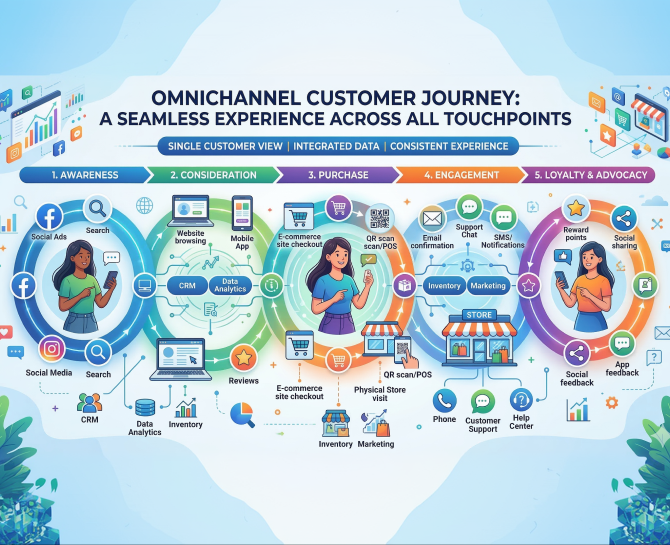
Omnichannel Customer Journey: Connecting the Dots Between Every Touchpoint
An omnichannel customer journey connects all touchpoints across platforms into a single, unified experience. Unlike multichannel approaches that treat each platform separately, omnichannel mapping reveals how customers move between LinkedIn, email, website visits, and demos as one continuous path to purchase.
An omnichannel customer journey is the complete path a customer takes across all platforms and touchpoints, from first awareness through conversion and beyond. Unlike traditional multichannel marketing that treats each platform separately, omnichannel customer journey strategies integrate every interaction into one seamless experience that reflects how customers actually behave.
Here’s what that looks like in practice. Someone sees your LinkedIn post during their morning commute. Two days later, they open an email about your product. A week passes, and they visit your pricing page. Yesterday, they finally signed up for a demo.
Most marketing teams treat these as four separate events. Social got an impression. Email got an open. The website got a visit. Sales got a demo request. Four different channels, four different metrics, four different teams taking credit.
But your customer experienced something completely different. They didn’t compartmentalize your brand into social presence, email communications, and website experience. To them, it was one continuous relationship with your company. Each touchpoint built on the last, creating momentum toward that demo request.
The gap between how companies measure success and how customers actually experience brands creates real problems. You can’t see which channel combinations drive the best results. Teams duplicate efforts or send conflicting messages. Budget gets allocated based on incomplete data. Most critically, you miss opportunities to create the kind of seamless experience that matches how people naturally engage with brands today.
This guide walks through how omnichannel customer journey mapping works, why the traditional linear funnel doesn’t match reality, and how unified data platforms reveal the messy, non-linear paths your customers actually take.
Key Takeaways
- Omnichannel customer journeys integrate all touchpoints into one seamless experience instead of treating channels separately.
- Real customer journeys are non-linear and unpredictable; traditional funnel models oversimplify actual buyer behavior.
- Channel silos prevent teams from understanding how touchpoints work together in omnichannel customer journeys.
- Successful omnichannel customer journey mapping requires unified data connecting every interaction into a single view.
- Platforms like DiGGrowth integrate all touchpoint data to reveal which channel sequences drive the highest conversions.
What Is an Omnichannel Customer Journey?
An omnichannel customer journey represents how buyers interact with your brand across multiple channels in a connected, continuous experience. Instead of treating social media, email, website visits, and sales conversations as separate events, omnichannel customer journey mapping connects these touchpoints into one unified path.
The key difference from multichannel marketing is integration. Multichannel means you’re present on LinkedIn, email, and your website. Omnichannel means these channels work together, sharing data and coordinating messages to create a seamless experience as customers move between them.
In B2B environments, omnichannel customer journeys are particularly complex. Multiple stakeholders engage through different channels at different times. A technical evaluator might start on your documentation site. A budget approver might see a LinkedIn ad. An end user might hear about you from a colleague. These separate paths eventually converge into one purchasing decision.
Understanding the complete omnichannel customer journey helps you see which channel combinations drive results, where customers drop off, and how to allocate budget based on actual customer behavior rather than isolated channel metrics.
The Myth of the Linear Funnel in Omnichannel Customer Journeys
Every marketing textbook shows the same funnel diagram. Awareness at the top, consideration in the middle, decision at the bottom. Customers flow through in a predictable sequence, and your job is to create content for each stage.
Real omnichannel customer journeys look nothing like this.
Customers Jump Between Stages Constantly
Someone might land on your pricing page (clearly a decision-stage action) before they ever read your introductory blog post. They could attend your advanced webinar, disappear for three months, then suddenly request a demo after seeing a basic explainer video. They might follow you on LinkedIn, completely ignore five emails, and convert immediately after a retargeting ad.
According to Salesforce’s 2025 State of the Connected Customer report, 73% of customers use multiple channels during their purchasing journey, and the sequence varies dramatically based on how they discovered the brand, what role they play in the buying decision, and dozens of other factors.
The linear funnel assumes everyone starts at awareness, moves to consideration, and then reaches a decision. Real omnichannel customer journey data shows people skip stages, revisit earlier steps, and take completely unpredictable paths.
The Same Channel Plays Different Roles in Different Customer Journeys
LinkedIn might be where someone first hears about you in one omnichannel customer journey. It could also be where a nearly-decided buyer goes to validate your credibility before signing a contract in another journey. Email might nurture a cold lead over months or re-engage someone who abandoned their trial yesterday.
Treating LinkedIn as “top of funnel” and email as “middle of funnel” ignores that the same channel serves different purposes at different moments in different omnichannel customer journeys.
The Real Trigger Is Often Something You Can’t Measure
Attribution models try to identify which touchpoint in the omnichannel customer journey caused conversion. But often the actual trigger isn’t trackable. A conversation with a colleague who recommended you. A competitor is raising their prices. A budget is getting approved. A minor problem suddenly becomes urgent.
Your marketing creates conditions for conversion, but the final push frequently comes from outside your measurement systems. Obsessing over finding the one converting touchpoint misses how your entire presence across the omnichannel customer journey builds readiness.
B2B Omnichannel Customer Journeys Involve Multiple Stakeholders
In business purchases, different stakeholders follow completely different paths within the same omnichannel customer journey. The technical person evaluating your product might start on your documentation site. The person controlling the budget might see a LinkedIn ad. The end user might hear about you from someone at a conference.
These separate paths eventually merge into one purchasing decision, but the linear funnel can’t account for this complexity. You’re not guiding one person through stages. You’re influencing multiple people simultaneously, each taking their own path within a broader omnichannel customer journey.
The Problem: Channels as Separate Buckets
Most companies organize marketing around channels. There’s a social media person, an email specialist, a content writer, and someone running paid ads. Each has its own goals, dashboards, and tools.
This structure fragments the omnichannel customer journey in ways that become obvious once you start looking.
Everyone Optimizes for Channel Metrics, Not Omnichannel Customer Journey Outcomes
The social team chases likes and shares. Email focuses on open rates. Content wants pageviews. Paid ads optimize for clicks. None of these metrics actually tells you whether you’re moving customers forward in their omnichannel customer journey.
A LinkedIn post with thousands of engagements means nothing if none of those people ever take another step in their customer journey. An email with a 40% open rate that doesn’t drive any downstream action is just noise in someone’s inbox.
When teams optimize for channel-specific vanity metrics instead of omnichannel customer journey progress, they lose sight of what matters. Are we helping customers make progress toward a decision?
Messages Get Inconsistent Across the Omnichannel Customer Journey
Without coordination, customers encounter contradictory positioning as they move through their omnichannel customer journey. Your LinkedIn content emphasizes innovation and cutting-edge features. Your emails focus on cost savings and ROI. Your website highlights simplicity and ease of use. Your sales team leads with customer support quality.
Each message might be true, but the lack of consistency creates confusion. Someone engaging with you across multiple touchpoints in their omnichannel customer journey can’t figure out what you actually stand for or why they should pick you over competitors.
You’re Wasting Money on Duplicate Work
Multiple teams might target the same accounts with similar messages through different channels, creating a spammy experience and burning budget. Or worse, they contradict each other. One team promotes a feature while another downplays it in favor of something else.
Without visibility into the complete omnichannel customer journey, you can’t coordinate efficiently. Resources get wasted on overlapping efforts that don’t compound.
Attribution Becomes Impossible Without Omnichannel Customer Journey Visibility
If social, email, content, and ads operate independently, how do you know which combination actually drives results in the omnichannel customer journey? You end up with partial data showing each channel’s performance in isolation but revealing nothing about how they work together.
This makes smart budget decisions nearly impossible. You’re guessing which channels deserve more investment because you can’t see the complete picture of the omnichannel customer journey.
The Solution: Creating Seamless Omnichannel Customer Journey Experiences
The omnichannel customer journey approach starts simple. Customers experience your brand as a whole, not as disconnected channel interactions. Your marketing should reflect this reality.
Design Omnichannel Customer Journeys, Not Just Campaigns
Instead of creating separate campaigns that happen to run simultaneously, you design connected omnichannel customer journeys that coordinate how different channels work together.
A product launch omnichannel customer journey might work like this:
- LinkedIn post introduces the problem your new product solves
- Retargeting ad offers a detailed guide to people who engaged with the post
- Email delivers that guide to downloaders, along with a case study showing results
- Website experience customizes based on which content someone has consumed
- Sales outreach references the specific materials someone engaged with
Each touchpoint in the omnichannel customer journey builds on the previous one. It’s a coherent experience, not random disconnected messages hitting someone from multiple directions.
Keep Core Messages Consistent Across the Omnichannel Customer Journey
Omnichannel customer journey strategies don’t mean copy-pasting the same content everywhere. They mean maintaining consistent themes, value propositions, and positioning while adapting how you communicate to fit each channel’s strengths.
Your LinkedIn post might tease a problem in 100 words. Your email explains the solution in 500 words. Your website provides complete technical specifications. The core message stays the same throughout the omnichannel customer journey (we solve this specific problem), but the depth and format match the channel.
Connect All Your Data to See the Real Omnichannel Customer Journey
You can’t create seamless omnichannel customer journey experiences if you don’t know how customers actually move between channels. Effective omnichannel customer journey mapping requires integrating data from every touchpoint into one view.
This means connecting social analytics, email platforms, website tracking, your CRM, and every other system capturing customer interactions. Only then can you spot patterns in omnichannel customer journeys like “people who engage with LinkedIn posts open emails at 3x the rate of those who don’t” or “website visitors from email convert 40% faster than those from paid ads.”
Organize Teams Around Omnichannel Customer Journey Stages, Not Channels
Some companies solve silos by restructuring teams around customer segments or omnichannel customer journey stages instead of channels. Instead of a “social media team,” you have a “customer acquisition team” that uses social, email, content, and ads together to achieve one goal.
This structural change naturally aligns incentives around omnichannel customer journey outcomes rather than channel metrics.
Mapping Your Omnichannel Customer Journey: Identifying Key Touchpoints
Before creating effective omnichannel customer journey experiences, you need to understand where your customers spend time and how they move between platforms.
List Every Touchpoint in Your Omnichannel Customer Journey
Start by documenting every place someone might interact with your brand throughout their omnichannel customer journey:
- Social platforms (LinkedIn, Twitter, Reddit, industry-specific communities)
- Email (newsletters, product announcements, automated sequences)
- Your website (blog, product pages, pricing, resource library)
- Search (organic listings, paid search ads)
- Third-party sites (review platforms, comparison sites, industry publications)
- Events (webinars, conferences, virtual meetups)
- Direct conversations (sales calls, demos, support interactions)
Most companies discover they have way more touchpoints in their omnichannel customer journey than they realized, and many aren’t being properly tracked or intentionally optimized.
Find High-Impact Channel Combinations in Your Omnichannel Customer Journey
Once you have tracking across touchpoints, analyze which channel sequences in your omnichannel customer journey correlate with conversions. You might discover patterns like:
- Customers who engage on LinkedIn and then get an email convert twice as fast
- Website visitors who previously attended a webinar spend 40% more
- People who read three blog posts before requesting a demo close at 60% higher rates
These patterns show which channel combinations create real momentum in the omnichannel customer journey and which touchpoints naturally work well together.
Map the Typical Sequence in Your Omnichannel Customer Journey
Knowing that customers use LinkedIn, email, and your website in their omnichannel customer journey isn’t enough. You need to understand the usual order. Do people typically discover you on LinkedIn first? Do they visit your website before or after engaging with email?
DiGGrowth’s platform visualizes these sequences, showing the most common omnichannel customer journey paths from first touch to conversion. This reveals opportunities to strengthen weak transitions or replicate patterns that consistently work.
Identify Gaps Where People Drop Off in the Omnichannel Customer Journey
Omnichannel customer journey mapping also shows where people disengage. Maybe lots of people click from LinkedIn to your website, but immediately bounce. Maybe email engagement is strong, but those people rarely visit your site. Maybe website visitors almost never request demos.
These gaps indicate where you need to improve the handoff between channels in your omnichannel customer journey or where your messaging isn’t connecting.
The Power of Consistent Messaging Across Your Omnichannel Customer Journey
Consistency throughout the omnichannel customer journey doesn’t mean saying the exact same thing everywhere. It means every touchpoint reinforces the same core positioning while adding new information or value.
Define Your Core Narrative for the Omnichannel Customer Journey
Before you can maintain consistency across your omnichannel customer journey, you need clarity on what you’re communicating. This includes:
- The main problem you solve
- Who do you solve it for
- Why your approach works differently from alternatives
- What outcome can customers expect
This core narrative should be recognizable across every stage of the omnichannel customer journey, even when specific messages vary.
Adapt Format Without Changing Your Story
LinkedIn posts are short and conversational. Emails can go deeper into details. Website copy needs scannable formatting. Sales conversations get personalized to specific situations. The format changes throughout the omnichannel customer journey, but the underlying message stays consistent.
Inconsistency in omnichannel customer journeys happens when different teams emphasize completely different value propositions or target different audiences without any coordination.
Build Content Series That Span Your Omnichannel Customer Journey
Instead of standalone pieces, create content series that naturally span multiple channels in the omnichannel customer journey. A LinkedIn post teases a concept. An email explores it with data and examples. A blog post provides the complete guide. A webinar answers questions and goes even deeper. A case study shows real results.
This approach naturally creates consistency across the omnichannel customer journey because each piece is part of the same ongoing conversation, just delivered through different formats.
Use the Language Your Customers Actually Use
One reason messaging becomes inconsistent across omnichannel customer journeys is that different teams use different terminology. Sales talks about “solutions.” Marketing says “platform.” The product uses technical jargon. Meanwhile, customers just want to solve a specific problem and don’t care about your internal vocabulary.
Agree on the language your actual customers use when describing their challenges and goals, then apply that language consistently across the entire omnichannel customer journey.
How DiGGrowth Creates Unified Omnichannel Customer Journey Views
Most companies struggle to implement real omnichannel customer journey strategies because their data lives in separate systems. Social analytics in one platform. Email data in another. Website behavior in a third tool. CRM data is disconnected from all of them.
DiGGrowth solves this by creating a unified view that connects every touchpoint into complete omnichannel customer journeys.
Pulling Data from All Your Systems
DiGGrowth integrates with social platforms, email systems, website analytics, CRM tools, advertising platforms, and any other systems you use to reach customers. It doesn’t just collect data from each source. It connects interactions across all these sources to the same individual or account within their omnichannel customer journey.
This means you can see that the person who engaged with your LinkedIn post is the same person who opened your email three days later and visited your pricing page yesterday. They’re not three separate anonymous interactions. They’re one person taking one omnichannel customer journey.
Visualizing Actual Omnichannel Customer Journey Paths
Once data connects, DiGGrowth visualizes how customers actually move through their omnichannel customer journey with your brand. You see real sequences: LinkedIn engagement to website visit to email open to demo request. Or email, click on the website, visit for two weeks of silence to retarget the ad for conversion.
These visualizations reveal patterns in omnichannel customer journeys that are completely invisible when looking at channels separately. You can spot which paths lead to the best outcomes and which sequences tend to stall.
Identifying Omnichannel Customer Journey Patterns That Convert Best
DiGGrowth’s AI analyzes thousands of omnichannel customer journeys to find which specific paths lead to the highest conversion rates and best customer outcomes. It might be discovered that customers who touch three particular touchpoints in a certain order within their omnichannel customer journey convert at twice the rate of other paths.
You can then design campaigns and nurture sequences that guide more customers along these proven high-performing omnichannel customer journey routes.
Tracking Omnichannel Customer Journeys in Real Time
DiGGrowth doesn’t just show historical omnichannel customer journey patterns. It tracks where customers are in their journey right now. This enables timely interventions, like triggering a relevant email when someone visits your pricing page or alerting your sales team when an account hits specific engagement thresholds in their omnichannel customer journey.
Real-time visibility means you can respond to buying signals as they happen instead of discovering them weeks later in a monthly report.
Attribution That Shows How Channels Work Together in Omnichannel Customer Journeys
Because DiGGrowth sees complete omnichannel customer journeys, its attribution reflects how channels actually collaborate to drive outcomes. Instead of giving all credit to one touchpoint, it shows how LinkedIn awareness enabled email engagement, which drove website exploration, which led to demo requests throughout the omnichannel customer journey.
This accurate attribution helps you allocate budget based on real channel contribution across the entire omnichannel customer journey, not isolated metrics that miss the bigger picture.
Pro Tip : Start by mapping omnichannel customer journeys of your best customers first. High-value accounts that converted quickly reveal the patterns most worth replicating. Design campaigns that guide more prospects along these proven omnichannel customer journey paths.
Building Your Omnichannel Customer Journey Strategy: Practical Steps
Understanding omnichannel customer journey principles is different from actually implementing them. Here’s how to make it real.
Step 1: Connect Your Data Sources for Omnichannel Customer Journey Tracking
You can’t map omnichannel customer journeys without integrated data. Start by connecting:
- Marketing automation (HubSpot, Marketo, Pardot
- CRM (Salesforce, Microsoft Dynamics)
- Website analytics (Google Analytics, Adobe Analytics)
- Social platforms (LinkedIn, Twitter, Facebook)
- Advertising (Google Ads, LinkedIn Ads)
- Email systems (if separate from marketing automation)
Tools like DiGGrowth, Segment, or custom API integrations can connect these sources into one customer data platform for complete omnichannel customer journey visibility.
Step 2: Define Shared Goals Across Your Omnichannel Customer Journey
Channel teams need to stop optimizing for channel-specific metrics and start focusing on omnichannel customer journey outcomes. Establish shared goals like:
- Average time from first touch to conversion in the omnichannel customer journey
- Quality of opportunities generated (not just quantity)
- Customer lifetime value by acquisition source
- Engagement across multiple channels (not just one)
When everyone measures success based on complete omnichannel customer journey outcomes, collaboration happens naturally.
Step 3: Plan by Omnichannel Customer Journey Stage, Not by Channel
Stop creating channel-specific campaign plans. Instead, plan around omnichannel customer journey stages or objectives, then determine which channels support each goal.
For example, a “new market expansion” omnichannel customer journey campaign might include:
- Thought leadership content published on industry sites
- LinkedIn promotion targeting specific personas in that market
- Email nurture for people who engage with the content
- Website experience customized for visitors from this campaign
- Sales outreach coordinated with marketing touchpoints
Each channel plays a specific role in one coordinated omnichannel customer journey, not separate campaigns that happen to run simultaneously.
Step 4: Design Smooth Transitions Between Channels
Pay close attention to how customers move from one channel to another in their omnichannel customer journey. If LinkedIn drives website traffic, make sure the landing page acknowledges where visitors came from and continues that conversation. If email promotes a resource, ensure the download process is seamless, and follow-up is relevant to what they downloaded.
These transitions are where many omnichannel customer journey strategies break down. Getting someone to click is only half the battle. What happens after they click determines whether the omnichannel customer journey continues or stops.
Step 5: Test Different Omnichannel Customer Journey Sequences
Use your unified data to experiment with different omnichannel customer journey paths. Test whether LinkedIn to email to website converts better than website to email to LinkedIn. Try different message progressions. Vary the timing between touchpoints.
Treat omnichannel customer journey design as ongoing optimization, not a one-time setup. What works today might not work as well next quarter as market conditions and customer behavior evolve.
Pro Tip : Create omnichannel customer journey playbooks for different customer segments. Document which channel sequences work best for enterprise vs. mid-market accounts, or for different industries, so teams can replicate successful omnichannel customer journey patterns instead of guessing.
Common Omnichannel Customer Journey Mistakes to Avoid
Even with good intentions, companies often stumble when implementing omnichannel customer journey approaches.
Mistake 1: Thinking Multichannel Is the Same as an Omnichannel Customer Journey
Being present on lots of channels doesn’t create an omnichannel customer journey. That’s just multichannel. True omnichannel customer journey strategies require integration and coordination between those channels. If your channels don’t connect and your messages don’t align, you’re not delivering an omnichannel customer journey experience.
Mistake 2: Forcing Everyone Down Your Preferred Omnichannel Customer Journey
Just because you designed what seems like a perfect omnichannel customer journey doesn’t mean customers will follow it. Stay flexible. Let people engage however they want, and adapt your strategy to their actual behavior rather than insisting they follow your predetermined omnichannel customer journey path.
Mistake 3: Bombarding People with Touchpoints
Effective omnichannel customer journey strategies aren’t about hitting customers on every possible platform at the same time. They’re about being present where people naturally spend time and creating smooth transitions between those places. More touchpoints in the omnichannel customer journey aren’t automatically better. Sometimes they’re just annoying.
Mistake 4: Ignoring What Works on Each Channel
While messages should be consistent across the omnichannel customer journey, tactics need to respect each channel’s culture and best practices. LinkedIn content should feel like it belongs on LinkedIn. Email should follow email conventions. Don’t sacrifice channel fit just to maintain perfect uniformity throughout the omnichannel customer journey.
Mistake 5: Expecting Perfect Omnichannel Customer Journey Attribution
Even with unified data and sophisticated tools, omnichannel customer journey attribution will never be 100% accurate. External factors, offline conversations, and unmeasurable influences all play roles in purchasing decisions. Use attribution to inform your decisions about the omnichannel customer journey, not as an absolute truth about what “caused” every conversion.
Conclusion
Your customers already live in an omnichannel world. They check LinkedIn during breakfast, read emails between meetings, browse your website in the evening, and make buying decisions based on all these touchpoints combined. Their omnichannel customer journey doesn’t separate these experiences into neat channel categories.
The question isn’t whether omnichannel customer journey strategies make sense. It’s whether your marketing will catch up to how customers already behave.
Companies that successfully map and optimize their omnichannel customer journey gain clear advantages. They waste less budget on disconnected tactics that don’t build on each other. They create experiences that feel coherent instead of fragmented and confusing. Most importantly, they understand what actually drives conversions because they can see complete omnichannel customer journeys instead of isolated channel interactions.
DiGGrowth’s platform pulls data from every touchpoint and connects it into unified omnichannel customer journey views. You see which channel combinations work best, where people drop off, and which omnichannel customer journey patterns consistently lead to conversion and long-term value.
Ready to see complete omnichannel customer journeys instead of fragmented channel data? Let’s Talk!
Reach out to us at info@diggrowth.com to start mapping and optimizing your omnichannel customer journey.
Ready to get started?
Increase your marketing ROI by 30% with custom dashboards & reports that present a clear picture of marketing effectiveness
Start Free Trial
Experience Premium Marketing Analytics At Budget-Friendly Pricing.

Learn how you can accurately measure return on marketing investment.
How Predictive AI Will Transform Paid Media Strategy in 2026
Paid media isn’t a channel game anymore, it’s a chessboard. Search, social, programmatic, video, influencer, native,...
Read full post post
Don’t Let AI Break Your Brand: What Every CMO Should Know
AI isn’t just another marketing tool. It’s changing how we connect with customers, personalize content, and...
Read full post post
From Demos to Deployment: Why MCP Is the Foundation of Agentic AI
A quiet revolution is unfolding in AI. And it’s not happening inside research labs. For decades,...
Read full post postFAQ's
An omnichannel customer journey is the complete path customers take across all platforms and touchpoints with your brand, integrated into one seamless experience. Unlike multichannel marketing that treats each platform separately, omnichannel customer journey strategies connect social media, email, website visits, and other interactions so they work together and share data to create a unified experience.
Multichannel means being present on multiple platforms but treating each one separately with its own goals and metrics. An omnichannel customer journey integrates all channels so touchpoints coordinate with each other and customer data flows between platforms, creating seamless transitions as people move through their journey.
Start by integrating data from all customer touchpoints (social media, email, website, CRM, advertising platforms) into one unified view. Then analyze which channel sequences your best customers follow, identify where people drop off, and design coordinated campaigns that guide prospects along proven omnichannel customer journey paths.
Platforms like DiGGrowth integrate data from all your marketing and sales tools to visualize complete omnichannel customer journeys. Alternatives include customer data platforms like Segment combined with analytics tools, or custom integrations between your existing systems to connect touchpoints into unified customer views.
By creating consistent, coordinated experiences across touchpoints, omnichannel customer journey strategies reduce friction and confusion in the buying process. Customers receive relevant messages at the right time through channels they prefer, which builds trust and moves them toward purchase more efficiently than disconnected random touches across uncoordinated channels.