Marketing Mix Elements in 2026: The AI-Powered 7Ps
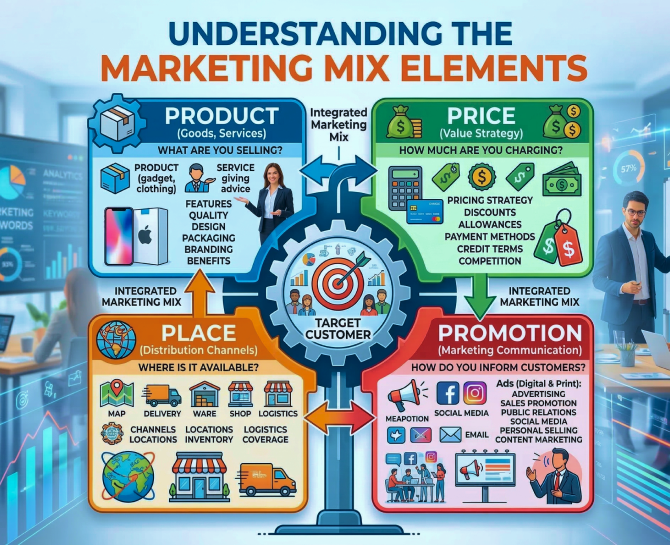
The marketing mix is a strategic framework that helps businesses plan how to bring products or services to market. Built around the 7Ps (Product, Price, Place, Promotion, People, Process, and Physical Evidence), it gives marketers a structured way to align every element of their strategy. In 2026, AI and automation are reshaping how each P is executed, making the framework more powerful and more urgent to get right.
Ten years ago, a well-placed ad and a solid product were enough to compete. Today, brands are dealing with splintered attention spans, a dozen active channels, and customers who expect to feel understood before they even engage. The marketing mix still sits at the core of good strategy. The question is whether yours has kept pace with how much the game has changed.
Let’s break down the marketing mix elements, what they mean today, and how forward-thinking brands are using AI to get more out of every P.
Key Takeaways
- The 7Ps (Product, Price, Place, Promotion, People, Process, and Physical Evidence) build on the original 4Ps to give marketers a complete framework for strategy, one that covers both what you sell and how you deliver it.
- The marketing mix only works when you revisit it regularly. Treating it as a one-time exercise means your strategy quietly goes stale while your market keeps moving.
- AI is no longer optional. Dynamic pricing, predictive segmentation, and automated customer journeys are already standard practice for fast-growing brands, and the gap widens every year for those not using these tools.
- Promotion is the most over-indexed P on most marketing plans. Ads bring people in, but the rest of the mix determines whether they convert, stay, and come back.
- The brands winning today are not always the ones with the deepest pockets. They are the ones asking sharper questions about every element of their mix and using data to act on the answers faster.
What Are Marketing Mix Elements?
The marketing mix is a framework that helps businesses plan how to bring their products or services to market. It gives you a structured way to think about your strategy so nothing important gets left out.
The Traditional 4Ps and the Extended 7Ps
The original framework, known as the 4Ps, was introduced by E. Jerome McCarthy in the 1960s. It covers Product, Price, Place, and Promotion.
As marketing evolved, especially in service-based industries, three more elements were added: People, Process, and Physical Evidence. Together, these form the 7Ps of marketing.
Why the Marketing Mix Still Matters Today
The 7Ps have held up because they force clarity. They make you ask hard questions about your offering, your audience, and your delivery. The framework itself hasn’t changed much. What has changed is how each element is executed in a digital-first world.
Why the Traditional Marketing Mix Is No Longer Enough
The 4Ps were designed for a world with fewer channels, slower feedback loops, and less demanding customers. Markets have moved on since then, and so have customer expectations.
Shift from Product-Centric to Customer-Centric Marketing
Buyers today expect experiences, not just products. They want personalization. They want brands to understand them before they even ask. A product that does the job is no longer enough if the experience around it falls flat.
Rise of Data, AI, and Automation
Brands now have access to more customer data than ever before. AI can process that data in real time and help marketers make smarter decisions faster. Predictive analytics can tell you what a customer might need before they realize they need it.
Fragmented Digital Channels
Your customers are on email, social media, search engines, mobile apps, and physical stores all at once. Reaching them means building a consistent experience across all of these. That’s the definition of omnichannel marketing. It’s also why an integrated strategy matters more than ever.
The 7 Marketing Mix Elements Explained (With Modern Context)
1. Product: From Offering to Experience
Features and quality are still important. But they’re rarely what makes a product stick. What keeps people coming back is the experience built around it.
Think about how Netflix recommends what to watch next. Or how Spotify builds a playlist that feels like it was made just for you. The product itself hasn’t changed much. But the experience around it has become a competitive advantage.
Modern product strategy also borrows heavily from the SaaS mindset. Iterate fast. Listen to users. Ship improvements continuously. This applies even to physical products and services.
2. Price: From Static to Dynamic Pricing
Fixed pricing is becoming harder to justify in most categories.
AI-powered dynamic pricing lets businesses adjust prices based on demand, behavior, and context. Airlines and hotels have done this for years. Now e-commerce brands and SaaS companies are doing it too, through tiered subscriptions and usage-based models that reflect real customer value.
Behavioral pricing is also gaining ground. This means understanding the psychology behind what a customer is willing to pay and building your pricing around that insight.
3. Place: From Physical to Omnichannel Presence
Distribution used to mean choosing between wholesale, retail, or direct sales. Today, it means managing a digital-first ecosystem with multiple touchpoints.
Brands now sell through their own websites, third-party marketplaces like Amazon, and social commerce platforms like Instagram and TikTok Shop. The goal is a seamless cross-channel experience. Customers should be able to discover, research, and buy without friction, wherever they happen to be.
4. Promotion: From Campaigns to Continuous Engagement
Traditional advertising ran in defined bursts. A campaign would launch, run its course, and then stop. Modern promotion doesn’t work that way.
Performance marketing runs continuously and adjusts based on real-time data. AI-generated content helps brands scale their messaging across channels without compromising quality. Hyper-personalized messaging means your email to one customer can look completely different from the one sent to another, even if they bought the same thing.
5. People: From Teams to Customer and AI Collaboration
This P used to refer mainly to your employees and service staff. That’s still true, but the scope has expanded.
Customer success teams now work alongside AI chatbots that handle routine queries instantly. This frees up human agents to focus on complex issues that need real empathy and judgment. Internally, marketing teams are upskilling to understand automation platforms, data tools, and AI-assisted workflows.
6. Process: From Linear Funnels to Automated Journeys
The old funnel model assumed customers moved in a straight line from awareness to purchase. Real buying behavior rarely works that way.
Marketing automation tools now map customer journeys across multiple touchpoints. CRM workflows trigger the right message at the right moment without a human having to initiate it. Lifecycle marketing keeps the relationship going long after the first sale. The process becomes less of a funnel and more of a dynamic loop.
7. Physical Evidence: From Tangible Proof to Digital Trust Signals
For service brands especially, physical evidence used to mean the look and feel of a store or the quality of packaging. Online, this translates to digital trust signals.
Reviews and ratings. UX design that feels intuitive. A website that loads fast and works on mobile. A brand voice that’s consistent across every channel. These are the things that tell a potential customer: you can trust us, even before they’ve ever spoken to anyone on your team.
How AI Is Transforming Marketing Mix Elements
AI isn’t coming for your marketing strategy. It’s already inside it. The brands that are growing fastest right now are the ones treating AI as a core part of their operations, not a bonus feature.
- Personalization at scale is one of the clearest examples. AI-driven segmentation lets you go beyond basic demographics. You can now group customers by behavior, intent, and predicted lifetime value. And you can serve each segment a different message automatically.
- Predictive decision-making is changing how brands plan. Instead of reacting to what happened last quarter, AI tools help you forecast demand and anticipate how customers will behave next. That means fewer surprises and better resource allocation.
- Content generation and optimization have become faster and more data-driven. AI tools can help write ad copy, email subject lines, and blog posts. More importantly, they can run A/B tests at scale and surface what’s actually working.
- Marketing automation and efficiency tie everything together. When your campaigns run on automated workflows, your team spends less time on repetitive tasks and more time on strategy.
Building a Modern Marketing Mix Strategy
Step 1: Define Your Target Audience with Data
Skip the guesswork. Use analytics tools and AI-powered insights to understand who your best customers actually are. Look at behavior, not just demographics.
Step 2: Align the 7Ps with Business Goals
Every element of your marketing mix should connect back to a business goal. Revenue growth, customer retention, or new market acquisition. Each P should have a clear role to play.
Step 3: Integrate Technology and Your MarTech Stack
Your CRM, automation platform, and analytics tools should work together. Data silos kill efficiency. Integration drives clarity.
Step 4: Test, Measure, and Optimize Continuously
Set your KPIs before you launch anything. Review them regularly. And be willing to change what isn’t working. The best marketing strategies are never finished. They’re always evolving.
Real-World Example: The 7Ps in Action for a B2B SaaS Brand
Imagine a mid-sized SaaS company selling a project management tool. Here’s how the 7Ps might come to life.
Product: The tool itself is updated based on user feedback every sprint. An AI layer suggests features each user is most likely to find useful.
Price: A freemium tier drives sign-ups. Paid tiers are priced around team size and usage. Annual plans come with a discount to drive retention.
Place: The product is sold directly through the website and listed on platforms like G2 and Capterra, where buyers do their research.
Promotion: Content marketing drives inbound traffic. Retargeting ads re-engage visitors who didn’t convert. Email sequences are personalized by user segment.
People: A customer success team monitors usage data and reaches out proactively when accounts show signs of churn. Chatbots handle onboarding questions at 2 a.m.
Process: The entire buyer journey from trial signup to paid conversion runs on automated workflows. No one slips through the cracks.
Physical Evidence: Case studies, G2 reviews, and a polished UI all signal credibility before a sales conversation even happens.
Common Mistakes Businesses Make with Marketing Mix Elements
Even well-resourced teams get this wrong. Here are the most common mistakes.
- Treating the 7Ps as a one-time exercise is probably the biggest one. The framework only works if you revisit it regularly as your market evolves.
- Ignoring customer experience is another. You can have the best product and the sharpest pricing, but if the experience feels clunky or cold, customers will leave.
- Lack of integration across channels creates a disjointed experience. Your messaging on social should match your email and your website. Consistency builds trust.
- Underutilizing data and AI is a missed opportunity that grows more costly every year. If you’re not using the tools available to you, your competitors are.
- Over-focusing on promotion while neglecting the other six Ps is a trap many brands fall into. Ads can bring people in. But the rest of the mix determines whether they stay.
The Future of Marketing Mix Elements
Everything we’ve discussed here will happen more quickly in the next few years.
Marketing tactics that prioritize AI will become commonplace rather than novel. Hyper-personalization will advance beyond segment-level to genuinely unique
experiences. While humans concentrate on strategy and creativity, autonomous marketing systems will handle more execution.
Brands that stay with what worked in 2015 won’t be the ones that prevail. The marketing mix is viewed as a living strategy by them. One that changes in tandem with their clients, data, and technology.
Final Thoughts
The marketing mix isn’t outdated. It’s more relevant than ever. But it only works when it’s treated as a dynamic framework, not a static checklist.
Businesses that rethink their 7Ps with data and intelligent automation at the center will move faster, connect better, and grow stronger. The question isn’t whether to modernize your marketing mix. The question is how quickly you can get started.
Modern growth requires exactly that kind of rethinking. And the right partner makes all the difference.
Ready to get started?
Increase your marketing ROI by 30% with custom dashboards & reports that present a clear picture of marketing effectiveness
Start Free Trial
Experience Premium Marketing Analytics At Budget-Friendly Pricing.

Learn how you can accurately measure return on marketing investment.
How Predictive AI Will Transform Paid Media Strategy in 2026
Paid media isn’t a channel game anymore, it’s a chessboard. Search, social, programmatic, video, influencer, native,...
Read full post post
Don’t Let AI Break Your Brand: What Every CMO Should Know
AI isn’t just another marketing tool. It’s changing how we connect with customers, personalize content, and...
Read full post post
From Demos to Deployment: Why MCP Is the Foundation of Agentic AI
A quiet revolution is unfolding in AI. And it’s not happening inside research labs. For decades,...
Read full post postFAQ's
The 7Ps of the marketing mix are Product, Price, Place, Promotion, People, Process, and Physical Evidence. Each element covers a different dimension of how a business brings its offering to market, from what it sells and how it prices it, to how it delivers it and earns customer trust.
The original 4Ps (Product, Price, Place, and Promotion) were introduced by E. Jerome McCarthy in the 1960s. As service-based industries grew, three additional elements were added: People, Process, and Physical Evidence, forming the extended 7Ps framework used today.
AI is transforming every element of the marketing mix. It enables dynamic pricing, hyper-personalized messaging, predictive customer segmentation, automated buyer journeys, and content optimization at scale, helping brands make faster and smarter decisions across all 7Ps.
The marketing mix forces strategic clarity. It makes teams ask the right questions about their offering, audience, channels, and delivery. While the framework itself has stayed largely the same, the tools and data available to execute each element have changed dramatically, making it more useful than ever.
The most common mistakes include treating the 7Ps as a one-time exercise rather than an ongoing strategy, over-investing in promotion while neglecting the other elements, ignoring customer experience, and failing to integrate data and AI into decision-making.