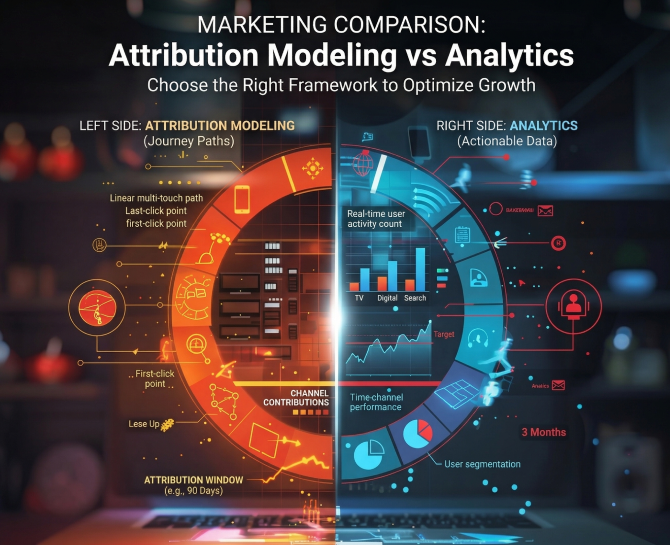
Attribution Modeling vs. Marketing Mix Modeling: Why You Need the Microscope and the Telescope
Attribution modeling and Marketing Mix Modeling (MMM) are two distinct measurement frameworks that answer different questions about marketing performance. Attribution modeling tracks individual customer touchpoints to inform tactical decisions. MMM looks at the big picture to guide long-term strategy and budget planning. The most effective marketing teams in 2026 are not choosing between them. They are using both.
There is a conversation that plays out in marketing teams almost everywhere. The digital team wants to know which specific ad drove the click, which email got the open, and which landing page finally converted the lead. Meanwhile, the leadership team is sitting in a boardroom asking a completely different question: Is our overall marketing investment actually growing the brand, and how should we be planning for next year?
Both questions matter. Both are urgent. And for too long, teams have been forced to answer them with tools that were only ever built for one or the other.
According to a July 2025 survey by EMARKETER and TransUnion, 46.9% of US marketers now plan to invest more in Marketing Mix Modeling over the next year, and 27.6% named it the most reliable measurement methodology, placing it ahead of every other approach. And yet, attribution modeling is not going anywhere either. The shift is not from one to the other. It is toward using both intelligently, at the same time.
The good news is that you genuinely do not have to choose sides. You just need to understand what each tool was built to see, and what it was never designed for.
Key Takeaways
- Attribution modeling is the microscope. It shows you exactly which clicks, channels, and paths led to a conversion, making it ideal for tactical decisions about where to shift spend today.
- MMM is the telescope. It pulls back to show how your total marketing investment, including offline channels, economic conditions, and seasonal trends, is driving long-term brand growth.
- The two tools answer fundamentally different questions. Using only one means, you are either optimizing tactics without a strategic compass, or setting strategy without any granular feedback on what is actually working day to day.
- Privacy changes and cookie deprecation have weakened the individual-level tracking that attribution modeling depends on. MMM has grown in importance precisely because it does not rely on user-level data to produce reliable insights.
- Modern marketing teams do not have to choose. Combining both approaches in a unified platform gives you real-time tactical intelligence alongside long-term strategic clarity, without having to switch between tools or reconcile conflicting reports.
The Difference Between Tracking and Optimizing
Think of attribution modeling as a microscope. It lets you zoom in close enough to see individual interactions, specific moments in a customer’s journey where something shifted, and the exact path that led from first click to conversion.
In practice, attribution modeling tracks the digital touchpoints a prospect interacts with before they buy. The LinkedIn ad they clicked on a Tuesday morning. The blog post they read a few days later. The email that brought them back to the pricing page. The demo request that followed a week after that.
By assigning credit to these touchpoints, attribution modeling helps you answer questions that feel genuinely urgent on a Monday morning. Which channel is driving the most qualified pipeline right now? Should we shift budget from Google Ads to LinkedIn this month? Is this retargeting campaign earning its spend, or just showing up last and taking all the credit for a decision that was already made?
These are tactical questions. They need fast, granular answers. And for digital channels with trackable user behavior, attribution modeling is genuinely good at delivering exactly that.
It works best when your sales cycle is short enough for individual journeys to be measurable within a reasonable window, when your channels are primarily digital, and when the decisions you are making are about near-term allocation rather than annual planning.
The limitation is that attribution modeling can only see what it can track. It is blind to offline channels. It struggles with long B2B sales cycles where a single journey spans months and dozens of touchpoints across multiple devices. And as privacy regulations tighten and third-party cookies continue to disappear, the individual-level data it depends on is becoming harder to collect cleanly.
Marketing Mix Modeling: The Telescope
Now pull back. Way back.
Marketing Mix Modeling is the telescope. Instead of zooming in on individual interactions, it looks at the entire universe of factors influencing your revenue over time and tries to understand how each one is actually contributing to the result.
MMM uses statistical analysis of aggregate data to measure the impact of every marketing channel, including the ones attribution modeling cannot see at all. Television advertising. Out-of-home placements. Sponsorships. Trade shows. It also factors in variables that have nothing to do with marketing: economic conditions, competitor activity, seasonality, and even the weather.
The questions MMM answers are strategic rather than tactical. How much of our revenue growth last year came from brand advertising versus performance marketing? What is the right total marketing budget for next year? If we cut TV spend by 20%, what actually happens to long-term brand equity and revenue? These are boardroom questions. They need a broad view across long time horizons, and they simply cannot be answered by looking at click paths.
MMM’s strength is exactly where attribution modeling is weakest. It does not rely on individual-level tracking, which makes it naturally resilient to privacy changes. It captures offline influence. And it surfaces the long-term compounding effects of brand investment that performance dashboards consistently undervalue, because those effects do not show up in last-click reports.
The tradeoff is speed and granularity. MMM models are traditionally built on months or years of data and updated seasonally or annually. They tell you what happened at a market level, not what a specific user did on a specific Tuesday afternoon.
The Comparison: Microscope vs. Telescope
| Feature | Attribution Modeling | Marketing Mix Modeling |
|---|---|---|
| Focus | Short-term, digital clicks | Long-term, total brand impact |
| Level of detail | High (individual users) | Broad (market trends) |
| Speed | Real-time | Seasonal or annual |
| Data type | User-level, digital | Aggregate, online and offline |
| Privacy sensitivity | High | Low |
| Best for | Tactical budget decisions | Strategic planning and forecasting |
Neither column is better than the other. They are built for different altitudes, and they answer different questions. Treating them as competitors is the wrong frame entirely.
Why Modern Brands Need Both
Here is what happens when you pick only one.
Teams that rely only on attribution modeling end up quietly over-indexing on bottom-funnel performance channels, because those are the ones that show up last in the data and collect all the credit. Brand campaigns, content marketing, and awareness-stage investment get gradually defunded, not because they are not working, but because attribution gives them little visible credit, even when they are doing the heaviest lifting earlier in the journey.
Teams that rely only on MMM have the opposite problem. They can see that their overall marketing investment is working, but they cannot tell the digital team where to shift spending this week. The strategic view is clear. The tactical feedback loop is missing entirely.
The most advanced organizations are no longer debating MMM versus attribution. They are integrating them into a unified framework. And it makes sense. You need the microscope to see the cells. You need the telescope to see the stars. Trying to do astronomy with a microscope produces results that are technically impressive and practically useless.
The DiGGrowth Edge: One Dashboard, Both Views
The traditional barrier to combining attribution modeling and MMM has always been practical rather than conceptual. Most teams understood why both mattered. The problem was that the two approaches lived in separate tools, required different skill sets, and produced outputs that were genuinely difficult to reconcile with each other. You ended up with two pictures of your marketing that did not quite match, and no clear way to resolve the difference.
DiGGrowth bridges that gap by using AI to combine granular click-level attribution data with big-picture market trend analysis in a single platform. The digital team can see which specific channels and messages are driving conversions today. Leadership can see how the overall marketing investment is tracking against long-term revenue goals. And both views update continuously, rather than waiting for a quarterly model refresh that arrives after the decisions have already been made.
The result is that tactical decisions and strategic decisions are no longer being made from two different pictures of reality. They are being made from the same one, just viewed at different zoom levels depending on who is looking and what they need to know.
That is not just a workflow improvement. It is a fundamentally different way of running marketing, where the microscope and the telescope are pointed in the same direction, at the same time, without anyone having to choose between them.
Conclusion
The tension between attribution modeling and MMM has always been a false choice. It was never really about which tool was better. It was about the fact that most teams could only manage one and had to hope it covered enough ground.
In 2026, that constraint no longer needs to exist. The data infrastructure, the AI capabilities, and the platforms to bring both views together are genuinely available. The question is whether your team is set up to use them.
Stop optimizing short-term wins at the expense of long-term brand growth. Stop setting long-term strategy without granular feedback on what is working in your campaigns right now. Both views exist for a reason, and the teams that combine them are the ones that will be hardest to compete against.
Ready to get started?
Increase your marketing ROI by 30% with custom dashboards & reports that present a clear picture of marketing effectiveness
Start Free Trial
Experience Premium Marketing Analytics At Budget-Friendly Pricing.

Learn how you can accurately measure return on marketing investment.

How Predictive AI Will Transform Paid Media Strategy in 2026
Paid media isn’t a channel game anymore, it’s a chessboard. Search, social, programmatic, video, influencer, native,...
Read full post post
Don’t Let AI Break Your Brand: What Every CMO Should Know
AI isn’t just another marketing tool. It’s changing how we connect with customers, personalize content, and...
Read full post post
From Demos to Deployment: Why MCP Is the Foundation of Agentic AI
A quiet revolution is unfolding in AI. And it’s not happening inside research labs. For decades,...
Read full post postFAQ's
Attribution modeling tracks individual digital touchpoints to explain specific conversions. MMM uses aggregate data to measure the broad impact of all marketing activity, including offline channels, on long-term revenue. One zooms in, the other pulls back.
Both serve different purposes. Attribution modeling helps B2B teams make faster tactical decisions about digital spend. MMM helps with annual budget planning and understanding the long-term value of brand investment. Most mature B2B teams benefit from using both together.
Yes, and that is a big part of why it has grown so significantly. MMM uses aggregate data rather than individual-level tracking, making it far more resilient to cookie deprecation, iOS privacy changes, and evolving data regulations than attribution modeling alone.
DiGGrowth's AI-driven platform connects granular click-level attribution data with broader market trend analysis in a single dashboard, giving digital teams and leadership a unified view of marketing performance without needing to reconcile two separate tools or wait for a quarterly model refresh.