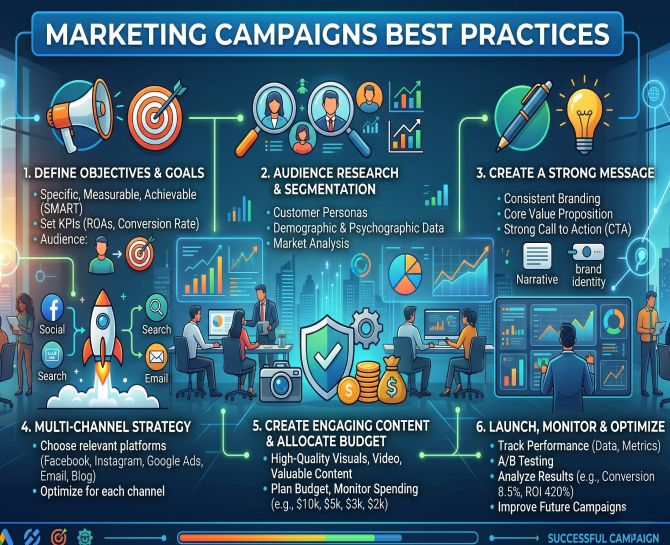
Strategic Marketing Campaigns Best Practices for Competitive Markets
Marketing competition now depends on precision timing and message clarity, not volume. This article breaks down campaign structure, positioning, planning systems, channel strategy, and personalization approaches that improve performance in crowded markets with practical frameworks and execution-focused insights.
Why do some marketing campaigns win attention in crowded markets while others disappear without a trace, even with strong budgets behind them? Why does the same audience respond to one brand and ignore another offering something similar?
These are not random outcomes. They are usually signs of deeper issues in strategy.
In competitive markets, the pressure is constant. Every brand is fighting for the same attention span, the same clicks, and often the same customer intent. The result is predictable. Messages start blending together. Campaigns feel repetitive.
Many teams feel this gap early. Campaigns look good on paper, but conversions stay inconsistent. Engagement drops after an initial spike. Budgets increase, but impact does not scale at the same pace.
Key Takeaways
- Strategic campaigns depend on clarity of objective before anything else.
- Audience behavior and intent matter more than broad demographic targeting.
- Positioning only works when it is consistent across every touchpoint.
- Market insights reduce guesswork and improve campaign precision.
- Performance improves when messaging and personalization feel timely and relevant.
Understanding Competitive Markets
Competitive markets are not just crowded. They are fast-moving, comparison-heavy, and unforgiving to unclear messaging. A customer does not need much effort to switch from one brand to another, which means loyalty is always under pressure.
What makes this even more challenging is how similar most offerings start to look. Features overlap. Pricing becomes close. Even positioning begins to sound familiar after a point. When everything feels interchangeable, the deciding factor shifts to perception and clarity.
At this stage, small gaps become expensive mistakes. A slightly unclear message can push a potential customer toward a competitor. A delayed response to a trend can make a brand feel outdated almost instantly.
A simple way to see this difference is below.
| Market Factor | Low Competition Markets | Competitive Markets |
|---|---|---|
| Customer choice | Limited options | High comparison behavior |
| Messaging impact | Moderate influence | High influence |
| Switching behavior | Low frequency | High frequency |
| Brand loyalty | More stable | Easily disrupted |
The pressure here is not only external. It also comes from within teams trying to keep up with constant changes while maintaining consistency. That balance is where most campaigns either start to strengthen or slowly lose direction.
Understanding this environment is the first step before building any meaningful strategy.
Core Principles of Strategic Marketing Campaigns
Strong campaigns in competitive markets do not succeed by chance. They are built on structure, where every decision connects back to a clear purpose. Without that, even well-designed campaigns start to feel scattered and inconsistent.
The real difference shows up in how intentional the approach is. Not just what is being said, but why it is being said, and who it is meant for.
Clarity of Objective and Direction
A campaign without a clear objective tends to drift. Teams end up optimizing for multiple outcomes at the same time, and results become difficult to measure or trust.
In competitive markets, clarity becomes even more important because small wins need to compound into meaningful impact. That only happens when success is defined early and in specific terms. It could be lead quality, conversion rate, or retention improvement, but it must be measurable and consistent throughout the campaign.
This clarity also reduces internal confusion. When everyone is aligned on one outcome, decisions become faster and more focused.
Audience Focus and Message Consistency
Broad messaging often feels like a safer option, but it rarely performs well in highly competitive spaces. Audiences are constantly filtering information, and only messages that feel directly relevant make it through.
This is why precision matters. Understanding who the campaign is truly for changes everything, from tone to channel selection.
Equally important is consistency. A strong message loses impact if it shifts too much across platforms. The goal is not to repeat the same line everywhere, but to keep the core idea stable while adapting how it is delivered. This balance builds familiarity, and familiarity builds trust over time.
Market Research and Audience Intelligence
Most campaigns do not fail because of weak execution. They fail because the foundation is based on assumptions instead of insight. In competitive markets, guessing is expensive. Every missed signal means lost relevance.
Understanding the market is not just about collecting data. It is about reading what the data is actually trying to say about customer behavior, intent, and hesitation points.
Understanding Customer Behavior and Intent
Customers rarely follow a straight path to purchase. They compare, pause, revisit, and switch between options before making a decision. If a campaign does not reflect this reality, it feels disconnected from how people actually think.
This is where behavioral patterns matter. What triggers interest. What causes drop-off. What builds trust at different stages of the journey. These insights help shape messaging that feels timely instead of generic.
Even small signals matter. A repeated product comparison search or hesitation at pricing pages can completely change how a campaign should be structured.
Competitive Benchmarking and Insight Mapping
In crowded markets, understanding competitors is not about imitation. It is about identifying gaps.
What are others overemphasizing? Where is messaging becoming repetitive? What customer needs are still not being addressed clearly?
These gaps often reveal positioning opportunities that are easy to miss at surface level. Insight mapping also helps reduce wasted effort. Instead of spreading campaigns evenly across channels, it becomes clearer where attention is actually shifting and where it is not.
Positioning and Differentiation Strategies
When multiple brands are offering something similar, the audience rarely spends time analyzing every detail. That is where positioning becomes the deciding factor. It shapes how people categorize a brand in their mind long before they compare features or pricing.
Finding a Clear and Defensible Position
A strong position does not come from trying to be different for the sake of it. It comes from identifying what the audience actually values but is not getting clearly enough from existing options.
This usually sits at the intersection of customer frustration, unmet expectations, and overlooked opportunities in the category. When these are understood well, messaging becomes sharper and easier to remember.
Key shifts that help define a stronger position include:
- Narrowing focus to a specific audience instead of speaking to everyone.
- Solving one core problem with depth rather than multiple problems superficially.
- Framing value in terms of outcomes instead of product features.
- Building messaging around real user pain points instead of generic benefits.
- Aligning tone and communication style with how the audience actually thinks and speaks.
Each of these choices reduces noise and makes the brand easier to recognize in a crowded space.
Positioning in Real Campaign Execution
Even well-defined positioning loses impact if it is not carried through execution. Campaigns often start strong in strategy discussions but become inconsistent once they move across channels and formats.
Every touchpoint should reinforce the same central idea. That includes ads, landing pages, emails, and even retargeting messages. When the narrative shifts too much, the audience is forced to re-learn the brand each time, which weakens recall.
The strongest campaigns maintain one clear thread throughout execution, allowing repetition to build familiarity instead of confusion.
Campaign Planning Framework
Strong campaigns rarely fail at execution first. They fail much earlier, at the planning stage, where decisions are either too broad, too rushed, or too disconnected from actual market behavior.
Turning Strategy Into A Working Plan
Before anything goes live, the direction needs to be broken down into something actionable. This is where most campaigns either become focused or start drifting.
A practical planning approach usually involves:
- Defining a single primary business goal that anchors all decisions.
- Translating that goal into clear performance metrics that can be tracked daily or weekly.
- Segmenting the audience based on intent, not just demographics.
- Mapping where the audience interacts, hesitates, and converts.
- Matching channels to specific stages of the journey instead of using them interchangeably.
- Structuring messaging so it evolves from awareness to conversion naturally.
- Aligning budget with expected impact instead of distributing it evenly.
- Setting decision points for optimization instead of waiting until the end.
This is where campaigns start to feel intentional rather than experimental.
Channel Strategy and Omnichannel Execution
Reaching the right audience is no longer the challenge. The real challenge is staying consistent across every place they interact with a brand. Most customers do not convert after a single touchpoint. They move between search, social, email, and ads before they decide.
When these touchpoints feel disconnected, interest drops quickly. When they feel aligned, trust builds quietly over time.
Choosing Channels With Clear Intent
Not every channel plays the same role, and treating them the same often leads to wasted effort. Strong campaigns assign purpose to each channel instead of spreading activity evenly everywhere.
A more focused approach looks at how each channel supports the journey:
- Search captures active demand and high intent users.
- Social media builds awareness and emotional connection.
- Email nurtures interest and supports decision-making.
- Paid ads accelerate visibility and retargeting.
- Content strengthens trust and long-term discovery.
The key is not presence everywhere, but presence with purpose.
Building Consistency Across Touchpoints
Even well-chosen channels can fail if the messaging feels fragmented. A user might see one message in an ad, another on a landing page, and something completely different in an email. That disconnect creates friction.
Consistency does not mean repeating the same words. It means maintaining the same core idea while adapting the format to fit the platform.
A simple way to think about it: the message should feel like it is coming from the same brand, even when the channel changes.
When this alignment is done well, each touchpoint reinforces the next instead of competing with it.
Creative Messaging and Personalization
Attention is expensive in crowded markets. People do not ignore marketing because they are uninterested. They ignore it because most messages feel irrelevant within seconds.
That is why creative ideas alone are not enough. A strong concept still needs precision behind it. The message has to feel like it was created for a specific situation, not broadcast to everyone at once.
Building Messages That Actually Land
Good messaging starts with understanding what the audience is trying to solve in the moment, not just what a brand wants to say. This shift changes how campaigns perform at every stage.
A more effective approach focuses on:
- Framing the problem before introducing the solution.
- Using language that reflects how customers actually think and search.
- Aligning tone with intent, not just brand guidelines.
- Highlighting outcomes instead of listing features.
- Adjusting messaging based on where the user is in the journey.
Even small changes in framing can significantly improve engagement, especially when audiences are constantly comparing options.
Personalization That Feels Natural, Not Forced
Personalization is often misunderstood as adding a name or segment label. Real impact comes from relevance, not surface-level customization.
A campaign becomes more effective when it responds to behavior and context. For example, a returning visitor should not see the same message as a first-time user. Someone comparing options needs different information than someone ready to convert.
When done well, personalization does not feel like targeting. It feels like timing.
The goal is simple. Make the message feel like it arrived at the right moment, without making it feel intrusive or overly engineered.
| User Context | What They Need | Messaging Approach |
|---|---|---|
| First-time visitor | Awareness and clarity | Focus on problem + simple value introduction |
| Returning visitor | Deeper consideration | Highlight differentiation and proof points |
| Comparison stage user | Decision support | Show comparisons, outcomes, and trust signals |
| Ready-to-convert user | Final push | Reduce friction and reinforce urgency |
Pro Tip : When messaging and personalization work together, campaigns stop feeling generic. They start feeling responsive, which is exactly what drives stronger engagement in competitive environments.
Conclusion
Most campaigns do not struggle because of a lack of effort. They struggle because direction gets blurred once execution begins. What starts as a strong idea often gets diluted across channels, rushed decisions, and inconsistent messaging.
How clearly a brand is positioned in the customer’s mind? How naturally the message fits into their decision-making process? How well each campaign move connects back to a single intent instead of multiple competing goals?
There is a quiet advantage in keeping things structured. It removes unnecessary guesswork and gives teams space to focus on what actually influences outcomes instead of chasing activity for the sake of visibility.
DiGGrowth works closely with brands that want their marketing to feel more aligned, measurable, and consistent across every stage of execution. Connect at info@diggrowth.com.
Ready to get started?
Increase your marketing ROI by 30% with custom dashboards & reports that present a clear picture of marketing effectiveness
Start Free Trial
Experience Premium Marketing Analytics At Budget-Friendly Pricing.

Learn how you can accurately measure return on marketing investment.

How Predictive AI Will Transform Paid Media Strategy in 2026
Paid media isn’t a channel game anymore, it’s a chessboard. Search, social, programmatic, video, influencer, native,...
Read full post post
Don’t Let AI Break Your Brand: What Every CMO Should Know
AI isn’t just another marketing tool. It’s changing how we connect with customers, personalize content, and...
Read full post post
From Demos to Deployment: Why MCP Is the Foundation of Agentic AI
A quiet revolution is unfolding in AI. And it’s not happening inside research labs. For decades,...
Read full post postFAQ's
An effective campaign is built on clear objectives, precise audience targeting, and consistent messaging across all channels. It focuses on relevance rather than reach and adapts based on real performance data instead of assumptions.
Most campaigns fail because they lack strong positioning and rely on generic messaging. When brands sound similar, customers have no clear reason to choose one over another, which weakens engagement and conversions.
Audience research is critical because it shapes every decision in the campaign. Understanding intent, behavior patterns, and decision triggers helps brands create messaging that feels timely and relevant instead of broad and disconnected.
Personalization improves performance by aligning messages with user context. When communication reflects where a user is in their journey, it increases engagement and reduces friction in the decision-making process.
Brands can improve consistency by maintaining a single core message and adapting its format for each platform. This ensures that every touchpoint reinforces the same idea instead of creating confusion or mixed signals.