
You’re Targeting Your Ideal Customer. So Why Aren’t They Buying?
Your best customers reveal the traits associated with success. Your lost opportunities reveal where fit breaks down. A useful ideal customer profile needs both views.
Your best customers reveal the traits associated with success. Your lost opportunities reveal where fit breaks down. A useful ideal customer profile needs both views.
Many B2B teams build an ICP by interviewing a few sales leaders or reviewing their largest accounts. That can produce a plausible description, but it cannot show which attributes actually separate a strong-fit account from a weak one. Historical deal data gives the analysis a comparison group. Closed-won records show which companies converted. Closed-lost records help explain why similar-looking companies did not.
This is a quick explainer on how to structure that comparison, choose useful variables, and turn the findings into an account-level model that Marketing, Sales, and RevOps can use.
Teams that build an ICP from win loss data can test which account characteristics are associated with strong outcomes instead of relying on a profile built from assumptions alone.
Why closed won data is not enough
A list of successful customers can identify recurring characteristics such as industry, employee count, technology stack, contract value, and buying process. The problem is that common traits are not automatically predictive. If most of your prospects come from one industry, that industry may dominate your customer list even when it does not convert especially well.
Closed-lost opportunities provide the baseline. They let you compare accounts that had a chance to buy but reached a different outcome. A trait becomes more useful when it appears more often among wins than among losses, or when it is associated with stronger revenue, retention, or expansion among customers.
Choose the business outcome before choosing the data
An ICP can optimize for different outcomes. One team may want accounts that close quickly. Another may prioritize lifetime value, retention, or expansion. Define the desired outcome before assigning weight to any attribute. Otherwise, the model may rank accounts that look like past buyers without distinguishing the buyers that produced durable value.
- New customer acquisition: emphasize conversion rate, sales cycle, and acquisition efficiency.
- Revenue quality: emphasize contract value, gross margin, renewal, and expansion.
- Operational fit: consider implementation effort, support burden, security requirements, and integration complexity.
- Strategic expansion: identify segments that support a product, geography, or market-entry goal.
Prepare closed won and closed lost records
Start with account and opportunity records from a consistent period. Include enough history to cover a representative sales cycle, but do not mix records from materially different products, pricing models, or market strategies without labeling those differences. A pivot in packaging or target market can make older deals less relevant.
Standardize the outcome labels
Closed-won is usually straightforward. Closed-lost needs more care. Separate competitive losses, no decisions, budget failures, disqualified accounts, and opportunities that were closed for administrative reasons. A loss caused by timing carries a different signal from a loss caused by poor product fit.
Join account opportunity and customer data
Opportunity data explains the sales outcome, while account data describes the company. Customer success and billing data reveal what happened after the sale. Join these sources at the account level so the analysis can distinguish a quick win that churned from a customer that renewed and expanded.
Audit data quality before analysis
Review missing values, duplicate accounts, inconsistent industry labels, stale employee counts, and incomplete loss reasons. Enrichment can fill firmographic and technographic gaps, but it should not conceal uncertainty. Record which fields came from first-party systems and which were appended later.
Compare the signals that may explain fit
Organize candidate variables into groups so the model remains interpretable. The goal is to identify attributes that help the revenue team make a decision, not to collect every field in the CRM.
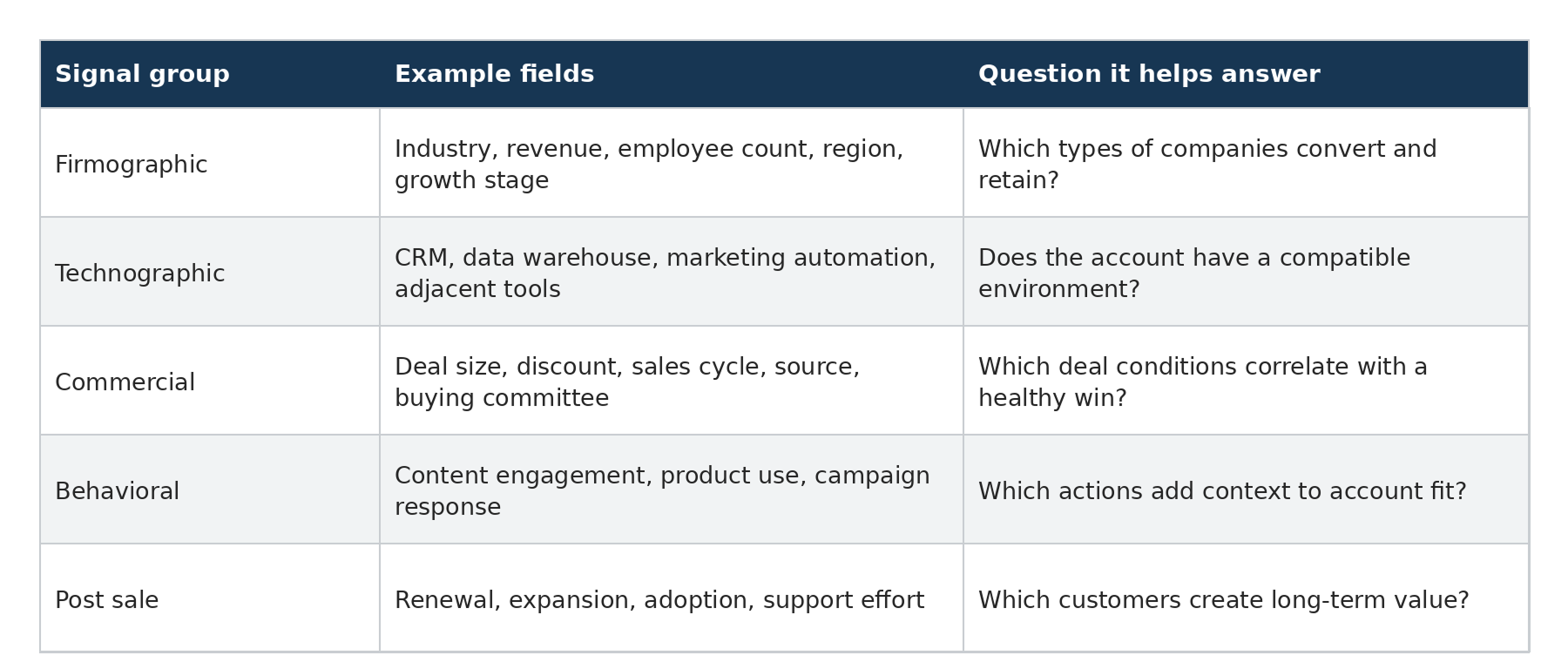
Find patterns without mistaking correlation for fit
Compare win rate and post-sale performance across each candidate attribute. Look for attributes that remain useful after controlling for obvious sources of bias. For example, enterprise accounts may generate more revenue per deal while taking longer to close and requiring more implementation work. The right conclusion depends on the outcome the ICP is meant to improve.
Use segment sizes that are large enough to evaluate. A perfect win rate across two opportunities is not a reliable basis for a market decision. Preserve the sample count beside each rate, and review whether the same pattern appears across multiple time periods or product lines.
Turn the comparison into an ICP scoring model
- Define positive-fit attributes based on patterns that distinguish strong wins from losses and weak customers.
- Define negative-fit attributes based on recurring disqualification, low conversion, churn, or excessive delivery cost.
- Assign weights according to their relationship with the chosen business outcome, rather than treating every field equally.
- Calculate an account-level score and group accounts into practical tiers such as strong fit, possible fit, and low fit.
- Back-test the tiers against historical results before using them to route leads or reallocate budget.
The first model should remain explainable. Sales teams need to know why an account received a score, and RevOps needs to identify when a missing or incorrect field distorted the result. A transparent starting model is easier to challenge, validate, and improve.
Use the ICP as a living decision system
After validation, write the score, tier, and strongest fit factors back to the systems where teams work. Marketing can use tiers for audience selection and budget allocation. Sales can prioritize accounts while still considering buying readiness and relationship context. Customer Success can compare new opportunities with patterns linked to adoption and retention.
Recalculate the model as new wins, losses, renewals, and product changes accumulate. The purpose is not to chase every short-term fluctuation. It is to prevent an old snapshot from controlling current go-to-market decisions.
Build your ICP from evidence already in your CRM
DiGGrowth’s ICP Analytics applies AI to historical win/loss and account data to identify best-fit customers, high-performing segments, similar accounts, and opportunity fit. The model can be validated against historical performance and activated through CRM and marketing automation fields that revenue teams already use.
Find out what your wins and losses say about who to target next. Get a free ICP Analysis.
Ready to get started?
Increase your marketing ROI by 30% with custom dashboards & reports that present a clear picture of marketing effectiveness
Start Free Trial
Experience Premium Marketing Analytics At Budget-Friendly Pricing.

Learn how you can accurately measure return on marketing investment.
You’re Targeting Your Ideal Customer. So Why Aren’t They Buying?
Your best customers reveal the traits associated with success. Your lost opportunities reveal where fit breaks...
Read full post post
How Predictive AI Will Transform Paid Media Strategy in 2026
Paid media isn’t a channel game anymore, it’s a chessboard. Search, social, programmatic, video, influencer, native,...
Read full post post
Don’t Let AI Break Your Brand: What Every CMO Should Know
AI isn’t just another marketing tool. It’s changing how we connect with customers, personalize content, and...
Read full post post