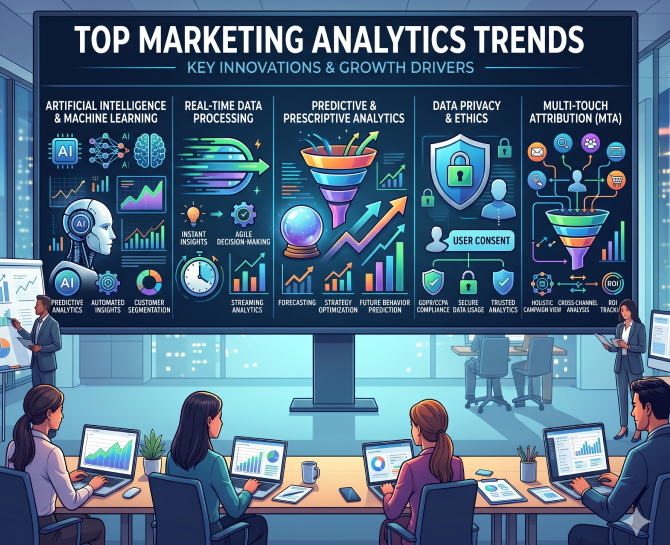
Top Marketing Analytics Trends in 2026: From “What Happened?” to “What Should I Do Next?”
The top marketing analytics trends in 2026 are centered on one fundamental shift: analytics is no longer just about viewing data. It's about acting on it. AI agents, predictive revenue modeling, and first-party data strategies are turning passive dashboards into living systems that learn, adapt, and make recommendations in real time. For CMOs and growth teams, the question isn't whether these trends are relevant. It's how quickly you can put them to work.
For years, the marketing analytics conversation was dominated by dashboards. Build a better dashboard. Add more charts. Track more metrics. The data piles up and the insight somehow doesn’t.
According to Funnel’s 2026 Marketing Intelligence Report, nearly eight in ten marketers say they don’t have a clear signal on what’s truly working. Despite record investment in analytics and automation, most teams analyze reports on what happened but don’t have the intelligence required to understand why something happened or what to do next.
That’s the gap 2026 is closing. The most significant shift isn’t a new tool. It’s a new expectation: that your analytics infrastructure should do more than report. It should recommend, predict, and, increasingly, act.
According to Analytics Insight, the AI marketing sector is projected to reach nearly $46 billion this year, with the most important shift being the rise of agent-based systems that can observe, make decisions, and take action in real time rather than waiting for a marketer to review dashboards and initiate a change.
Here’s what that shift looks like in practice, and what it means for how your team operates.
Key Takeaways
- Agentic AI has moved analytics from observation to execution. AI systems now monitor campaigns, surface issues, and make adjustments without waiting for a human to pull a report first.
- Zero-party and first-party data have replaced third-party tracking as the foundation of every meaningful personalization and analytics strategy as cookies continue to disappear.
- Predictive revenue analytics is replacing MQL-focused reporting, shifting the measurement conversation from activity metrics to actual financial impact.
- Data democratization means every person on your team, not just analysts, should be able to answer their own data questions without needing technical help.
- The biggest competitive gap in 2026 is not which tools you’re using. It’s whether your analytics infrastructure is actively contributing to decisions or just recording what happened after the fact.
What Are the Top Marketing Analytics Trends in 2026?
Marketing analytics in 2026 covers the tools, methods, and frameworks that connect marketing activity to business outcomes. The trends shaping it this year aren’t primarily about new software. They’re about a fundamental change in how analytics operates, moving from a function that explains the past to one that drives what happens next.
As Elegant Disruption noted in their 2026 marketing predictions, marketing in 2026 is not a stack of tools. It’s an intelligence system. The question every growth leader should be asking is: Are you still optimizing channels, or are you building a system that compounds learning week after week?
Trend 1: What Is Agentic AI and Why Is It the Biggest Shift in Marketing Analytics?
For most of recent memory, AI in marketing meant a tool that helped with a task when you asked it to. Write this email. Summarize this report. Generate some ad variations.
Agentic AI is a different category entirely.
According to Analytics Insight, instead of waiting for a marketer to review dashboards, AI agents now monitor performance around the clock, automatically reallocate budget across channels, suspend ads that don’t deliver results, test creative, and maintain bidding operations throughout the entire process.
The difference in practice is significant. Campaign managers are no longer adjusting bids manually. Their role is shifting toward setting objectives, guardrails, and success metrics while the AI handles execution at scale.
Growth Hakka’s 2026 AI Marketing Trends report found that brands adopting agentic frameworks are compressing campaign cycles from weeks to hours, creating a measurable competitive gap over teams still operating on manual optimization cycles.
For CMOs, this raises a practical question worth sitting with: how much of what your team does today is genuinely strategic, and how much is execution that an agent could handle faster and with less error?
Research cited by Landbase found that 89% of respondents stress combining human connection with AI efficiency. This hybrid model allows humans to focus on complex, high-value interactions while AI handles routine tasks and data analysis.
The role that actually compounds in value is the one that trains, governs, and directs AI. DiGGrowth’s Paid Media Agent is built around exactly this principle. It doesn’t just report on your ad performance. It actively monitors campaigns, surfaces optimization opportunities, and applies changes in real time, so your team can stop managing execution and start focusing on strategy.
Trend 2: Why Are Zero-Party and First-Party Data Now Non-Negotiable?
What is zero-party data? Zero-party data is information customers voluntarily and intentionally share with a brand through preference centers, interactive quizzes, surveys, and direct feedback. It’s distinct from first-party data, which you collect from your own tracking, because the customer is actively choosing to give it to you.
The context for why this matters is straightforward. Third-party cookies are gone or going. iOS privacy changes have fragmented tracking. Privacy regulations are tightening globally.
Ruskin Consulting’s 2026 Marketing Technology report notes that privacy regulations and the deprecation of traditional tracking have made first-party and zero-party data the ultimate currency. The most successful organizations in 2026 are those building “data moats” through interactive content, quizzes, polls, and preference centers that encourage customers to voluntarily share information.
There’s a human reason this matters beyond the technical one. When a customer tells you what they care about, you’re no longer guessing. You can build marketing that actually reflects their preferences rather than inferring from behavioral signals that may or may not represent their intent.
According to Growth Hakka, first-party data strategy has become non-negotiable in 2026, as privacy regulations tighten globally and AI models require clean, consented data pipelines to perform effectively.
Practically, this means building direct relationships with your audience through every touchpoint: email preference centers, post-purchase surveys, onboarding questions, and content that invites engagement rather than just tracking it.
Trend 3: What Is Predictive Revenue Analytics and Why Should You Care?
Most marketing teams have spent years optimizing for MQLs. The problem is that MQLs are an activity metric. They tell you that someone raised their hand, not that they represent revenue.
Merkle’s 2026 Marketing Playbook points out that with last-click attribution increasingly unreliable, marketing effectiveness must be assessed through models and frameworks that reflect real commercial contribution rather than platform-reported convenience metrics. A strong KPI framework requires metrics that ladder up to revenue, margin, and long-term value.
Predictive revenue analytics takes this a step further. Instead of reporting on what happened last quarter, it forecasts what will happen next. If you increase LinkedIn spend by $10,000 this week, what’s the expected impact on the pipeline in 60 days? Which customer segments are showing churn signals before they’ve indicated any dissatisfaction? Which content pieces are most predictive of conversion, not just clicks?
Analytics Insight reports that growth teams using predictive analytics as a decision layer are seeing meaningful reductions in wasted ad spend and faster identification of high-performing audience segments. The competitive advantage compounds: each campaign cycle generates data that makes the next prediction more accurate.
The shift from MQL-focus to revenue-focus also changes who marketing reports to and how. When marketing can say “this program is forecast to generate $X in pipeline next quarter based on current engagement signals,” the budget conversation looks fundamentally different than when marketing says “we generated 400 MQLs.”
Trend 4: What Does Data Democratization Mean for Marketing Teams?
What is data democratization in marketing? Data democratization means making analytics accessible to every person on the marketing team, not just analysts or data scientists, so that decisions at every level are informed by data rather than instinct.
Improvado’s data democratization guide defines democratized data as making data accessible and understandable to everyone in an organization, not just data scientists, using user-friendly tools and clear processes to help all employees make better decisions.
For marketing teams specifically, this means a content manager can check which topics are driving pipeline without submitting a request to the data team. A demand generation manager can see which channel mix is producing the lowest CAC without building a custom report. A CMO can get a revenue forecast without waiting for a weekly analytics meeting.
The Reporting Hub’s 2026 analytics report notes that with conversational querying and AI-assisted exploration, democratization is no longer theoretical. Anyone can ask questions in natural language, drill deeper, and participate in decision-making without being limited by the complexity of the underlying data environment.
The practical implication for leadership is that investing in data accessibility isn’t just a technical project. It’s a culture shift. Teams that can self-serve their own data questions move faster, make better calls, and spend less time waiting for reports that arrive after the decision was already made.
Trend 5: Why Is Generative Engine Optimization Now Part of the Analytics Conversation?
This one catches some teams off guard when it surfaces in analytics discussions, but it belongs here.
Growth Hakka notes that AI-generated search results via ChatGPT, Perplexity, and Google AI Overviews are replacing traditional search clicks for many queries. Brands must optimize for AI citation, not just keyword ranking. This means structuring content with clear headings, bullet points, specific data, and FAQ sections so AI systems can extract and attribute answers reliably.
Why is this an analytics trend? Because, measuring visibility in AI-generated answers requires different metrics than traditional SEO. You can’t track position one in an AI overview the same way you track a blue link. Analytics infrastructure needs to evolve to capture citation frequency, mention volume in AI responses, and dark funnel signals that show up before any tracked interaction occurs.
B2the7’s May 2026 marketing trends report reports that Google AI Mode now processes over one billion queries per month, reaching 75 million daily active users, representing one of the fastest adoption rates for any new search feature in Google’s history.
Teams that are measuring only traditional search performance are already missing a significant share of how their audience discovers content.
Conclusion
The top marketing analytics trends in 2026 represent a fundamental shift in what analytics is supposed to do. The teams pulling ahead have stopped treating analytics as a reporting function and started treating it as a decision-making engine.
Agentic AI, first-party data, predictive revenue modeling, democratized access, and AI search optimization all point in the same direction: your analytics infrastructure should be actively contributing to growth, not just documenting it. DiGGrowth’s Paid Media Agent is built for exactly this shift, helping teams move from reading last week’s performance report to acting on what’s happening right now.
Ready to get started?
Increase your marketing ROI by 30% with custom dashboards & reports that present a clear picture of marketing effectiveness
Start Free Trial
Experience Premium Marketing Analytics At Budget-Friendly Pricing.

Learn how you can accurately measure return on marketing investment.
How Predictive AI Will Transform Paid Media Strategy in 2026
Paid media isn’t a channel game anymore, it’s a chessboard. Search, social, programmatic, video, influencer, native,...
Read full post post
Don’t Let AI Break Your Brand: What Every CMO Should Know
AI isn’t just another marketing tool. It’s changing how we connect with customers, personalize content, and...
Read full post post
From Demos to Deployment: Why MCP Is the Foundation of Agentic AI
A quiet revolution is unfolding in AI. And it’s not happening inside research labs. For decades,...
Read full post postFAQ's
The top trends are agentic AI, zero-party and first-party data strategies, predictive revenue analytics, data democratization, and generative engine optimization. Together they represent a shift from analytics that reports on the past to systems that actively inform and drive future decisions.
Agentic AI refers to AI systems that don't just analyze data when asked but autonomously monitor performance, identify issues, and take action. In marketing, that means AI agents that reallocate budgets, pause underperforming ads, and test creative variations without waiting for human direction.
Zero-party data is information customers voluntarily share with a brand through surveys, quizzes, and preference centers. Unlike tracked behavioral data, it's given directly and intentionally, making it more reliable, more privacy-compliant, and more useful for personalization as third-party tracking erodes.
Predictive analytics shifts the focus from explaining past performance to forecasting future outcomes. Instead of reporting on last quarter's MQLs, teams can model the revenue impact of budget decisions before making them and identify at-risk accounts before they show visible churn signals.
It allows every team member, not just analysts, to access and act on data independently. When a content manager can self-serve their own performance insights and a demand generation manager can check CAC without waiting for a report, decisions happen faster and more consistently across the organization.