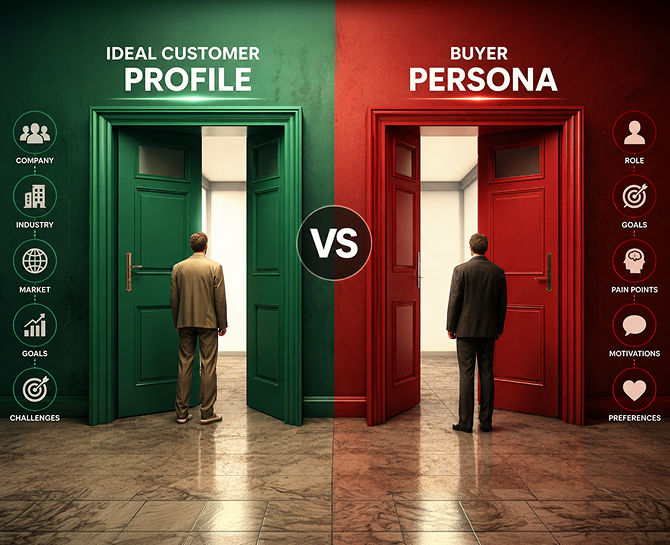
Ideal Customer Profile vs Buyer Persona: Key Differences and When to Use Each
ICP vs buyer persona helps businesses define their ideal accounts and understand the decision-makers within them. See how these frameworks differ, what data shapes them, and how combining both improves targeting, personalization, and B2B growth strategies.
Most B2B teams do not struggle because they lack leads. They struggle because they spend time pursuing the wrong ones.
Imagine launching a campaign that generates hundreds of inquiries,mar only to discover that very few companies are actually a good fit. Or worse, your sales team gets meetings with the right companies but fails to connect with the people making the purchasing decision.
The ideal customer profile vs buyer persona debate is not about choosing one over the other. It is about knowing what each framework is meant to accomplish. An Ideal Customer Profile helps you identify the businesses that are most likely to deliver long-term value. A buyer persona gives you a clearer picture of the Decision Makers within those businesses by combining Demographics, Psychographics, goals, challenges, and buying motivations.
When these frameworks work together, targeting becomes more precise, messaging becomes more relevant, and Purchase Intent is easier to identify throughout the buying journey.
Key Takeaways
- An Ideal Customer Profile helps businesses identify the companies that are most likely to become valuable customers, while buyer personas help understand the people within those companies.
- ICPs focus on account-level factors such as industry, company size, revenue, and growth potential, while buyer personas focus on individual goals, challenges, and buying motivations.
- Using ICPs and buyer personas together helps marketing and sales teams create more relevant campaigns and engage the right Decision Makers.
- Strong customer profiles should be built using real customer insights, sales feedback, and performance data instead of assumptions.
- ICPs and buyer personas should evolve as customer needs, market conditions, and business priorities change.
What Is an Ideal Customer Profile (ICP)?
An Ideal Customer Profile (ICP) identifies organizations that are most likely to convert, remain customers, and generate long-term business value.
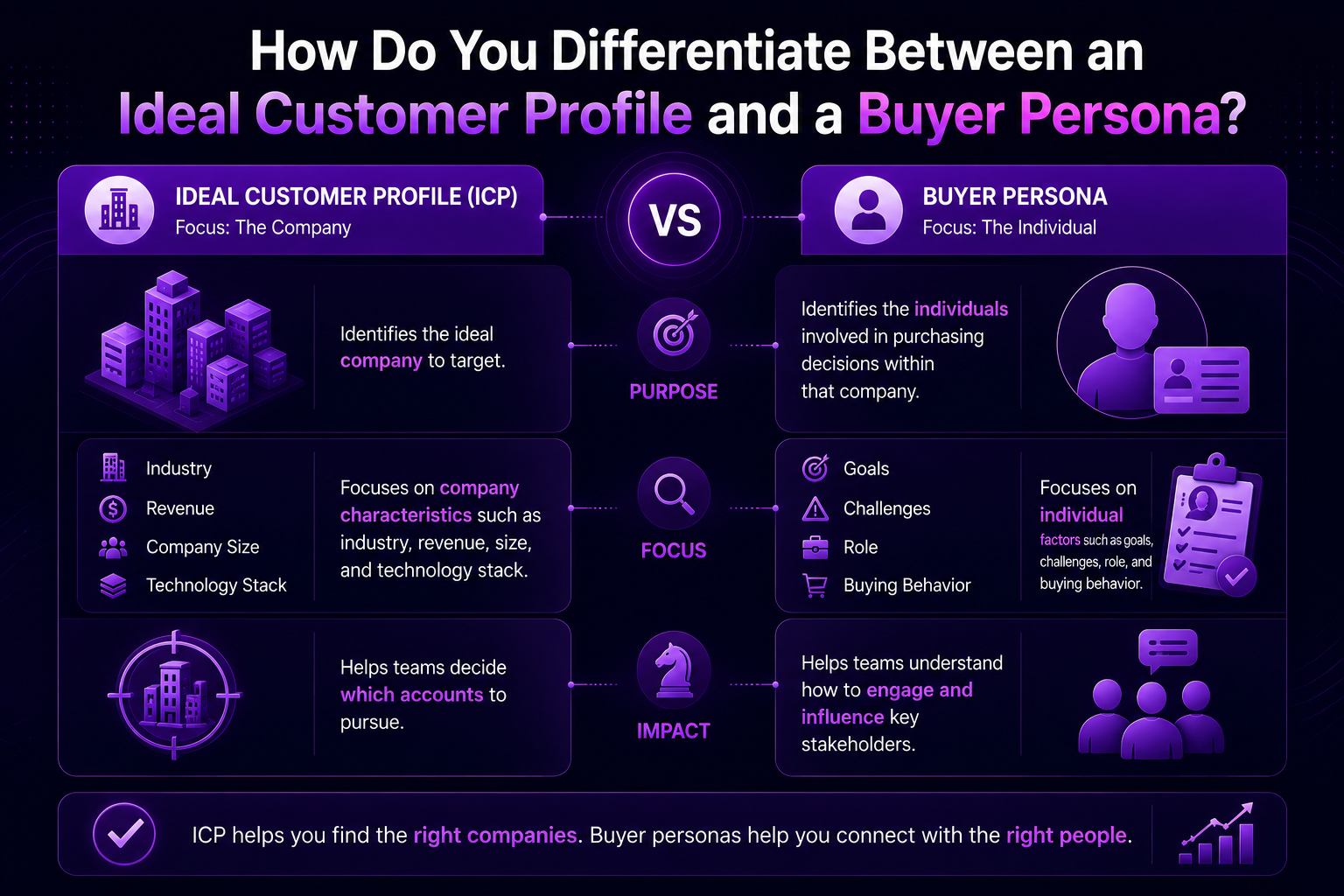
Unlike a buyer persona, an ICP focuses on accounts, not individuals. It helps B2B teams decide which companies to target based on factors such as business fit, revenue potential, and growth opportunity.
What Information Does an ICP Include?
An ICP is built using company-level data such as:
- Industry and market segment
- Company size and revenue
- Geographic location
- Technology stack
- Business model
- Growth stage
- Operational needs
- Budget and purchasing capacity
Teams often refine their ICP using customer success data, retention patterns, and expansion opportunities.
Why Does an ICP Matter?
An Ideal Customer Profile (ICP) helps businesses identify the types of accounts that are most likely to benefit from their offering. Instead of pursuing every possible lead, sales and marketing teams can direct their time and resources toward prospects that match their ideal customer characteristics.
For example, an enterprise analytics provider may focus on companies with dedicated data teams, complex reporting requirements, and the financial capacity to invest in advanced analytics platforms. This targeted approach allows teams to create more relevant Account-Based Marketing campaigns, improve outreach, and prioritize opportunities with stronger revenue potential.
What Is a Buyer Persona?
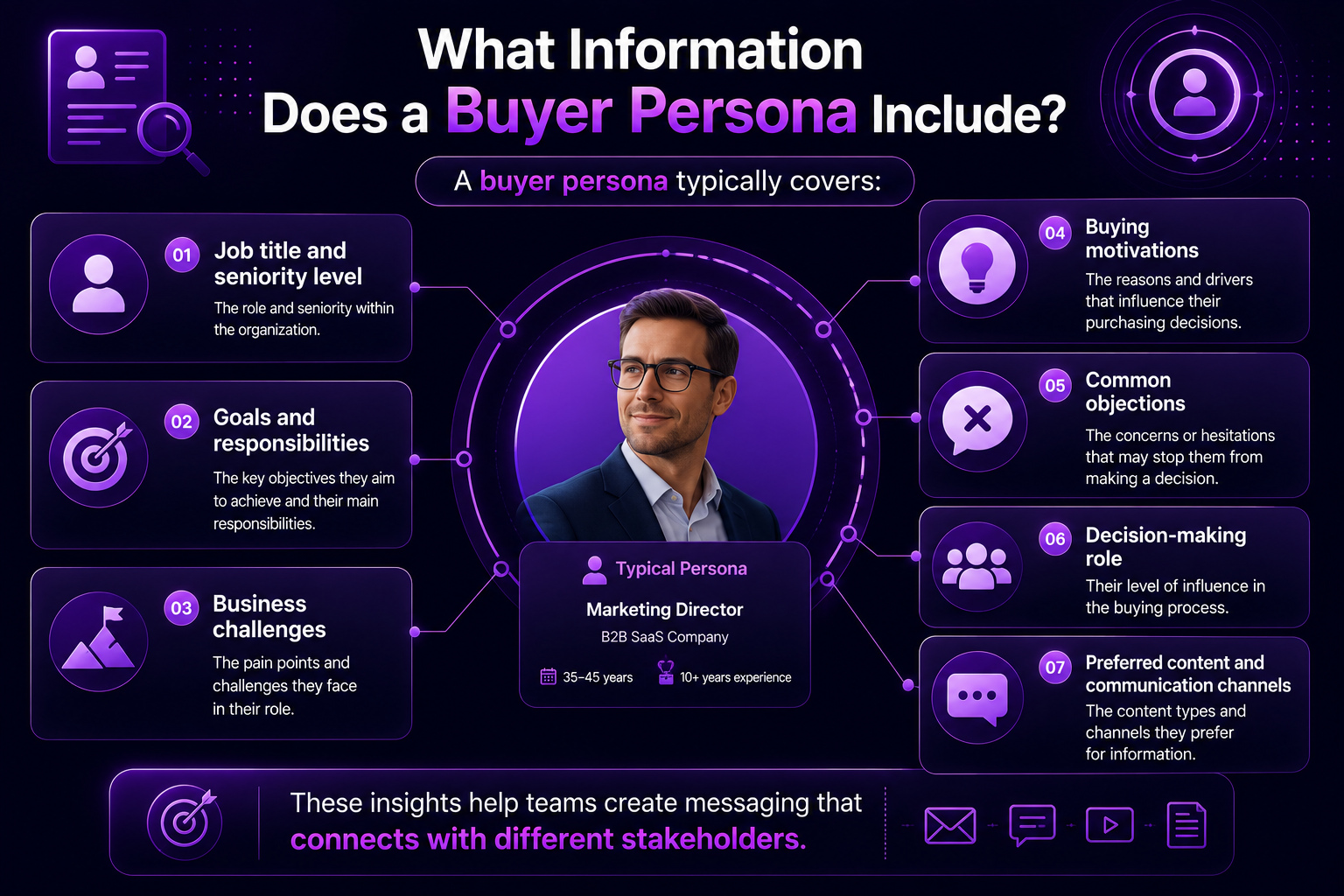
A buyer persona represents the key individuals involved in the purchasing process within a target account. It outlines their role, goals, challenges, priorities, and factors that influence their decision-making.
While an ICP defines which companies a business should target, buyer personas explain the people within those companies who research solutions, influence decisions, approve purchases, or use the product. Together, they give teams a clearer understanding of both the organization and the individuals driving the buying process.
What Information Does a Buyer Persona Include?
Why Do Buyer Personas Matter?
B2B purchases usually involve multiple decision-makers with different priorities. A CFO may focus on cost, while a technical leader may evaluate integration and security.
Combined with an ICP, they create a clearer strategy for reaching the right companies and engaging the right people.
Ideal Customer Profile vs Buyer Persona: Key Differences at a Glance
An Ideal Customer Profile and a buyer persona answer different questions. An ICP helps you determine which companies are worth pursuing, while a buyer persona explains which people within those companies you need to influence. Understanding this distinction prevents teams from targeting the wrong accounts or delivering generic messaging to the right ones.
| Aspect | Ideal Customer Profile (ICP) | Buyer Persona |
|---|---|---|
| Focus | Company | Individual stakeholder |
| Purpose | Identify high-value accounts | Understand buyer motivations and behavior |
| Data Used | Firmographics, company size, industry, revenue, technology | Demographics, Psychographics, goals, challenges, preferences |
| Primary Users | Sales, marketing, RevOps | Marketing, sales, product, customer success |
| Business Question | Which companies should we target? | How should we engage each stakeholder? |
| Stage in Strategy | Account selection | Messaging and engagement |
| Outcome | Better account prioritization | More relevant communication |
Pro Tip : Neither framework replaces the other. An ICP narrows your target market, while buyer personas help build stronger relationships with the people involved in the purchasing process. Using both gives teams a clearer path from identifying the right accounts to winning their business.
Demographics vs Psychographics: What Data Powers Each
The value of a buyer persona depends on the quality of the data behind it. While Demographics and Psychographics are often discussed together, they answer different questions and serve different purposes.
What Is Demographic Data?
Demographic data describes factual characteristics about an individual. In B2B marketing, this often includes job title, department, seniority, years of experience, and location. These details help identify who the buyer is and where they fit within an organization.
What Is Psychographic Data?
Psychographic data explains why someone makes a decision. It uncovers motivations, priorities, challenges, risk tolerance, and professional goals. This information shapes messaging by revealing what matters most to different stakeholders during the buying process.
Why Both Types of Data Matter
Using only demographic information gives you a basic understanding of your audience, but it rarely explains their purchasing behavior. Adding psychographic insights creates a more complete picture, making it easier to address concerns, highlight relevant value, and connect with buyers in a meaningful way.
Together, these data types transform a buyer persona from a simple profile into a practical tool for personalized marketing and sales conversations.
Company-Level Targeting vs Decision Maker Targeting
B2B organizations need both company-level and decision maker targeting to build an effective sales and marketing strategy. One determines which accounts to pursue, while the other determines who to engage within those accounts.
| Comparison | Company-Level Targeting | Decision Maker Targeting |
|---|---|---|
| Focus | Organizations that match your ICP | Individuals involved in the buying process |
| Primary Goal | Prioritize high-value accounts | Personalize outreach and conversations |
| Data Used | Firmographics, revenue, industry, technology | Demographics, Psychographics, responsibilities, goals |
| Best Used For | Account selection, market expansion, Account-Based Marketing | Email campaigns, sales conversations, content personalization |
| Business Outcome | Better account quality | Higher engagement and conversion rates |
Quick Insight: Company-level targeting helps your team invest in the right businesses. Decision maker targeting ensures your messaging reaches the stakeholders who influence the purchase. Combining both creates a more efficient path from prospecting to conversion.
How ICPs and Buyer Personas Capture Purchase Intent Differently
An ICP helps businesses spot companies that have a strong reason to consider their solution.
Changes such as rapid business growth, rising operational demands, technology upgrades, or shifting market dynamics can signal that an account may be facing challenges your solution can address.
These insights help sales teams focus their efforts on companies where the opportunity is strategically aligned.
Whereas, buyer personas help teams understand how different stakeholders behave during the buying process. A marketing leader researching solutions, a finance executive comparing costs, or an IT manager evaluating requirements may each show different signs of interest.
Tracking these behaviors helps teams tailor conversations based on the stakeholder’s role, priorities, and stage in the decision process.
Pro Tip : A company can match your ICP but have no immediate buying intent. Similarly, an engaged buyer may come from an account that is not a strong fit. Combining both signals creates a clearer picture of sales opportunities.
When to Use an ICP vs When to Use a Buyer Persona
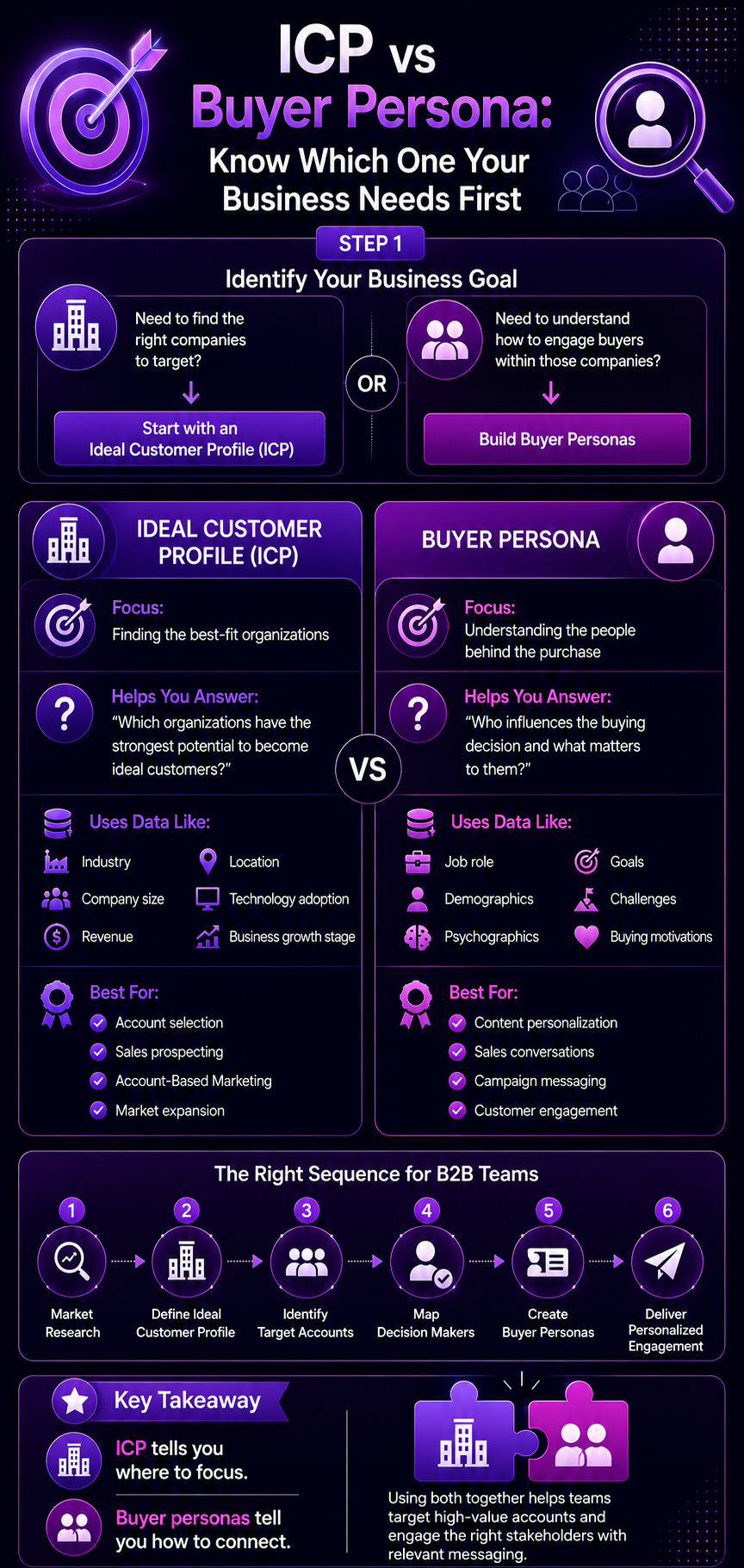
The choice between an ICP and a buyer persona depends on the business challenge you are trying to solve. ICP identifies the right companies to target, while a buyer persona helps you understand and engage the people within those companies.
How ICPs and Buyer Personas Work Together in Your Marketing Strategy
An ICP tells you which companies are worth pursuing, while buyer personas explain who inside those companies you need to engage and what matters to them. When combined, they create a clearer targeting framework for marketing and sales teams.
For example, a B2B software company may define its ICP as mid-market companies with 200–1,000 employees, growing revenue, and a need for workflow automation. The buyer personas within those companies could include a VP of Operations focused on efficiency, a Finance Manager concerned about cost control, and an IT Lead evaluating technical requirements.
The ICP helps the team avoid wasting resources on companies that are unlikely to convert. Buyer personas help create messaging that speaks to the priorities, challenges, and decision-making factors of the people involved in the purchase.
Together, they help businesses answer two critical questions:
- Is this account a good fit for our solution?
- Why would the people in this account want to buy from us?
ICP and Buyer Persona Fit Score Checklist
Use this simple scoring model to check whether your marketing strategy is aligned with both the company and the buyer.
| Evaluation Area | Question To Ask | Score |
|---|---|---|
| Company Fit | Does the company match your target industry, size, location, and revenue range? | 0–5 |
| Business Need | Does the company have a problem your product can solve? | 0–5 |
| Growth Potential | Is there room for expansion, higher usage, or long-term partnership? | 0–5 |
| Buyer Relevance | Are you reaching the right decision-makers or influencers? | 0–5 |
| Pain Point Alignment | Does your messaging address their specific challenges? | 0–5 |
How To Interpret The Score
- 25–30: Strong ICP and buyer persona alignment. Prioritize these accounts in campaigns and sales outreach.
- 18–24: Good potential, but refine messaging or gather more buyer insights.
- Below 18: Revisit your targeting criteria before investing more resources.
A strong marketing strategy does not choose between ICPs and buyer personas. It uses both to identify valuable accounts and create messages that connect with the people who influence buying decisions.
ICP and Buyer Persona Examples for B2B Teams
Seeing how ICPs and buyer personas work together becomes easier with real examples. The ICP defines the type of organization a business wants to attract, while the buyer persona focuses on the people within those organizations who influence or make purchasing decisions.
Example 1: Skincare Brand Selling Through Retail Partnerships
ICP Example
A skincare brand looking to expand through retail partnerships may target:
| ICP Criteria | Ideal Account Characteristics |
|---|---|
| Industry | Beauty retailers, specialty stores, wellness chains |
| Company Size | 20–500 employees |
| Location | Urban markets with strong skincare demand |
| Business Need | Looking for unique skincare products to expand their product range |
| Growth Potential | Retailers planning new category launches or increasing beauty offerings |
| Buying Trigger | Consumer demand for clean, premium, or trending skincare products |
Buyer Persona Examples
| Buyer Persona | Role In Purchase | Key Priorities |
|---|---|---|
| Category Manager | Selects products for store shelves | Product demand, margins, customer interest |
| Retail Buyer | Evaluates partnership opportunities | Brand reputation, pricing, supply reliability |
| Marketing Manager | Promotes new product lines | Campaign support, customer engagement, brand story |
How They Work Together
The ICP helps the skincare brand identify retailers with the right market opportunity. Buyer personas help shape outreach messages based on each person’s role.
A category manager may respond to sales data and product performance, while a marketing manager may be more interested in campaign support and customer appeal.
Example 2: Technology Solutions Provider Selling to Enterprises
ICP Example
A technology company offering workflow automation software may focus on:
| ICP Criteria | Ideal Account Characteristics |
|---|---|
| Industry | Financial services, healthcare, manufacturing, enterprise software |
| Company Size | 500+ employees |
| Technology Environment | Uses multiple business systems and cloud platforms |
| Business Need | Wants to reduce manual processes and improve operational efficiency |
| Growth Potential | Expanding teams, increasing digital operations, or adopting automation |
| Buying Trigger | Rising operational costs, inefficient workflows, or scaling challenges |
Buyer Persona Examples
| Buyer Persona | Role In Purchase | Key Priorities |
|---|---|---|
| Chief Operating Officer | Approves strategic investments | Efficiency, scalability, business impact |
| IT Director | Evaluates technical suitability | Security, integration, implementation effort |
| Operations Manager | Uses the solution daily | Ease of use, workflow improvements, time savings |
How They Work Together
The ICP ensures the technology provider focuses on companies with the right operational complexity and budget. Buyer personas help create relevant messaging for different stakeholders involved in the buying process.
A COO may care about business outcomes, while an IT Director needs confidence in security and integration. Using both frameworks allows marketing teams to attract the right companies and engage the right decision-makers.
Common Mistakes Businesses Make With ICPs and Buyer Personas
Creating ICPs and buyer personas is only useful when businesses apply them correctly. These common mistakes can reduce targeting accuracy and make marketing efforts less effective.
Mistake: Building Profiles Based on Assumptions
Solution: Use customer data, sales feedback, and account insights to create profiles based on real buying patterns instead of internal opinions.
Mistake: Making ICPs and Personas Too Broad
Solution: Define clear characteristics, challenges, goals, and buying behaviors. Specific profiles help teams focus on customers with stronger potential.
Mistake: Ignoring Existing Customer Patterns
Solution: Study your highest-value customers to identify common traits, purchasing behaviors, and factors that contribute to long-term success.
Mistake: Treating Profiles as One-Time Documents
Solution: Update ICPs and buyer personas regularly as customer needs, market conditions, and business priorities change.
Mistake: Creating Profiles Without Sales Collaboration
Solution: Include sales insights when building and refining profiles. Sales teams can provide valuable information about objections, decision-makers, and customer expectations.
Conclusion
Better customer acquisition starts with better customer understanding. The strongest teams do not treat targeting and engagement as separate challenges. They build a clear view of where the right opportunities exist and what drives the people behind those decisions.
When ICPs and buyer personas work together, marketing and sales teams can spend their efforts with greater precision instead of relying on broad assumptions. That clarity creates a stronger foundation for attracting the right accounts and building conversations that move business forward.
Need a clearer view of your ideal customers and buying audiences? Connect with DiGGrowth at info@diggrowth.com to build a more focused approach to customer acquisition.
Ready to get started?
Increase your marketing ROI by 30% with custom dashboards & reports that present a clear picture of marketing effectiveness
Start Free Trial
Experience Premium Marketing Analytics At Budget-Friendly Pricing.

Learn how you can accurately measure return on marketing investment.
You’re Targeting Your Ideal Customer. So Why Aren’t They Buying?
Your best customers reveal the traits associated with success. Your lost opportunities reveal where fit breaks...
Read full post post
How Predictive AI Will Transform Paid Media Strategy in 2026
Paid media isn’t a channel game anymore, it’s a chessboard. Search, social, programmatic, video, influencer, native,...
Read full post post
Don’t Let AI Break Your Brand: What Every CMO Should Know
AI isn’t just another marketing tool. It’s changing how we connect with customers, personalize content, and...
Read full post postFAQ's
An Ideal Customer Profile focuses on the organizations a business should pursue based on factors like fit, potential value, and business characteristics. A buyer persona focuses on the people inside those organizations who participate in researching, influencing, or making purchasing decisions.
An ICP can help identify promising accounts, but buyer personas add context about the people behind those accounts. Using both gives teams a clearer picture of where to focus and how to communicate with relevant stakeholders.
An ICP is most useful when businesses need to define their target market, identify qualified accounts, or prioritize outreach efforts. Buyer personas become more valuable when teams need to understand stakeholder motivations and create relevant messaging.
An ICP is built around company-level insights, including market segment, business size, growth potential, technology environment, and operational needs. A buyer persona captures human-level details such as professional responsibilities, goals, obstacles, preferences, and buying influences.
ICPs help ABM teams decide which companies deserve focused attention, while buyer personas guide how to approach the different stakeholders within those companies. Together, they help create account strategies that are both selective and personalized.