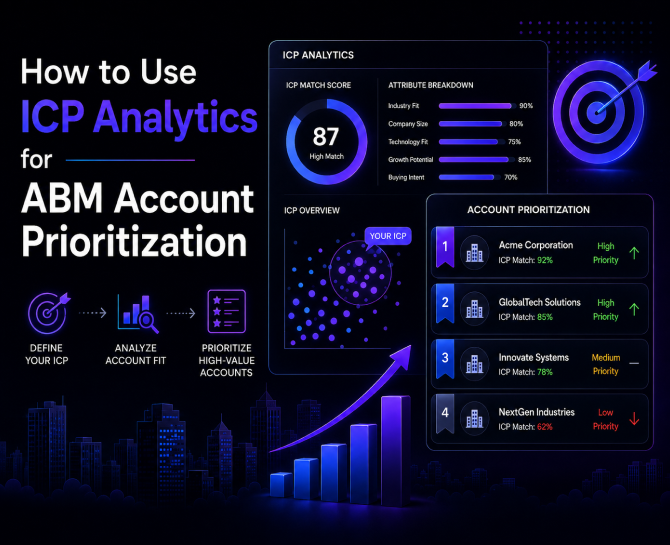
How to Use ICP Analytics for ABM Account Prioritization
ICP analytics turns customer and account data into measurable signals that help Sales, Marketing, and RevOps decide which companies deserve greater ABM attention. Instead of relying on company size or assumptions, teams can evaluate fit alongside intent, engagement, revenue potential, and customer outcomes. Read on.
ABM sounds precise until the target account list reaches hundreds or thousands of companies. At that scale, treating every account as equally valuable can drain sales capacity, inflate marketing spend, and dilute personalization.
ICP analytics gives teams a more defensible way to decide where to focus. By analyzing firmographic, technographic, engagement, intent, and revenue data, businesses can measure how closely an account matches their Ideal Customer Profile (ICP) and identify which accounts deserve attention first.
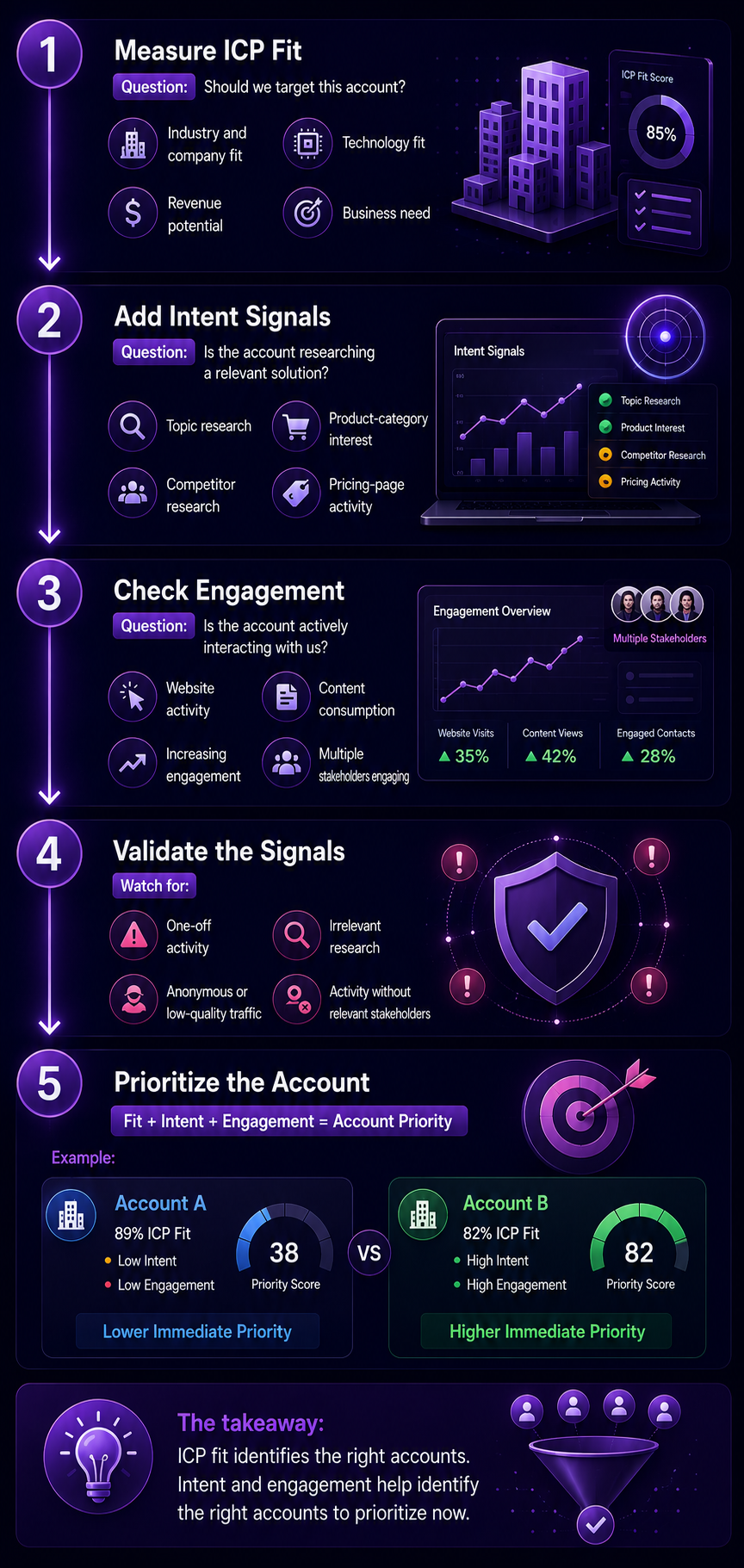
The key is to separate account fit from buying readiness. A company may look like an ideal customer but show little evidence of active demand. Another account may have a slightly lower ICP fit but display strong intent and engagement across its buying group.
For medium and large enterprises, combining these signals creates a smarter approach to ABM account prioritization. It gives Sales, Marketing, and RevOps a shared framework for deciding which accounts belong in high-touch ABM programs, which need scaled engagement, and which should remain lower priority.
Key Takeaways
- ICP analytics turns customer and account data into measurable priorities for ABM teams.
- Combining ICP fit with intent and engagement helps identify accounts worth pursuing now.
- Outcome-based scoring makes account prioritization more consistent across Sales, Marketing, and RevOps.
- Tiered ABM programs help teams match investment and engagement with account potential.
- Regular model validation keeps ICP analytics aligned with changing customer behavior and business conditions.
What Is ICP Analytics in Account-Based Marketing?
ICP analytics turns an Ideal Customer Profile into measurable account-level scores. It uses firmographic, technographic, engagement, and other account data to determine which companies best match the ICP and deserve greater attention in an ABM program.
Why Account Prioritization Fails Without ICP Data
Without ICP data, teams can prioritize accounts based on size, assumptions, or outdated lists. A data-backed ICP gives Sales and Marketing consistent criteria for ranking accounts and allocating resources.
Why Company Size Alone Is a Weak Prioritization Signal
Company size indicates scale, not fit. A large enterprise may lack the right technology, business need, or growth potential, while a smaller company may have stronger product fit and active demand.
How Gut-Based Account Selection Creates ABM Waste
Subjective account selection can direct resources toward companies with limited potential, leading to:
- Spending sales time on low-fit accounts
- Increasing ad spend without stronger pipeline
- Personalizing outreach for unlikely buyers
- Involving executives in low-probability accounts
ICP analytics replaces subjective selection with measurable account signals.
Why Static Target Account Lists Become Outdated
Account priorities change as companies adopt new technologies, change leadership, grow, acquire businesses, or shift priorities. Regularly updating account data keeps the Target Account List (TAL) aligned with current conditions.
The Data Behind ICP Analytics: Firmographic, Technographic, Intent, and Engagement Signals
ICP analytics becomes useful when different account signals are combined to answer one practical question: Which accounts should receive attention first?
The four signal groups serve different roles. Firmographic and technographic data establish baseline fit, while engagement and intent data show whether that fit is becoming commercially relevant.
How Different ICP Signals Work Together
Rather than scoring every data point equally, ABM teams can use each signal to answer a different prioritization question:
| Signal | What It Tells You | Prioritization Use |
|---|---|---|
| Firmographic | Does the account match the target market? | Establish baseline fit |
| Technographic | Does its technology environment support the use case? | Confirm solution fit |
| Engagement | Is the account interacting with your business? | Identify active accounts |
| Intent | Is the account researching a relevant need? | Identify potential buying activity |
This creates a more useful account picture than any single data source. For example, strong firmographic fit may qualify an account for ABM, but high engagement and intent can move it higher on the priority list.
Why Signal Combinations Matter More Than Individual Data Points
A single signal rarely justifies a major ABM investment. Company growth may indicate potential, but it does not prove demand. A pricing-page visit may indicate interest, but it does not confirm ICP fit.
The stronger approach is to look for multiple reinforcing signals.
For example:
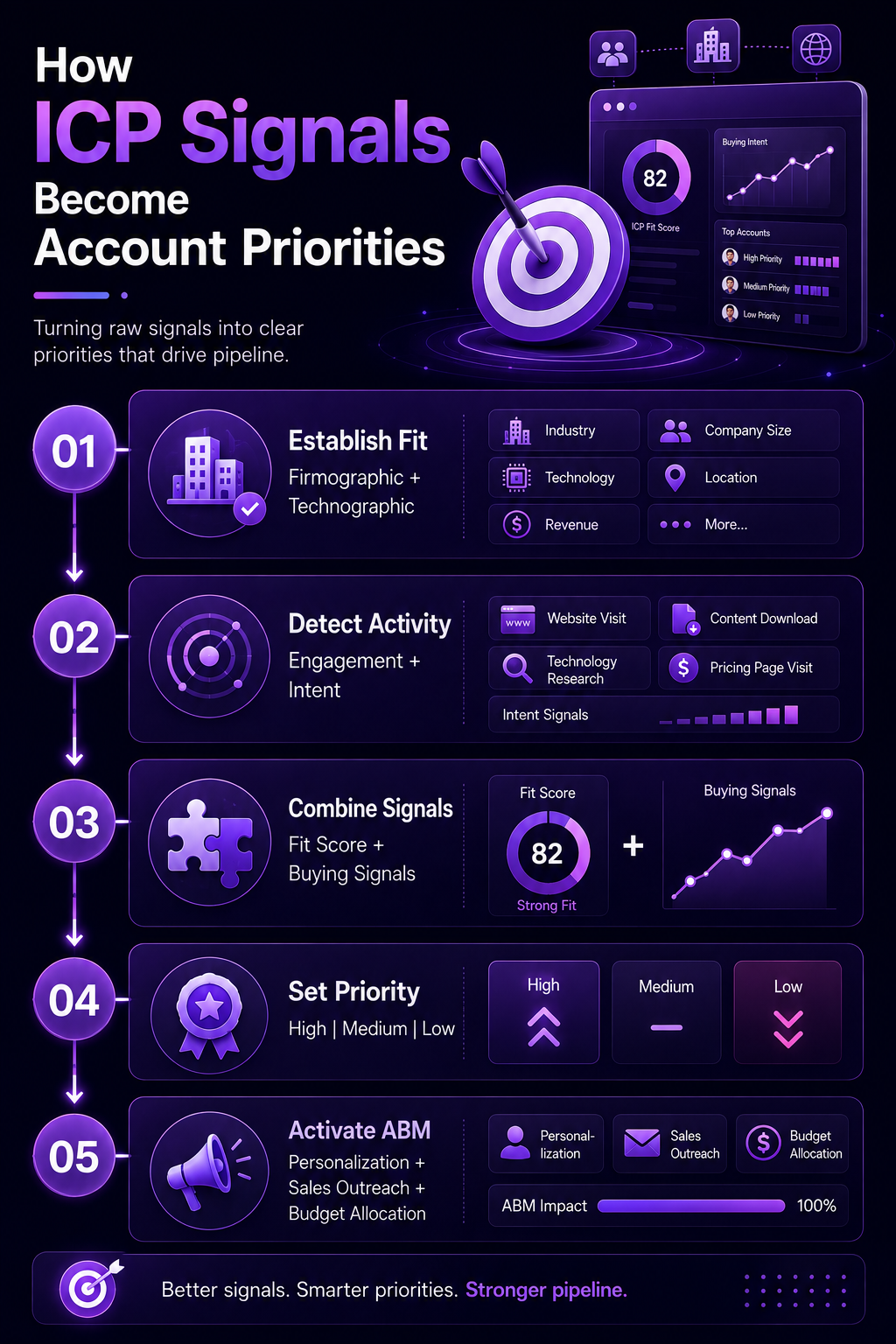
High ICP Fit + Compatible Technology + Rising Engagement + Strong Intent = High Account Priority
This approach also reduces false positives because accounts need to demonstrate relevance across more than one dimension.
How to Build an ICP Scoring Model for Account Prioritization
An ICP scoring model ranks accounts by assigning points to characteristics that correlate with customer value, conversion, and revenue outcomes. The goal is not to create the most complicated formula. It is to create a scoring system that consistently identifies accounts worth prioritizing.
1. Start With Your Highest-Value Customer Data
Build the model from customers who have produced strong business outcomes rather than from assumptions about the ideal buyer. Analyze closed-won accounts alongside metrics such as:
- Customer Lifetime Value (CLV)
- Deal size
- Win rate
- Sales cycle
- Retention
- Expansion revenue
- Churn
Look for characteristics that repeatedly appear among high-value customers. CRM analytics can make these patterns easier to identify across a large customer base.
2. Choose the Variables That Predict Account Value
Select criteria based on their relationship with revenue or customer outcomes. If accounts using a particular technology consistently generate larger deals, technology fit may deserve more weight. If a specific industry produces strong retention and expansion, industry fit may become a stronger scoring factor.
Avoid adding a variable simply because the data is available. Each criterion should answer a business question such as: Does this characteristic increase the likelihood that the account will become a valuable customer?
3. Assign Weights to ICP Criteria
Give greater weight to criteria that have a stronger relationship with desirable outcomes. A simple model could look like this:
| ICP Criterion | Example Weight |
|---|---|
| Industry Fit | 20% |
| Company Size | 15% |
| Technology Fit | 20% |
| Business Need | 20% |
| Revenue Potential | 15% |
| Geographic Fit | 10% |
These percentages are illustrative, not universal benchmarks. Your weights should come from your own customer, pipeline, and revenue intelligence data.
4. Calculate the Account-Level ICP Fit Score
Score each account against the selected criteria and combine the weighted results into one account-level score.
For example, an account that scores strongly on technology fit and business need but poorly on geographic fit would receive a high score overall if the first two criteria carry greater weight.
The final score gives Sales and Marketing a consistent basis for ranking accounts instead of relying on separate spreadsheets or individual judgment.
5. Validate the Model Against Closed-Won and Closed-Lost Accounts
A scoring model should prove its usefulness against historical outcomes. Compare scores across closed-won and closed-lost accounts to determine whether higher-scoring accounts actually convert, generate more revenue, or retain customers at higher rates.
If low-scoring accounts repeatedly outperform high-scoring accounts, revisit the criteria or their weights. This validation step turns ICP scoring into a form of predictive analytics rather than a static ranking exercise.
How to Tier Your Target Accounts Using ICP Fit Scores
ICP fit scores help ABM teams group accounts by fit, value, and required investment.
What Are ABM Account Tiers?
Tier 1: Highest ICP fit and revenue potential; use high-touch, 1:1 ABM.
Tier 2: Strong fit and potential; use segment-level personalization.
Tier 3: Moderate fit or lower potential; use scaled, lower-touch programs.
How to Set Tier Thresholds
Set thresholds based on ICP score distribution, historical customer outcomes, and available Sales and Marketing capacity. Do not force a fixed percentage of accounts into each tier.
What Should Each ABM Tier Receive?
| Tier | Priority | ABM Approach |
|---|---|---|
| Tier 1 | Highest fit and value | 1:1 personalization and high-touch outreach |
| Tier 2 | Strong fit and potential | Segment-based personalization |
| Tier 3 | Moderate fit or value | Scaled campaigns and automated engagement |
How to Align Sales and Marketing Around ICP-Prioritized Tiers
Set the Action for Each Tier
Focus only on what Sales and Marketing should do once an account enters a tier.
Tier 1: Sales-led, highly personalized engagement
Tier 2: Coordinated campaigns with sales follow-up
Tier 3: Marketing-led scaled engagement
Define When an Account Moves Between Tiers
Use changes in:
- ICP score
- Intent
- Engagement
- Opportunity stage
- Account value
This creates a dynamic process instead of treating tiers as permanent labels.
Create a Shared Account Handoff
Define the trigger for Marketing to involve Sales, such as:
High ICP Fit + Rising Intent + Relevant Engagement → Sales Activation
That is enough. I would keep this section around 150 to 200 words and avoid repeating definitions, scoring, tiering, or metrics.
This also creates a cleaner progression:
Score Accounts → Tier Accounts → Identify In-Market Accounts → Activate Sales and Marketing → Allocate Resources → Measure Results
Pro Tip : Combine ICP fit with Account Value, Customer Lifetime Value (CLV), deal size, expansion potential, and strategic importance. A high-fit account with greater revenue potential should receive more resources than an equally high-fit account with limited commercial value.
How to Find In-Market Accounts With ICP Analytics
A high ICP score tells you an account is a good fit. Intent and engagement tell you whether that account may be ready to buy. Combining all three helps ABM teams prioritize the right accounts at the right time.
Allocating ABM Budget and Personalization by Account Tier
ABM budget allocation works best when teams treat account investment as a variable rather than a fixed amount. Spending should increase when additional effort creates measurable movement in account engagement or pipeline.
Set Investment Rules Before Campaigns Launch
Define how much budget each account group can receive across paid media, content, events, direct mail, and sales support. Setting these rules in advance makes budget decisions more consistent and prevents high-profile accounts from receiving disproportionate spend.
Use Engagement to Trigger More Investment
Account activity can determine when to increase investment. For example, repeated engagement from multiple stakeholders may justify additional paid exposure, account-specific content, or sales support. Low or declining activity can trigger a lower spending level.
Measure the Cost of Account Engagement
Track the cost required to move accounts through the buying process. Compare campaign spend, sales effort, content production, and other account-level costs with pipeline and revenue generated.
How to Measure and Refine Your ICP Analytics Over Time
ICP analytics should be reviewed against business outcomes, not treated as a one-time scoring exercise. Performance data shows whether higher-fit accounts actually produce better results.
Which Metrics Show Whether ICP Prioritization Works?
Track metrics across ICP scores and account tiers:
| Metric | What It Shows |
|---|---|
| ICP-to-opportunity conversion | Whether high-fit accounts enter pipeline |
| Win rate by ICP score | Whether fit correlates with conversion |
| Average deal size by tier | Which tiers generate larger deals |
| Pipeline contribution by tier | Which tiers create pipeline |
| Sales cycle by tier | Which tiers move faster |
| Revenue by tier | Which tiers generate revenue |
| Customer retention | Which accounts remain customers |
| Expansion revenue | Which accounts create additional value |
Test Whether Higher ICP Scores Predict Better Outcomes
Compare high-scoring and low-scoring accounts across these outcomes. If Tier 1 accounts consistently fail to outperform lower-priority accounts, the scoring model may need adjustment.
Incorporate Sales and Customer Success Feedback
Performance data shows what happened. Sales and Customer Success teams can explain why. Use their feedback to identify missing signals, changing customer needs, or criteria that no longer reflect account quality.
Review the ICP Model on a Regular Cadence
Monitor performance quarterly and conduct deeper reviews every six to twelve months. Faster-moving markets may require more frequent adjustments.
Reweight Signals When Market Conditions Change
Update scoring when customer behavior, technology adoption, pricing, competitive conditions, or target segments change. A signal that predicted customer value last year may not carry the same weight today.
Tools and Platforms for ICP Analytics and Account Prioritization
ICP analytics usually involves several data and technology layers rather than one standalone tool. CRM platforms store account and revenue history, ABM platforms add intent and engagement signals, and specialized analytics tools can turn those inputs into ICP scores and account priorities.
ICP Analytics Platforms
DiGGrowth ICP Analytics uses AI agents to analyze customer and account data against ICP criteria. It can identify patterns in high-value customers, score accounts based on ICP fit, and surface segments that align with the characteristics of valuable customers. This gives Sales, Marketing, and RevOps teams a more scalable way to analyze ICP fit than relying on manually maintained account lists and spreadsheets.
CRM Platforms
Salesforce, HubSpot, and Microsoft Dynamics 365 provide the underlying account and revenue data needed for ICP analysis. Teams can use customer records, opportunity history, deal values, sales activity, and engagement data to identify patterns among valuable accounts.
ABM and Intent Platforms
6sense, Demandbase, and Bombora add account intelligence and intent signals that can indicate active research or buying interest. These signals can complement ICP fit when teams need to distinguish high-fit accounts from high-fit accounts showing current demand.
What Should an ICP Analytics Platform Connect?
Use this checklist when evaluating an ICP analytics platform:
-
- Connect Customer Data:
CRM records, customer history, and opportunity data
-
- Analyze Firmographic and Technographic Data:
Company attributes and technology stack
-
- Track Account Behavior:
Website activity and engagement signals
-
- Integrate Intent Data:
Research activity and buying signals
-
- Calculate ICP Scores:
Account-level fit and prioritization
-
- Activate Account Priorities:
CRM workflows, account lists, and sales alerts
-
- Measure Outcomes:
Pipeline, revenue, conversion, and scoring-model performance
Conclusion
Effective ABM depends on making confident decisions about where limited resources should go. ICP analytics gives revenue teams a way to make those decisions using evidence instead of assumptions.
As account data changes, prioritization should change with it. Teams that continuously connect customer outcomes with account signals can build a more responsive approach to growth and avoid treating their target list as a permanent blueprint.
The next advantage comes from turning that analysis into action. See how DiGGrowth can help operationalize ICP analytics at scale.
Get a free DiGGrowth demo or email info@diggrowth.com.
Ready to get started?
Increase your marketing ROI by 30% with custom dashboards & reports that present a clear picture of marketing effectiveness
Start Free Trial
Experience Premium Marketing Analytics At Budget-Friendly Pricing.

Learn how you can accurately measure return on marketing investment.

How Predictive AI Will Transform Paid Media Strategy in 2026
Paid media isn’t a channel game anymore, it’s a chessboard. Search, social, programmatic, video, influencer, native,...
Read full post post
Don’t Let AI Break Your Brand: What Every CMO Should Know
AI isn’t just another marketing tool. It’s changing how we connect with customers, personalize content, and...
Read full post post
From Demos to Deployment: Why MCP Is the Foundation of Agentic AI
A quiet revolution is unfolding in AI. And it’s not happening inside research labs. For decades,...
Read full post postFAQ's
ICP analytics gives ABM teams a consistent way to rank accounts using measurable fit and account-level signals. Instead of treating every target company equally, teams can focus resources on accounts that show stronger potential and relevant activity.
An ICP scoring model can combine firmographic, technographic, revenue, engagement, intent, and customer outcome data. The most useful signals are those that show a meaningful connection with conversion, deal value, retention, or expansion.
Score accounts against the selected ICP criteria, then group them according to their priority and business value. Higher-priority accounts can receive more focused ABM efforts, while lower-priority accounts can move through scalable programs.
ICP fit shows whether an account matches the characteristics of a valuable customer. Intent data shows whether that account is currently researching a relevant problem, category, or solution. Using both helps teams distinguish strong-fit accounts from those showing current buying interest.
Teams should update changing account signals regularly and review scoring performance at least quarterly. A deeper review may be needed when customer behavior, market conditions, technology adoption, pricing, or target segments change.