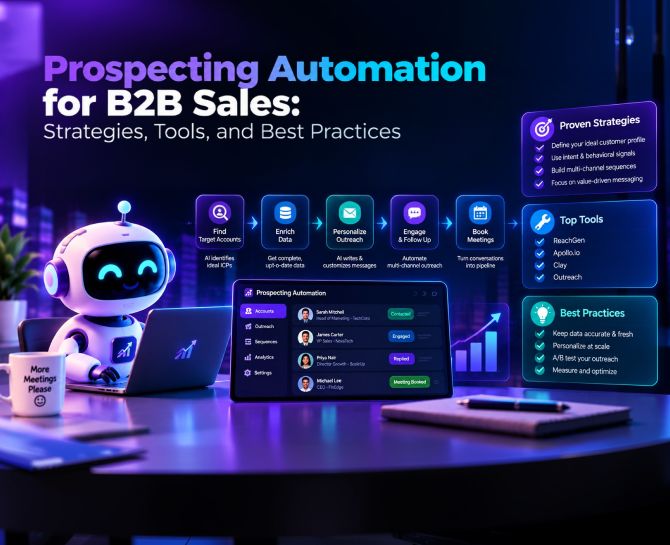
Prospecting Automation for B2B Sales: Strategies, Tools, and Best Practices
Prospecting automation for B2B sales uses software, data, and AI to reduce repetitive work and improve account targeting, prospect research, and prioritization. See how teams balance automation with human judgment, evaluate tools, and improve sales capacity.
More leads do not necessarily give a B2B sales team more opportunities.
A thousand new contacts mean very little if the team cannot tell which accounts fit the ICP, who actually influences the purchase, or which companies have a reason to talk right now.
That is where prospecting starts getting expensive.
Reps spend time switching between databases, LinkedIn, company websites, intent platforms, and CRM records just to build enough context for one outreach decision. Multiply across hundreds or thousands of accounts, and prospecting becomes a capacity problem.
Prospecting automation for B2B sales can change that equation by bringing account research, contact discovery, enrichment, intent signals, prioritization, and outreach support into a more scalable process.
The bigger question for sales leadership is what to automate, what to keep human-led, and which technology or service model makes financial sense.
Let’s get into it.
Key Takeaways
- Prospecting automation reduces manual work across account research, contact discovery, enrichment, prioritization, and outreach.
- Effective automation starts with a clear ICP and focuses sales attention on the accounts most likely to matter.
- AI and buying signals can add context, but human judgment remains important for strategic accounts and high-value conversations.
- The right prospecting tool depends on your sales model, data needs, market, and level of automation required.
- ROI should be measured through productivity, qualified opportunities, pipeline, revenue, and the total cost of automation.
What Is Prospecting Automation for B2B Sales?
Prospecting automation for B2B sales uses software, AI, data, and automated actions to reduce the manual work involved in finding and researching potential buyers. It can help sales teams identify target accounts, find relevant contacts, enrich records, detect buying signals, prioritize prospects, and support outreach.
The important distinction is what gets automated. Prospecting automation works best when technology handles repetitive information-heavy tasks while salespeople remain responsible for decisions that require context and judgment.
What Does Prospecting Automation Automate?
B2B prospecting automation can handle repetitive research, data, and prioritization tasks while sales teams retain control over decisions that require judgment.
| Prospecting Activity | What Automation Handles | Human Role |
|---|---|---|
| Account Identification | Finds companies matching ICP criteria | Validate strategic account fit |
| Contact Discovery | Identifies decision-makers and buying committee members | Determine the right stakeholders to engage |
| Data Enrichment | Adds company, contact, and firmographic data | Verify important information |
| Signal Monitoring | Tracks intent, engagement, and business signals | Assess relevance and timing |
| Prospect Research | Collects and summarizes account and prospect information | Interpret business context |
| Prioritization | Scores accounts based on fit and available signals | Decide where sales capacity should go |
| Account Insights | Surfaces relevant company-specific information | Connect insights to sales strategy |
| Message Personalization | Generates or suggests relevant messaging inputs | Approve and refine the message |
| Follow-Ups | Triggers scheduled outreach and sales actions | Handle responses and meaningful conversations |
| CRM Updates | Records prospect and activity information | Review data quality and make key updates |
Pro Tip: Automate the tasks that consume sales reps’ time but add little strategic value. Keep account strategy, messaging decisions, relationship building, and high-value conversations human-led.
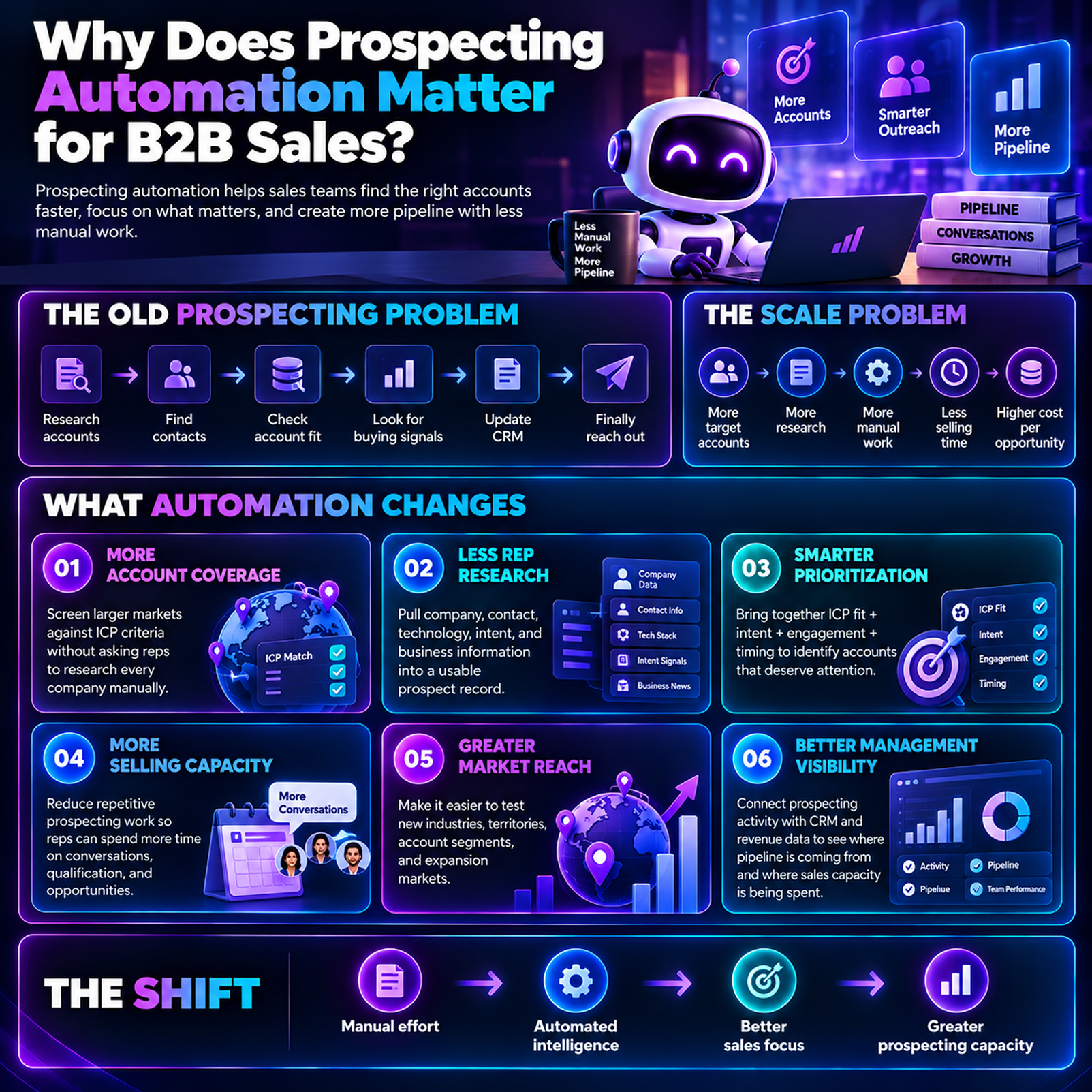
Prospecting Automation Strategies for B2B Sales
Effective prospecting automation strategies connect account data, ICP targeting, buying signals, prioritization, personalization, and outreach. The strongest programs do not use automation simply to contact more people. They use it to help sales teams decide where to focus, whom to contact, and why the conversation matters.
1. Automate ICP-Based Account Identification
Use ICP criteria such as industry, company size, revenue, geography, technology stack, business model, and growth stage to identify accounts that fit your target market.
Automation can screen large account pools against these criteria, giving sales teams a more focused list of companies to pursue.
2. Automate Account and Contact Data Enrichment
Enrich prospect records with company information, job titles, firmographics, technologies, contact details, funding signals, and organizational changes.
Reliable data gives sales teams the context they need to qualify accounts and reduces manual research.
3. Use Buyer Intent to Prioritize Accounts
Combine ICP fit with signals such as website activity, content engagement, product interactions, research behavior, and relevant business events.
Intent should strengthen ICP-based prioritization, not replace it. A company showing interest is not automatically a good prospect if it does not fit the target market.
4. Use AI for Prospect Research and Personalization
AI can bring relevant company and prospect information together, helping sales teams identify useful context before outreach.
Use that context to personalize messaging around business priorities, role responsibilities, company events, or relevant buying signals instead of relying on basic name or company personalization.
5. Automate Account-Level Prospecting
B2B purchases often involve multiple stakeholders. Use automation to identify buying committee members, potential champions, economic buyers, and technical stakeholders within target accounts.
This approach gives sales teams a broader view of the opportunity, particularly for enterprise and ABM sales.
What Types of B2B Prospecting Automation Tools Exist?
| Tool Category | Primary Purpose | Business Value |
|---|---|---|
| B2B Data Platforms | Find companies and contacts | Expand addressable market |
| Sales Intelligence Platforms | Add company and buyer context | Improve targeting |
| AI Prospecting Platforms | Automate research and prioritization | Reduce manual research |
| Intent Data Platforms | Identify active buying signals | Improve timing |
| Sales Engagement Platforms | Automate outreach and follow-ups | Increase sales capacity |
| CRM Enrichment Tools | Keep records current | Improve data reliability |
| Account Intelligence Platforms | Analyze target accounts | Support ABM and enterprise sales |
| AI Research Tools | Summarize prospect intelligence | Reduce research time |
B2B Prospecting Automation Tools: What Should You Invest In?
The right prospecting automation tool should reduce manual research while helping sales teams identify the right accounts, find relevant stakeholders, prioritize opportunities, and act on useful buying signals. The best choice depends on where your prospecting process has the biggest gap.
1. ReachGen
ReachGen is an AI-powered B2B prospecting platform built around ICP-based targeting, account intelligence, prospect research, prioritization, and CRM enrichment. It helps sales teams move beyond simply generating contact lists by adding the account and prospect context needed to decide who deserves attention.
What Makes ReachGen Different?
ReachGen brings ICP targeting, account intelligence, prospect discovery, AI research, and prioritization into one prospecting layer. Instead of starting with a large database and asking reps to manually qualify every contact, teams can focus their sales capacity on accounts that better match their market and business priorities.
How to Automate Prospecting With ReachGen
Sales teams can define their ICP, identify matching accounts, enrich those accounts with relevant business information, research decision-makers, and prioritize prospects based on fit and available signals. AI-generated research can then give reps useful context before they begin outreach.
For example, a B2B software company targeting mid-market technology companies can use ReachGen to narrow a broad market into ICP-fit accounts, identify relevant stakeholders, and surface the information reps need to decide which accounts should be contacted first.
How ReachGen Supports B2B Prospecting
ReachGen can support several high-effort prospecting activities:
- Account Identification: Find companies that match defined ICP criteria.
- Account Intelligence: Add firmographic, business, and organizational context.
- Prospect Discovery: Identify relevant stakeholders within target accounts.
- AI Research: Gather useful information about companies and prospects.
- Prioritization: Help sales teams focus on accounts with stronger potential.
- CRM Enrichment: Keep prospect and account records more useful for sales execution.
How ReachGen Fits Into Your Sales Stack
ReachGen can sit between a company’s CRM, sales engagement tools, B2B data sources, and other intelligence platforms, helping turn scattered prospect information into actionable sales context.
Its strongest use case is for teams that already have access to prospect data but still spend significant time researching accounts, identifying stakeholders, qualifying prospects, or deciding who to contact first.
Prospecting Automation Readiness Scorecard
Ask six questions:
| Question | Score 1 point if… |
|---|---|
| ICP targeting | Your team manually searches for ICP-fit accounts |
| Data enrichment | Reps spend time filling missing account or contact information |
| Decision-maker discovery | Finding the right stakeholders requires manual research |
| Account research | Reps visit multiple sources before outreach |
| Prioritization | Sales teams struggle to decide which accounts deserve attention |
| CRM enrichment | Prospect records frequently lack useful sales context |
0–2 points: Basic automation needs
3–4 points: Strong prospecting automation opportunity
5–6 points: High potential for an AI-powered prospecting platform
2. Pipedrive
Pipedrive is a sales CRM designed around pipeline management, lead tracking, sales activities, and automation. It can help teams automate repetitive prospecting tasks and follow-ups while keeping sales activity connected to the CRM.
How to Automate Prospecting With Pipedrive
Teams can use Pipedrive to automate lead capture, assign sales activities, schedule follow-ups, manage prospect movement through the pipeline, and trigger actions based on changes in lead or deal status.
Pipedrive is particularly useful when the main prospecting challenge is sales process consistency and follow-up, rather than deep account intelligence or AI-led prospect research.
| Pros | Cons |
|---|---|
| Simple pipeline and lead management | Prospect intelligence is not its primary focus |
| Sales activity automation | Advanced prospect research may require additional tools |
| Easy-to-adopt CRM structure | Teams may need integrations for broader data needs |
| Strong fit for sales process automation | Less specialized in account-level intelligence |
3. G2 Buyer Intent Data
G2 Buyer Intent Data adds a research signal to B2B prospecting by showing which companies are engaging with software-related content and researching relevant categories. This can help sales teams identify accounts that may already be evaluating solutions.
Key Features
- Buyer research signals
- Account-level intent information
- Category-level research activity
- Account prioritization
- Integration with sales and marketing processes
How to Automate Prospecting With G2 Buyer Intent Data
Sales teams can combine G2 research activity with ICP criteria to identify accounts that both fit the target market and show relevant research behavior. Those accounts can then be prioritized for outbound engagement rather than treating every ICP-fit company equally.
The Advantage: The biggest advantage is timing. ICP data tells sales teams which companies could be a good fit. Buyer intent can add context about which of those companies may be actively researching a relevant solution.
4. Gong
Gong is a revenue intelligence platform that analyzes customer and sales interactions to provide insights for sales teams. Its role in prospecting is different from a traditional lead database: it helps teams use conversation and revenue intelligence to improve how they identify, engage, and prioritize opportunities.
How Gong Supports Prospecting
Sales teams can use insights from calls, emails, and sales interactions to understand what messaging resonates, identify potential deal risks, and improve qualification. Those insights can also help managers identify patterns in successful prospect conversations and coach reps on better outreach.
Gong is therefore better suited to organizations looking to connect prospecting and sales execution with conversation intelligence, rather than simply finding more contacts.
Pros and Cons
| Pros | Cons |
|---|---|
| Provides conversation and revenue intelligence | Not primarily a prospect database |
| Helps teams improve sales messaging and qualification | May require other tools for contact discovery and enrichment |
| Supports sales coaching with interaction insights | Can be more valuable after sales engagement begins |
| Helps identify patterns across sales conversations | May be more than smaller teams need for basic prospecting |
| Connects prospecting insights with broader sales execution | Best value depends on having sufficient sales interaction data |
5. Leadinfo
Leadinfo identifies companies visiting a B2B website and turns otherwise anonymous website activity into company-level sales intelligence. This makes it particularly useful for teams that want to use website behavior as a prospecting signal.
How to Automate Prospecting With Leadinfo
Sales teams can monitor relevant website visits, identify companies showing interest, and use that activity to prioritize accounts for follow-up. Instead of treating every website visitor equally, teams can focus on companies whose behavior suggests potential interest.
What Is Leadinfo Best For?
Leadinfo is best for B2B companies that want to identify high-value website visitors and connect website engagement with outbound sales activity.
It works especially well as an intent or engagement signal alongside ICP data rather than as a replacement for a complete prospecting database.
6. HubSpot Sales Hub
HubSpot Sales Hub combines CRM data with sales engagement, automation, prospect management, and reporting. It is designed for teams that want prospecting activity, follow-ups, and customer information connected within a broader sales platform.
Key Highlights
- CRM-based prospect management
- Automated sales tasks and follow-ups
- Email sequences and engagement tracking
- Lead routing and management
- Sales reporting and analytics
- Integrations across the broader HubSpot ecosystem
How to Automate Prospecting With HubSpot Sales Hub
Teams can automate lead assignment, follow-up tasks, email sequences, prospect engagement, and other repetitive sales activities. Contacts can be enrolled based on defined criteria, while reps can focus their time on prospects that require direct interaction.
Use Case
A B2B company generating leads through content, forms, and website activity can use HubSpot to capture those prospects in the CRM, assign them to sales, automate initial follow-up, and track engagement until a rep needs to step in.
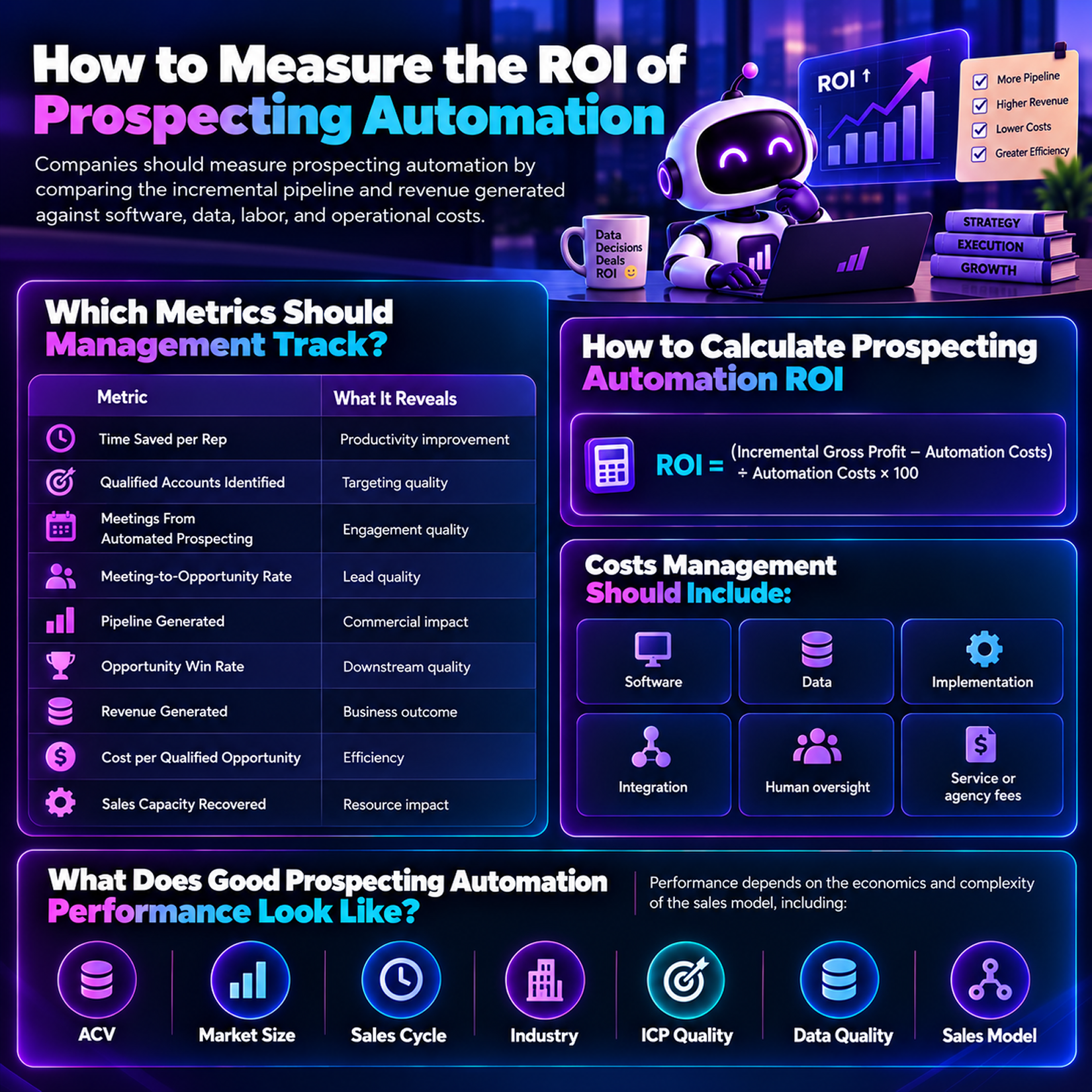
Best Practices for Prospecting Automation
Successful B2B prospecting automation depends on more than choosing the right software. Teams need clear targeting, reliable data, thoughtful automation rules, and enough human oversight to keep prospecting relevant.
1. Start With a Clear ICP
Define the companies and buyers you want to reach before automating prospecting. Include factors such as industry, company size, revenue, geography, technology, business model, and relevant buyer roles.
A clear ICP prevents automation from simply producing larger prospect lists.
2. Automate Based on Sales Priorities
Not every prospecting task needs automation. Prioritize repetitive activities that consume significant rep time, such as data enrichment, account research, contact discovery, and CRM updates.
Keep strategic account decisions and high-value interactions human-led.
3. Use Multiple Signals to Prioritize Accounts
Avoid relying on a single intent or engagement signal. Combine ICP fit, buyer intent, engagement, company changes, and timing to create a stronger basis for prioritization.
An interested company is not automatically a qualified prospect.
4. Keep Prospect Data Clean
Regularly review contact information, company attributes, job changes, duplicates, and outdated CRM records.
Set clear rules for data validation and enrichment so inaccurate information does not spread across the sales stack.
5. Personalize With Relevant Context
Use automation to surface information that makes outreach more relevant, rather than generating generic messages at scale. Personalization can reference a company initiative, business change, role responsibility, or relevant buying signal.
Sales reps should review important messages before sending them to high-value prospects.
6. Align Automation With the Sales Motion
The right level of automation depends on deal size, sales cycle, market size, and buying complexity. High-volume SMB sales may support more automation, while enterprise and ABM motions usually require greater account research and human involvement.
7. Connect Prospecting With the CRM
Keep prospecting data and sales activity connected to the CRM. This gives sales and revenue leaders better visibility into account coverage, engagement, pipeline progression, and data quality.
Disconnected prospecting activity makes it harder to measure business impact.
Pro Tip: If automation increases the number of contacts but does not improve account quality, sales productivity, or pipeline creation, the automation strategy needs to be reevaluated.
Conclusion
Prospecting automation becomes valuable when it solves a real sales capacity problem. If reps are spending hours researching accounts, correcting data, finding stakeholders, and deciding where to focus, adding more prospects will only increase the workload.
The better approach is to make prospecting more selective. Technology should help sales teams identify the right accounts, bring relevant intelligence together, and surface the signals that can influence timing and prioritization.
For sales leaders, the investment decision should come down to a practical question: will automation help the team create more qualified pipeline without proportionally increasing sales effort and cost? If the answer is clear, prospecting automation can become a meaningful part of the revenue strategy rather than another layer in the sales tech stack.
Looking for One Platform for Smarter B2B Prospecting? Let’s Connect!
Get your free ReachGen demo and see how your team can spend less time researching and more time selling.
Ready to get started?
Increase your marketing ROI by 30% with custom dashboards & reports that present a clear picture of marketing effectiveness
Start Free Trial
Experience Premium Marketing Analytics At Budget-Friendly Pricing.

Learn how you can accurately measure return on marketing investment.
Lookalike Account Modeling for B2B Revenue Teams
Lookalike account modeling takes a different approach. It studies the attributes and outcomes of successful customers,...
Read full post post
You’re Targeting Your Ideal Customer. So Why Aren’t They Buying?
Your best customers reveal the traits associated with success. Your lost opportunities reveal where fit breaks...
Read full post post
How Predictive AI Will Transform Paid Media Strategy in 2026
Paid media isn’t a channel game anymore, it’s a chessboard. Search, social, programmatic, video, influencer, native,...
Read full post post