Lookalike Account Modeling for B2B Revenue Teams
A target account list usually starts with filters: industry, company size, geography, revenue, and perhaps a few technologies. Those filters are useful, but they treat every criterion as a hard boundary and every matching company as equally promising.
Lookalike account modeling takes a different approach. It studies the attributes and outcomes of successful customers, represents each company through a consistent set of signals, and identifies prospects with similar patterns. The result is an expanded pool of accounts ranked by resemblance to the customers your business serves best.
What lookalike account modeling means in B2B
In B2B go-to-market strategy, a lookalike account is a company that resembles a selected group of high-value customers. Similarity may include firmographic characteristics, technology environment, operating model, buying process, and outcomes linked to successful adoption.
The seed group matters. If the model learns from every customer, it may reproduce the traits of low-retention or low-margin accounts. Strong seed accounts should reflect the outcome the revenue team wants to repeat, such as reliable conversion, healthy contract value, retention, expansion, or efficient implementation.
How similarity differs from a fixed ICP filter
A fixed filter answers whether a company passes a set of rules. Similarity scoring estimates how closely the full pattern of an account resembles the seed group. This makes it possible to find promising companies that miss one preferred criterion but match several stronger ones.
For example, a rule-based list might require a company to have 500 or more employees. A similarity model may identify a 420-person company with the same industry, technology stack, growth profile, buying structure, and operating complexity as the best customers. The model can surface the account without pretending that employee count does not matter.
Choose seed accounts based on the goal
- For net-new acquisition, choose customers that converted and reached value with a healthy sales and onboarding process.
- For expansion, choose customers with meaningful adoption, renewal, and cross-sell behavior.
- For enterprise growth, select accounts that reflect enterprise buying and implementation requirements, not only high contract value.
Exclude accounts that are successful for unusual reasons the model cannot reproduce, such as a one-off partnership, founder relationship, or discontinued product configuration. Documenting exclusions helps reviewers understand what the score represents.
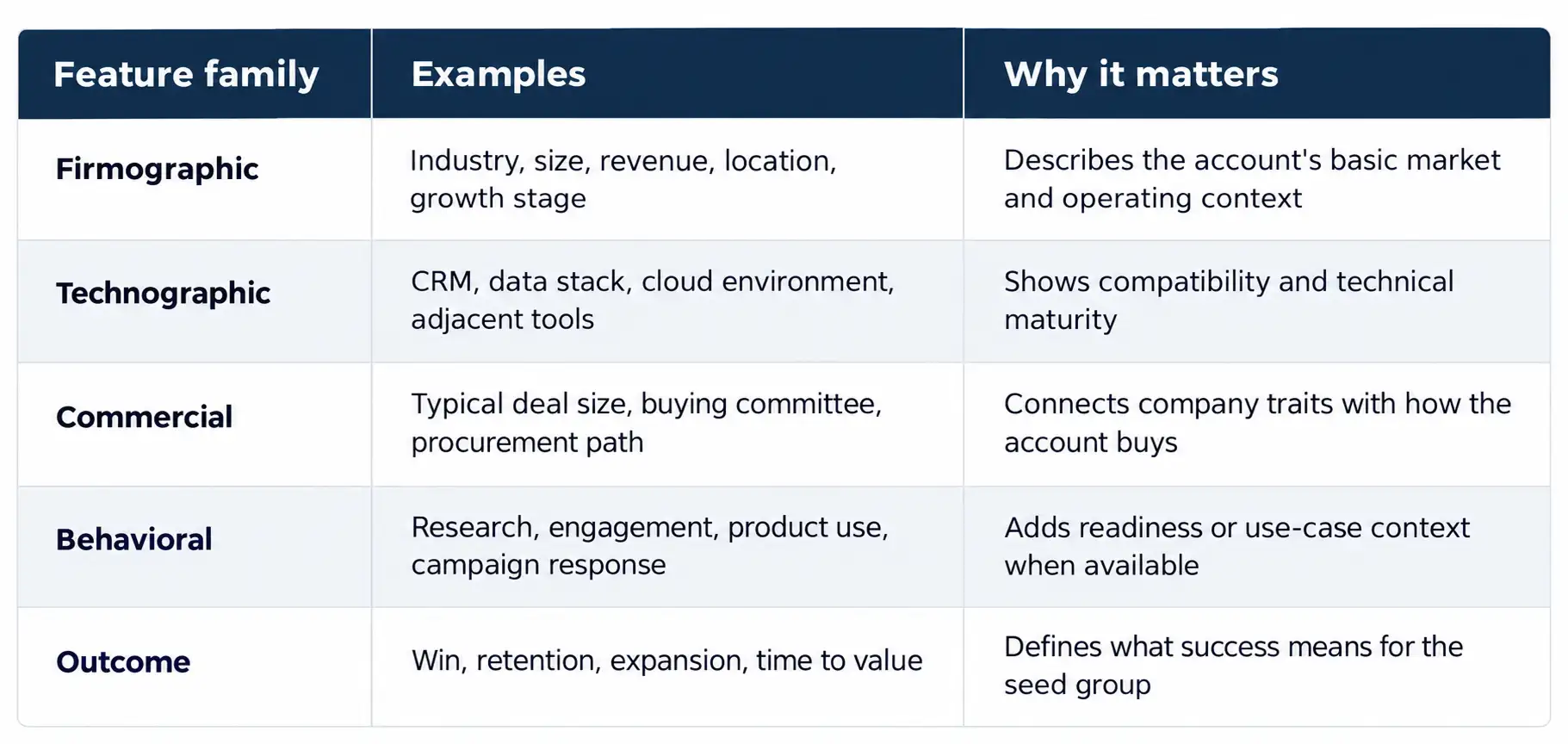
Build the account feature set
Represent every seed and candidate account using comparable fields. Start with attributes that are available across a meaningful share of the database and that have a plausible relationship with fit.
Calculate similarity without hiding the reasoning
A model can compare accounts using weighted distances, nearest-neighbor methods, clustering, or other statistical and machine-learning techniques. The exact method matters less to the end user than three operating properties: relevant inputs, validated results, and understandable reasons.
Normalize numeric fields so large scales do not dominate the result. Encode categorical fields consistently. Treat missing data separately from a known negative value. Weight features according to their relationship with successful outcomes and the current go-to-market goal.
The result should include a similarity score or tier plus the strongest reasons behind it. A seller can act on ‘similar to top fintech customers because of technology environment, company size, and buying structure.’ A score with no explanation is harder to trust and harder to correct.
Validate the model before expanding the target list
- Hold out a portion of known accounts so the model can be tested on records it did not use to learn the pattern.
- Check whether high-similarity accounts include a greater share of strong wins and successful customers than lower tiers.
- Inspect false positives and false negatives to identify missing features, data errors, or over-weighted attributes.
- Review results with Sales, Marketing, Customer Success, and RevOps because each team sees different evidence of fit.
- Test a limited activation program before increasing media spend or changing broad territory coverage.
Use lookalike accounts across the revenue process
Expand an ABM target account list
Start with accounts similar to customers in the segment that an ABM program is designed to reach. Apply practical eligibility rules such as geography, serviceability, customer status, and regulatory constraints. Similarity identifies candidates; it does not replace operating requirements.
Prioritize sales research
Give sellers the score, fit reasons, and relevant customer pattern. This helps them decide where deeper research is justified and which use case may resonate. Avoid auto-generating outreach solely from the similarity score because the current account context still matters.
Find adjacent segments
Clusters of strong lookalike accounts may reveal an adjacent industry, company-size band, or technology ecosystem that the existing ICP does not describe well. Treat that pattern as a testable market hypothesis. Compare pipeline and customer outcomes before changing the core ICP.
Review open opportunities
Similarity can add fit context to open pipeline. An opportunity that resembles the best customers may deserve closer executive attention, while a dissimilar opportunity may require stronger qualification or a different success plan. Opportunity stage and buying activity remain separate inputs.
Avoid common lookalike modeling errors
- Using the largest customers as seeds without checking retention, margin, or delivery fit.
- Letting one easily available field, such as employee count, dominate the model.
- Treating absent technographic data as proof that a technology is not present.
- Building one global model for products or regions with different success patterns.
- Sending every high-similarity account directly to Sales without checking readiness, ownership, and suppression rules.
- Failing to retrain or review the model as the customer base and product change.
Find the next accounts that resemble your best customers
DiGGrowth’s ICP Analytics identifies similar accounts based on the patterns found in historical customer and opportunity data. Revenue teams can use those results to expand ABM lists, prioritize prospects, compare segments, and bring fit information into existing workflows.
Ready to get started?
Increase your marketing ROI by 30% with custom dashboards & reports that present a clear picture of marketing effectiveness
Start Free Trial
Experience Premium Marketing Analytics At Budget-Friendly Pricing.

Learn how you can accurately measure return on marketing investment.
Lookalike Account Modeling for B2B Revenue Teams
Lookalike account modeling takes a different approach. It studies the attributes and outcomes of successful customers,...
Read full post post
You’re Targeting Your Ideal Customer. So Why Aren’t They Buying?
Your best customers reveal the traits associated with success. Your lost opportunities reveal where fit breaks...
Read full post post
How Predictive AI Will Transform Paid Media Strategy in 2026
Paid media isn’t a channel game anymore, it’s a chessboard. Search, social, programmatic, video, influencer, native,...
Read full post post