
AI Agents in Production: The Reliability Reality Check
AI agents can look excellent in a controlled demo and still become unreliable, expensive or unsafe in production. The gap is not just model quality - it is systems engineering.
TL;DR A demo is one sample from the happy path. Production is a distribution: ambiguous requests, stale context, tool failures, retries, permissions and long-running state. Multi-agent orchestration adds another layer: coordination, handoff and error-propagation failures, plus higher variance and cost. The practical fix is to narrow scope, measure repeatability, put hard controls around actions and cost, instrument every run, and increase autonomy only after the system earns it.
The demo is not a lie. It is a sample size of one.
Every data scientist knows the gap between a notebook and a serving endpoint. Offline metrics look clean; production introduces drift, missing data, latency, weird inputs and users who do things nobody put in the test set. AI agents inherit all of that, then add a new problem: their output can be an action, not just a prediction.
That matters because an agent can issue a refund, update a record, send an email or call another system. Once the model can act, reliability is no longer only an answer-quality question. It becomes an operational, security and governance question.
1. Reliability compounds across multi-step work
Suppose a workflow has n dependent steps and, as a simplified illustration, each step succeeds independently with probability p. End-to-end reliability is p^n. The independence assumption is not literally true in production – failures can be correlated – but the arithmetic shows why a strong-looking per-step score can become weak across a long task.
| Per-step success | 5 steps | 10 steps | 20 steps |
| 99% | 95.1% | 90.4% | 81.8% |
| 95% | 77.4% | 59.9% | 35.8% |
| 90% | 59.0% | 34.9% | 12.2% |
Illustrative compounding under equal, independent per-step reliability. Real systems may be better or worse because errors are correlated.
Repeatability is a separate problem. The tau-bench benchmark introduced pass^k to measure whether an agent can solve the same task consistently across multiple independent trials. In its retail domain, one evaluated GPT-4o setup scored about 61% on pass^1 but fell to roughly 25% on pass^8. The point is not that this number predicts your production accuracy. It is that one successful run can hide large run-to-run variance. tau-bench.
| Production rule : Do not report pass^1 alone. Run important eval tasks repeatedly, report the distribution, and gate releases on repeatability as well as the mean. |
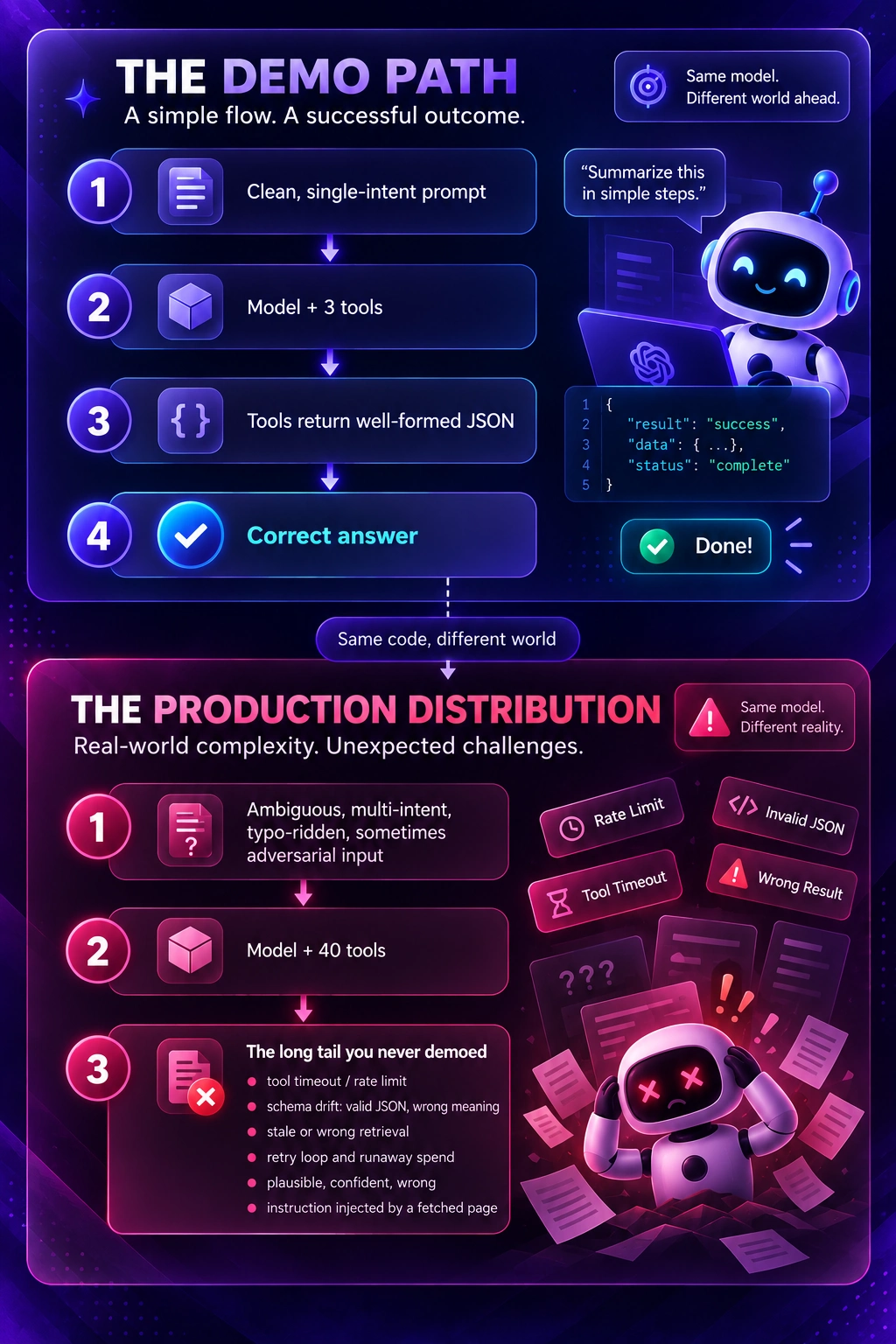
Figure 1. The same agent code meets a very different input and failure distribution in production.
2. The production gap is real – but avoid the fake “89% failure rate”
A common mistake is to turn adoption-stage data into a failure rate. Deloitte’s Tech Trends 2026 reports that 38% of surveyed organizations were piloting agentic AI, 14% had solutions ready to deploy, and 11% were actively using agents in production. That shows a meaningful pilot-to-production gap; it does not mean 89% of pilots failed. Deloitte Tech Trends 2026.
The risk signal is still strong. Gartner predicts that more than 40% of agentic AI projects will be canceled by the end of 2027 because of cost, unclear business value or inadequate risk controls. In a newer May 2026 forecast, Gartner also predicted that 40% of enterprises will demote or decommission autonomous agents by 2027 because governance gaps are discovered after production incidents. These are forecasts, not observed failure rates, but they reinforce the same engineering lesson: autonomy without operating discipline is expensive to unwind. Gartner cancellation forecast Gartner governance forecast.
Operational failures are part of model reliability
Datadog’s State of AI Engineering 2026 found that 5% of LLM call spans in its customer traces reported an error in February 2026, and 60% of those errors were caused by exceeded rate limits. That is not a reasoning failure; it is capacity engineering. A production agent must handle provider limits, tool timeouts, retries and partial failure as first-class product behavior. Datadog State of AI Engineering 2026.
3. Context is a reliability budget, not free memory
Long context windows do not remove context engineering. Chroma’s Context Rot research tested 18 models and found that model performance became increasingly unreliable as input length grew, even when task complexity was held constant. The safe takeaway is not a universal token threshold; it is that the advertised context limit is a capacity limit, not a guarantee of uniform reasoning quality. Chroma Context Rot.
In production, that suggests four practical controls:
Retrieve only what the current step needs : More context can add distractors as well as signal.
Gate tools by phase : Do not load dozens of tool schemas when a step needs only two or three.
Externalize state : Store task state in a typed system of record instead of forcing the model to reconstruct it from the conversation.
Compact long runs : Summarize completed work and carry forward structured state rather than an ever-growing transcript.
4. Optimize for completed tasks, not cheap calls
Agent cost grows with loops. Each retry, tool hop, verification step and replayed history can add tokens and latency. Datadog’s 2026 data also found rising token volume per request as AI systems became more complex. Falling token prices can help, but they do not make an inefficient agent architecture efficient.
The useful unit is cost per successfully completed task. Track it next to task completion rate and tail latency. Then put hard controls around the loop:
Set maximum steps, wall-clock time, token use and spend per task. Terminate or escalate when the budget is exhausted.
Cache stable prefixes when your provider supports it, and keep sub-step outputs concise.
Parallelize independent read-only calls where it is safe; serialize or carefully coordinate writes.
Route simple classification or retrieval work to smaller models only when your evals show the quality trade-off is acceptable.
Measure p95 and p99 latency as well as the median. Agents have variable step counts, so averages can hide the runs users experience as broken.
5. Once an agent can act, guardrails must live outside the prompt
The OWASP Top 10 for Agentic Applications 2026 treats agent goal hijack, tool misuse, identity and privilege abuse, supply-chain vulnerabilities and other agent-specific risks as distinct security problems. A system prompt can influence behavior, but it cannot be your only authorization boundary. OWASP Top 10 for Agentic Applications 2026.
Industry survey data points in the same direction. Gravitee’s April 2026 survey of 750 senior technology leaders reported that 54% of organizations had experienced an AI-agent security incident, and estimated that 48% of production AI agents were running unsecured. Treat these as vendor survey findings rather than a universal incident rate, but the control gap is difficult to ignore. Gravitee State of AI Agent Security 2026.
A production guardrail layer should include:
An action classifier that separates reads, reversible writes and irreversible or high-impact actions.
Least-privilege, short-lived credentials scoped to the exact action and resource.
Human approval for irreversible or high-risk actions, with the proposed change and evidence visible to the reviewer.
Idempotency keys and safe retry behavior on every write.
Tool outputs treated as untrusted input, especially fetched pages, email and third-party content.
Blast-radius limits and a human-accessible kill switch.
An immutable audit trail of inputs, tool calls, approvals, policy decisions and outcomes.
6. Multi-agent orchestration
When a single agent struggles, the tempting fix is to add more agents: a planner, a researcher, a writer, a critic, each with a smaller job. That can work. Anthropic’s multi-agent research system uses an orchestrator-worker pattern in which a lead agent spawns subagents that explore independent directions in parallel, each with its own context window, and it outperformed a single-agent baseline by 90.2% on their internal research eval. The same write-up reports the bill: agents use roughly 4x the tokens of a chat interaction, and multi-agent systems roughly 15x. Anthropic: multi-agent research system.
That result does not generalize to every workflow. The MAST study annotated more than 1,600 execution traces across seven popular multi-agent frameworks and found that measured gains over single agents are often small. It catalogues 14 failure modes in three groups: system design issues, inter-agent misalignment and task verification. The conclusion that matters for production teams is that stronger base models alone will not close those gaps, because the failures live in the orchestration layer rather than in any single model call. Why Do Multi-Agent LLM Systems Fail?.
Five failure classes that orchestration adds
Every handoff is a new interface, and every interface is a new place to fail. Price these in before committing to a multi-agent architecture.
| Failure class | How it shows up in a trace | Control that contains it |
| Coordination | Subagents duplicate the same work, leave a subtask unclaimed, or write conflicting values to one record. The lead agent spawns far more workers than the task needs. | Explicit subtask ownership and a shared task ledger; caps on fan-out and recursion depth; serialize or lock writes. |
| Handoff | A subagent returns a confident summary without its evidence, or in a shape the receiver did not expect. Vague briefs get filled in with guesses. | Typed handoff schemas with required fields; briefs that state objective, output format, tools and boundaries; pass references to source data, not only conclusions. |
| Error propagation | An early wrong assumption is laundered into fluent downstream output, and a verifier agent approves a well-formatted wrong answer. | Verify against the system of record rather than the previous agent’s claim; carry provenance on every claim; fail loudly instead of absorbing errors silently. |
| Variance | Routing decisions are themselves stochastic, so the same input takes different paths on different runs and failures are hard to reproduce. | pass^k measured on the assembled system; full trace logging including routing decisions; p95 and p99 as release signals. |
| Cost | Tokens multiply per subagent and again when the orchestrator reads their outputs back. A misbehaving worker can spawn more workers. | Run-level budget ceilings shared across all agents; hard fan-out and recursion limits; a circuit breaker that terminates the whole run. |
Orchestration failure classes, how they present in a trace, and the controls that contain them.
Variance and cost scale with the agent count
Two rows in that table are routinely under-budgeted. Variance is the first. A single agent already has run-to-run sampling variance; an orchestrated system adds stochastic routing on top, so the same input can take a different path through the system on every run. That is why pass^k belongs at the system level. Measuring each agent in isolation will look reassuring while the assembled system stays inconsistent, and a failure that cannot be reproduced is a failure that cannot be fixed.
Cost is the second. Token use multiplies once per subagent and again when the orchestrator reads their output back, and the multiplier compounds when something misbehaves – a worker that spawns further workers, or a tool that returns an oversized payload. Budget ceilings therefore belong at the run level, covering every agent in the tree, rather than per agent. Track cost per successfully completed task for the system as a whole, and compare it against the single-agent baseline you are replacing.
Add agents only when the work is genuinely parallel
The test is structural, not aspirational. Multi-agent designs earn their overhead when subtasks are independent, when the information exceeds a single context window, and when a completed task is valuable enough to absorb the token multiple. Anthropic is direct about the boundary: domains where every agent needs the same context, or where subtasks depend heavily on one another, are a poor fit today. Tightly coupled work – most coding, most transactional back-office flows – usually runs better as one agent with well-described tools, or as a deterministic workflow that calls a model at specific steps.
| Production rule : Before adding a second agent, specify the interface: who owns which subtask, what schema crosses the boundary, and what happens when one side fails. If the handoff cannot be written down, orchestration will not fix the underlying task. |
7. Use the simplest control flow that solves the problem
Not every LLM application needs an autonomous agent. Anthropic’s useful distinction is simple: workflows follow predefined code paths; agents let the model dynamically choose the process and tools. Their guidance is to start with the simplest approach and add autonomy only when flexibility is genuinely required. Anthropic: Building Effective Agents.
Before coding, write a capability contract: exactly what the system can do, which data it may access, what is explicitly out of scope, when it must refuse or escalate, and what success looks like. Narrow scope is not a limitation; it is what makes evaluation and safe rollout possible.
Promote autonomy instead of switching it on
A reliable rollout has gates. Start with offline replay, then shadow mode on real traffic, then suggestions that a human can accept or reject, then action with approval, and only then bounded autonomy. If quality, cost or safety metrics regress, drop back a level.
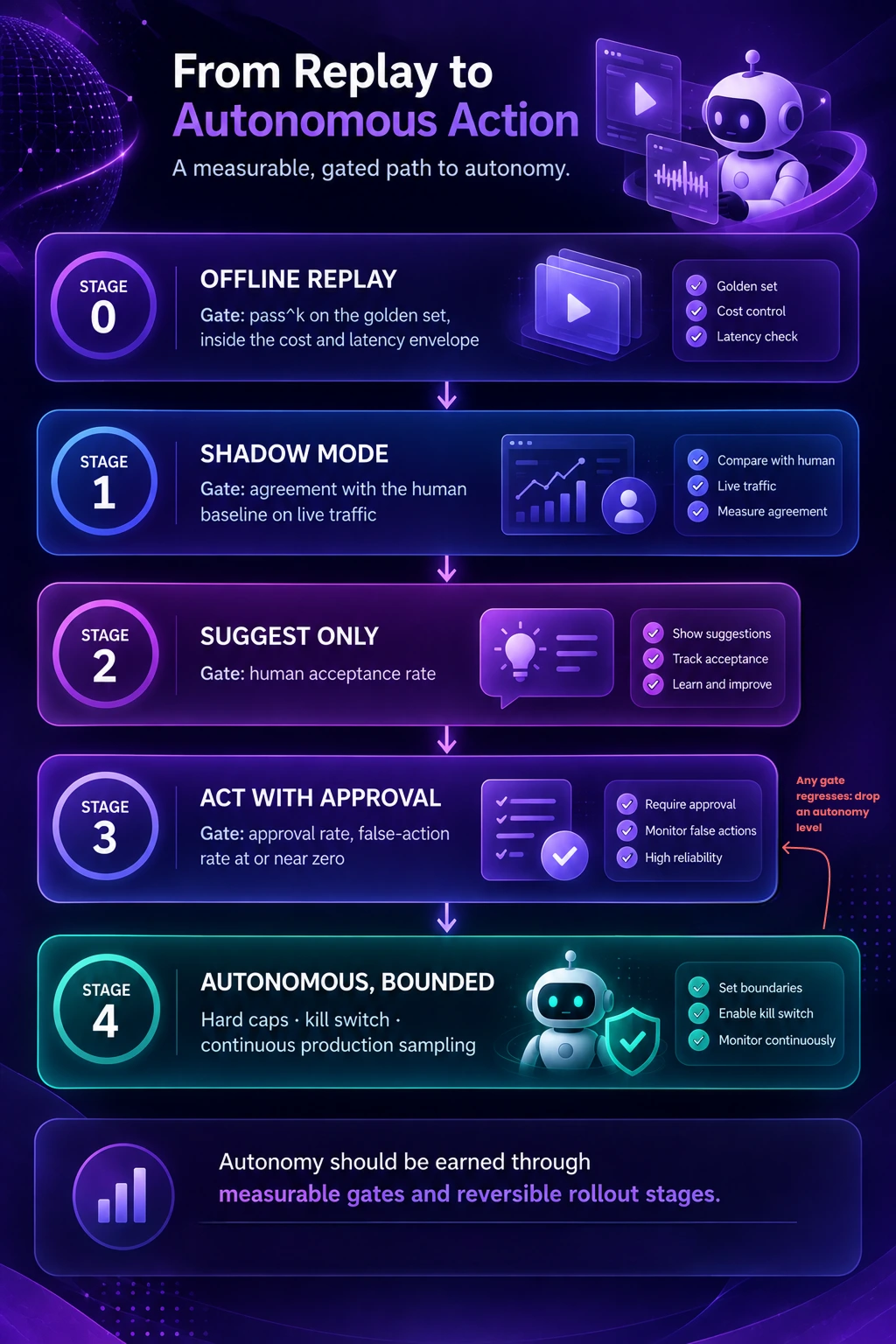
Figure 2. Autonomy should be earned through measurable gates and reversible rollout stages.
8. The eval harness is part of the product
A production agent needs more than a benchmark score. Test deterministic properties in CI, maintain a golden set for task-level evaluation, run important tasks multiple times, and sample production traces for review. Failed or anomalous production runs should become new eval cases.
For observability, OpenTelemetry’s GenAI semantic conventions are already being used to standardize model, token and tool telemetry, but the GenAI conventions remain under active development. Use OpenTelemetry-compatible instrumentation where it fits, and pin and test schema versions rather than treating the convention as frozen. OpenTelemetry GenAI observability.
Production readiness checklist
- Written capability contract: in-scope actions, out-of-scope cases and escalation path.
- Repeatability measured on a representative golden set, not only one run per task.
- Hard caps on steps, time, tokens and spend, with a deterministic fallback or escalation path.
- Typed, resumable task state outside the conversation transcript.
- Action risk classification before execution and human approval for high-impact writes.
- Least-privilege credentials, idempotent writes and blast-radius limits.
- Tool outputs treated as untrusted input and checked before they can influence privileged actions.
- Trace-level cost and latency metrics, including p95/p99, plus retention of failed and anomalous runs.
- Staged rollout through offline replay, shadow mode and approval gates before bounded autonomy.
- For multi-agent designs: typed handoffs, explicit subtask ownership, fan-out and recursion caps, and one budget ceiling shared across every agent in the run.
- Named owner, incident response process and kill switch that works without a new deployment.
The production reality check
The strongest production teams are not trying to make an agent look autonomous. They are trying to make a system dependable. That means choosing the smallest useful scope, designing for long-tail inputs, measuring repeated-run reliability, constraining actions and spend, and keeping humans in the loop where the blast radius justifies it.
The model is one component. The production system is everything around it.
Ready to get started?
Increase your marketing ROI by 30% with custom dashboards & reports that present a clear picture of marketing effectiveness
Start Free Trial
Experience Premium Marketing Analytics At Budget-Friendly Pricing.

Learn how you can accurately measure return on marketing investment.
You’re Targeting Your Ideal Customer. So Why Aren’t They Buying?
Your best customers reveal the traits associated with success. Your lost opportunities reveal where fit breaks...
Read full post post
How Predictive AI Will Transform Paid Media Strategy in 2026
Paid media isn’t a channel game anymore, it’s a chessboard. Search, social, programmatic, video, influencer, native,...
Read full post post
Don’t Let AI Break Your Brand: What Every CMO Should Know
AI isn’t just another marketing tool. It’s changing how we connect with customers, personalize content, and...
Read full post post