Attribution Modeling vs Analytics: Understanding the Difference and Why Both Matter
The distinction between what happened and what caused it is highlighted by attribution modeling vs. analytics, where each is insufficient on its own and how combining the two produces better insights and choices.
Attribution modeling vs analytics is a distinction many marketing teams blur, often using the terms interchangeably. Because each responds to a fundamentally different topic, this poses a serious issue. Reporting may appear thorough on the surface when they are treated equally, but it is unable to clarify what truly generates money..
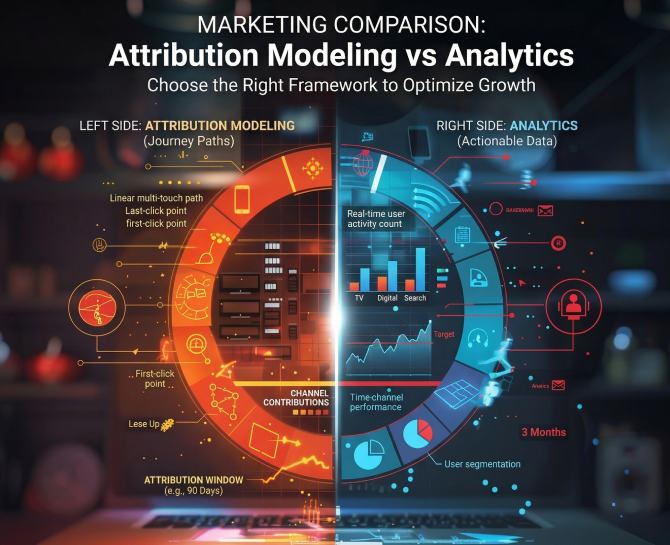
Marketing analytics tells you what is happening across your marketing program. Attribution modeling tells you which specific interactions caused those outcomes.
Without understanding the difference, teams end up with data—but not clarity.
This blog shows attribution modeling vs analytics, where they overlap, where they diverge, and why relying on one without the other creates measurement blind spots that impact budget decisions and strategy.
Key Takeaways
- Analytics reveals what happened, while attribution clarifies its cause.
- Blind spots and bad decisions result from using just one.
- Models of attribution can differ greatly. Their data quality and context are important.
- Marketing Mix Modeling (MMM) complements both by guiding budget allocation across channels.
- Unified data is essential for accurate, actionable insights.
What Is Marketing Analytics?
Marketing analytics is the practice of collecting, measuring, and interpreting data from marketing activity to understand performance and guide decisions. It covers a wide surface area: website traffic, campaign engagement, lead volume, pipeline contribution, customer acquisition cost, and more.
Consider marketing analytics as the more general field. It provides you with information on your marketing program’s overall performance. For instance, it may show you that this month, traffic increased by 20%. Email open rates decreased. Last quarter, 400 conversions were generated via paid search. These are results of analysis. They explain results over time and across channels.
Modern marketing analytics platforms pull data from multiple sources, normalize it and surface trends that would be invisible inside any single channel’s native reporting. At its best, analytics gives leadership a continuous, unified read on marketing health.
What it does not tell you, at least not on its own, is why a conversion happened or which specific touchpoint deserves credit for it. That is where attribution modeling enters.
What Is Attribution Modeling?
Attribution modeling is the process of allocating credit for a conversion to the marketing touchpoints that contributed to it. It is a subset of the broader analytics approach that focuses solely on one question: which interactions in the customer journey led to this result?
A customer might see a LinkedIn ad, read a blog post two days later, click a retargeting ad on Meta, and then convert through a Google search a week after that. Attribution modeling determines how much credit each of those touchpoints receives. Depending on the model applied, the answer changes substantially.
The identical conversion can appear very different depending on which model is used. For instance, a Facebook ad may gain 100% credit under one model, 20% under another, and zero credit under a third. The transaction occurred, and the income is genuine. However, the story your statistics tell about which marketing efforts caused that result varies substantially depending on your attribution system.
This is not a minor reporting detail. It directly shapes where the budget goes next.
Main Differences
| Aspect | Marketing Analytics | Attribution Modeling |
|---|---|---|
| Core Question | What is happening across our marketing program? | Which specific touchpoints caused conversions to happen? |
| Primary Focus | Overall performance across channels and campaigns | Contribution of individual touchpoints to conversions |
| Nature | Descriptive and diagnostic at scale | Causal and channel-specific |
| Insight Type | Explains trends (e.g., traffic and conversions increasing) | Assigns credit to specific channels or interactions |
| Limitation | Shows what happened but not why it happened | Shows who gets credit but lacks broader performance context |
| Scope | Holistic view of marketing performance | Narrow, conversion-path-focused view |
| Dependency | Can exist without attribution but lacks causality | Needs analytics context to be meaningful |
| Common Confusion | Both use dashboards and conversion data | Same as analytics—often appears similar in tools |
| Business Value | Helps monitor and diagnose performance trends | Helps optimize channel investment and budget allocation |
The Main Attribution Models Explained
Understanding attribution modeling requires knowing what the standard models actually do and where each one misleads.
Last-Click Attribution
The most common one. The last touchpoint before to a conversion receives 100% of the conversion credit in this model. Its widespread use can be attributed to its ease of implementation, comprehension, and strong tilt toward the bottom of the funnel. Organizations consistently underinvest in the activity that fills the top of the funnel because channels that foster intent and raise awareness are not given credit.
First-Click Attribution
First-click attribution is oppostie of last-click. The first touchpoint deserves all the credit. Similarly insufficient as last-click because it overlooks everything that occurs between discovery and choosing. However, it is helpful for comprehending what first motivates discovery and decision.
Linear Attribution
In this type of attribution, credit is distributed equitably across all touchpoints during the consumer journey. More honest than single-touch models, but considers a momentary display impression as seriously as a 10-minute product page visit, which rarely represents reality.
Time-Decay Attribution
Gives more credit to touchpoints that occurred close the conversion. Useful for shorter sales cycles where recency is genuinely relevant, but may punish awareness channels that conduct actual work early in long B2B purchasing journeys.
Data-Driven Attribution
Data-driven attribution examines all of your data’s converting and non-converting channels using machine learning methods. In order to find patterns and discover which touchpoints actually had the biggest impact, it compares the routes of consumers who converted to those who did not. Credit is then assigned based on the incremental lift that each interaction contributed. Although this method is the most precise, it needs a significant conversion volume to work consistently.
Where Analytics and Attribution Break Down Separately
When you rely only on Marketing Analytics
- You see traffic and total conversions, but not what caused them.
- You can’t link specific marketing actions to actual revenue.
- Decisions are based on volume or intuition, not proven impact.
- High-spend channels look more important just because they’re more visible.
- This often leads to vanity metrics (numbers that look good but lack real insight)
When you rely only on Attribution Modeling
- You focus only on credited conversions, missing the bigger picture.
- You may optimize based on a model that isn’t fully accurate.
- Different platforms use different attribution rules (e.g., 7-day click vs last-click).
- The same campaign can look successful in one tool and weak in another.
- This creates confusion and conflicting reports.
- Teams may argue over which data is “right” instead of making decisions.
This challenge is not isolated. 53% of marketers say measuring and improving ROI is their top priority, according to Salesforce.
Key takeaway
- Analytics without attribution = no clear cause
- Attribution without analytics = narrow, potentially misleading view
- You need both together to make confident marketing decisions
Attribution Modeling vs Marketing Mix Modeling
Another concept that comes up when talking about Attribution Modeling is Marketing Mix Modeling (MMM). It is a separate approach from attribution as it works without user-level tracking, captures full-funnel impact, and supports budget planning
MMM focuses more on the strategic decisions, like how to allocate budget across channels. On the other hand, Attribution focuses on execution decisions like which touchpoints drive conversions within channels. Finally, Analytics is the visibility layer that shows overall performance, so both can work.
Simple framework:
- Analytics → what is happening
- Attribution → what caused it
- MMM → where to invest next
How They Work Together
- Analytics identifies performance changes (e.g., drop in conversions)
- Attribution explains the cause (e.g., fewer content touchpoints driving conversions)
- Combined, they turn data into clear, actionable decisions
Common Mistakes Teams Make
Here are some common mistakes that teams make when working with attribution and analytics:
Using last-click as “attribution.”
- It’s just a default setting, not a real strategy
- Ignores earlier touchpoints in longer customer journeys
Trusting attribution results blindly
- Outputs are only as good as the data behind them
- Poor tracking = misleading conclusions
Measuring performance in channel silos
- Each platform uses its own attribution rules
- Results don’t match across tools
- You need a unified analytics layer for consistency
Setting and forgetting your attribution model
- Customer behavior and channels change over time
- Models need regular updates to stay accurate
What to Look for in a Platform That Handles Both
Although the majority of platforms promise to handle both attribution and marketing analytics, relatively few really do so. Their ability to consistently link data, context, and decision-making is what makes them different.
Choose a platform that:
- Allows you to compare how credit changes using a variety of attribution methods.
- Creates a single source of truth by combining data from several tools and channels.
- Links attributed conversions—rather than merely clicks or leads—to real revenue
- Flags data quality issues early, before they distort insights
Without these, you are just getting more dashboards.
Conclusion
While it is often framed as Attribution modeling vs analytics, these concepts work more like a partnership.
- Analytics tells you what is happening
- Attribution tells you why it is happening
- MMM (when used) tells you where to invest next
Relying on only one creates blind spots. Together, they give you a complete, decision-ready view of marketing performance.
The teams that get this right are building systems that connect performance to revenue with clarity and confidence.
Our platform DiGGrowth is designed around these exact needs. It brings analytics, attribution, and data quality into one unified layer so decisions are based on reality, not assumptions. Reach out today to find more.
Ready to get started?
Increase your marketing ROI by 30% with custom dashboards & reports that present a clear picture of marketing effectiveness
Start Free Trial
Experience Premium Marketing Analytics At Budget-Friendly Pricing.

Learn how you can accurately measure return on marketing investment.

You’re Targeting Your Ideal Customer. So Why Aren’t They Buying?
Your best customers reveal the traits associated with success. Your lost opportunities reveal where fit breaks...
Read full post post
How Predictive AI Will Transform Paid Media Strategy in 2026
Paid media isn’t a channel game anymore, it’s a chessboard. Search, social, programmatic, video, influencer, native,...
Read full post post
Don’t Let AI Break Your Brand: What Every CMO Should Know
AI isn’t just another marketing tool. It’s changing how we connect with customers, personalize content, and...
Read full post postFAQ's
Marketing analytics measures overall performance across your marketing program. Attribution modeling is a specific discipline within analytics focused on assigning credit for conversions to the touchpoints that influenced them.
Data-driven attribution is generally the most accurate because it uses machine learning to determine incremental lift rather than applying a fixed rule. It requires a high conversion volume to work reliably.
Basic attribution is available natively in tools like Google Analytics 4. For multi-channel, multi-touch attribution that connects to CRM revenue data, a dedicated attribution or marketing analytics platform gives significantly more reliable results.
Each platform applies its own default attribution model and conversion window. The underlying conversions are the same but the credit assigned to each channel differs based on the rules each platform uses.
Attribution supports campaign-level execution and optimization. Marketing mix modeling informs strategic budget allocation across channels. They answer different questions and work best when used together alongside a broader analytics foundation.