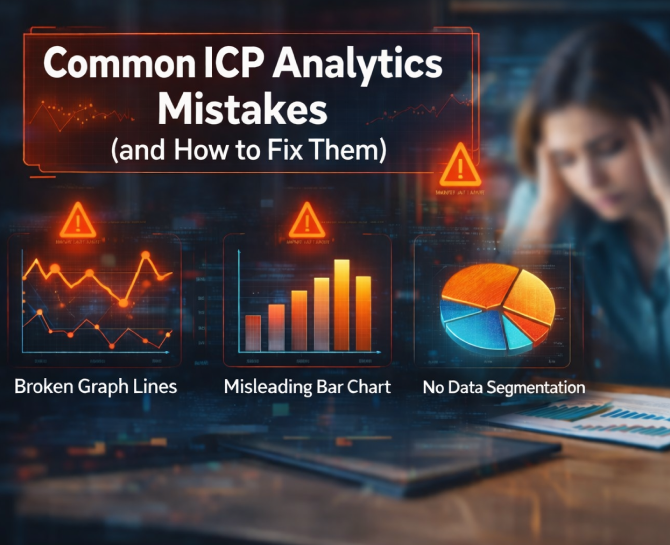
Common ICP Analytics Mistakes (and How to Fix Them)
Most B2B teams struggle with ICP analytics due to overgeneralized definitions, static models, ignored negative profiles, messy data, and misaligned metrics. These mistakes waste budget and slow pipeline growth. The fix requires AI-driven scoring, quarterly updates, exclusion lists, clean data pipelines, and revenue-focused success metrics.
Your marketing budget is burning through accounts that will never convert. Sales teams chase leads that stall in demos. Customer success struggles with accounts that churn within months.
The root cause is rarely the absence of an ideal customer profile. It’s that the ICP itself is broken.
Most B2B SaaS teams make the same critical mistakes when building and maintaining their ICP analytics systems. They create profiles based on assumptions, leave them untouched for years, and wonder why targeting accuracy keeps declining. Meanwhile, high-value accounts slip through unnoticed while low-fit prospects consume resources.
The difference between predictable growth and wasted effort often comes down to fixing a handful of recurring ICP analytics mistakes.
This article breaks down the five most common ICP analytics mistakes that sabotage revenue growth and provides actionable fixes you can implement immediately. Whether you’re building your first ICP or refining an existing one, these insights will help you target smarter, convert faster, and grow more predictably.
Key Takeaways
- Overgeneralized ICPs waste budget by treating different buyers the same; fix it with AI-driven fit and intent scoring.
- Static ICP models miss market shifts and emerging opportunities; refresh profiles quarterly using actual pipeline data.
- Ignoring negative ICPs allows low-fit accounts to drain resources; build exclusion lists to avoid wasted spend.
- Messy or incomplete data produces flawed ICP models; standardize pipelines and validate inputs before analysis.
- Vanity metrics mislead teams; tie ICP success to pipeline velocity, deal size, and retention for real revenue impact.
Mistake 1: Overgeneralized ICP Definitions
The Problem
Many teams define their ICP with broad strokes: “mid-market tech companies” or “healthcare organizations with 500+ employees.” On paper, this seems reasonable. In practice, it treats vastly different buyers as identical.
Two companies in the same industry, same size, and same region can behave completely differently. One may have centralized decision-making and move through evaluations quickly. The other may have fragmented approval processes that stall deals for months.
When ICPs are overgeneralized, marketing wastes budget on campaigns that attract the wrong accounts. Sales spends time on prospects that match surface criteria but lack structural readiness to buy. The result is inconsistent pipeline quality and unpredictable revenue.
Why It Happens
Teams often build ICPs around what’s easy to measure rather than what actually predicts success. Basic firmographics like industry and employee count are readily available in CRM systems, so they become the default criteria.
Without deeper segmentation based on technographics, behavioral patterns, or intent signals, the ICP remains a blunt instrument. It identifies potential buyers but fails to distinguish between accounts that will close in 30 days versus those that will churn after six months.
The Fix: Use AI-Driven Fit and Intent Scoring
Replace broad definitions with multi-dimensional scoring that combines firmographics, technographics, and behavioral signals.
Firmographic Fit: Company size, industry, revenue range, and location provide baseline qualification. Analyze which combinations historically convert and expand.
Technographic Fit: Existing tech stack reveals adoption readiness. Accounts running modern CRMs, cloud infrastructure, or marketing automation tools typically move faster through evaluations.
Behavioral Intent: Engagement with pricing pages, product demos, case studies, and comparison content indicates active evaluation. Intent signals separate accounts researching solutions from those passively consuming content.
AI-driven platforms like DiGGrowth, 6sense, or Demandbase can automate this scoring, continuously refining fit criteria based on actual outcomes.
Instead of treating all mid-market accounts the same, you prioritize those showing high fit across multiple dimensions.
Pro Tip: Segment your ICP into tiers based on fit and intent scores. Tier 1 accounts get immediate sales attention, Tier 2 enters nurture sequences, and Tier 3 remains in awareness campaigns. This ensures resources flow to opportunities with the highest probability of closing.
Mistake 2: Static ICP Models
The Problem
Most teams build their ICP once, document it in a slide deck, and never revisit it. The profile becomes a fixed reference point that marketing and sales follow regardless of market changes, product evolution, or shifting buyer behavior.
Markets move fast. A segment that drove growth 18 months ago may now show slower adoption or higher churn. New buyer types may emerge as product capabilities expand. Competitor movements and economic shifts alter which accounts are ready to purchase.
Static ICPs create blind spots. Teams continue targeting accounts based on outdated assumptions while missing emerging high-value segments. Pipeline quality degrades, but the ICP remains unchanged because no system exists to challenge it.
Why It Happens
Updating an ICP feels like starting from scratch. Teams lack the data infrastructure to continuously track performance across segments. Without automated feedback loops connecting pipeline outcomes to ICP criteria, profiles stagnate.
Cultural factors also play a role. Marketing teams may resist changing targeting strategies mid-campaign. Sales teams grow comfortable with familiar account types. The path of least resistance is to keep the ICP as is.
The Fix: Refresh ICP Quarterly With New Data Signals
Build a recurring cadence to evaluate ICP performance against actual results. Every quarter, analyze:
- Win Rate by Segment: Which firmographic, technographic, or behavioral segments converted at the highest rates?
- Sales Cycle Length: Which account types moved through the pipeline fastest?
- Churn and Expansion Patterns: Which customers retained, expanded, or churned within the first year?
- Emerging Trends: Are new industries, company sizes, or tech stacks showing unexpected conversion potential?
Pull data from CRM systems, product analytics, marketing automation platforms, and customer success tools. Compare current quarter performance against previous periods to identify shifts.
Use this quarterly loop to keep your ICP aligned with real pipeline outcomes.
If a segment that historically converted well now shows declining win rates, investigate why. If a previously overlooked account type demonstrates strong expansion behavior, adjust targeting accordingly.
Pro Tip: Schedule quarterly ICP reviews as a cross-functional meeting involving marketing, sales, RevOps, and customer success. Use actual pipeline data to drive decisions, not opinions. Document changes clearly so all teams understand updated targeting priorities.
Mistake 3: Ignoring Negative ICPs
The Problem
Most teams define who they want to target. Few define who they should actively avoid.
Negative ICPs are account profiles that consistently underperform. They may match surface-level criteria but demonstrate poor fit through slow sales cycles, high churn rates, low adoption, or minimal expansion potential.
Without a defined negative ICP, marketing campaigns reach accounts that will never convert efficiently. Sales teams waste time on prospects that appear qualified but stall repeatedly. Budget flows toward low-probability opportunities while high-value accounts receive less attention.
Negative ICPs prevent this waste by proactively filtering out accounts unlikely to deliver value.
Why It Happens
Defining a negative ICP feels counterintuitive. Teams focus on expanding reach rather than narrowing it. There’s also a fear of missing opportunities by being too restrictive.
Data infrastructure plays a role as well. Identifying negative patterns requires analyzing accounts that churned, stalled, or required excessive support. Many teams lack the systems to track these outcomes systematically.
The Fix: Build Exclusion Lists to Avoid Wasted Spend
Start by analyzing accounts that performed poorly across key metrics:
- High Churn Accounts: Which firmographic, technographic, or behavioral traits were common among customers who churned within the first year?
- Stalled Deals: Which account types consistently reached late-stage pipeline but never closed?
- Low Adoption: Which customers signed contracts but showed minimal product engagement post-sale?
- High Support Costs: Which accounts required disproportionate customer success resources relative to contract value?
Document these patterns and create exclusion criteria.
For example, you might exclude accounts below a certain revenue threshold, those using incompatible legacy systems, or industries with regulatory constraints that complicate implementation.
Apply these exclusion rules across marketing automation, ad targeting, and lead scoring systems. Prevent negative ICP accounts from receiving campaign budget or entering high-touch sales sequences.
Pro Tip: Treat negative ICP criteria as dynamic. Just like positive ICPs evolve, negative patterns may shift as your product matures or market conditions change. Review exclusion lists quarterly alongside positive ICP updates.
Mistake 4: Messy or Incomplete Data
The Problem
ICP analytics is only as accurate as the data feeding it. When CRM records are incomplete, inconsistent, or outdated, the entire model breaks down.
Common data quality issues include missing firmographic fields, inconsistent industry classifications, duplicate accounts, outdated contact information, and incomplete deal stage tracking. These gaps prevent accurate analysis of which account types consistently perform well.
For example, if half your closed-won deals lack industry data, you cannot reliably determine which industries convert best. If technographic information is missing, you cannot identify which tech stacks correlate with faster sales cycles.
Messy data leads to flawed conclusions. Teams may target the wrong segments, deprioritize high-value accounts, or waste budget on campaigns built on incorrect assumptions.
Why It Happens
Data quality deteriorates over time. Sales reps rush to log deals without completing all fields. Marketing automation systems pull in incomplete information from form fills. Mergers, acquisitions, and organizational changes make account records obsolete.
Without standardized data entry processes and regular hygiene checks, CRM systems become unreliable. Teams continue building ICP models on top of flawed foundations, compounding errors.
The Fix: Standardize Data Pipelines and Validate Inputs Before Modeling
Implement data governance practices to ensure consistency and completeness across all systems.
- Required Fields: Make critical firmographic, technographic, and behavioral fields mandatory in CRM workflows. Sales reps cannot move deals to the next stage without completing key data points.
- Data Enrichment Tools: Use platforms like Clearbit, ZoomInfo, or BuiltWith to automatically append missing firmographic and technographic data to account records.
- Regular Audits: Schedule monthly or quarterly data hygiene reviews. Identify duplicate accounts, outdated records, and incomplete fields. Assign responsibility for cleanup to specific team members.
- Standardized Taxonomies: Ensure industry classifications, company size ranges, and other categorical fields use consistent naming conventions across all systems. Avoid variations like “Tech,” “Technology,” and “IT” that fragment analysis.
- Validation Rules: Build automated checks that flag accounts with missing or inconsistent data before they enter reporting dashboards or ICP models.
Clean data creates reliable ICP analytics. When every account record contains accurate, complete information, you can trust the patterns that emerge. and make confident targeting decisions.
Pro Tip: Integrate your CRM with data enrichment tools so fields populate automatically when new accounts are created. This reduces manual entry errors and ensures consistency from the start.
Mistake 5: Misaligned Success Metrics
The Problem
Many teams measure ICP performance using vanity metrics like website traffic, content downloads, email open rates, or social media engagement. These metrics show activity but reveal nothing about revenue impact.
An ICP that generates thousands of clicks may still produce zero pipeline. An account type with high email engagement may consistently churn within six months. Measuring the wrong outcomes creates a false sense of success while actual revenue performance stagnates.
When success metrics are misaligned, teams optimize for the wrong goals. Marketing celebrates lead volume while sales complain about quality. RevOps forecasts are based on inflated pipelines that never materialize into closed deals.
Why It Happens
Vanity metrics are easy to track and report. They show consistent upward trends that make campaigns look successful. Revenue metrics, by contrast, take longer to materialize and are harder to attribute directly to ICP changes.
Teams also struggle to connect early-stage engagement signals with downstream outcomes like deal size, sales cycle length, and retention rates. Without integrated analytics across the full customer lifecycle, it’s difficult to measure what truly matters.
The Fix: Tie ICP Scoring to Pipeline Velocity, Deal Size, and Retention
Replace vanity metrics with revenue-focused KPIs that reflect actual business impact.
- Pipeline Velocity: Measure how quickly accounts move from first touch to closed-won. High-fit accounts should progress faster through each stage.
- Win Rate by Segment: Track conversion rates across different firmographic, technographic, and behavioral segments. Focus resources on segments with the highest close rates.
- Average Deal Size: Identify which account types consistently generate larger contracts. Prioritize targeting toward these higher-value segments.
- Customer Lifetime Value (LTV): Analyze retention, expansion, and churn patterns across customer cohorts. Accounts that expand usage and renew at higher tiers deliver more long-term value.
- Sales Efficiency: Calculate cost per acquisition and sales cycle length by segment. Accounts that close faster with less effort improve overall efficiency.
Build dashboards that connect ICP criteria directly to these metrics.
For example, track how accounts scored as “high fit” in your ICP model perform across win rate, deal size, and retention compared to “medium fit” or “low fit” accounts.
This alignment ensures every team optimizes for the same goal: revenue.
Marketing campaigns target segments with proven conversion potential. Sales prioritizes accounts that close efficiently. Customer success focuses on account types with a strong expansion history.
Pro Tip: Create a unified scorecard that tracks ICP performance across the full customer lifecycle, from initial engagement through renewal and expansion. Review this scorecard monthly with leadership to ensure targeting and resource allocation remain aligned with revenue outcomes.
How to Implement These Fixes in Your Organization
Fixing ICP analytics mistakes requires more than understanding the problems. It demands systematic implementation across people, processes, and technology.
Step 1: Audit Your Current ICP
Start by documenting how your ICP is currently defined and used. Ask:
- What criteria define your ICP today?
- How often is the ICP updated?
- Which data sources feed into ICP decisions?
- Are the negative ICP criteria defined?
- Which metrics measure ICP success?
Identify gaps between the current state and best practices. Prioritize fixes based on impact and ease of implementation.
Step 2: Establish Data Governance
Assign responsibility for data quality to specific roles. Implement required fields, validation rules, and enrichment tools. Schedule regular audits to maintain hygiene over time.
Step 3: Build Cross-Functional Alignment
ICP analytics cannot succeed in silos. Marketing, sales, RevOps, and customer success must agree on definitions, metrics, and processes.
Schedule quarterly ICP reviews where all teams examine performance data together. Use actual outcomes to drive decisions, not opinions or assumptions.
Step 4: Invest in the Right Tools
Manual ICP analysis does not scale. Invest in platforms that automate data collection, scoring, and reporting.
Consider tools like DiGGrowth for real-time engagement insights, 6sense or Demandbase for intent signals, and ZoomInfo for firmographic and technographic enrichment.
Integrate these with your CRM and marketing automation systems to create a unified view of account fit and readiness.
Step 5: Measure and Iterate
Track ICP performance against revenue metrics monthly. Identify which segments drive the highest win rates, deal sizes, and retention.
Adjust targeting and scoring criteria based on what the data reveals.
ICP analytics is not a one-time project. It’s a continuous process of learning, refining, and optimizing based on real buyer behavior.
ICP Health Assessment
| Area | Healthy ICP | Unhealthy ICP |
|---|---|---|
| ICP Definition | Multi-dimensional scoring (firmographics + technographics + behavioral signals) | Single-dimension targeting (industry or size only) |
| Update Frequency | Quarterly reviews with data-driven adjustments | Built once, rarely or never updated |
| Negative ICP | Clearly defined exclusion criteria based on churn and poor-fit patterns | No negative ICP or exclusion rules in place |
| Data Quality | Clean, complete, standardized data with validation rules | Missing fields, duplicates, inconsistent entries |
| Success Metrics | Pipeline velocity, win rate, deal size, LTV, retention | Clicks, downloads, traffic, engagement only |
| Cross-Team Alignment | Marketing, sales, RevOps agree on ICP criteria and scoring | Teams use different definitions and priorities |
| Tool Integration | Automated scoring with CRM, marketing automation, and intent data connected | Manual tracking, disconnected systems |
| Segmentation | Tiered approach (high/medium/low fit) with different engagement strategies | One-size-fits-all treatment of all accounts |
Scoring Guide
| Score (Checks in “Healthy ICP”) | Interpretation |
|---|---|
| 7–8 | Your ICP analytics is performing well. |
| 4–6 | Moderate improvements needed. |
| 0–3 | Significant ICP overhaul required. |
Conclusion
ICP analytics mistakes are costly. They waste marketing budgets, slow sales cycles, and flood pipelines with accounts that will never convert or retain. The good news is that these mistakes are fixable.
By refining overgeneralized definitions, updating models regularly, defining negative ICPs, cleaning data, and aligning metrics to revenue, you transform ICP analytics from a static document into a dynamic growth engine.
The teams that get this right don’t guess which accounts to target. They know. They focus resources on high-probability opportunities, close deals faster, and grow predictably.
If your current ICP analytics system is producing inconsistent results, now is the time to fix it. DiGGrowth’s ICP analytics platform helps B2B teams identify high-value accounts, automate fit and intent scoring, and continuously refine targeting based on real revenue outcomes.
Ready to stop wasting effort on the wrong accounts? Let’s Talk!
Reach out to us at info@diggrowth.com to turn your ICP insights into predictable revenue.
Ready to get started?
Increase your marketing ROI by 30% with custom dashboards & reports that present a clear picture of marketing effectiveness
Start Free Trial
Experience Premium Marketing Analytics At Budget-Friendly Pricing.

Learn how you can accurately measure return on marketing investment.
You’re Targeting Your Ideal Customer. So Why Aren’t They Buying?
Your best customers reveal the traits associated with success. Your lost opportunities reveal where fit breaks...
Read full post post
How Predictive AI Will Transform Paid Media Strategy in 2026
Paid media isn’t a channel game anymore, it’s a chessboard. Search, social, programmatic, video, influencer, native,...
Read full post post
Don’t Let AI Break Your Brand: What Every CMO Should Know
AI isn’t just another marketing tool. It’s changing how we connect with customers, personalize content, and...
Read full post postFAQ's
A too-broad ICP results in low conversion rates, inconsistent lead quality, and wasted marketing spend across unqualified accounts. A too-narrow ICP limits pipeline volume and may exclude high-value segments. The fix is to analyze win rates, sales cycle length, and retention by segment. If certain account types consistently outperform others, narrow focus there. If pipeline volume is insufficient, expand targeting to adjacent high-performing segments.
Accurate ICP analytics requires CRM data (deal stages, win rates, sales cycle length), product usage data (adoption, feature engagement), customer success metrics (churn, expansion, support tickets), marketing engagement signals (content downloads, website visits, demo requests), and technographic data (existing tools, infrastructure, platforms). Combining these sources reveals which account types convert, adopt, and retain most effectively.
Present the cost of inaction: calculate wasted spend on low-fit accounts, missed revenue from overlooked high-value segments, and inefficiencies caused by manual ICP processes. Show how ICP analytics platforms improve win rates, shorten sales cycles, and increase customer lifetime value. Use case studies or pilot results demonstrating ROI from better targeting and prioritization.
Yes. Start with basic firmographic and behavioral analysis using existing CRM and marketing automation data. Focus on qualitative insights from sales and customer success teams regarding which accounts close the fastest and retain the longest. As data volume grows, layer in technographic signals and intent tracking. Even small datasets can reveal meaningful patterns when analyzed systematically.
Precision and volume are not opposites when managed correctly. Utilize tiered ICP scoring to segment accounts based on their fit and intent. High-fit accounts enter immediate sales engagement, medium-fit accounts receive targeted nurture campaigns, and low-fit accounts remain in awareness programs. This approach maintains pipeline volume while ensuring resources focus on the highest-probability opportunities.