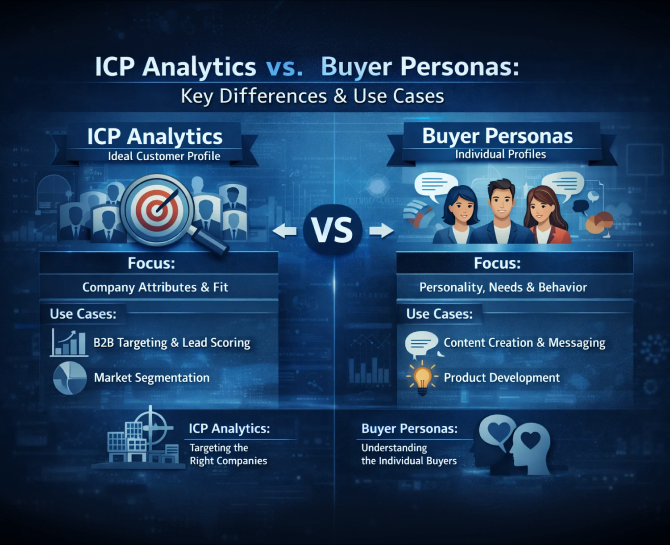
ICP Analytics vs Buyer Personas: Key Differences & Use Cases
Many teams confuse buyer personas with ICP analytics, causing misaligned targeting and wasted effort. This blog explains the difference, shows where each framework adds value, and guides leaders on using both to improve account focus and engagement outcomes.
If you have ever sat through a growth discussion where targeting felt settled but results did not, this will sound familiar.
Buyer personas get mentioned. ICPs get mentioned. Everyone moves on, assuming alignment exists.
Then the numbers show up.
Some deals move fast. Others never should have entered the pipeline. Retention feels unpredictable. Teams debate quality, fit, and focus, often using the same words to mean different things.
That is usually when it becomes clear. The business does not have a targeting problem. It has a definition problem.
Buyer personas and ICPs are being treated as the same thing. Or worse, they are being used without clarity on what decisions they are meant to guide.
A buyer persona is about a person.
An ICP is about a business.
When that distinction is not respected, personas start driving account selection, and ICPs turn into loose descriptions instead of strategic filters. Focus becomes subjective, and growth follows suit.
This is where ICP analytics vs buyer personas actually matters. Not as a terminology debate, but as a framework that shapes how growth decisions are made. Read this blog to understand the key differences between buyer personas and ICP analytics, and how using each correctly drives smarter targeting and better growth outcomes.
Key Takeaways
- Buyer personas help you understand the people behind the decisions, not the accounts themselves.
- ICP analytics identifies the accounts that actually drive revenue and long-term growth.
- Using the wrong framework for the wrong decision creates misaligned focus and wasted effort.
- Personas shape engagement; ICP analytics guides prioritization and resource allocation.
- Both frameworks work best when applied together in their intended context to drive evidence-led strategy.
Understanding Buyer Personas
Buyer personas are often the first framework teams build. They feel intuitive. They put a face to the buyer and give language to otherwise abstract decisions.
At their core, buyer personas are meant to help you understand the people involved in a purchase.
What Buyer Personas Represent
A buyer persona is a qualitative representation of a decision-maker or influencer. It captures how someone thinks, what they care about, and how they approach buying decisions.
Buyer personas are typically used to answer questions such as:
- Who is involved in the buying process?
- What motivates or blocks a decision?
- How different roles evaluate value?
They are especially useful when messaging feels generic or disconnected from real buyer concerns.
Where Buyer Personas Add Real Value
When used with intent, buyer personas create clarity at the communication layer of your strategy. They help teams move away from generic messaging and toward conversations that feel relevant to the buyer’s reality.
Personas guide how value is positioned across different touchpoints. They shape what gets emphasized, what gets avoided, and how trade-offs are explained during the buying journey.
Specifically, buyer personas help teams align on:
- Motivations, challenges, and priorities that influence how decisions are evaluated.
- Objections that typically emerge during research, internal alignment, and final approval.
- Content formats and communication channels that match how different roles consume information.
This is why buyer personas are most effective in marketing, product, and enablement workflows. They bring consistency to how narratives are built, how problems are framed, and how solutions are introduced.
Used this way, buyer personas do not decide who you target. They determine how you engage once a target is in focus.
Example: A Typical SaaS Buyer Persona
Consider a mid-market operations leader evaluating a new SaaS platform.
The persona outlines what success looks like in their role, what risks they are trying to avoid, and what internal pressures shape their decisions. Messaging focuses on efficiency, control, and visibility. Content addresses common objections around adoption and change management.
In this context, the buyer persona does its job. It helps shape conversations. It informs how value is communicated.
Problems begin only when this persona is asked to do more than it was designed for.
Understanding ICP Analytics
ICP analytics is the framework that tells you which accounts actually drive value .
It moves targeting from assumptions to evidence. From guesswork to clarity.
At its core, ICP analytics is meant to help you understand the types of companies worth investing in.
What ICP Analytics Focuses On
ICP analytics is data-driven. It identifies patterns in high-value accounts and uses those insights to guide strategy.
It answers questions such as:
- Which companies consistently generate revenue?
- What account attributes correlate with retention and expansion?
- Where should sales and marketing focus their efforts?
It is especially useful when pipelines feel unpredictable or targeting feels scattered.
Where ICP Analytics Adds Real Value
When applied correctly, ICP analytics brings clarity to account selection and prioritization.
It helps teams align around measurable signals, reduce wasted effort, and focus on accounts that truly impact growth.
Specifically, ICP analytics helps teams identify:
- High-value segments based on revenue, deal size, and growth potential.
- Accounts most likely to convert and adopt successfully.
- Patterns in product usage, engagement, and behavior that indicate success.
This is why ICP analytics is most effective across sales, marketing, and customer success. It ensures targeting is evidence-led, not opinion-led , and drives predictable outcomes.
Used this way, ICP analytics does not tell you how to message individual buyers . It tells you which accounts deserve attention .
Example: An Analytics-Driven ICP
Consider a land management company evaluating accounts for a new property management platform.
The ICP outlines which accounts are most likely to adopt successfully, deliver revenue, and remain long-term customers. It focuses on company size, systems in use, adoption patterns, and past engagement signals. Outreach prioritizes accounts that match these criteria. Marketing emphasizes efficiency and measurable ROI. Product highlights features that solve the most critical operational challenges.
In this context, the ICP does its job. It helps focus effort on accounts that actually drive growth. It informs prioritization and resource allocation.
Problems begin only when this ICP is treated like a persona. It defines accounts. Not individual decision-makers.
ICP Analytics Vs Buyer Personas: Key Differences
Buyer personas and ICP analytics are often discussed as interchangeable. They are not.
The difference becomes clear when you compare what each framework is built on and what decisions it is meant to support.
Comparison Table: ICP Analytics Vs Buyer Personas
| Dimension | Buyer Personas | ICP Analytics |
|---|---|---|
| Data Foundation | Qualitative insights from interviews, assumptions, and observations. | Quantitative data from revenue, product usage, and account behavior. |
| Level Of Objectivity | Interpretive and subjective by nature. | Evidence-led and pattern-driven. |
| Update Frequency | Updated infrequently as roles and motivations evolve slowly. | Updated regularly as performance data and market conditions change. |
| Revenue Predictability | Improves relevance in conversations but does not predict outcomes. | Directly tied to deal velocity, retention, and expansion. |
| Cross-Team Usability | Primarily used by marketing, product, and enablement teams. | Used across sales, marketing, leadership, and revenue operations. |
Pro Tip : Use ICP analytics to identify high-value accounts first, then apply buyer personas to guide engagement. Update ICPs regularly and personas periodically to keep targeting and messaging accurate and effective.
Choosing The Right Framework For The Right Decision
Buyer personas and ICP analytics are both critical, but they solve different problems.
Understanding when and why to use each ensures decisions are aligned, resources are optimized, and outcomes are measurable.
Use Cases Where Buyer Personas Work Best
Buyer personas are about understanding the people inside the accounts you care about.
They are most effective when decisions focus on communication, engagement, and experience, rather than account selection.
Situations where buyer personas deliver real value include:
- Early-Stage Positioning and Messaging: Determine how to frame value propositions for different roles.
- Content Strategy and Brand Storytelling: Align messaging with the motivations, pain points, and priorities of individual decision-makers.
- UX, Onboarding, and Customer Experience Design: Guide product interactions, content delivery, and engagement flows that feel relevant to each role.
- Sales Enablement: Provide sales teams with context on objections, priorities, and role-specific triggers to improve conversations.
- Marketing Campaign Optimization: Refine messaging and creative to resonate with decision-makers’ perspectives.
Why This Matters: Buyer personas help teams engage meaningfully once accounts are in focus. They are not meant to guide which accounts to target.
Use Cases Where ICP Analytics Works Best
ICP analytics is about understanding which accounts drive predictable revenue.
It is most effective when decisions focus on prioritization, resource allocation, and revenue impact, rather than individual behavior.
Situations where ICP analytics delivers real value include:
- Account-Based Marketing and Targeting: Identify high-value segments and allocate marketing spend efficiently.
- Sales Prioritization and Pipeline Focus: Rank accounts by likelihood to convert, expand, or retain.
- Revenue Forecasting and Performance Planning: Use data patterns to predict deal size, velocity, and potential churn.
- Expansion, Upsell, and Retention Strategies: Determine which existing accounts are most likely to adopt additional products or renew.
- Cross-Team Alignment: Ensure sales, marketing, and customer success focus on accounts that maximize ROI.
Why This Matters: ICP analytics ensures effort is applied where the business actually sees results, reducing wasted spend and improving growth predictability.
Why The Distinction Is Critical
Using buyer personas to choose accounts leads to misaligned pipelines and wasted effort. Using ICP analytics to guide messaging for individual decision-makers makes engagement impersonal and ineffective.
Buyer personas shape how you engage people. ICP analytics determines where you invest effort.
Used correctly, in their intended context, these frameworks reinforce each other:
- ICP analytics defines the right accounts.
- Buyer personas ensure that engagement with those accounts resonates.
This separation transforms vague targeting into structured, evidence-led growth decisions.
Conclusion
Confusing buyer personas with ICP analytics costs focus, effort, and results. When personas drive account selection or ICPs shape messaging for individuals, teams waste energy and miss opportunities. Understanding the difference lets you focus on the right accounts and engage the right people with precision.
The clarity you create here determines whether your targeting drives predictable growth or drifts into guesswork. Use each framework for its intended purpose, and your strategy becomes intentional, evidence-led, and measurable.
If you want guidance on applying these frameworks to sharpen your targeting and maximize impact, reach out to us at info@diggrowth.com.
Let’s turn strategy into results that actually move the needle.
Ready to get started?
Increase your marketing ROI by 30% with custom dashboards & reports that present a clear picture of marketing effectiveness
Start Free Trial
Experience Premium Marketing Analytics At Budget-Friendly Pricing.

Learn how you can accurately measure return on marketing investment.
How Predictive AI Will Transform Paid Media Strategy in 2026
Paid media isn’t a channel game anymore, it’s a chessboard. Search, social, programmatic, video, influencer, native,...
Read full post post
Don’t Let AI Break Your Brand: What Every CMO Should Know
AI isn’t just another marketing tool. It’s changing how we connect with customers, personalize content, and...
Read full post post
From Demos to Deployment: Why MCP Is the Foundation of Agentic AI
A quiet revolution is unfolding in AI. And it’s not happening inside research labs. For decades,...
Read full post postFAQ's
ICPs should update with account performance and market shifts. Buyer personas refresh as roles, priorities, or decision-making patterns change. Regular updates ensure targeting remains precise and engagement stays relevant.
No. ICPs identify high-value accounts, but personas guide how to engage the people within them. Both are needed for data-driven targeting and effective, personalized engagement.
Track account conversion, deal velocity, retention, and engagement quality. ICPs influence account prioritization, while personas shape messaging and interaction effectiveness. Metrics show whether targeting and engagement are aligned with business goals.
Qualitative insights inform messaging but rarely predict account outcomes. Without data-backed ICPs, targeting can be inefficient, pipelines misaligned, and resources wasted. Combining insights ensures both relevance and measurable impact.
ICPs focus teams on high-value accounts. Personas ensure consistent engagement across marketing, sales, and customer success. Together, they align priorities, reduce wasted effort, and make growth strategy intentional and evidence-led.