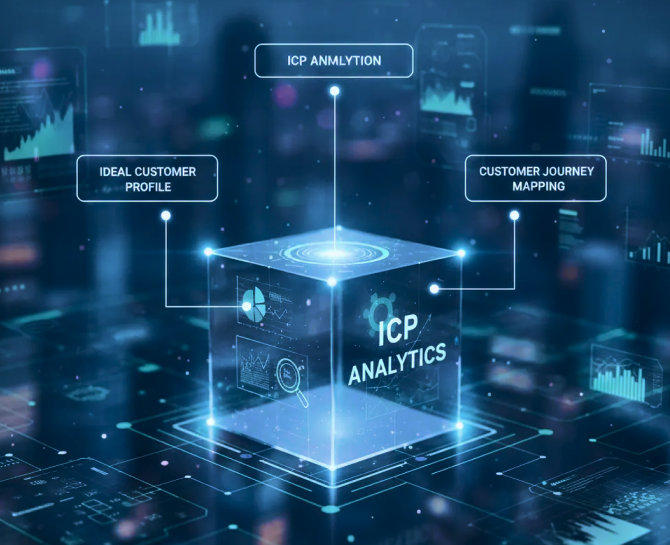
What Is ICP Analytics? Definition, Benefits & Examples
ICP analytics identifies the ideal customers who deliver real revenue outcomes. Unlike static profiles, it uses behavioral, technographic, and revenue data to prioritize accounts and align teams around measurable results. This article covers its definition, benefits, real examples, and practical applications for B2B SaaS teams.
You probably have an ICP somewhere. A slide. A doc. A Notion page that gets pulled up when targeting goes wrong.
But ask yourself this honestly.
Does it actually guide decisions, or does it just explain them after the fact?
If your ICP were doing its job, your pipeline would feel clearer. Instead, you keep revisiting the same questions. Why certain leads stall. Why some accounts close quickly while others drain time. Why alignment conversations never really end.
What usually happens next is familiar.
Marketing targets companies that look right but do not behave like buyers.
Sales spends time qualifying accounts that never convert.
Revenue teams debate lead quality instead of improving it.
At that point, the problem is not effort or execution. It is definition. When ICPs are built on assumptions rather than evidence, they stop being a growth tool and start becoming a reference point.
This is where ICP analytics enters the picture.
Instead of asking who should buy, you start looking at who actually does. You analyze the customers that convert faster, stay longer, and generate consistent revenue, then identify the patterns behind those outcomes.
Key Takeaways
- ICP analytics replaces assumption-based ideal customer profiles with data-backed insights.
- Revenue, marketing, and sales teams use ICP analytics to improve targeting, prioritization, and pipeline quality.
- Data-driven ICPs evolve continuously based on real customer behavior and outcomes.
What Is ICP Analytics?
At a surface level, ICP analytics sounds like a smarter way to define your ideal customer. In practice, it is much more than that.
Instead of relying on static traits like company size or industry, you start with evidence. You look at which customers actually move through your funnel, close efficiently, renew consistently, and expand over time.
ICP analytics helps you break that pattern down.
You analyze firmographic, behavioral, engagement, and revenue data across your customer base. Then you identify what your best customers have in common, not just who they are, but how they buy and why they succeed with your product.
The difference is subtle but important.
A traditional ICP tells you who should be a good fit. ICP analytics shows you who is a good fit, based on real outcomes rather than assumptions. It turns your ICP into a living model that evolves as your market, product, and customers change.
Once your ICP is built on analytics, it stops being a reference point and starts influencing decisions across targeting, prioritization, and pipeline strategy.
How ICP Analytics Works In Practice?
ICP analytics works by reversing how most teams define fit.
Instead of starting with who you want to sell to, you start with who already buys, stays, and grows. You analyze customers that move through your funnel with less resistance and deliver consistent revenue over time.
From there, the focus shifts to signals.
You bring together data from CRM records, marketing engagement, product usage, and revenue outcomes. Individually, these data points feel noisy. When analyzed together, they reveal clear patterns around readiness, fit, and long-term value.
Those patterns shape your ICP.
You begin to see which attributes consistently show up among high-performing accounts. Not just industry or company size, but behavior such as engagement depth, buying timelines, and usage maturity. These insights turn your ICP into a measurable model rather than a descriptive profile.
Once activated, ICP analytics changes daily execution.
Marketing refines targeting based on proven fit signals. Sales prioritizes accounts with higher conversion likelihood. Revenue teams align scoring and forecasting around the same data-backed definition of value.
A Practical Example
Take DiGGrowth as an example. Instead of revisiting their ICP document, the team analyzed which mid-market SaaS accounts moved fastest through the pipeline and stayed engaged after onboarding. They noticed consistent signals across engagement activity, technology stack, and product usage.
Once those patterns were clear, targeting shifted. Marketing focused on accounts showing similar behavior. Sales prioritized conversations where buying readiness was already visible. Pipeline quality improved without increasing lead volume.
The ICP did not need another rewrite. It started guiding decisions in real time, and it continued to evolve as new data came in.
Key Data Sources Used In ICP Analytics
ICP analytics works because it pulls insight from multiple angles. No single data source tells the full story. Each one answers a different question about fit, intent, and long-term value.
Firmographic Data
Firmographic data defines the starting line. It tells you which accounts fall within your realistic field of play before time, budget, or attention are spent.
Beyond basic details like company size, industry, revenue range, and growth stage, firmographic signals help teams understand structural fit. Factors such as geographic presence, market maturity, business model, and organizational scale influence how decisions are made and how long buying cycles tend to be.
- For marketing, this data sharpens audience segmentation and prevents campaigns from targeting companies that will never convert.
- For sales, it creates early clarity on account prioritization and deal potential.
- For revenue teams, it establishes consistency in forecasting and pipeline planning.
Firmographic data answers a foundational question. Does this account belong in your target universe at all?
It brings focus and alignment, but on its own, it does not explain intent, urgency, or likelihood to close. That clarity comes only when firmographic insights are combined with deeper behavioral and revenue signals.
Technographic Data
Technographic data shows how a company actually operates. It tells you which tools, platforms, and systems are already in place and what that reveals about buying readiness.
This data goes beyond surface-level fit. It highlights operational maturity, workflow complexity, and whether your solution can slot into the existing environment without friction.
The tools an account uses already say a lot. Core platforms such as CRM systems, marketing automation tools, analytics platforms, and cloud infrastructure often signal budget readiness and internal process maturity. Teams with established stacks tend to move faster because the problem is not education. It is optimization.
Integration context adds another layer. Existing integrations reveal how flexible the organization is and how easily new software can be adopted. Accounts with complex but connected ecosystems are often better positioned for change than those running fragmented systems.
Competing or adjacent tools also matter. Usage of alternatives frequently indicates active evaluation or upcoming replacement cycles, creating natural entry points for sales conversations.
On its own, it does not predict conversion. But when combined with behavioral and revenue data, it helps teams focus on accounts that are not just interested, but realistically positioned to buy.
Behavioral Data
You can usually tell when an account is just looking and when it is getting serious.
Behavioral data captures that difference. It shows how prospects move once they enter your ecosystem and whether their actions point toward real buying intent or surface-level curiosity.
This is where patterns start to matter more than profiles.
An account that returns pricing pages, revisits solution-specific content, or engages with comparison material is not browsing. It is evaluating. Those repeated actions signal that a problem has already been acknowledged internally.
Product interaction takes a step further. Trial usage, feature adoption, frequency of logins, and time spent inside the product reveal whether the solution resonates. Shallow activity often fades quickly. Consistent usage usually means the account is testing fit in real conditions.
Speed also tells a story. Accounts that move quickly from first interaction to meaningful engagement often have urgency, internal alignment, and budget conversations already in motion.
Behavioral data confirms intent. And when combined with firmographic and technographic data, it turns ICP analytics into something teams can act on, not debate.
Engagement And Intent Signals
You often know an account is interested before it ever talks to sales.
Engagement and intent signals surface early momentum. They show when companies are actively researching problems, evaluating solutions, or responding to market triggers that signal buying readiness.
This data extends beyond your owned channels. It includes third-party intent insights, account-level research behavior, and engagement patterns across ads, emails, events, and outbound touchpoints. Together, these signals reveal demand that has not yet turned into direct interaction.
Intent data highlights what an account is paying attention to right now. Topic research, content consumption across the web, and repeated exposure to specific solution categories often indicate an active buying window. This helps teams prioritize timing, not just fit.
Engagement signals add context to that intent. Spikes in ad interactions, email responses, webinar attendance, or outbound replies often correlate with internal conversations already happening inside the account.
Without engagement and intent signals, teams react late. With them, ICP analytics becomes proactive instead of reactive.
CRM And Revenue Data
Every ICP eventually has to prove itself in revenue.
CRM and revenue data connect profiles to outcomes. They show which accounts convert, how long deals take to close, and which customers deliver sustained value over time.
This data includes opportunity histories, deal velocity, win and loss reasons, contract values, renewal rates, expansion patterns, and churn signals. Together, these inputs reveal which customer profiles consistently perform well and which only look good on paper.
CRM data exposes patterns across the funnel. Certain segments close faster. Others require longer sales cycles or heavier enablement. These trends help teams refine prioritization and set realistic expectations.
Revenue data adds the long-term view. High-fit customers are not defined by initial conversion alone. Retention, expansion, and lifetime value determine whether an ICP supports sustainable growth or short-term pipeline inflation.
Without this layer, ICP analytics remains theoretical. With it, the ICP evolves based on what actually works, not what teams hope will work.
Benefits Of ICP Analytics For B2B SaaS Companies
ICP analytics brings structure to growth decisions by replacing assumption-led targeting with evidence drawn from real customer outcomes. Each benefit compounds over time as teams refine who they focus on and when.
- Higher Pipeline Quality: Data-backed ICPs reduce low-fit leads entering the funnel and increase the share of opportunities that align with real buying behavior. Sales teams spend more time on deals that are capable of closing, not just engaging.
- Stronger Sales And Marketing Alignment: A shared, data-driven ICP removes subjective interpretations of fit. Marketing targets accounts that sales wants to engage, and sales follows up on leads grounded in proven patterns.
- Faster Deal Velocity: Accounts that match a refined ICP tend to move through the funnel more efficiently. Conversations start with context, objections surface earlier, and buying cycles shorten due to clearer readiness.
- Improved Retention And Expansion: ICP analytics extends beyond acquisition. It identifies which customers stay longer, expand usage, and deliver predictable lifetime value, helping teams avoid growth that creates churn later.
- More Efficient Resource Allocation: Campaign budgets, sales effort, and enablement resources are focused on accounts with the highest likelihood of success, reducing wasted spend and internal friction.
- Proactive Decision-Making: Targeting and prioritization evolve continuously based on live performance data. Teams adjust strategy based on what is working now, not what worked in past quarters.
Pro Tip : Review your ICP analytics quarterly using closed-won, churned, and expanded accounts. Small shifts in customer behavior often appear early in the data and adjusting targeting sooner helps prevent pipeline decay and misaligned growth before it becomes expensive to fix.
Examples Of ICP Analytics Across B2B SaaS Teams
ICP analytics matters most when it changes how teams actually work. Not in theory. Not in dashboards. In daily decisions that shape pipeline, focus, and revenue outcomes.
Marketing Example
Marketing teams often start with reach and work backward to results.
ICP analytics flips that approach. Campaign targeting is refined using signals tied to conversion and long-term value, not surface-level interest. Accounts are selected based on fit, readiness, and past revenue patterns rather than broad personas.
As targeting tightens, performance metrics shift as well. Volume matters less. Fit-driven engagement becomes the benchmark. Marketing is no longer measured by how many leads enter the funnel, but by how many accounts progress and convert.
Sales Example
Sales teams feel the difference almost immediately.
Instead of working from long lists, reps prioritize accounts with higher ICP scores backed by real outcomes. These accounts tend to enter conversations with clearer needs, stronger intent, and fewer qualification gaps.
Focus improves. Time spent on stalled deals decreases. Close efficiency increases because sales effort is concentrated where fit and readiness already exist.
RevOps And Leadership Example
For RevOps and leadership, ICP analytics creates alignment where fragmentation often exists.
Scoring models reflect what actually closes, not what generates activity. Forecasts improve because pipeline quality is grounded in proven customer profiles. Growth plans become more realistic because they are based on patterns that repeat.
Most importantly, teams stop operating in silos. Marketing, sales, and revenue leaders work from the same definition of success, reinforced by shared data.
| Team | ICP Challenge | ICP Analytics Impact |
|---|---|---|
| Marketing | Outdated assumptions | Targets high-converting accounts effectively |
| Sales | Missed upsell opportunities | Identifies expansion-ready accounts |
| RevOps & Leadership | Scoring misalignment | Aligns scoring, forecasting, and priorities |
Conclusion
ICP analytics changes the way your teams see opportunities. It does not just tell you who should buy, it shows you who actually does, who moves faster, and who sticks around.
When you use real data to guide decisions, every team knows where to focus. Marketing targets account for that matter. The sales team spends time on deals that have a real chance. Leadership gains clarity on what drives predictable growth.
It is not about working harder. It is about working smarter, with signals you can act on today. ICP analytics turns uncertainty into insight and turns insight into results.
Most B2B teams are chasing the wrong leads, are you one of them? Let’s Talk!
Our experts at DiGGrowth can help you implement ICP analytics, prioritize the right accounts, and align your teams around actionable data. Get started now: info@diggrowth.com.
Ready to get started?
Increase your marketing ROI by 30% with custom dashboards & reports that present a clear picture of marketing effectiveness
Start Free Trial
Experience Premium Marketing Analytics At Budget-Friendly Pricing.

Learn how you can accurately measure return on marketing investment.
How Predictive AI Will Transform Paid Media Strategy in 2026
Paid media isn’t a channel game anymore, it’s a chessboard. Search, social, programmatic, video, influencer, native,...
Read full post post
Don’t Let AI Break Your Brand: What Every CMO Should Know
AI isn’t just another marketing tool. It’s changing how we connect with customers, personalize content, and...
Read full post post
From Demos to Deployment: Why MCP Is the Foundation of Agentic AI
A quiet revolution is unfolding in AI. And it’s not happening inside research labs. For decades,...
Read full post postFAQ's
ICP analytics reveals which accounts drive predictable revenue and long-term value. Leaders can allocate resources, prioritize high-fit segments, and make strategic decisions that align marketing, sales, and revenue operations with measurable business outcomes.
Yes. By identifying accounts with the highest conversion potential, executives can direct campaigns to focus on high-fit targets, minimizing wasted budget on low-probability leads and increasing the efficiency and ROI of marketing initiatives.
Analyzing fit, intent, and revenue patterns helps leadership identify accounts most likely to convert. Sales teams can prioritize high-potential opportunities, forecast pipeline accurately, and scale outreach without overextending resources or chasing low-value leads.
Behavioral and engagement data can uncover expansion or cross-sell potential in current customers. Leaders can spot accounts ready for upsell, align teams around actionable insights, and increase lifetime value without relying on guesswork.
By using real data on high-fit accounts, deal velocity, and engagement trends, executives can predict outcomes more reliably. Forecasts reflect actual pipeline quality rather than assumptions, enabling confident decisions for resource allocation and growth planning.