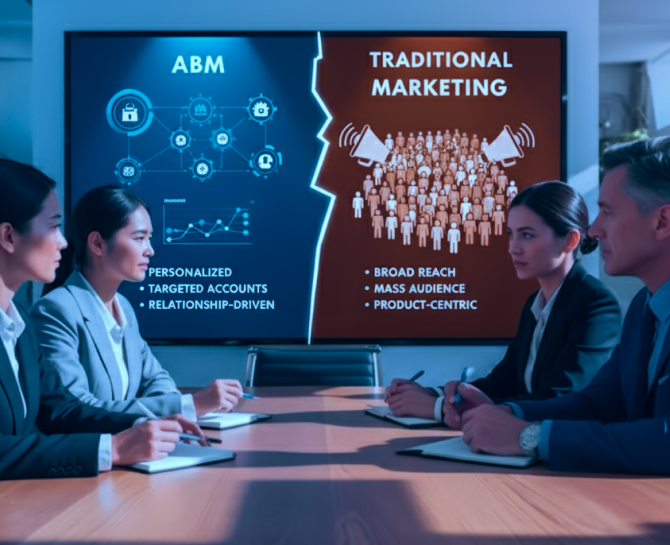
Why the ABM vs Traditional Marketing Debate Could Define Your Next Big Win
The debate between ABM vs Traditional Marketing is redefining how modern brands approach growth. While traditional marketing expands reach through mass campaigns, ABM focuses on precision targeting high-value clients. This article breaks down how each model works, compares their ROI impact, and explains why many marketers are now blending both for maximum results. Whether your goal is brand visibility or conversion efficiency, understanding when and how to use these two strategies together can give your marketing efforts the competitive edge they need.
Marketers are no longer asking if they should change their strategy, but how fast they can adapt. The biggest question driving that change today is ABM vs Traditional Marketing, and the answer could determine whether your next campaign outperforms expectations or fades into the noise.
Traditional marketing focuses on volume. It spreads a single message across wide audiences through advertising, email, or events. ABM, in contrast, is precise and intentional. It targets specific high-value accounts, tailoring every interaction to decision-makers who truly matter. Instead of chasing leads in bulk, it builds relationships that drive meaningful growth.
Choosing between ABM and traditional marketing is not about right or wrong, it is about fit. Each approach serves a different purpose, and knowing which one matches your goals can make all the difference.
Key Takeaways
- ABM focuses on precision, targeting specific high-value accounts with personalized campaigns that build long-term relationships.
- Traditional marketing prioritizes scale and visibility, ideal for driving brand awareness across mass audiences.
- ROI measurement is more transparent in ABM, while traditional marketing excels at generating rapid exposure and recognition.
- Combining both approaches creates a balanced strategy that blends reach with measurable engagement.
- Choosing between ABM and traditional marketing depends on your audience type, goals, and the complexity of your sales cycle.
What Is Account-Based Marketing (ABM)?
Account-Based Marketing, or ABM, is a highly focused growth strategy where marketing and sales teams work together to identify, target, and nurture specific high-value accounts. Unlike traditional campaigns that reach broad audiences, ABM centers on the idea that not every lead deserves equal attention. It channels effort, content, and resources toward companies or decision-makers that have the greatest potential to generate long-term revenue.
In simple terms, ABM treats each target account as a market of one. It involves researching the company’s structure, challenges, and priorities to design campaigns that speak directly to their needs. This creates a personalized buyer experience that builds trust faster and drives stronger engagement.
Example: Imagine a cybersecurity software company targeting five Fortune 500 firms. Instead of sending generic email campaigns, the marketing team develops personalized presentations, custom reports, and tailored demos for each company. The goal is not just to get attention but to position the brand as the ideal solution for that specific client.
When executed correctly, ABM builds deep relationships, improves sales alignment, and maximizes the impact of every marketing dollar invested.
What Is Traditional Marketing?
Traditional marketing is the classic, broad-reach approach that focuses on building brand awareness and attracting potential customers through mass communication. It relies on the principle of visibility: the more people see your message, the higher the chances of conversion.
This strategy includes familiar channels such as television, print, radio, outdoor advertising, and direct mail. In the digital era, it also extends to email blasts, display ads, and general social media promotions that target large audiences rather than specific accounts. The goal is to create widespread recognition and drive interest through repetition and scale.
Example: Consider a consumer electronics company launching a new smart speaker. Instead of identifying specific enterprise clients, it invests in nationwide ads, influencer collaborations, and retail promotions. The focus is on reaching as many potential buyers as possible, regardless of their individual needs or purchase power.
While traditional marketing can generate strong brand visibility and audience reach, it often lacks the precision and personalization that account-based strategies provide. However, when used strategically, it still plays a vital role in top-of-funnel awareness and market expansion.
| Aspect | Account-Based Marketing (ABM) | Traditional Marketing |
|---|---|---|
| Targeting Approach | Focuses on specific, high-value accounts | Targets broad audiences |
| Campaign Strategy | Personalized and research-driven | Standardized and message-driven |
| Sales Alignment | Marketing and sales work jointly | Operates as separate functions |
| Budget Utilization | Concentrated on fewer, high-impact accounts | Distributed across larger audience reach |
| Personalization Level | Deeply customized content per account | One-size-fits-all messaging |
| Conversion Focus | Long-term relationship building | Short-term lead generation |
| ROI Measurement | Based on engagement and deal size | Based on volume and reach metrics |
How ABM Works in Practice
Account-Based Marketing (ABM) thrives on precision and personalization. It is not just another marketing strategy, it is a complete shift in mindset from chasing leads to building valuable business relationships. Instead of asking, “How many leads can we generate?”, ABM asks, “Which accounts will truly drive long-term growth?”
Here is how a well-executed ABM strategy unfolds in practice:
Identify High-Value Accounts
Marketing and sales teams collaborate to identify companies that fit this profile based on industry, size, revenue potential, and alignment with your product or service.
Research and Map Decision-Makers
Once accounts are selected, marketers research each organization in depth. They identify key decision-makers, understand their goals and challenges, and uncover what influences their buying behavior. This research forms the basis for personalized outreach.
Develop Tailored Campaigns
ABM thrives on personalization. Teams create campaigns designed specifically for each account. This can include customized content, personalized email journeys, or presentations addressing that company’s unique challenges.
Engage Across Targeted Channels
Communication happens where decision-makers are most active, through platforms such as LinkedIn, email, or exclusive invite-only events. The goal is quality engagement that drives conversation rather than broad visibility.
Measure and Optimize Continuously
ABM success is measured at the account level. Instead of impressions or generic leads, metrics include account engagement, deal progression, and revenue influence. Insights from one campaign are used to improve the next, ensuring steady performance growth.
Example: A software company identifies ten enterprise clients that perfectly match its offerings. Instead of running a public ad campaign, the team develops personalized case studies for each company, highlighting how its product can solve their specific operational challenges. Every email, webinar, and follow-up presentation is customized for that account’s pain points. Over time, the company builds trust with decision-makers, leading to meaningful conversations and stronger conversion potential.
Pro Tip : When done right, ABM replaces guesswork with strategy. It transforms marketing from a numbers game into a focused approach that builds credibility, fosters alignment with sales, and drives long-term value.
How Traditional Marketing Operates
Traditional marketing has long been the foundation of brand building. It thrives on visibility, repetition, and trust. Before the era of data-driven personalization, this approach helped companies create household names that consumers instantly recognized. Even today, traditional marketing remains powerful when the goal is to reach broad audiences, build awareness, and establish credibility.
Here is how it works in practice:
Understanding the Market
Every campaign begins with audience research. Marketers analyze demographics, interests, and consumer habits to segment audiences into large, relatable groups. The goal is to understand who the audience is and where they spend their attention.
Crafting a Broad Message
The focus here is storytelling that appeals to everyone. Instead of customization, the strategy relies on universal emotions such as trust, excitement, or aspiration to connect with people at scale. Think of memorable slogans or jingles that stay in your mind long after you see the ad.
Launching Across Multiple Channels
Traditional marketing operates through reach. Brands distribute messages across television, print, radio, billboards, events, and even digital ads. The intent is simple: show up everywhere your audience might be.
Capturing Attention and Conversions
Once the campaign rolls out, success depends on recall and response. Metrics like foot traffic, website visits, or direct inquiries indicate whether the campaign resonated. The key advantage is visibility. The more people see your message, the stronger the brand impression becomes.
Evaluating and Reinforcing Success
Strong campaigns are often repeated to reinforce brand identity. Consistency across platforms helps audiences remember the product, trust it, and eventually buy it.
Example: A beverage company launching a new energy drink runs a nationwide campaign featuring athletes and vibrant outdoor billboards. The ads appear across television, streaming platforms, and sports events, creating excitement around the product. The brand does not target individuals. It creates a shared cultural moment that connects everyone watching.
Traditional marketing works best for mass-market products, retail, and industries that rely on emotion and scale. It builds recognition, shapes perception, and lays out the foundation for loyalty that newer digital models can later refine.
Comparing ROI and Conversion Metrics
The difference between ABM and traditional marketing becomes most evident when measuring performance. Both aim to generate returns, but their measurement frameworks, attribution accuracy, and conversion visibility differ significantly. Understanding these distinctions allows marketers to align strategy with business objectives and optimize marketing spend effectively.
1. ROI Measurement Approach
Traditional marketing evaluates ROI at a macro level. It measures overall sales uplift, brand recall, and audience exposure generated from campaigns. Since it reaches large, diverse audiences, pinpointing which channel or activity directly influenced a conversion is often complex. Attribution is typically based on aggregated data, which makes it harder to assess specific performance drivers.
ABM, in contrast, operates on a micro level. It tracks the financial and engagement impact of campaigns at the account level. Because ABM targets fewer but high-value accounts, marketers can measure ROI with higher precision. Metrics such as pipeline growth, deal size, and account retention reveal how personalized interactions translate into revenue. This direct connection between marketing effort and outcome makes ABM inherently more measurable.
2. Conversion Metrics and Measurement Depth
Traditional marketing uses broad-based metrics such as impressions, ad frequency, click-through rates, and total sales volume. These indicators reflect visibility and awareness but provide limited insight into buyer intent.
ABM focuses on depth of engagement rather than breadth. Key performance indicators include:
- Account engagement rate.
- Meeting-to-close ratio.
- Pipeline velocity.
- Revenue influenced per account.
These data points reveal the strength of relationships, quality of leads, and long-term revenue potential rather than surface-level reach.
3. Visibility and Attribution Accuracy
Traditional marketing attribution models are often linear or last-click based. It attributes success to the final touchpoint, ignoring the multi-step influence of earlier interactions. This limits strategic decision-making, especially in long sales cycles.
Pro Tip : ABM uses multi-touch attribution models that map the entire customer journey. From initial engagement to final purchase, every interaction is tracked across marketing and sales touchpoints. This integrated visibility helps teams identify which actions generate the most meaningful conversions.
4. Revenue Impact Over Time
Traditional marketing can deliver fast results, especially during launches or promotions. However, its effects tend to diminish once campaigns end. ABM drives gradual yet consistent growth. Since it focuses on relationship-building and personalized communication, it sustains revenue impact through long-term client retention and upselling opportunities.
Integrating ABM and Traditional Marketing for Hybrid Success
Many organizations find that combining Account-Based Marketing (ABM) with traditional marketing creates a powerful, balanced strategy. Instead of viewing them as competing approaches, blending both allows businesses to enjoy the precision of ABM alongside the reach and credibility of traditional marketing. This hybrid model maximizes engagement, optimizes ROI, and supports both short-term visibility and long-term growth.
1. Align Broad Awareness with Targeted Engagement
Traditional marketing builds visibility, while ABM converts attention into meaningful relationships. For example, a company can use television or digital ads to establish brand recognition and then follow up with personalized ABM campaigns directed at specific enterprise clients. This ensures that initial awareness is reinforced by targeted follow-ups that move high-value prospects through the sales funnel.
2. Use Traditional Campaigns as Top-of-Funnel Triggers
Mass campaigns often generate curiosity among a wide audience, including potential decision-makers. By tracking engagement data, marketers can identify which businesses interacted with the campaign and then move them into ABM programs for personalized nurturing. This creates a seamless journey from broad awareness to one-on-one conversion.
3. Maintain Consistency in Messaging
When both strategies share consistent messaging, tone, and visuals, they strengthen brand identity. Traditional marketing sets the narrative, and ABM deepens it by addressing how your product or service solves specific client problems. Consistent storytelling across channels builds credibility and trust among target accounts.
4. Leverage Data to Bridge Both Approaches
Data analytics plays a central role in integrating ABM and traditional marketing. Audience insights from mass campaigns can help refine target account lists for ABM, while engagement metrics from ABM can guide future brand-level campaigns. This two-way data exchange ensures continuous optimization and smarter investment decisions.
5. Create Unified KPIs for Success Measurement
To make integration effective, align performance metrics across both approaches. For instance, track how traditional campaigns influence ABM conversions, or how ABM relationships impact overall brand perception. A unified analytics framework ensures both efforts contribute to common business goals.
Conclusion
Account-Based Marketing (ABM) and traditional marketing are not rivals but allies in driving growth from different directions. ABM gives you the precision to engage high-value accounts with tailored experiences, while traditional marketing fuels the awareness that keeps your brand top of mind across the market.
The secret lies in using both together. When you combine ABM’s focused targeting with traditional marketing’s broad influence, you create a marketing engine that captures attention and converts it into measurable revenue. Businesses that embrace this hybrid model often find they reach more people, close more deals, and build stronger client loyalty.
So, before choosing sides, ask yourself: Why settle for one when you can amplify both?
The smartest marketers do not pick a side—they build strategies that make ABM and traditional marketing work hand in hand for unstoppable results.
Ready to turn your marketing strategy into measurable success? Let’s Talk!
Our experts at DiGGrowth can help you build an integrated marketing framework that balances precision with scale, ensuring every campaign delivers lasting impact. Connect with us at info@diggrowth.com
Ready to get started?
Increase your marketing ROI by 30% with custom dashboards & reports that present a clear picture of marketing effectiveness
Start Free Trial
Experience Premium Marketing Analytics At Budget-Friendly Pricing.

Learn how you can accurately measure return on marketing investment.

How Predictive AI Will Transform Paid Media Strategy in 2026
Paid media isn’t a channel game anymore, it’s...
Read full post post
Don’t Let AI Break Your Brand: What Every CMO Should Know
AI isn’t just another marketing tool. It’s changing...
Read full post post
From Demos to Deployment: Why MCP Is the Foundation of Agentic AI
A quiet revolution is unfolding in AI. And...
Read full post postFAQ's
ABM focuses on long-term engagement through personalized communication and tailored solutions, which strengthens loyalty among key clients. Traditional marketing, however, primarily attracts new customers and builds brand recognition but may not nurture existing relationships as effectively as ABM strategies do.
Technology is central to ABM execution. Tools such as CRM platforms, intent data software, and marketing automation systems help identify target accounts, track engagement, and deliver personalized content at scale, ensuring that campaigns remain precise, efficient, and measurable.
Yes. ABM may not be suitable for fast-moving consumer goods or industries targeting mass audiences, as these rely on large-scale visibility rather than niche account relationships. It works best in B2B environments with longer sales cycles and high-value client interactions.
Teams should start by identifying ideal customer profiles, narrowing target accounts, and aligning sales with marketing. Gradual integration of personalized campaigns, supported by data insights and account-level tracking, allows for a smoother transition from broad audience outreach to focused engagement.
Maintaining ABM requires consistent data accuracy, collaboration between sales and marketing, and continuous personalization. The challenge lies in balancing scalability with individual account customization while ensuring measurable ROI through regular performance reviews and optimization.