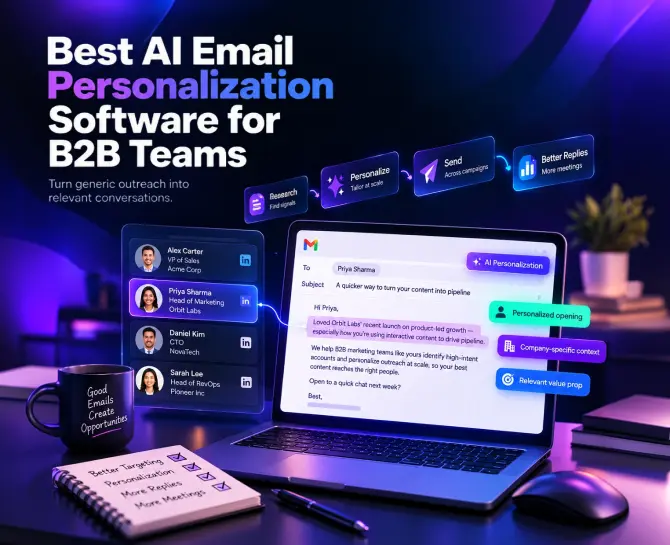
AI Email Personalization Software: How to Choose the Right Platform
AI email personalization software uses recipient, company, CRM, engagement, and business data to adapt email content. Compare personalization levels, platform capabilities, key features, and selection criteria to find the right solution for your B2B team.
Adding a prospect’s first name, company, or job title does not make an email meaningfully personal. B2B buyers expect outreach to reflect their role, company, priorities, and business context.
AI email personalization software uses recipient, company, CRM, engagement, and other relevant data to adapt email messaging. Instead of relying on predefined fields, these platforms use available context to create relevant openings, value propositions, examples, and CTAs.
Personalization quality depends on the data the platform has. Accurate, current data gives AI better inputs, while incomplete or outdated information limits message relevance.
The key buying question is: What level of personalization does the team need, and does the platform have the data and capabilities to support it?
This article compares personalization levels, leading platforms, and the features B2B teams should evaluate before choosing a solution.
What is AI Email Personalization Software?
AI email personalization software uses artificial intelligence to adapt email content using recipient, company, account, CRM, engagement, and business information.
Traditional personalization relies on predefined fields such as first name, company, job title, industry, or location. AI-driven personalization combines multiple data points, including role, company characteristics, technology use, business priorities, and verified developments, to shape email openings, value propositions, examples, and CTAs.
However, AI-generated copy does not automatically mean meaningful personalization. Its quality depends on data sources, research capabilities, AI controls, and integrations.
AI Email Personalization vs. Traditional Email Personalization
| Traditional Personalization | AI-Powered Personalization |
|---|---|
| Uses predefined fields | Combines multiple data sources |
| Relies on fixed templates | Adapts messaging to available context |
| Requires manual research | Assists with research and context discovery |
| Uses predefined segments | Interprets recipient and company context |
| Creates limited variations | Generates context-specific variations |
| Relies on predefined rules | Uses AI to select and adapt information |
| Requires manual content changes | Automates message adaptation |
The key difference is how information is used. Traditional personalization changes predefined elements based on stored fields, while AI-powered personalization interprets multiple inputs to adapt messaging.
AI does not guarantee better personalization. Data quality remains central, so teams must evaluate both messaging capabilities and the quality of the underlying information.
How Does AI Email Personalization Work?
AI email personalization turns recipient, company, CRM, engagement, and business information into relevant messaging. The platform gathers data, identifies useful context, and uses it to shape the email. Some solutions also support sending, sequencing, CRM connections, and performance measurement.
1. Collects Recipient and Company Data
The platform brings together contact, company, role, account, CRM, and engagement data from internal and external sources.
2. Finds Relevant Context
The system identifies useful email angles, such as hiring activity, technology adoption, leadership changes, company priorities, and verified business signals.
3. Selects Useful Information
More information does not automatically produce better personalization. The platform must identify details that support the message instead of inserting every available data point.
4. Generates the Personalized Message
AI uses selected context to adapt the opening, value proposition, examples, or CTA. A relevant message connects that context to a clear business reason for contacting the recipient.
5. Supports Sending and Performance Analysis
Depending on the platform, the process can extend to email sending, sequences, CRM connections, and performance measurement.

What are the Levels of AI Email Personalization?
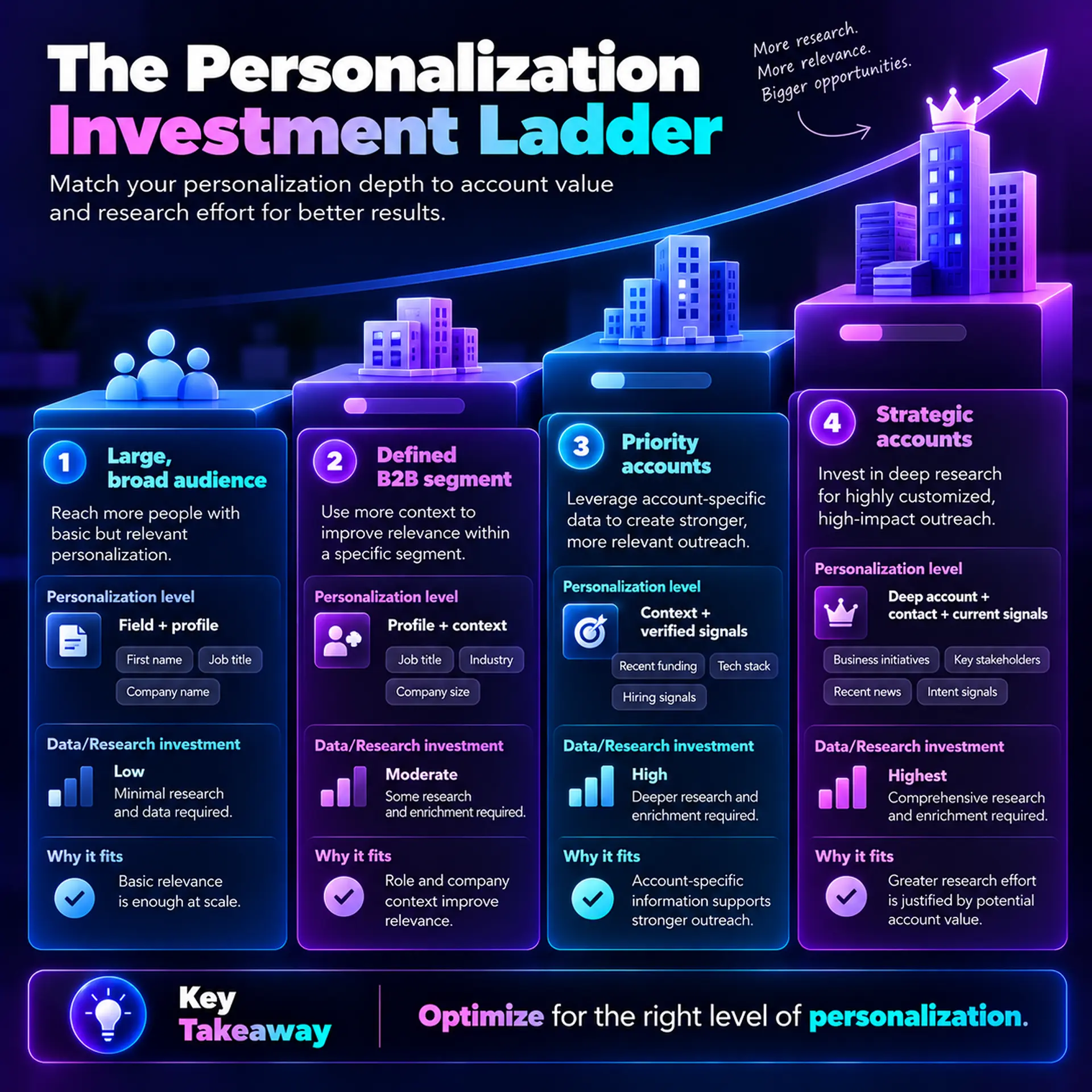
AI email personalization has four levels: field-based, profile-based, context-based, and signal-driven. Each level uses progressively richer information to make outreach more relevant.
Level 1: Field-Based Personalization
This level uses basic information such as first name, company, job title, location, and industry. These details establish basic relevance but rarely provide a strong reason for contacting someone.
Level 2: Profile-Based Personalization
This level adds role, seniority, responsibilities, persona, company size, industry, and business model. Messaging can reflect the recipient’s likely priorities instead of relying only on identity fields.
Level 3: Context-Based Personalization
This level incorporates business priorities, website content, technology environment, hiring activity, and company initiatives. These details create a stronger connection between the email and the account.
Level 4: Signal-Driven Personalization
This level uses current signals such as leadership changes, funding activity, hiring changes, technology changes, and recent engagement. Verified developments can provide a timely reason for outreach.
The right level depends on the audience, account value, and outreach strategy. Higher personalization levels generally require more research, better data, and stronger verification.
Pro Tip- Reserve signal-driven personalization for high-value accounts. Broader segments can use profile- or context-based personalization without unnecessary research.
Key Features to Look for in AI Email Personalization Software
The right platform should support the team’s data requirements, personalization depth, research needs, messaging controls, and execution workflow. Evaluate these capabilities before deciding.
Data and Context Sources
Assess which internal and external sources the platform uses and whether they provide the information required for the intended use case.
Personalization Depth
Determine whether the platform supports the required level, from basic profile information to current, signal-driven context.
AI-Powered Research
Look for research capabilities that reduce manual prospect research while surfacing relevant information about contacts, companies, and accounts.
Data Accuracy and Freshness
Evaluate verification methods, update frequency, matching quality, and safeguards against outdated or incorrect information.
Brand and Messaging Controls
Check whether teams can control tone, positioning, terminology, value propositions, and CTAs to keep messaging consistent.
Human Review and Guardrails
Evaluate approval options, editing controls, and safeguards against unsupported claims or fabricated information, particularly when messages use external research.
Email Execution and Sequencing
Determine whether the platform only generates content or also supports sending, sequences, and automated follow-ups.
CRM and GTM Integrations
Assess compatibility with CRM systems, sales engagement platforms, email providers, and other tools in the existing GTM stack.
Deliverability Controls
For sending platforms, evaluate sending controls, domain protection, email infrastructure, and other deliverability capabilities.
Performance Measurement
Check whether the platform connects personalization activity to replies, meetings, opportunities, pipeline, and other business outcomes.
Pro Tip- Test the platform with incomplete records, not only well-researched prospects. Remove important data points and check whether the system produces sensible messages without inventing details or forcing irrelevant personalization.
Best AI Email Personalization Software
AI email personalization platforms differ in where they create the most value. Some focus on enrichment and account research, while others emphasize prospecting, CRM-driven personalization, email improvement, or outbound execution.
The following comparison highlights their primary use cases and differentiating capabilities.
| Platform | Best For | Key Differentiator | Trade-Off |
|---|---|---|---|
| ReachGen | Account intelligence + personalized prospecting | Enrichment, ICP and decision-maker discovery, verification, segmentation, and personalized outreach | More focused on intelligence and prospecting than email writing alone |
| Clay | Research-driven personalization | Multi-source enrichment, AI web research, intent signals, and outbound activation | Can require more configuration |
| Apollo | Prospecting + sales engagement | Prospect data, AI research, personalized messaging, and sequences | Broad scope |
| HubSpot | CRM-driven personalization | CRM-based content, targeting, and send-time optimization | Best when CRM data is central |
| Salesforge | AI-assisted outbound execution | Personalized email and LinkedIn sequences | More outbound-focused |
| Lemlist | Multichannel personalized outreach | AI research, enrichment, and multichannel outreach | Best for multichannel execution |
| Instantly | Scaled cold-email execution | Campaign management, sending, and AI-assisted personalization | More execution-focused |
| Smartlead | Scaled outbound campaigns | Campaign execution, sending, and deliverability | More execution-focused |
| Lavender | Individual email improvement | AI coaching, recipient context, and writing guidance | Complements existing infrastructure |
| Humanlinker | Deep 1:1 sales personalization | Research, sales intelligence, enrichment, and personalized copy | Better suited to high-touch outreach |
1. ReachGen
Best For: Teams that need account intelligence alongside personalized prospecting.
ReachGen combines account and contact intelligence with firmographic and technographic enrichment, verification, ICP discovery, decision-maker discovery, dynamic segmentation, and AI-powered personalized outreach. It also integrates with Salesforce and HubSpot.
Its differentiator is combining account intelligence with personalized prospecting. Teams can use account and contact context to identify suitable prospects, understand account fit, and support outreach from the same data foundation.
2. Clay
Best For: Teams that need flexible, research-driven personalization.
Clay combines multi-source enrichment with AI web research, intent signals, lead scoring, personalized messaging, and outbound activation. Its flexibility suits teams that want control over research and enrichment inputs, although it can require more configuration.
3. Apollo
Best For: Teams combining prospecting with sales engagement.
Apollo combines prospect and account data with AI research, personalized messaging, and sequences. Its breadth across prospect discovery, research, personalization, and engagement makes it relevant for teams seeking these capabilities in one platform.
4. HubSpot
Best For: Teams that want CRM-driven email personalization.
HubSpot uses unified CRM data to generate personalized email content using contact and company information. Its AI-powered email capabilities also support audience targeting and send-time optimization.
It is a strong fit for teams that want email creation and execution within their existing CRM ecosystem.
5. Salesforge
Best For: Teams that want AI-assisted outbound personalization and execution.
Salesforge supports multichannel outreach across email and LinkedIn, combining personalized messaging with outbound sequences. It is relevant when teams want to connect personalization directly to multichannel prospecting.
6. Lemlist
Best For: Teams combining personalized messaging with multichannel outreach.
Lemlist combines AI-powered research, data enrichment, personalization, and outreach across email, LinkedIn, calls, WhatsApp, and SMS. Its differentiator is the breadth of multichannel execution rather than email personalization alone.
7. Instantly
Best For: Teams prioritizing scaled cold-email execution.
Instantly focuses on cold-email campaign execution, with AI-assisted personalization supporting customized messaging. It suits teams prioritizing sending scale over deep account research.
8. Smartlead
Best For: Teams running scaled outbound campaigns.
Smartlead focuses on outbound campaign execution, including personalization, sending controls, and deliverability capabilities. Its emphasis is on operating outbound campaigns at scale.
9. Lavender
Best For: Sales representatives who need help improving individual emails.
Lavender provides AI email coaching, personalization assistance, recipient context, and real-time writing guidance. It complements existing prospecting and sending infrastructure by improving email quality and rep-level personalization.
10. Humanlinker
Best For: Teams focused on highly personalized 1:1 sales outreach.
Humanlinker combines prospect and account research, AI sales intelligence, enrichment, personalized sales copy, CRM enrichment, and multichannel engagement. Its deeper context supports high-touch sales personalization.
No single platform fits every use case. The right choice depends on whether the primary requirement is data, research, CRM context, message quality, execution, or scale.
[ADD INFOGRAPHIC HERE] Suggested topic: Best AI Email Personalization Software
How to Choose the Right AI Email Personalization Platform
Choosing the right platform requires matching its capabilities to the team’s personalization requirements, existing technology, and business goals.
1. Start With the Personalization Problem
Define the primary requirement: improving individual sales emails, personalizing outbound at scale, creating account-level messaging, supporting CRM marketing, or combining personalization with execution.
2. Determine How Much Research You Need
Decide whether profile information is enough or whether the team needs company context, current business signals, or deeper account intelligence. Research requirements should match the value and complexity of the target audience.
3. Choose Between a Personalization Layer and a Full Platform
If the team already has a CRM and sales engagement system, a personalization layer can add research capabilities without replacing existing tools. A broader platform can simplify a fragmented stack when prospecting, personalization, and execution need to work together.
4. Test With Representative Records
Run a controlled pilot using the team’s own CRM or prospect records.
Evaluate:
- Contact and account match rates.
- Data accuracy and freshness.
- Contextual relevance and factual accuracy.
- Percentage of usable records.
- Human editing and approval requirements.
- Integration and implementation effort.
Testing actual records provides a more realistic view of performance than relying only on product demonstrations.
5. Calculate the Cost of Usable Personalization
Do not compare platforms only by credits, seats, or emails generated. Calculate the cost of records that are accurate, relevant, and ready for use.
For example, at $0.10 per record and an 80% usable rate, the effective cost is $0.125 per usable record. At a 50% usable rate, it increases to $0.20.
Key Buying Principle: The best platform is not necessarily the one with the most AI features. It is the one that produces useful personalization at the required quality, scale, and cost.
[ADD INFOGRAPHIC HERE] Suggested topic: How to Choose the Right AI Email Personalization Platform
How to Measure AI Email Personalization Performance
Measure AI email personalization across engagement, conversion, message quality, and efficiency. These metrics show whether personalization improves outcomes and justifies its operational costs.
Engagement Metrics
Track reply rate, positive reply rate, and click-through rate where relevant.
- Reply rate: Shows whether personalized messaging generates responses.
- Positive reply rate: Indicates whether messages generate relevant responses.
- Click-through rate: Helps assess whether emails create enough interest to move recipients to the next step.
A 2025 randomized test involving more than one million users found that LLM-generated email titles increased click-through rates on items within emails by 23.63%. However, the same experiment found only a non-significant 0.46% open-rate increase and no significant improvement in overall buyer conversion. The study’s findings on AI-generated email titles offer a useful look at the difference between driving clicks and improving conversions.
Compare these metrics with a non-personalized or less-personalized control group. A higher reply rate alone does not prove effectiveness if responses do not progress toward business outcomes.
Conversion Metrics
Measure meetings booked, qualified opportunities, conversion rate, and pipeline generated to determine whether engagement translates into meaningful GTM results.
For example, a campaign that generates more replies but fewer qualified meetings may be producing attention without improving targeting. Pipeline generated provides a stronger business-level measure by connecting personalization to potential revenue impact.
Personalization Quality Metrics
Track accuracy, freshness, relevance, usable records, and human edit or approval rates.
Accurate, current data gives AI a stronger basis for generating relevant messages. Human edit rates also show how much correction is required before emails are usable. Frequent rewrites can reduce the time saved by the platform.
Efficiency Metrics
Measure research time saved, personalized emails per representative, cost per usable record, cost per meeting, and cost per opportunity.
These metrics show whether the platform increases sales capacity and connects technology spend to measurable outcomes. If AI increases personalization volume but also increases data costs, editing time, or acquisition costs, higher output alone does not represent an efficiency gain.
Pro Tip- Compare personalized emails with a relevant control group instead of reviewing personalized campaigns in isolation. Evaluate engagement and downstream conversion to determine whether additional data, research, and AI processing produce measurable improvements.
Conclusion
AI email personalization is more than automated copy generation. Meaningful personalization depends on accurate data, useful context, appropriate research depth, and messaging tied to the recipient’s priorities.
When evaluating AI email personalization software, consider context depth, data quality, the existing GTM stack, scale, and measurable business outcomes.
For teams that need account and contact intelligence alongside personalized prospecting, DiGGrowth’s ReachGen combines enrichment, verification, ICP targeting, account intelligence, decision-maker discovery, and personalized outreach.
Ready to Get Started? Talk to Us!
To explore whether this approach fits your prospecting and personalization needs, contact info@diggrowth.com.
Ready to get started?
Increase your marketing ROI by 30% with custom dashboards & reports that present a clear picture of marketing effectiveness
Start Free Trial
Experience Premium Marketing Analytics At Budget-Friendly Pricing.

Learn how you can accurately measure return on marketing investment.
Lookalike Account Modeling for B2B Revenue Teams
Lookalike account modeling takes a different approach. It studies the attributes and outcomes of successful customers,...
Read full post post
You’re Targeting Your Ideal Customer. So Why Aren’t They Buying?
Your best customers reveal the traits associated with success. Your lost opportunities reveal where fit breaks...
Read full post post
How Predictive AI Will Transform Paid Media Strategy in 2026
Paid media isn’t a channel game anymore, it’s a chessboard. Search, social, programmatic, video, influencer, native,...
Read full post post