Top 8 Best Practices for Using AI Lead Generation Tools to Improve B2B Outreach and Conversions
B2B buyers expect faster, more relevant, and data-driven communication today. This article explains AI lead generation tools best practices for improving targeting, personalization, lead scoring, outreach optimization, and conversion-focused B2B strategies.
Are you among the 56% of marketers who believe generating leads today is easier than it was 10 years ago? According to the HubSpot State of Marketing Report, 2026, AI is changing how businesses approach lead generation and B2B outreach.
What is even more interesting is that 37% of marketers say AI is helping them attract more informed leads. Buyers are entering conversations with better awareness, clearer intent, and stronger buying signals.
Sounds ideal for B2B teams.
But here is the catch: most businesses are still using AI the wrong way.
They are automating outreach, scaling email campaigns, and building massive lead lists, yet many still struggle with low reply rates and poor conversions.
Because AI alone does not fix bad outreach.
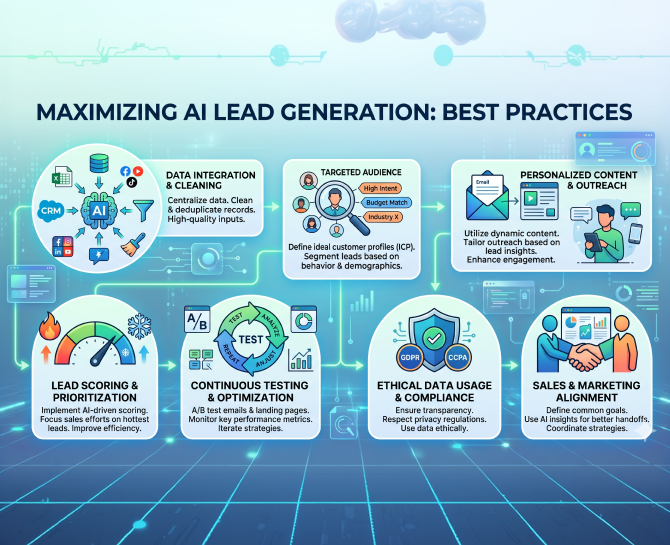
The businesses seeing real results are the ones using AI lead generation tools best practices to personalize conversations, identify high-intent prospects, and focus on leads that are actually likely to convert.
That is where AI starts becoming more than just another automation tool.
Key Takeaways
- AI lead generation tools work best when businesses focus on strategy, not just automation.
- High-intent targeting and accurate prospect data can improve outreach quality more than increasing outreach volume.
- Personalization backed by real engagement insights helps businesses create more relevant B2B conversations.
- AI-powered lead scoring and CRM alignment help sales teams prioritize prospects with stronger conversion potential.
- Continuous testing, optimization, and smarter workflow automation are essential for improving long-term outreach performance.
Why AI Is Becoming a Core Part of B2B Lead Generation
A few years ago, lead generation was mostly manual. Sales teams built prospect lists, researched companies one by one, and sent outreach campaigns based on assumptions rather than real buying signals.
AI is changing that process quickly.
Today, businesses can use AI tools to identify high-intent prospects, analyze customer behavior, personalize outreach, enrich lead data, automate repetitive workflows, and even predict which leads are more likely to convert.
That is a major shift for B2B outreach teams.
Instead of spending hours chasing cold prospects, sales reps can focus on leads already showing signs of interest. Instead of sending the same message to hundreds of companies, teams can create outreach that feels more relevant and timely.
Some platforms help businesses improve prospecting and data enrichment, while others focus on personalization, lead scoring, campaign optimization, or CRM alignment.
Understanding how these tools fit into the outreach process is what helps businesses use AI more strategically.
Here are some of the most commonly used AI lead generation tools businesses rely on to improve B2B outreach and conversions.
AI Lead Generation Tools and Their Best Use Cases
| Tool | Primary Use Case | Best Practice Supported |
|---|---|---|
| Apollo.io | Prospecting and intent-based lead discovery. | Prioritize high-intent leads. |
| ZoomInfo | B2B contact data and buyer intelligence. | Improve lead targeting and segmentation. |
| Clay | Data enrichment and prospect research. | Clean and enrich prospect data. |
| DiGGrowth Email Marketing Dashboard | Campaign engagement tracking and outreach insights. | Personalize outreach and optimize messaging. |
| Outreach | Multi-channel sales engagement workflows. | Manage connected outreach strategies. |
| Salesloft | Sales communication and follow-up sequencing. | Improve multi-channel outreach consistency. |
| HubSpot | CRM management and predictive lead scoring. | Prioritize leads and align outreach with CRM data. |
| 6sense | Intent data and predictive analytics. | Improve lead scoring accuracy. |
| Lavender | AI-powered email optimization. | Test and improve AI-generated messaging. |
| DiGGi-GPT | AI-driven marketing intelligence and reporting insights. | Automate analysis and optimize outreach decisions. |
| Salesforce | CRM and sales pipeline management. | Align outreach with customer and sales data. |
| Clearbit | Company and contact data enrichment. | Improve data quality and targeting accuracy. |
The tools alone are not the competitive advantage. How businesses use them is what improves outreach performance and conversions.
Some tools help identify high-intent prospects, while others improve personalization, lead scoring, campaign optimization, or sales alignment.
The following best practices explain how businesses can use AI lead generation tools more strategically to improve B2B outreach and conversion opportunities.
1. Prioritize High-Intent Leads Instead of Chasing Volume
One of the biggest mistakes businesses make with AI lead generation tools is assuming more leads automatically mean more conversions.
They do not.
A list with 5,000 random prospects will rarely outperform a smaller list filled with people already showing buying intent. Yet many sales teams still focus on volume because AI makes it easy to scale outreach fast.
The problem is that scaling bad targeting only creates more noise.
This is where AI lead generation tools best practices start becoming important. Instead of collecting every possible contact, smart businesses use AI to identify leads that actually match their ideal customer profile.
Tools like Apollo.io, ZoomInfo, and Clay help sales teams filter prospects based on intent signals, company size, industry, hiring activity, technologies used, and buying behavior.
That changes the outreach strategy completely.
Instead of spending hours emailing cold prospects with little interest, sales teams can focus on businesses already showing signs they may need a solution.
For example:
- A company hiring aggressively may need new software tools.
- A prospect visiting pricing pages multiple times may already be comparing vendors.
- A business recently raising funding may be preparing to scale operations.
AI helps surface these signals faster.
And that matters because timing often decides whether outreach gets ignored or answered.
2. Use AI to Personalize Outreach at Scale
Most B2B outreach fails for one simple reason: it feels generic.
Buyers receive dozens of sales emails every week. If the messaging feels irrelevant or too broad, they move on almost instantly.
That is why personalization has become one of the most effective AI lead generation tools best practices for improving B2B outreach and conversions.
But here is the challenge.
Personalizing outreach manually across hundreds of leads, multiple industries, and different buyer journeys is almost impossible to scale efficiently.
How DiGGrowth Helps Businesses Improve Outreach Personalization
This is where DiGGrowth’s Email Marketing Dashboard becomes valuable for B2B teams.
Instead of relying on assumptions, the dashboard helps businesses understand how prospects are actually engaging with email campaigns. Teams can track metrics like:
- Email open rates.
- Click-through rates.
- Link interactions.
- Webpage visits.
- Form submissions.
- Account-level engagement activity.
That visibility gives sales and marketing teams something most outreach campaigns lack: context.
For example, imagine a SaaS company running email campaigns across ecommerce and fintech audiences. Instead of sending the same follow-up sequence to every lead, the team can analyze engagement patterns inside the dashboard.
If ecommerce prospects are consistently clicking on emails related to attribution tracking and customer acquisition costs, that becomes a clear signal about what matters most to that audience. Outreach can then focus more heavily on those pain points.
At the same time, if fintech leads are engaging more with emails related to reporting accuracy and operational visibility, messaging can shift accordingly.
That changes outreach from generic to data-informed.
3. Clean and Enrich Prospect Data Before Outreach
Many B2B outreach campaigns underperform because the prospect data behind them is outdated or incomplete.
Incorrect job titles, inactive contacts, duplicate records, and missing company information can significantly reduce outreach effectiveness. Even well-written messaging struggles when businesses target the wrong audience.
This is why data quality remains one of the most important AI lead generation tools best practices for improving B2B outreach and conversions.
Why Accurate Prospect Data Matters
Personalization only works when the underlying data is reliable. If businesses are working with inaccurate CRM records, outreach becomes less relevant and conversion opportunities decrease.
Tools like Clearbit and Clay help businesses enrich prospect profiles with updated company information, firmographic insights, and contact details before outreach campaigns begin.
This allows sales and marketing teams to segment audiences more effectively, improve targeting accuracy, and create outreach campaigns that are more aligned with the right buyers.
Because in B2B lead generation, stronger conversions often begin with better data quality.
4. Combine AI With Multi-Channel Outreach Strategies
Relying on a single outreach channel is becoming less effective in B2B sales.
An email may go unread. A LinkedIn message may get noticed later. A webinar interaction may create the actual conversion opportunity. Buyers move across platforms before responding, and outreach strategies need to reflect that behavior.
This is why combining multiple channels has become one of the most effective AI lead generation tools best practices for improving B2B outreach and conversions.
AI helps businesses understand where prospects are engaging and which channels are driving stronger interactions. Instead of relying only on email campaigns, sales teams can build more connected outreach journeys across LinkedIn, email, webinars, retargeting campaigns, and follow-ups.
Tools like Outreach and Salesloft help businesses manage multi-channel outreach sequences while maintaining consistency in communication.
For example, a prospect may ignore an initial cold email but later engage with a LinkedIn post or revisit a pricing page. Those engagement signals create better opportunities for more relevant follow-ups.
Pro Tip- The goal is not to increase outreach volume across every platform. It is to create connected interactions that feel more timely, more relevant, and more aligned with how B2B buyers actually engage today.
5. Use Predictive Lead Scoring to Prioritize Sales Efforts
Not every lead has the same conversion potential.
Some prospects are actively researching solutions and ready for conversations. Others may only be exploring options with no immediate intent to buy. Treating both the same often leads to wasted sales effort.
This is why predictive lead scoring has become one of the most valuable AI lead generation tools best practices for improving B2B outreach efficiency.
Instead of relying only on manual qualification, AI can analyze engagement patterns, behavioral signals, company data, and past interactions to identify which leads are more likely to convert.
Tools like HubSpot and 6sense help businesses prioritize leads based on intent and engagement data rather than assumptions alone.
For example, a lead consistently visiting product pages, engaging with email campaigns, and downloading resources may signal stronger buying intent than a contact with minimal interaction. AI helps sales teams identify those patterns faster.
That changes how outreach is prioritized.
Instead of spending equal time on every prospect, teams can focus more attention on leads showing higher engagement and stronger conversion potential.
The result is often better sales efficiency, more qualified conversations, and a stronger pipeline overall.
6. Continuously Test and Optimize AI-Generated Messaging
AI can help businesses create outreach faster.
But faster messaging does not automatically mean better messaging.
One of the biggest mistakes companies make is assuming AI-generated emails will perform well without testing, refinement, or optimization. In reality, even small changes in subject lines, tone, personalization, or call-to-action placement can significantly impact engagement rates.
This is why continuously testing outreach content has become one of the most important AI lead generation tools best practices for improving B2B conversions.
Tools like Lavender help sales teams improve email quality and optimize messaging performance, while DiGGrowth’s Email Marketing Dashboard helps businesses analyze engagement trends across campaigns.
Instead of relying on assumptions, teams can evaluate how different audience segments respond to outreach based on real campaign data.
What Should Businesses Optimize in AI-Generated Outreach?
Businesses should continuously evaluate:
- Which subject lines improve open rates?
- Which messaging style drives more replies?
- Which calls-to-action generate stronger engagement?
- Which audience segments respond best to specific messaging approaches?
AI makes testing easier by helping teams generate and refine outreach variations quickly, but the real advantage comes from using performance data to improve messaging over time.
Because in B2B outreach, better messaging is rarely created once. It is optimized continuously based on audience behavior and engagement trends.
Pro Tip- Do not optimize outreach based only on open rates. A subject line may increase opens but still fail to generate replies or conversions. Focus on deeper engagement metrics like response rates, booked meetings, and pipeline contribution to understand whether AI-generated messaging is actually improving outreach performance.
7. Automate Repetitive Tasks Without Losing Human Relevance
AI can save B2B teams a significant amount of time.
But is automation alone enough to improve conversions?
Not really.
Many businesses automate outreach workflows but still struggle with engagement because the focus stays on speed instead of relevance. Buyers still expect communication that feels timely, contextual, and aligned with their needs.
This is why one of the most effective AI lead generation tools best practices is automating repetitive operational tasks while keeping outreach decisions data-driven and customer-focused.
Example: How Can Teams Make Faster Outreach Decisions
Sales and marketing teams often spend hours pulling reports, analyzing campaign performance, and identifying which channels are actually generating qualified leads.
That process slows down optimization.
This is where DiGGi-GPT can help businesses streamline decision-making. The AI-powered assistant allows teams to ask questions in plain English and quickly access insights from their marketing and campaign data.
For example, teams can identify:
- Which campaigns are driving high-quality leads?
- Which channels are underperforming?
- Which audience segments are engaging most with outreach efforts?
- Where are customer acquisition costs increasing?
Instead of manually reviewing multiple dashboards, teams can access actionable insights faster and make quicker outreach adjustments based on real performance data.
That creates a more efficient workflow without removing the human side of B2B communication.
Because the goal is not to automate every interaction. It is to reduce repetitive work so teams can focus more on strategy, personalization, and meaningful conversations that improve conversions.
8. Align AI Outreach With CRM and Sales Data
AI outreach becomes far more effective when sales and marketing data work together.
Many businesses still manage outreach campaigns separately from their CRM systems. Marketing teams track engagement in one platform, while sales teams manage follow-ups somewhere else. That disconnect often creates inconsistent communication, missed follow-ups, and weaker conversion opportunities.
This is why aligning AI outreach with CRM and sales data is one of the most effective AI lead generation tools best practices for improving B2B outreach performance.
When outreach activity, customer engagement, and sales interactions are connected, businesses gain a clearer view of the buyer journey. Sales teams can understand which campaigns a lead engaged with, which pages they visited, and how they interacted with previous outreach before starting conversations.
Tools like Salesforce and HubSpot help businesses centralize outreach and customer data, making it easier to improve targeting, follow-up timing, and lead prioritization.
For example, if a prospect revisits pricing pages multiple times or engages heavily with product-related emails, sales teams can prioritize follow-ups based on real engagement signals instead of assumptions.
Because in B2B outreach, better visibility often leads to better conversions.
Conclusion
AI lead generation tools are becoming a core part of modern B2B outreach.
Most businesses are already using them in some way.
But using AI is not enough.
The real results come from using AI strategically.
That means prioritizing high-intent leads, improving personalization, cleaning prospect data, optimizing outreach messaging, and connecting AI insights with CRM and sales workflows.
The businesses doing this well are not just automating outreach.
They are building smarter conversations that lead to better conversions.
Whether you are improving lead scoring, scaling multi-channel campaigns, or optimizing outreach performance, the right AI lead generation strategy can help your team work more efficiently and close more qualified opportunities.
And if you want a clearer view of what is driving engagement, conversions, and pipeline growth, DiGGrowth can help you make smarter, faster marketing decisions.
Book a demo with DiGGrowth and see how your team can improve B2B outreach with AI-driven insights and better conversion visibility.
Ready to get started?
Increase your marketing ROI by 30% with custom dashboards & reports that present a clear picture of marketing effectiveness
Start Free Trial
Experience Premium Marketing Analytics At Budget-Friendly Pricing.

Learn how you can accurately measure return on marketing investment.
You’re Targeting Your Ideal Customer. So Why Aren’t They Buying?
Your best customers reveal the traits associated with success. Your lost opportunities reveal where fit breaks...
Read full post post
How Predictive AI Will Transform Paid Media Strategy in 2026
Paid media isn’t a channel game anymore, it’s a chessboard. Search, social, programmatic, video, influencer, native,...
Read full post post
Don’t Let AI Break Your Brand: What Every CMO Should Know
AI isn’t just another marketing tool. It’s changing how we connect with customers, personalize content, and...
Read full post postFAQ's
AI lead generation tools help businesses identify high-intent prospects, automate repetitive tasks, personalize outreach, and prioritize leads more effectively. This helps sales and marketing teams improve engagement and focus on prospects with stronger conversion potential.
Sending more automated emails does not guarantee conversions. Stronger results usually come from better targeting, personalization, and data-driven outreach strategies.
Tools like Clay, Lavender, and DiGGrowth’s Email Marketing Dashboard help businesses personalize outreach by using engagement insights, prospect data, and messaging optimization to create more relevant communication.
CRM integration helps businesses connect customer interactions, campaign engagement, and sales activity in one place. This gives teams better visibility into buyer behavior and improves follow-up timing, lead scoring, and conversion opportunities.
Yes. Small businesses can use AI tools to automate manual work, improve prospect targeting, and optimize outreach without needing large sales teams. Even simple AI-driven insights can help improve lead quality and outreach efficiency.