
AI-Powered Lead Generation: Revolutionizing Customer Acquisition
AI-powered lead generation revolutionizes customer acquisition by automating prospect identification, enriching data, and optimizing outreach. With machine learning and predictive analytics, businesses can identify high-quality leads, personalize engagement, and accelerate conversions. From AI-driven lead scoring to CRM integration, discover how smart automation enhances sales efficiency and improves marketing ROI.
AI-powered lead generation automates the process of identifying, attracting, and nurturing potential customers. By leveraging machine learning algorithms and predictive analytics, AI filters vast datasets to pinpoint high-quality leads with precision.
Traditional lead-generation methods relied on manual outreach, cold calls, and broad advertising campaigns. These approaches often consumed time and resources with inconsistent results. AI-driven solutions have replaced guesswork with data-driven precision, enabling businesses to identify ideal prospects faster and more accurately. Machine learning models analyze customer behavior, automate outreach, and optimize engagement strategies. AI not only reduces operational workload but also enhances personalization, ensuring that prospects receive relevant content at the right moment. Businesses that integrate AI into lead generation workflows see higher conversion rates, improved customer relationships, and a more efficient sales pipeline.
Enhanced Data Strategies: Data Enrichment and Lead Scoring
The significance of data quality in lead generation
Lead generation depends on the accuracy, completeness, and relevance of data. Poor-quality data increases acquisition costs, reduces conversion rates, and leads to inefficient resource allocation. A Salesforce report found that 70% of CRM data becomes outdated annually, making data maintenance essential for sustained lead flow.
AI-driven approaches mitigate these issues by automating data cleansing, deduplication, and validation. Algorithms detect anomalies, remove redundant entries, and enhance datasets with real-time updates, ensuring that businesses operate with precise and actionable insights.
Techniques for data enrichment
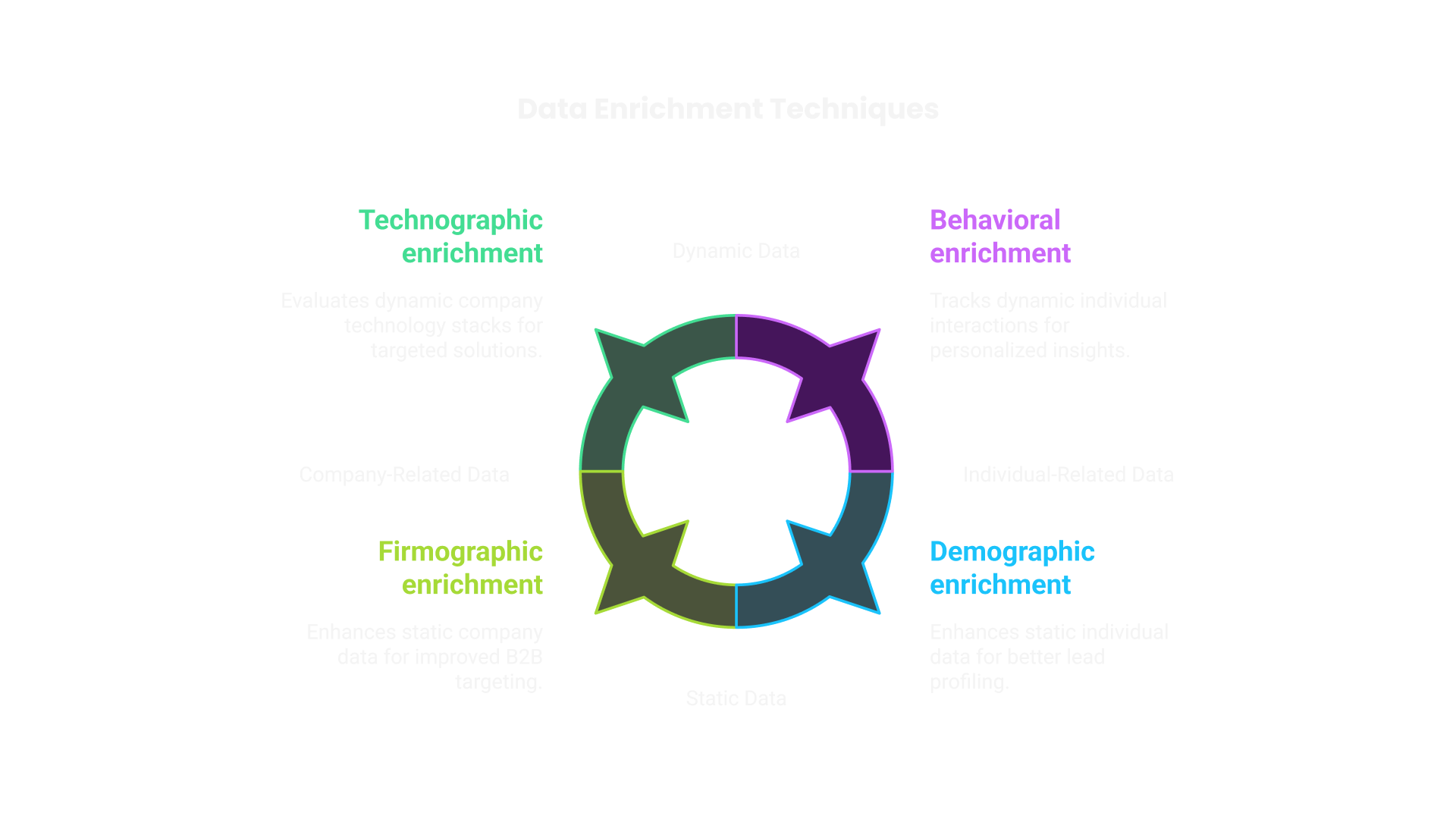
- Firmographic enrichment: AI supplements company-related data, including industry classification, revenue estimates, and employee counts, improving B2B targeting.
- Demographic enrichment: Algorithms enhance lead records with age, location, and professional details extracted from publicly available datasets.
- Behavioral enrichment: AI tracks digital interactions, such as website visits, email engagement, and content consumption patterns, creating dynamic profiles.
- Technographic enrichment: AI evaluates a prospect’s technology stack, offering insights for targeted software solutions.
The role of AI in lead scoring
Lead scoring quantifies a prospect’s potential to convert, distinguishing high-value leads from unqualified prospects. Traditional scoring methods rely on predefined rules, whereas AI-driven models adapt based on behavioral patterns and historical data.
Machine learning algorithms assess thousands of data points, weighting attributes such as past interactions, firmographics, engagement frequency, and predictive intent signals. Algorithms like logistic regression, decision trees, and neural networks continuously refine scoring models, identifying patterns that manual methods overlook.
Predictive lead scoring incorporates real-time data, dynamically adjusting scores as prospects engage with emails, content, and digital touchpoints. AI optimizes scoring thresholds, ensuring sales teams prioritize leads with the highest probability of conversion.
Conversing with Potential: Natural Language Processing for Lead Engagement
Fundamentals of NLP in Understanding Customer Queries
Natural Language Processing (NLP) enables AI systems to interpret, process, and respond to human language in a meaningful way. Tokenization breaks sentences into individual words or phrases, giving the system a structured dataset. Named Entity Recognition (NER) identifies crucial pieces of information such as names, dates, and product mentions. Sentiment analysis gauges customer intent by recognizing the emotions behind the text.
AI models, such as transformer-based architectures like BERT and GPT, excel at context retention. These models analyze conversational patterns, helping businesses recognize lead intent and urgency. By identifying patterns in language and tone, NLP-based systems distinguish between inquiries, complaints, and buying signals.
Personalization of Customer Interaction
Dynamic response generation in NLP enables AI-driven systems to craft relevant replies based on customer data. User history, past interactions, and browsing behaviors influence the generated messages. Instead of generic responses, NLP-driven systems adapt replies to mirror an individual’s unique preferences.
Natural Language Understanding (NLU) enhances this personalization by classifying requests into categories and determining the most appropriate course of action. A returning customer asking about a pricing plan receives a response acknowledging their previous interactions, while a new lead may receive a guided product introduction.
- Context-aware recommendations: AI identifies products or solutions aligned with the customer’s expressed needs.
- Adaptive conversation flows: Sentiment shifts alter the chatbot’s approach, ensuring the tone remains appropriate.
- Multilingual support: NLP-powered systems bridge language barriers, allowing businesses to engage leads in their preferred language.
NLP for Improved Customer Experiences and Engagement
Rapid, accurate responses increase engagement and reduce friction in the buying process. NLP enables real-time query resolution, minimizing wait times that often cause leads to disengage. Predictive text suggestion further streamlines communication, enabling AI chat systems to anticipate customer needs before they explicitly state them.
Conversational AI powered by NLP makes interactions feel more human. By mimicking natural speech patterns, these systems foster trust and increase lead retention rates. Interactive dialogues simulate real sales conversations, keeping prospects interested. An AI-powered assistant that understands slang, idioms, and industry-specific terminology ensures a seamless conversation flow.
Beyond chat interactions, NLP-driven sentiment monitoring offers valuable insights. By analyzing tone and wording across customer touchpoints, businesses detect shifts in engagement levels. Leads showing hesitancy may receive additional nurturing efforts, while high-intent prospects move through the sales pipeline more efficiently.
Pro Tip- Leverage NLP-driven sentiment analysis to prioritize leads—engage high-intent prospects immediately while nurturing hesitant ones with personalized follow-ups to maximize conversions.
Streamlining Communication: Email Marketing Automation
Email Marketing in the Lead Generation Landscape
Email remains a primary channel for lead generation, delivering an average return of $42 for every dollar spent, according to the Data & Marketing Association. AI-powered email automation enhances this efficiency by optimizing timings, messaging, and audience targeting. Automated workflows guide leads through the sales funnel while minimizing manual intervention.
Marketing automation platforms leverage AI to analyze user behavior, predict engagement patterns, and send targeted emails at strategic moments. Traditional batch-and-blast email campaigns lose effectiveness when compared to AI-driven sequencing, which adapts to individual recipient responses. Automated email workflows nurture leads with content relevant to their interests and actions.
Benefits of Automation for Timely and Relevant Communication
- Consistent Engagement: AI ensures emails reach recipients at optimized times based on historical engagement data.
- Time Efficiency: Automated workflows reduce manual effort, allowing teams to focus on strategy and higher-level planning.
- Lead Nurturing: AI adapts messaging based on user interactions, guiding leads through tailored email sequences.
- Increased Conversion Rates: Personalized automation improves engagement, resulting in more conversions compared to static email campaigns.
Behavioral Email Triggers and Dynamic Content for Personalization
Behavior-driven email automation enhances engagement by responding to user actions. AI identifies key behaviors, such as email opens, link clicks, or abandoned carts, and triggers emails accordingly.
- Lead Interaction Monitoring: AI tracks user activity, triggering emails based on past actions or inactivity.
- Cart Abandonment Recovery: E-commerce brands use AI to send reminders, offer incentives, or display related products.
- Re-Engagement Campaigns: AI segmentation identifies inactive leads, delivering personalized content to reignite interest.
Dynamic email content further refines personalization. AI-driven systems customize subject lines, product recommendations, and body text based on user preferences. Personalized emails outperform generic ones, generating six times higher transaction rates, according to Experian.
A sophisticated AI-powered email marketing strategy keeps leads engaged, nurtured, and primed for conversion. Automated sequences adapt in real-time, ensuring each message aligns with recipient needs.
System Synergy: Integration with CRM Systems
The Critical Role of CRM Integration with AI Tools
AI-powered lead generation reaches its full potential when seamlessly integrated with customer relationship management (CRM) systems. A standalone AI tool can analyze data, score leads, and automate engagement, but without direct synchronization with a CRM, critical insights remain siloed. Organizations that integrate AI with their CRM gain a unified view of customer interactions, from initial touchpoints to post-sale engagement.
Data consistency improves immediately with AI-powered automation feeding real-time behavioral insights into CRM platforms. Sales teams access AI-enriched lead profiles, complete with predictive analytics that highlights conversion probability and optimal outreach timing. Automated workflows ensure that leads are not just generated are tracked, nurtured, and converted without manual intervention.
How AI Boosts CRM Effectiveness in Lead Management
Once integrated, AI enhances lead management in multiple ways by optimizing data handling, accelerating response times, and personalizing communication strategies. AI-driven CRMs streamline lead categorization, using machine learning to classify potential buyers based on behavioral patterns and engagement metrics.
- Automated Lead Scoring: AI assigns numerical values to leads based on engagement history, site behavior, and demographic data, ensuring sales teams prioritize high-intent prospects.
- Intelligent Follow-Ups: NLP-driven CRM integrations trigger automated follow-ups, adjusting messaging based on previous interactions and detected sentiment.
- Predictive Analytics for Conversion: Machine learning identifies buying signals and recommends action plans for sales representatives, increasing the probability of conversion.
- Elimination of Data Silos: AI consolidates customer data across various channels-email, social media, and website interactions-into a single CRM dashboard for a 360-degree prospect view.
The synergy between AI and CRM systems transforms lead generation into a highly efficient, data-driven process. Organizations leveraging this integration gain clarity, automation, and precision in their sales pipelines, ensuring higher conversion rates with reduced manual effort.
Pro Tip- Integrate AI-powered lead scoring with your CRM to automatically prioritize high-intent prospects—helping your sales team focus on the most valuable opportunities and close deals faster.
Predictive Power: AI in Sales Forecasting and Trends Analysis
The Impact of AI on Sales Forecasting
AI-powered models outperform traditional forecasting methods by processing vast datasets with precision. Machine learning algorithms analyze historical sales figures, customer behaviors, and market variables to generate predictions. According to a 2023 report by McKinsey, companies implementing AI in sales forecasting experience a 10-20% increase in forecast accuracy, leading to better resource allocation and inventory management.
Neural networks and regression models detect patterns hidden within complex datasets, allowing businesses to anticipate demand fluctuations. AI-driven forecasting also adapts dynamically, updating projections in real-time based on new data inputs. This agility reduces the risk of stock shortages or overstocking, optimizing supply chain operations.
Analyzing Market Trends with AI
AI continuously monitors consumer behaviors, economic indicators, and industry shifts to reveal emerging market trends. Natural language processing (NLP) scans news, social media, and financial reports, identifying sentiment changes that may indicate shifts in demand.
- Sentiment Analysis: AI evaluates online discussions and customer reviews to gauge product or service perception.
- Competitor Monitoring: Algorithms track competitor activity, including pricing strategies and promotional efforts.
- Seasonal Trends Detection: Machine learning models recognize recurring sales patterns, helping businesses adjust campaigns accordingly.
- Economic Forecast Integration: AI correlates sales data with macroeconomic factors, such as inflation rates and consumer confidence indices.
By interpreting these insights, businesses can respond proactively, adjusting strategies before market shifts impact revenue.
How Businesses Can Leverage AI for Strategic Planning
AI enables data-driven decision-making, reducing reliance on intuition and guesswork. Predictive analytics inform pricing strategies, helping companies optimize profit margins without sacrificing competitiveness. Personalized recommendations, based on AI-driven insights, enhance upsell and cross-sell opportunities.
Scenario modeling powered by AI allows businesses to test multiple strategic approaches. Companies simulate various market conditions, evaluating which strategies yield the highest returns. This approach minimizes financial risk, ensuring preparedness for potential disruptions.
AI-powered lead generation platforms integrate forecasting insights, prioritizing high-value prospects. Sales teams receive predictive lead scores, allowing them to focus efforts on opportunities most likely to convert. This targeted approach increases efficiency, improves conversion rates, and accelerates revenue growth.
Pro Tip- Use AI-driven sales forecasting to anticipate demand shifts and refine your inventory, marketing, and pricing strategies—giving your business a competitive edge in dynamic markets.
Measuring Success: Performance Metrics and KPIs for AI-Powered Campaigns
Key Performance Indicators for Evaluating AI-Driven Lead Generation
AI-powered lead generation campaigns require precise measurement. Key performance indicators (KPIs) determine whether automation, predictive analytics, and personalization deliver measurable outcomes. Among the most relevant KPIs:
- Lead Conversion Rate: Measures the percentage of leads that transition into customers. A high rate signals effective targeting and engagement.
- Cost per Lead (CPL): Calculates the expense incurred for each acquired lead. AI optimization should lower this metric over time.
- Lead Velocity Rate (LVR): Tracks the month-over-month growth of qualified leads, revealing whether AI is improving pipeline acceleration.
- Engagement Rate: Analyzes interactions with AI-driven channels such as chatbots, emails, and personalized content.
- Sales Cycle Length: Measures the duration from first interaction to conversion. AI should shorten this timeline through predictive scoring and automated nurturing.
Tracking and Analyzing AI Campaign Effectiveness
Performance tracking relies on continuous monitoring of data points. AI algorithms generate insights by analyzing historical trends, customer responses, and campaign effectiveness. Methods of tracking include:
- A/B Testing: Compares different AI-driven approaches to identify higher-performing strategies.
- Attribution Modeling: Assigns credit to various touchpoints, helping assess AI’s role in guiding leads through the funnel.
- Real-Time Dashboards: Provides instant visibility into metrics such as response rates, engagement trends, and generated pipeline value.
- Customer Segmentation Analysis: Evaluates AI’s accuracy in clustering prospects based on behavioral and demographic data.
Continuous Improvement Through Data-Driven Insights
Optimizing AI-powered lead generation requires iterative refinements. Data-driven insights fuel these enhancements by pinpointing strengths and weaknesses. Strategies for ongoing improvement include:
- Feedback Loops: AI models refine targeting through machine learning adjustments based on real engagement data.
- Predictive Model Calibration: Regular updates enhance lead scoring accuracy and conversion likelihood predictions.
- Cohort Analysis: Identifies emerging trends in customer behaviors, allowing AI to adapt messaging and engagement tactics.
- Anomaly Detection: Flags unexpected drops or spikes in metrics, prompting deeper analysis and corrective actions.
Evaluating AI-driven campaigns requires precision. Tracking KPIs, analyzing trends, and refining strategies lead to higher conversion efficiency and optimized performance.
Pro Tip- Leverage AI-powered real-time dashboards to monitor KPIs dynamically, ensuring data-driven adjustments that maximize lead generation efficiency and conversion rates.
Selecting Your AI Arsenal: Choosing the Right AI-Powered Lead Generation Tools
Key Criteria for Selecting AI-Powered Lead Generation Tools
- Accuracy and Efficiency: The best AI tools leverage advanced machine learning models to enhance lead scoring, automate customer interactions, and refine predictive analytics.
- Integration with Existing Systems: The ability to seamlessly connect with CRM platforms, marketing automation software, and data analytics tools ensures a streamlined workflow.
- Scalability: Businesses need AI solutions that grow with their operations, maintaining functionality without sacrificing speed or reliability.
- Data Privacy and Compliance: Tools must adhere to regulatory frameworks such as GDPR or CCPA, minimizing risk and ensuring responsible data management.
- User-Friendliness: An intuitive interface and clear reporting features enable marketing teams to leverage AI insights without extensive technical expertise.
- Customization and Flexibility: AI tools with adaptable algorithms, configurable lead-scoring models, and workflow automation help businesses tailor solutions to specific needs.
- Cost vs. Value: A balance between affordability and functionality ensures companies receive the highest return on their AI investment.
Scalability, Budget, and Integration: Weighing Your Options
Choosing the right AI-powered lead generation tool requires balancing long-term needs with immediate business constraints.
- Scalability: Enterprise-level tools such as Salesforce Einstein support large-scale operations, while lean startups may benefit from cost-effective solutions like Apollo.io.
- Budget Considerations: Subscription-based models offer flexibility but vary in pricing tiers. Businesses should assess whether feature sets align with anticipated ROI.
- Ease of Integration: API accessibility matters. Platforms like Marketo Engage include native integrations, while others may require additional configuration efforts.
Key Takeaways
- AI eliminates guesswork by analyzing vast datasets, identifying high-quality leads, and automating outreach. Businesses leveraging AI-driven insights experience higher conversion rates and improved sales efficiency.
- Accurate, enriched data improves prospect profiling, while AI-driven lead scoring prioritizes high-value leads based on behavioral patterns, firmographics, and engagement history. This ensures sales teams focus on the most promising opportunities.
- NLP-powered chatbots and AI-driven email marketing enhance customer interactions, ensuring timely, context-aware responses. AI adapts messaging dynamically, increasing engagement and reducing drop-offs.
- Seamlessly integrating AI with CRM systems and sales forecasting tools provides real-time insights, automates lead nurturing, and optimizes sales strategies. Businesses that adopt AI-powered tools gain a competitive advantage in data-driven decision-making.
Selecting the right AI-powered lead generation tool demands evaluating its accuracy, automation capabilities, and long-term adaptability.
The right choice enhances marketing efficiency, strengthens pipeline management, and drives revenue growth. Drop us a line at info@diggrowth.com for assistance in AI-powered lead generation.
Ready to get started?
Increase your marketing ROI by 30% with custom dashboards & reports that present a clear picture of marketing effectiveness
Start Free Trial
Experience Premium Marketing Analytics At Budget-Friendly Pricing.

Learn how you can accurately measure return on marketing investment.
How Predictive AI Will Transform Paid Media Strategy in 2026
Paid media isn’t a channel game anymore, it’s...
Read full post post
Don’t Let AI Break Your Brand: What Every CMO Should Know
AI isn’t just another marketing tool. It’s changing...
Read full post post
From Demos to Deployment: Why MCP Is the Foundation of Agentic AI
A quiet revolution is unfolding in AI. And...
Read full post postFAQ's
AI automates prospect identification, enriches data, and predicts conversion likelihood using machine learning, making lead generation more efficient and targeted.
Data enrichment enhances lead profiles with firmographic, demographic, and behavioral insights, ensuring businesses engage with the most relevant prospects.
AI analyzes engagement history, customer behavior, and firmographics to assign scores, helping sales teams prioritize high-intent leads.
Yes, AI-powered chatbots, NLP-driven messaging, and dynamic email automation deliver personalized, context-aware communication based on user behavior.
CRM integration ensures seamless data flow, automates lead tracking, and enhances predictive analytics, enabling more effective sales strategies.