
AI Sales Email Generator: How to Automate Prospecting Without Losing Personalization
Relevant sales emails need more than names and job titles to drive meaningful conversations. An AI sales email generator connects prospect context with messaging, covering key types, common mistakes, workflow, personalization rules, and ways to measure outreach beyond email volume.
AI can write a sales email in seconds. So why are so many sales teams still spending hours figuring out what to send?
The bottleneck is not writing. It is knowing what makes the message relevant to this prospect, at this account, right now.
A sales team can have a clear ICP, thousands of prospects, and automated sequences ready to run. Yet if personalization stops at a first name, company name, or job title, the email can still feel like every other message in the inbox.
AI is changing how quickly teams can research, create, and deploy email campaigns, according to Litmus:
- 78% of teams now produce and deploy an email within three days or less.
- Advanced AI adopters are 75% more likely to achieve email ROI above 45:1.
But speed alone does not make outreach better.
The bigger opportunity is connecting prospect intelligence with email generation: understanding the account, identifying relevant signals, recognizing the buyer’s priorities, and using that context to shape the message.
That is where an AI sales email generator becomes more than a faster copywriting tool. It can turn the work behind prospecting into relevant outreach without making every email sound the same.
Key Takeaways
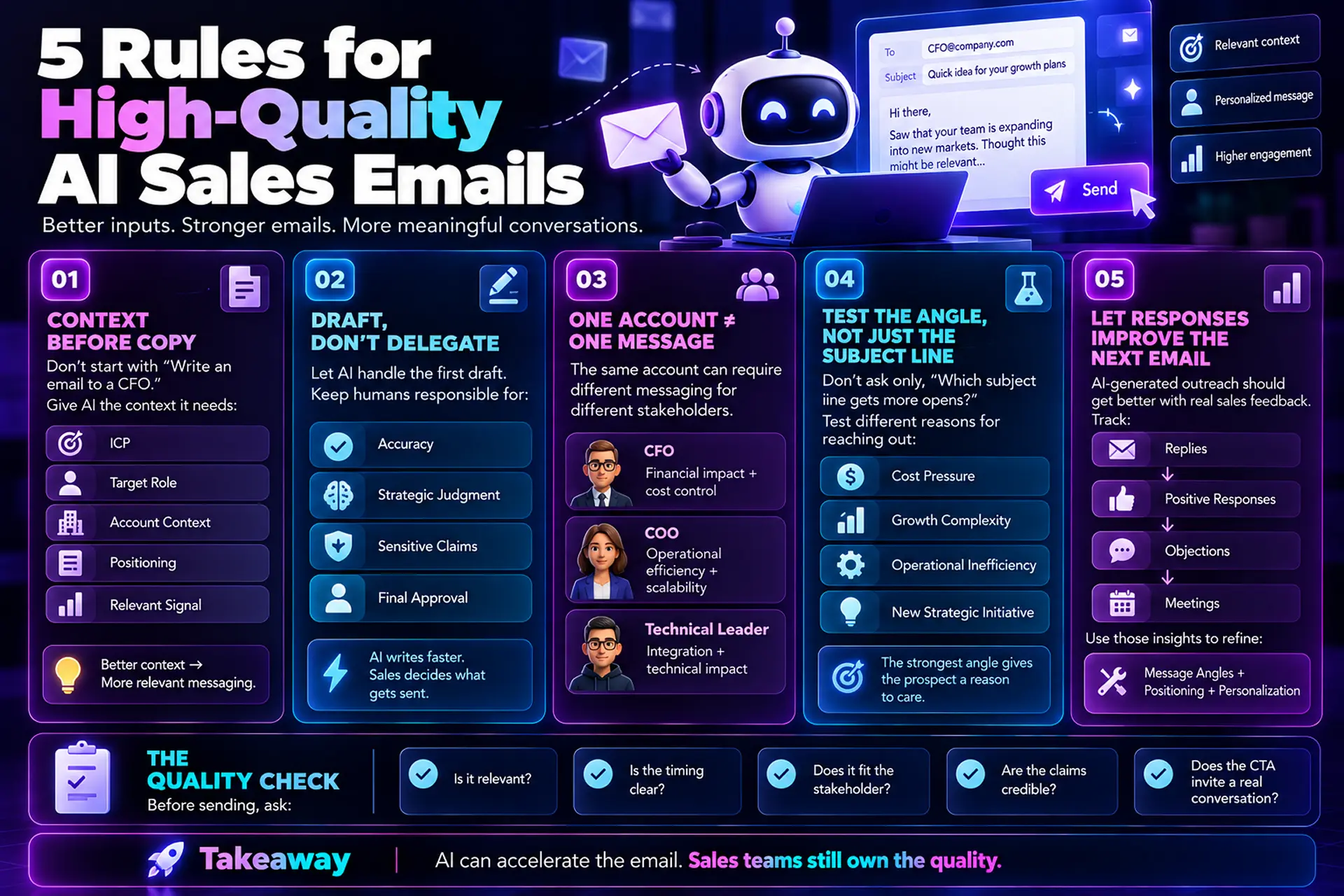
- AI sales email generators work best when they start with prospect and account context, including ICP fit, role, and business signals, instead of relying only on a name or template. This turns research into relevant messaging rather than faster generic copy.
- There are three main types of AI sales email generators. Prompt-based tools use seller instructions, template-driven tools adapt predefined frameworks, and prospecting-integrated platforms use prospect and account intelligence to shape the message.
- Generic AI emails often fail because they confuse personalization with relevance. They insert basic facts without changing the pitch, fail to explain why the prospect matters, lead with the seller instead of the buyer, and produce polished but predictable copy.
- AI should handle the initial email draft while sales teams remain responsible for reviewing its accuracy, assumptions, messaging, stakeholder fit, and claims before the email is sent.
- AI-generated outreach should be measured by the quality of sales outcomes it creates. Positive replies, qualified conversations, meetings, and pipeline matter more than the number of emails generated or sent.
What Are AI Sales Email Generators?
An AI sales email generator is an AI-powered system that creates sales emails using prospect, account, and sales context. It can use this information to tailor the message to the recipient instead of relying on a generic template.
The key difference is simple: an AI writing tool starts with the email, while an AI sales email generator starts with the prospect.
For example, a basic prompt might ask AI to write an email for a VP of Sales. The result may be polished, but it lacks the context needed to explain why that prospect should care.
An AI sales email generator can consider:
- Prospect: Role and responsibilities
- Account: Company and business context
- Fit: Alignment with the ideal customer profile
- Signals: Relevant business or buying signals
- Message angle: Why the outreach is relevant
- CTA: The appropriate next step
This turns prospect information into a sales message tailored to a specific outreach opportunity.
AI Sales Email Generator vs. Traditional Sales Email Templates
Email remains an effective prospecting channel, with 73% of B2B marketers saying it is their most effective way to contact prospects.
The difference is in how the email gets created. A traditional template gives sales reps a fixed structure they can customize. An AI sales email generator can use prospect, account, and sales context to shape the message itself.

What Types of AI Sales Email Generators Are There?
An AI sales email generator can refer to several types of AI-powered systems. They differ mainly in the information they use before generating an email. Some rely on seller instructions, while others combine sales templates with prospect and account data.
| Type | How It Works | Best For |
|---|---|---|
| Prompt-Based | Generates emails from seller instructions | One-off emails, rewrites, messaging ideas |
| Template-Driven | Adapts predefined sales templates with AI | Consistent messaging at scale |
| Prospecting-Integrated | Uses prospect and account intelligence to shape emails | Context-rich personalization |
Prompt-Based AI Email Generators
Prompt-based generators create sales emails from instructions provided by the seller. They are useful for one-off emails, rewriting existing copy, and testing different messaging angles.
Their biggest limitation is context. The seller must provide the relevant information, so a vague prompt can produce a polished email without a strong reason for the prospect to respond.
Template-Driven AI Email Generators
Template-driven generators combine predefined sales messaging with AI-generated variations. They are useful for teams with established messaging frameworks that want to create more variations while maintaining a consistent structure and tone.
AI changes the wording and details, but the underlying sales framework remains controlled by the team.
Prospecting-Integrated AI Email Generators
Prospecting-integrated AI email generators connect email creation with prospect and account intelligence. Instead of starting with a blank prompt or fixed template, they can use information such as the prospect’s role, company context, ICP fit, and relevant business signals to shape the message.
With AI email agents like ReachGen, prospecting intelligence can influence the message angle, personalization, and value proposition rather than simply filling details into a predefined template. This makes the generated email more specific to the prospect and the situation behind the outreach.
The important distinction is simple: the more relevant context the generator can use, the more meaningful its personalization can be.
Why Generic AI-Generated Sales Emails Fail
A grammatically correct email is not necessarily a commercially relevant one. AI can produce fluent copy from very little information, but fluency can hide weak sales reasoning. If the system does not understand why a prospect is worth contacting, it can turn limited data into an email that sounds convincing without having a convincing reason to exist.
The Email Sounds Personalized but Says Nothing Specific
Consider an email that says:
“I noticed your company is expanding its sales team. As a VP of Sales, you’re probably looking for ways to improve productivity.”
It contains the company, role, and a business event. Yet none of those details actually changes the pitch.
If the company is hiring because it is entering new markets, the challenge may be ramping new reps. If it is replacing an inefficient sales process, the priority could be operational consistency. The same signal can point to completely different sales conversations.
Generic AI often treats personalization as inserting available facts rather than determining how those facts should change the message.
The AI Does Not Understand Why the Prospect Matters
A prospect’s job title tells AI who they are. It does not necessarily tell AI why they are a good prospect.
For example, two VPs of Sales at companies with similar employee counts may look identical in a basic prospecting database. One may match the ICP, be actively investing in its sales organization, and show relevant buying signals. The other may have no current need for the product.
If the generator cannot distinguish between those situations, it has no strong basis for deciding what the email should emphasize.
The Message Starts With the Seller Instead of the Buyer
When context is weak, AI tends to fall back on the safest information available: the seller’s product description.
That produces familiar openings such as:
“We help sales teams improve productivity and automate prospecting.”
The statement may be true, but it gives the prospect no reason to connect it to their current priorities.
A stronger message works in the opposite direction: identify a credible situation affecting the prospect, explain the likely business implication, and then connect the offering to that problem.
The Copy Is Polished but Predictable
Generic AI sales emails often fail in ways that are difficult to catch during proofreading. The grammar is clean. The structure is logical. Nothing is technically wrong.
Yet the email may contain vague praise, interchangeable value propositions, unnecessary context, or claims that could be sent to hundreds of companies unchanged.
This is where a more reasoning-oriented approach matters. DiGGi-GPT AI Agent can be used to bring greater contextual reasoning into how a message is developed, rather than treating generation as a simple copywriting task.
Pro Tip- The underlying issue is not that AI writes bad emails. It is that AI cannot compensate for missing commercial context. Better inputs, stronger reasoning, and human review determine whether the final email is merely well-written or actually worth responding to.
How an AI Sales Email Generator Actually Works
An AI sales email generator does more than turn a prospect’s name and job title into an email. It uses available information about the prospect, their company, relevant business developments, and the sales opportunity to determine what the message should communicate.
The process typically moves from prospect identification and account research to message generation, review, and delivery. The exact capabilities vary by platform, but the following workflow illustrates how contextual email generation works.
1. Identify the Right Prospect
The first step is determining whether the individual and their company are worth targeting. The system can use ideal customer profile (ICP) criteria, job responsibilities, company size, industry, and other available firmographic or demographic information to assess prospect fit.
Consider a hypothetical FinTech company selling financial operations software to mid-market businesses. Its target audience includes CFOs at growing companies experiencing increasing financial and operational complexity.
An AI sales email generator can use these criteria to identify a CFO at a growing payments company that matches the target profile. This establishes who should receive the email before any messaging is generated.
2. Build the Account Context
Once the prospect is identified, the next step is understanding what is happening within their company. The system can bring together available information about the business, including its growth, business model, market expansion, organizational changes, and operating environment.
In this hypothetical example, the payments company has recently expanded into several new markets. This development provides useful account context because entering additional markets can introduce new financial processes, reporting requirements, and operational coordination.
3. Identify a Relevant Sales Trigger
Account context explains the company’s situation, while a sales trigger identifies a specific development that creates a timely reason to initiate contact.
The generator looks for developments that have a logical connection to the product or service being offered. These could include market expansion, new leadership appointments, hiring activity, funding announcements, product launches, or technology changes.
For the payments company, expansion into several markets is a potentially relevant trigger because it may introduce additional complexity into financial operations. A generic company announcement, by comparison, may not establish a meaningful reason to contact the CFO.
4. Verify the Information and Its Relevance
Before using a business signal in an email, the system should establish whether the information is accurate, recent, and relevant to the offering.
A company announcement may confirm that something has happened, but it does not automatically prove that the prospect is experiencing a problem the seller can solve.
For example, the payments company’s expansion may create additional financial coordination requirements. However, the generator should not assume that its finance team is struggling with reporting, compliance, or operational inefficiencies unless the available information supports those conclusions.
This verification step keeps the message grounded in evidence rather than turning assumptions into confident sales claims.
5. Determine the Message Angle
With the relevant information established, the generator determines why the development matters from a sales perspective.
It needs to answer three questions:
- Why this prospect?
- Why now?
- Why should this conversation matter?
For the CFO, the message angle could focus on maintaining financial visibility and operational consistency as the company expands into additional markets.
The objective is to connect a verified business development to a relevant capability of the offering, rather than simply mentioning the company’s latest announcement.
6. Generate the First Draft
The generator combines the prospect information, account context, verified business signal, and message angle to create an initial email.
It should prioritize the most relevant information instead of including every available research detail.
For the FinTech example, the inputs are:
- Prospect: CFO
- Account: Growing payments company
- Business development: Expansion into several markets
- Message angle: Maintaining consistent financial operations as the business scales
- Offering: Financial operations software
The generator can turn these inputs into an initial draft:
Subject: Financial operations as [Company] expands
Hi [First Name],
Saw that [Company] has expanded into several markets. As payment operations grow across regions, maintaining consistent financial processes and visibility can become more complex.
We help finance teams automate these processes so they can support business growth without adding unnecessary manual work.
Would it be worth a quick conversation about how you are managing this today?
Best,
[Sender Name]
The important distinction is that the email draws on the company’s business context to establish a reason for reaching out. It does not simply insert the prospect’s name, company, and job title into a predefined template.
7. Adapt the Message to the Recipient
The same account context can lead to different messages depending on the stakeholder receiving the email. The generator can adjust the emphasis based on the recipient’s responsibilities and the business outcomes most relevant to their role.
For the payments company, the message could change as follows:
- CFO: Focus on financial visibility, cost control, and consistency across markets.
- COO: Emphasize operational coordination, process efficiency, and scalability.
- Technical Leader: Address system integration, technical requirements, and the impact on existing infrastructure.
The underlying business development remains the same, but the reason it matters changes according to the recipient’s role.
8. Review and Refine the Email
The generated email should be checked for factual accuracy, relevance, clarity, and unsupported assumptions before it is sent.
For example, the company’s market expansion may be verified, but assuming that the CFO is struggling with financial reporting would go beyond the available evidence.
Sales representatives should also review the message for:
- Generic or unnecessary personalization.
- Unsupported business claims.
- Incorrect company or prospect information.
- Unclear value propositions.
- Excessive length or complicated wording.
- CTAs that do not suit the conversation.
AI can prepare the initial draft, but human judgment remains important for approving the final message.
9. Deliver the Email Into the Sales Workflow
Once approved, the email can move into the team’s existing outreach process. Depending on the platform, this may involve exporting the draft, sending it manually, adding it to an outreach sequence, or synchronizing it with a CRM.
Some AI sales email generators focus primarily on creating email drafts. Others integrate with CRM and sales engagement platforms to support sequencing, scheduling, follow-ups, and engagement tracking.
These capabilities vary by product, so email generation should not automatically be confused with complete outbound campaign automation.
At this stage, the email has moved beyond basic personalization. Its content has been shaped by who the prospect is, what is happening at the account, why the timing matters, and which business priorities are relevant to that particular stakeholder.
What Are the Most Common Mistakes Companies Make With AI Sales Email Generators?
AI can make sales email creation faster, but poor implementation can simply make bad outreach faster. Four mistakes are particularly common.
1. Automating Before Defining Who Should Receive the Email
Problem: Teams generate personalized emails for prospects who were never strong prospects in the first place. Personalization cannot compensate for poor targeting.
Solution: Define the ICP and establish account and prospect relevance before generating the email. AI should help sales teams prioritize the right people, not personalize outreach to everyone in the database.
2. Confusing Personalization With Personal Details
Problem: Adding a prospect’s company name, job title, or recent announcement can make an email look personalized without making it more relevant.
Solution: Personalize around a legitimate business reason for the conversation. The message should connect something about the prospect or account to a problem, priority, or opportunity that the offering can address.
3. Letting AI Invent the Sales Argument
Problem: AI can turn limited information into confident but unsupported claims. A polished email can still be inaccurate if the reasoning behind it is based on assumptions.
Solution: Ground the email in verified prospect and account context. Review claims, assumptions, and business implications before sending, particularly for strategic accounts.
4. Optimizing for Email Volume Instead of Sales Conversations
Problem: Teams may celebrate generating thousands of emails without asking whether those emails are producing meaningful responses or qualified opportunities.
Solution: Evaluate AI-generated outreach based on positive responses, qualified conversations, meetings, and pipeline, not simply the number of emails produced.
Conclusion
The real value of an AI sales email generator is not that it can write faster. It is that it can help sales teams move from “What should I send?” to “Why should this prospect care?”
That shift matters as outbound teams handle larger prospect pools without wanting their messaging to become increasingly generic. AI can take on the repetitive work of turning sales context into a starting point, while teams focus their attention on the conversations that deserve a human touch.
The strongest approach is not to remove people from email prospecting. It is to give them better context, better starting points, and more time to make decisions that AI should not make for them.
Don’t Scale Generic Outreach. Scale Relevance. Let’s Chat!
See what ReachGen can do for your sales team. Connect with DiGGrowth and make every email start with a reason to talk.
Ready to Get Started? Talk to Us!
Get a free demo or email info@diggrowth.com.
Ready to get started?
Increase your marketing ROI by 30% with custom dashboards & reports that present a clear picture of marketing effectiveness
Start Free Trial
Experience Premium Marketing Analytics At Budget-Friendly Pricing.

Learn how you can accurately measure return on marketing investment.
Lookalike Account Modeling for B2B Revenue Teams
Lookalike account modeling takes a different approach. It studies the attributes and outcomes of successful customers,...
Read full post post
You’re Targeting Your Ideal Customer. So Why Aren’t They Buying?
Your best customers reveal the traits associated with success. Your lost opportunities reveal where fit breaks...
Read full post post
How Predictive AI Will Transform Paid Media Strategy in 2026
Paid media isn’t a channel game anymore, it’s a chessboard. Search, social, programmatic, video, influencer, native,...
Read full post post