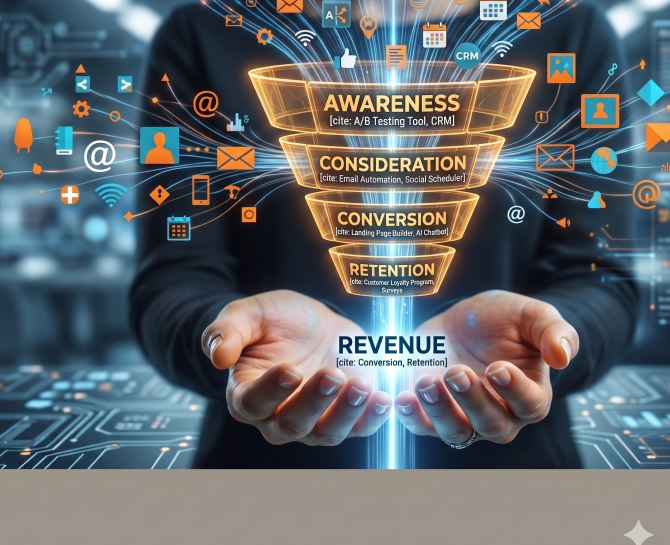
Best Tools To Optimize Your Marketing Funnel For Better Conversions
Marketing funnels often look efficient until conversion data tells a different story. Traffic may be steady, but revenue inconsistencies reveal gaps in tracking, engagement, and decision-making across stages. Read the blog to find the best tools to optimize marketing funnel performance, improve tracking, reduce drop-offs, and increase conversion efficiency across stages.
A marketing funnel can generate traffic, leads, and engagement while still struggling to drive consistent revenue. That is what makes conversion problems difficult to identify.
Most funnel leaks happen inside the customer journey itself. Slow follow-ups, weak personalization, confusing landing pages, and incomplete attribution often push prospects away before conversion happens.
Customer journeys have also become more complex. Buyers now interact with brands across multiple channels before making decisions, which makes optimization far more challenging for marketing teams.
This is why businesses are investing in smarter funnel optimization tools. Some help uncover friction points, while others improve automation, personalization, analytics, and attribution.
Let’s explore the tools helping businesses build stronger funnels and better conversions.
Key Takeaways
- Marketing funnels often lose conversions quietly, even when traffic and leads look strong.
- Most drop-offs happen inside the journey, not at the top of the funnel.
- Better visibility into user behavior and attribution is critical for improving conversion rates.
- Different tools solve different problems, so choosing depends on your specific funnel gap.
- The right optimization stack helps teams turn insights into consistent revenue growth.
What Makes A Marketing Funnel Optimization Tool Worth Using?
Many marketing tools generate reports. Fewer help businesses understand what is actually hurting conversions.
That is the real difference between tracking and optimization.
A strong funnel optimization tool helps teams identify weak points in the customer journey, understand user behavior, and improve conversion decisions using real insights instead of assumptions.
One business may struggle because leads are not nurtured properly. Another may lose conversions because attribution data is incomplete or landing pages create friction.
The right platform helps uncover those problems faster.
DiGGrowth: Best For Funnel Visibility And Revenue Attribution
Many marketing teams still make optimization decisions using incomplete data. A campaign generates leads, sales numbers increase, and reports appear positive. The problem is that most teams still cannot clearly explain which touchpoints actually influenced revenue.
That creates expensive blind spots.
DiGGrowth focuses heavily on attribution visibility and funnel intelligence. The platform helps businesses connect marketing activities with pipeline and revenue outcomes instead of relying only on surface-level engagement metrics.
This becomes especially important in longer customer journeys where buyers interact with multiple channels before converting.
How It Helps Marketing Teams
DiGGrowth helps businesses:
- Track multi-touch attribution across channels.
- Understand which campaigns influence pipeline growth.
- Identify high-performing customer acquisition paths.
- Reduce reporting gaps between marketing and sales.
- Improve decision-making using AI-driven insights.
The platform is particularly valuable for organizations struggling with fragmented reporting systems or unclear conversion journeys.
Example
A B2B SaaS company runs campaigns across LinkedIn, Google Ads, webinars, and email marketing. Google Ads generates the highest lead volume, so the team increases spend there consistently.
After implementing DiGGrowth, they discover LinkedIn campaigns generate fewer leads but significantly higher pipeline value and stronger conversion quality.
Why It Stands Out
Many analytics platforms focus heavily on traffic and engagement reporting. DiGGrowth approaches optimization through a revenue-focused lens.
That difference matters because strong conversion performance is not always tied to the highest traffic source. Sometimes the most valuable channels look smaller in traditional reports but influence far more revenue over time.
HubSpot: Best For Lead Nurturing And CRM Alignment
A surprising number of leads do not disappear because of bad campaigns. They disappear because businesses fail to maintain momentum after the first interaction.
Someone downloads a guide. Another prospect requests pricing information. A potential customer attends a webinar. Then communication slows down or becomes completely generic.
That gap hurts conversions.
HubSpot helps businesses manage lead nurturing, customer communication, and CRM alignment from a single platform. The tool combines marketing automation with sales visibility, which makes it easier to track how leads move through the funnel.
For growing teams, that centralization can remove a lot of operational friction.
Key Features
- Email marketing automation.
- Lead scoring and segmentation.
- CRM and pipeline management.
- Workflow automation.
- Behavioral tracking and personalization.
- Sales and marketing alignment tools.
Benefits For Organizations
HubSpot helps teams create more consistent customer journeys. Marketing and sales departments can access shared data, which reduces communication gaps and improves lead handoffs.
The platform also supports faster follow-ups. That matters because delayed responses often reduce conversion intent significantly.
Businesses using HubSpot can also build nurturing sequences based on customer behavior instead of sending identical campaigns to every lead.
Potential Limitation
HubSpot becomes more expensive as businesses scale and require advanced features. Teams also need proper workflow planning to avoid creating overly complicated automation systems.
Google Analytics 4: Best For Behavioral Funnel Insights
Many businesses know how much traffic they generate. Far fewer understand what users actually do after arriving on the website.
Google Analytics 4 helps marketing teams move beyond pageviews and basic traffic reporting. The platform focuses heavily on event-based tracking, which gives businesses deeper visibility into customer behavior across the funnel.
Instead of only measuring sessions, teams can track actions that directly influence conversions.
What Makes It Valuable
Google Analytics 4 helps businesses:
- Track customer journeys across devices.
- Analyze user engagement patterns.
- Identify funnel drop-off points.
- Measure conversion paths more accurately.
- Understand how different channels contribute to outcomes.
The platform also supports predictive insights, which can help teams identify users with stronger purchase intent.
Best For
Google Analytics 4 works especially well for businesses that want stronger visibility into customer behavior before conversion happens.
It is particularly valuable for teams trying to answer questions like:
- Which pages create the most drop-offs?
- Which channels drive engaged visitors instead of low-quality traffic?
- Which user journeys lead to stronger conversion rates?
- Where are prospects losing momentum inside the funnel?
Those insights make optimization decisions far more strategic instead of reactive.
Hotjar: Best For Understanding User Friction
Analytics platforms can show where users leave a funnel. They usually cannot explain why users leave.
That is where tools like Hotjar become useful.
Hotjar focuses on qualitative insights, helping businesses understand how users actually interact with pages, forms, landing experiences, and conversion paths. Instead of relying only on numbers, teams can observe behavior visually and identify friction points that traditional reports often miss.
Sometimes a small usability issue creates a much bigger conversion problem than expected.
Unique Value
Hotjar stands out because it combines behavioral visualization with direct customer feedback.
Core capabilities include:
- Heatmaps showing where users click and scroll.
- Session recordings that reveal browsing behavior.
- Feedback widgets for collecting user opinions.
- On-page surveys for understanding visitor intent.
- Funnel analysis for identifying drop-off patterns.
These insights help teams understand how users experience the funnel in real situations.
How It Improves Funnels
A landing page may look perfectly optimized internally, yet users may still struggle to navigate it clearly.
Hotjar helps uncover issues like:
- Users ignoring important CTAs.
- Visitors stopping midway through forms.
- Confusing page layouts reducing engagement.
- Important information getting missed entirely.
- Mobile experiences creating hidden friction.
This type of visibility often leads to faster UX improvements and stronger conversion performance.
Pros And Cons
| Pros | Cons |
|---|---|
| Easy-to-understand visual insights. | Limited attribution and revenue analysis. |
| Helpful for UX and CRO teams. | Less effective for deep campaign reporting. |
| Strong support for landing page optimization. | Can become overwhelming with large recording volumes. |
| Beginner-friendly interface. | Requires interpretation alongside analytics tools. |
ActiveCampaign: Best For Personalized Funnel Automation
Generic marketing journeys rarely perform well anymore. Customers expect communication that feels relevant to their interests, behavior, and stage in the buying process.
Many businesses still send the same emails to every lead and hope engagement improves.
That approach usually creates fatigue instead of conversions.
ActiveCampaign helps businesses build more personalized customer journeys through automation, behavioral targeting, and audience segmentation. The platform focuses heavily on nurturing leads based on real interactions instead of static workflows.
Key Capabilities
ActiveCampaign supports:
- Behavioral email automation.
- Dynamic audience segmentation.
- Lead scoring and engagement tracking.
- Personalized customer journeys.
- CRM integration and sales automation.
- Predictive sending and content optimization.
These features help businesses maintain engagement without relying entirely on manual follow-ups.
Example Workflow
A visitor downloads a pricing guide from a software company website.
Instead of entering a generic email list, the lead automatically receives content tailored to pricing concerns, implementation questions, and product comparisons. If the lead clicks multiple high-intent pages, the sales team receives a notification to follow up directly.
The journey adapts based on behavior instead of following a fixed sequence.
Optimizely: Best For Conversion Experimentation
A surprising number of marketing decisions are still based on assumptions.
Teams redesign landing pages because something “feels outdated.” CTAs get rewritten based on opinions instead of data. Entire funnel experiences change without clear evidence that the updates will improve conversions.
That creates unnecessary risk.
Optimizely helps businesses test ideas before fully committing to them. The platform focuses on experimentation, allowing teams to compare different versions of pages, messaging, layouts, and experiences to see what actually drives better performance.
Optimization becomes far more reliable when decisions are backed by user behavior instead of guesswork.
Features That Matter
Optimizely offers several capabilities designed for conversion optimization:
- A/B testing for landing pages and CTAs.
- Multivariate testing for deeper experimentation.
- Personalization testing across user segments.
- Feature experimentation for digital products.
- Real-time reporting and performance tracking.
These tools help teams make gradual improvements with measurable impact.
Salesforce Marketing Cloud: Best For Enterprise Funnel Management
Enterprise marketing funnels are rarely simple. Multiple teams, regions, channels, products, and customer segments often operate at the same time. Managing those journeys manually becomes difficult very quickly.
Disconnected systems make the problem even worse. The platform is designed for businesses handling large-scale campaigns, multi-channel communication, and advanced customer journeys.
For enterprise teams, visibility and coordination become just as important as automation itself.
Why Large Organizations Use It
Salesforce Marketing Cloud supports:
- Omnichannel customer engagement.
- Advanced audience segmentation.
- AI-powered customer journey orchestration.
- Email, mobile, social, and advertising automation.
- Real-time personalization.
- Deep CRM integration.
These capabilities help enterprises create more connected customer experiences across large audiences.
How It Can Benefit Organizations
Large organizations often struggle with inconsistent customer experiences between departments and channels.
Salesforce Marketing Cloud helps reduce that fragmentation by centralizing customer interactions and engagement data. Marketing teams can deliver more personalized communication while sales teams gain better visibility into customer activity and intent.
This creates stronger continuity throughout the funnel.
The platform also supports scalability, which becomes critical for businesses managing millions of customer interactions across multiple markets.
Semrush: Best For Top-Of-Funnel Optimization
Many businesses focus heavily on conversion optimization while ignoring the quality of traffic entering the funnel in the first place.
That creates a major problem.
A funnel filled with low-intent visitors will struggle to convert no matter how optimized the later stages become. Strong conversion performance often starts with attracting the right audience before they even reach a landing page.
Semrush helps businesses improve top-of-funnel performance through search visibility, competitive research, and content optimization insights. The platform gives marketing teams a clearer understanding of what audiences search for, how competitors attract traffic, and which keywords influence purchase intent.
Better traffic quality usually creates better conversion opportunities downstream.
How It Supports Funnel Growth
Top-of-funnel optimization is not just about increasing website traffic. It is about attracting visitors more likely to engage, convert, and move through the funnel successfully.
Semrush helps teams:
- Discover high-intent search opportunities.
- Improve organic visibility for conversion-focused keywords.
- Analyze competitor acquisition strategies.
- Reduce dependency on broad, low-converting traffic sources.
This creates stronger alignment between acquisition and conversion goals.
Best Fit
Semrush works especially well for businesses investing heavily in SEO, content marketing, and organic acquisition strategies.
It is particularly valuable for organizations trying to improve traffic quality before prospects even enter the middle stages of the funnel.
Conclusion: How To Choose The Right Funnel Optimization Tool
The right funnel optimization tool should make your customer journey clearer, not more complicated. It should help you understand where conversions are being lost, why they are happening, and what needs to change to improve performance.
Most teams do not struggle because of a lack of data. They struggle because the data is fragmented, hard to interpret, or disconnected from revenue outcomes. A strong tool brings everything together in a way that supports faster and better decisions.
Focus on impact. If a platform does not help you connect marketing activity to real conversion movement, it is adding noise instead of value.
For teams that want deeper visibility into what actually drives revenue, DiGGrowth helps connect funnel performance with attribution and outcomes in a more meaningful way. Book a demo with DiGGrowth to see how clearer insights can improve your marketing decisions and conversion results.
Ready to get started?
Increase your marketing ROI by 30% with custom dashboards & reports that present a clear picture of marketing effectiveness
Start Free Trial
Experience Premium Marketing Analytics At Budget-Friendly Pricing.

Learn how you can accurately measure return on marketing investment.
How Predictive AI Will Transform Paid Media Strategy in 2026
Paid media isn’t a channel game anymore, it’s a chessboard. Search, social, programmatic, video, influencer, native,...
Read full post post
Don’t Let AI Break Your Brand: What Every CMO Should Know
AI isn’t just another marketing tool. It’s changing how we connect with customers, personalize content, and...
Read full post post
From Demos to Deployment: Why MCP Is the Foundation of Agentic AI
A quiet revolution is unfolding in AI. And it’s not happening inside research labs. For decades,...
Read full post postFAQ's
Leadership should focus on whether the tool connects marketing activity to pipeline influence and revenue impact, not just clicks or leads. Clear attribution to business outcomes is key for ROI clarity.
The biggest challenges are fragmented data sources, lack of alignment between marketing and sales teams, and difficulty in translating insights into actionable strategy at scale.
They highlight which channels and campaigns are actually driving high-quality conversions, helping decision-makers shift budget away from low-impact activities toward revenue-generating sources.
They create a shared view of lead quality, engagement history, and conversion readiness, helping both teams act on the same data instead of working with separate assumptions.
Executives should choose systems that provide unified visibility across the funnel, reduce reporting delays, and present insights in a way that supports quick, confident strategic decisions.