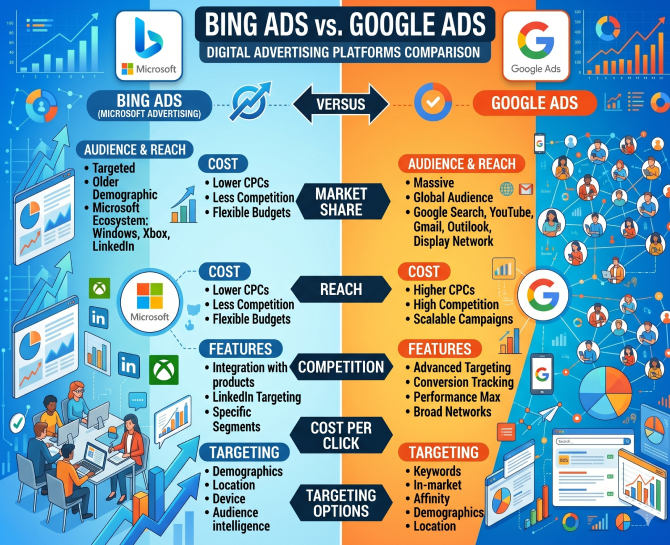
Bing Ads Vs Google Ads: Choosing the Right Platform in 2026
Search advertising is shifting toward efficiency-driven decisions as competition and automation reshape performance outcomes. This blog breaks down Bing Ads vs Google Ads in 2026, comparing reach, costs, audience quality, and enterprise use cases to guide smarter paid search planning.
Paid media is becoming more automated, more competitive, and far more expensive to ignore.
By 2030, 84.9% of advertising revenue is expected to come from programmatic advertising. That shift is pushing businesses toward platforms that can deliver stronger targeting, better visibility, and measurable growth outcomes at scale.
This is exactly why the Bing Ads vs Google Ads conversation matters more in 2026.
Both platforms continue helping organizations generate leads, increase visibility, drive ecommerce sales, and improve customer acquisition. But they do not operate in the same environment, and they do not always produce the same business outcomes.
Google still dominates the global search market with 90.02% market share, according to StatCounter. That reach gives businesses access to enormous search demand across industries, devices, and buying stages. For many brands, Google Ads remains a powerful channel for scaling visibility and capturing high-volume commercial intent.
At the same time, Bing holds a 5.14% share of the global search market and continues building relevance through Microsoft’s ecosystem, desktop-driven audiences, LinkedIn integration, and lower competition levels. For some businesses, that smaller share can create stronger acquisition efficiency and better lead quality.
This is where many companies start rethinking paid search strategy.
Choosing between Google Ads and Microsoft Ads is no longer just about audience size. You also need to think about competition, customer intent, acquisition costs, attribution visibility, and long-term revenue efficiency.
Read this blog to understand where each platform performs best and how you can decide which one aligns better with your business goals in 2026.
Key Takeaways
- Paid media continues to expand rapidly, with global advertising spend projected to exceed US$1.26 trillion in 2026, while digital channels are expected to contribute more than 82% of total ad spend by 2030.
- The most effective strategies are built on platform roles, where each ecosystem contributes differently to the funnel instead of competing for budget.
- Google still dominates search visibility with 90.02% market share, but rising CPC pressure is pushing many brands to rethink how efficiently that reach converts into revenue.
- Microsoft Ads, holding around 5.14% market share, is gaining relevance in enterprise and B2B environments where lower competition and stronger intent often improve acquisition efficiency.
Why The Bing Ads Vs Google Ads Debate Matters More In 2026
Paid search is becoming more expensive, more fragmented, and far more competitive for enterprise brands.
As AI reshapes search behavior and digital advertising captures a larger share of global marketing budgets, leadership teams are under growing pressure to balance reach, acquisition efficiency, and long-term profitability across multiple advertising platforms.
At the same time, customer journeys are becoming less predictable. Buyers now move between search engines, AI-generated recommendations, video platforms, marketplaces, and online communities before making decisions.
That shift is changing how businesses approach paid media strategy in 2026.
Key Takeaway: The Bing Ads vs Google Ads debate in 2026 is no longer about choosing one platform over another. It is about building a smarter paid media strategy that balances scale, efficiency, and long-term growth.
How Organizations Can Leverage Google Ads In 2026
Google Ads continues to dominate the paid search ecosystem in 2026, but scale alone is no longer enough to guarantee strong performance. Rising competition, higher CPCs, and AI-driven search changes are forcing organizations to rethink how they approach paid acquisition.
The companies seeing stronger results are not necessarily the ones spending the most. They are the ones using Google Ads with greater precision, stronger audience intelligence, and clearer revenue alignment.
Capturing High-Intent Demand At Scale
One of Google Ads’ biggest advantages remains its ability to capture users with immediate commercial intent.
Whether buyers are searching for software solutions, enterprise services, or high-value products, Google still provides access to audiences actively looking to make decisions. This makes the platform especially valuable for organizations focused on bottom-funnel acquisition.
In 2026, successful advertisers are becoming more selective with targeting instead of expanding keyword portfolios aggressively. High-intent search terms, tighter match strategies, and conversion-focused campaigns are becoming more important than broad traffic generation.
The focus is shifting from:
- Generating more clicks.
- Improving conversion quality.
- Reducing wasted acquisition spend.
- Driving profitable pipeline growth.
Using AI Automation With Strategic Oversight
AI-powered campaign automation is becoming central to Google Ads performance.
Features such as Smart Bidding, Performance Max, and predictive audience targeting are helping organizations optimize campaigns faster than manual management alone. However, automation without oversight can also create inefficiencies.
Many enterprises are discovering that blindly scaling automated campaigns often increases spend without improving revenue quality.
Organizations leveraging Google Ads effectively in 2026 are:
- Combining automation with human performance analysis.
- Monitoring audience quality closely.
- Using first-party data to improve targeting accuracy.
- Continuously refining conversion signals.
This balance between AI efficiency and strategic control is becoming critical for sustainable growth.
Pro Tip : AI automation in Google Ads works best as an accelerator, not a decision-maker. Treat Smart Bidding and Performance Max as execution layers, while your strategy, audience signals, and conversion quality inputs define the actual performance outcome.
Building Multi-Touch Buyer Journeys Across Google Ecosystem
Google Ads is no longer limited to traditional search campaigns.
Organizations can now create connected buyer journeys across:
- Google Search.
- YouTube.
- Display Network.
- Discover placements.
- Shopping campaigns.
This allows brands to engage audiences at different stages of the decision-making process instead of relying entirely on last-click conversions.
Strengthening First-Party Data Strategies
As privacy regulations evolve and third-party tracking becomes less reliable, first-party data is becoming a major competitive advantage.
Organizations are increasingly integrating CRM systems, customer data platforms, and audience segmentation directly into Google Ads campaigns. This helps improve targeting precision while reducing wasted spend on low-quality audiences.
In 2026, stronger first-party data strategies are helping organizations:
- Improve lead qualification.
- Build more accurate audience segments.
- Strengthen retargeting performance.
- Increase customer lifetime value visibility.
This shift is especially important for B2B companies managing long and complex buying cycles.
Prioritizing Revenue Efficiency Over Traffic Volume
One of the biggest mistakes organizations continue making with Google Ads is equating traffic growth with business growth.
Higher impressions and click volumes do not always translate into stronger pipeline performance. With acquisition costs rising across industries, leadership teams are placing greater emphasis on profitability metrics rather than vanity metrics.
Organizations are now evaluating Google Ads performance based on:
- Customer acquisition cost.
- Revenue contribution.
- Pipeline quality.
- Return on ad spend.
- Sales-qualified lead generation.
This change is pushing marketing teams to optimize campaigns for long-term revenue efficiency instead of short-term traffic spikes.
Bing Ads In 2026: The Underrated Enterprise Opportunity
Google Ads may dominate overall search volume, but that does not mean every business should approach paid search the same way.
This is where Microsoft Ads continues gaining attention among enterprise advertisers looking for stronger acquisition efficiency, lower competition, and more targeted audience behavior.
For many brands, Bing Ads is no longer viewed as a secondary platform. It is becoming a strategic channel for reaching professional audiences and controlling customer acquisition costs more effectively.
Why Microsoft Ads Deserve More Attention
One of the biggest advantages of Microsoft Ads is audience composition.
Bing’s ecosystem attracts a strong desktop user base, professional search audiences, and users integrated into Microsoft products and services. That creates valuable opportunities for B2B companies, enterprise solution providers, and brands targeting decision-makers during research-heavy buying journeys.
Microsoft Ads also benefits from:
- Lower competition across many keyword categories.
- Lower average CPCs compared to Google Ads.
- LinkedIn profile targeting integration.
- Stronger visibility in desktop-driven environments.
- Additional reach through Microsoft-owned platforms.
For businesses focused on efficiency instead of pure scale, these advantages can create meaningful performance improvements.
Pro Tip : Microsoft Ads often performs best when it is not treated as a “scaled-down Google Ads,” but as a precision channel. The strongest results come from focusing on high-intent B2B queries, layering LinkedIn-based audience signals, and prioritizing desktop-first decision-making behavior rather than chasing broad keyword volume.
Audience Quality Vs Audience Volume
One reason many companies overlook Bing Ads is because they compare it directly to Google’s scale.
That comparison often misses the bigger strategic advantage.
Paid search success is not always about reaching the largest audience possible. In many industries, it is about reaching the audience most likely to convert profitably.
Microsoft Ads can perform particularly well for:
- Enterprise software companies.
- B2B service providers.
- Financial and professional services.
- Healthcare organizations.
- Industrial and manufacturing brands.
These industries often rely on high-intent professional searches where audience quality matters more than raw traffic volume.
Where Bing Ads Can Outperform Google Ads
Different platforms create different advantages depending on business goals.
| Business Goal | Google Ads | Bing Ads |
|---|---|---|
| Massive audience reach | Stronger | Moderate |
| Lower CPC efficiency | Moderate | Stronger |
| Enterprise audience targeting | Moderate | Stronger |
| B2B lead generation | Strong | Stronger |
| Consumer ecommerce scale | Stronger | Moderate |
| Lower competition environments | Moderate | Stronger |
This is why many businesses are now building multi-platform paid search strategies instead of relying entirely on a single advertising ecosystem.
The Biggest Misconception About Bing Ads
In many B2B industries, smaller but more targeted search audiences can generate better conversion efficiency than broader high-volume campaigns. Lower competition also allows businesses to maintain visibility without facing the same CPC pressure common across highly saturated Google Ads categories.
For companies focused on profitability, Microsoft Ads can become less about replacing Google Ads and more about improving overall paid media efficiency through diversification and intent-driven targeting.
Choosing The Right Platform Based On Your Business Goals
In 2026, leadership teams are less interested in “which platform is bigger” and more focused on “which platform delivers better unit economics.” The decision between Google Ads and Bing Ads is increasingly about efficiency, audience quality, and how each channel supports specific growth outcomes.
Platform Selection Based On Business Goals
| Business Goal | Google Ads | Microsoft Ads (Bing Ads) |
|---|---|---|
| Rapid scale and demand capture | Strong fit due to high search volume and reach. | Limited by smaller overall traffic share. |
| Cost-efficient acquisition | Higher CPC pressure in competitive markets. | Often more efficient due to lower competition. |
| B2C and high-volume ecommerce | Strong performance for mass-market demand. | Moderate impact due to lower consumer scale. |
| B2B and enterprise targeting | Strong, but highly competitive environment. | Stronger efficiency for professional and desktop users. |
| Budget predictability | More volatility due to bidding intensity. | More stable cost environment in many categories. |
| Lead quality optimization | Requires tighter segmentation to avoid waste. | Often higher intent in niche B2B segments. |
Key Insight: The most effective strategy in 2026 is not choosing one platform over the other, but aligning each platform with its most efficient role in the funnel.
Building A Balanced Paid Search Strategy In 2026
In 2026, the most effective paid search strategies are no longer built around choosing between Google Ads and Bing Ads. They are built around how intelligently organizations distribute budget across platforms based on intent, efficiency, and measurable business outcomes.
For leadership teams, the focus has shifted from platform performance to overall acquisition efficiency. That means evaluating paid search as a connected system rather than isolated channels competing for budget.
Shifting From Platform Thinking To Portfolio Thinking
High-performing organizations are treating paid search like an investment portfolio, where each platform plays a defined role.
- Google Ads is used for scale, reach, and high-intent demand capture.
- Microsoft Ads is used for efficiency, lower competition, and B2B precision targeting.
- Budget allocation is continuously adjusted based on CAC and conversion quality.
- Performance is measured at the portfolio level, not just channel level.
This approach reduces overdependence on a single ecosystem and creates more stability in volatile auction environments.
What Strong Execution Looks Like In Practice
Instead of running identical strategies across platforms, leading teams are:
- Aligning campaigns to specific funnel stages rather than duplicating efforts.
- Separating KPI expectations for Google Ads and Bing Ads based on their strengths.
- Using audience quality signals, not just click volume, to guide scaling decisions.
- Integrating CRM and sales data to validate true lead value across platforms.
This creates a clearer view of which platform contributes to actual revenue, not just traffic or conversions.
Why This Model Works Better In 2026
Search behavior is more fragmented, competition is higher, and automation is increasing unpredictability in performance. A balanced strategy helps organizations:
- Reduce acquisition risk across a single platform.
- Adapt faster to CPC fluctuations and auction changes.
- Improve long-term revenue efficiency instead of short-term volume gains.
Conclusion
Paid search is no longer shaped by platform preference alone. It is shaped by how clearly organizations understand the economics behind every click, query, and conversion. Google Ads and Microsoft Ads operate within the same ecosystem, but they reward very different execution styles. The gap between high spend and high performance is now defined by how well strategy adapts to intent, competition, and audience quality across both platforms.
The strongest outcomes are emerging from teams that treat paid media as a connected growth system rather than a collection of campaigns. This shift is pushing marketing decisions closer to business outcomes, where efficiency carries more weight than visibility and consistency matters more than scale.
Every strong search strategy starts with one decision: treating paid media as a growth system, not a channel comparison.
For a deeper conversation on building performance-driven paid search strategies tailored to your business model, connect with us at info@diggrowth.com.
Ready to get started?
Increase your marketing ROI by 30% with custom dashboards & reports that present a clear picture of marketing effectiveness
Start Free Trial
Experience Premium Marketing Analytics At Budget-Friendly Pricing.

Learn how you can accurately measure return on marketing investment.

How Predictive AI Will Transform Paid Media Strategy in 2026
Paid media isn’t a channel game anymore, it’s a chessboard. Search, social, programmatic, video, influencer, native,...
Read full post post
Don’t Let AI Break Your Brand: What Every CMO Should Know
AI isn’t just another marketing tool. It’s changing how we connect with customers, personalize content, and...
Read full post post
From Demos to Deployment: Why MCP Is the Foundation of Agentic AI
A quiet revolution is unfolding in AI. And it’s not happening inside research labs. For decades,...
Read full post postFAQ's
Most mature teams avoid fixed splits. Instead, budgets are adjusted based on cost per qualified lead, pipeline contribution, and conversion stability. Google Ads often absorbs scale-driven demand, while Microsoft Ads is used to improve efficiency in high-intent or niche segments. The allocation shifts as performance data evolves rather than staying static.
Yes, and in many cases they perform better together. Google Ads typically drives scale, while Bing Ads helps improve efficiency and reach additional high-intent users. Using both allows businesses to balance volume and cost more effectively.
CPCs are rising due to higher competition, more advertisers entering the platform, and increased demand for premium search placements. As more businesses compete for the same high-intent keywords, bidding pressure naturally increases.
The main risk is dependency on a single auction environment. As CPCs rise and automation increases, even small changes in competition or algorithm behavior can significantly impact acquisition costs. This creates volatility in forecasting, especially for companies that rely heavily on paid search for pipeline consistency.
Resilient models are built around diversification and intent alignment. Instead of treating platforms as competing channels, they are structured based on role: one for scalable demand capture and another for efficiency and precision. This reduces acquisition risk, improves forecasting stability, and creates more predictable growth under changing market conditions.