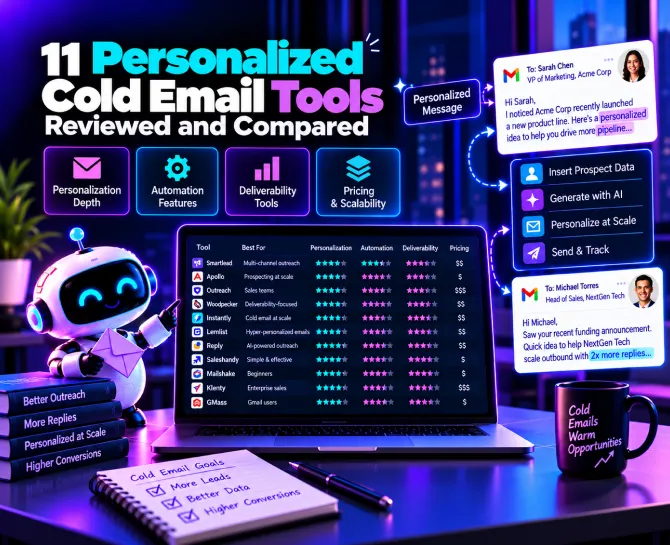
11 Best Personalized Cold Email Tools for 1:1 Outreach in 2027
Personalized cold email tools can vary significantly in their approach. Some focus on prospect intelligence and AI personalization, while others prioritize email volume, deliverability, CRM workflows, or behavioral targeting. This blog compares 11 tools across these factors, highlighting strengths, limitations, ideal use cases, and which platforms fit different B2B outreach needs.
How many cold emails in your inbox actually feel like they were written for you?
Probably not many.
Your prospects may feel the same. Consumers report receiving an average of 15 cold emails per week, creating a crowded environment for any sales team trying to earn attention. At the same time, EmailToolTester found that personalized cold email subject lines were 26% more likely to be opened than generalized ones.
Now consider your own outbound process. Adding a prospect’s name is easy. But can your team research every contact’s role, company priorities, recent activity, and potential reason for buying before sending an email?
That is where things get difficult.
Personalized cold email tools can bring prospect intelligence, data enrichment, AI, buying signals, and automated outreach into the process, making it possible to build more relevant messages without relying entirely on manual research.
But there is a catch: personalization means different things across different platforms. Some focus on data, some on email automation, and others go deeper into prospect research and AI-generated messaging.
So, which tools are actually worth considering for 1:1 outreach in 2027?
Key Takeaways
- Personalized cold email goes beyond using a prospect’s name. The strongest messages connect the offer with relevant business context.
- Different tools solve different parts of outbound, from prospect research and data enrichment to email automation and customer engagement.
- High sending volume does not automatically create better outreach. Data quality, relevance, personalization, and deliverability still matter.
- AI can make prospect research and email creation faster, but human editing is important to keep messages specific and natural.
- The right tool depends on your outreach goals, prospecting needs, email volume, team size, and the level of personalization you want to achieve.
What Is a Personalized Cold Email Tool?
A personalized cold email tool is software that uses prospect information, company data, and relevant business context to create targeted sales emails for people who have not previously engaged with your business. Depending on the platform, it can support contact discovery, data enrichment, prospect research, AI-assisted messaging, and automated outreach.
Personalization can take different forms depending on the information available and how deeply it is used.
| Level | What It Uses | What Changes in the Email | Example |
|---|---|---|---|
| Basic | Name, company, job title, location | Basic details and opening line | “Hi Joihn, I saw you are the VP of Marketing at your company.” |
| Contextual | Hiring, funding, expansion, technology, role priorities | Connects the message to a specific business situation | “I saw your company is expanding its sales and marketing team…” |
| AI-Powered | Prospect, company, and business context | Adapts the message and positioning for each recipient | A CFO sees a sales efficiency angle, while a VP of Sales sees a pipeline generation angle. |
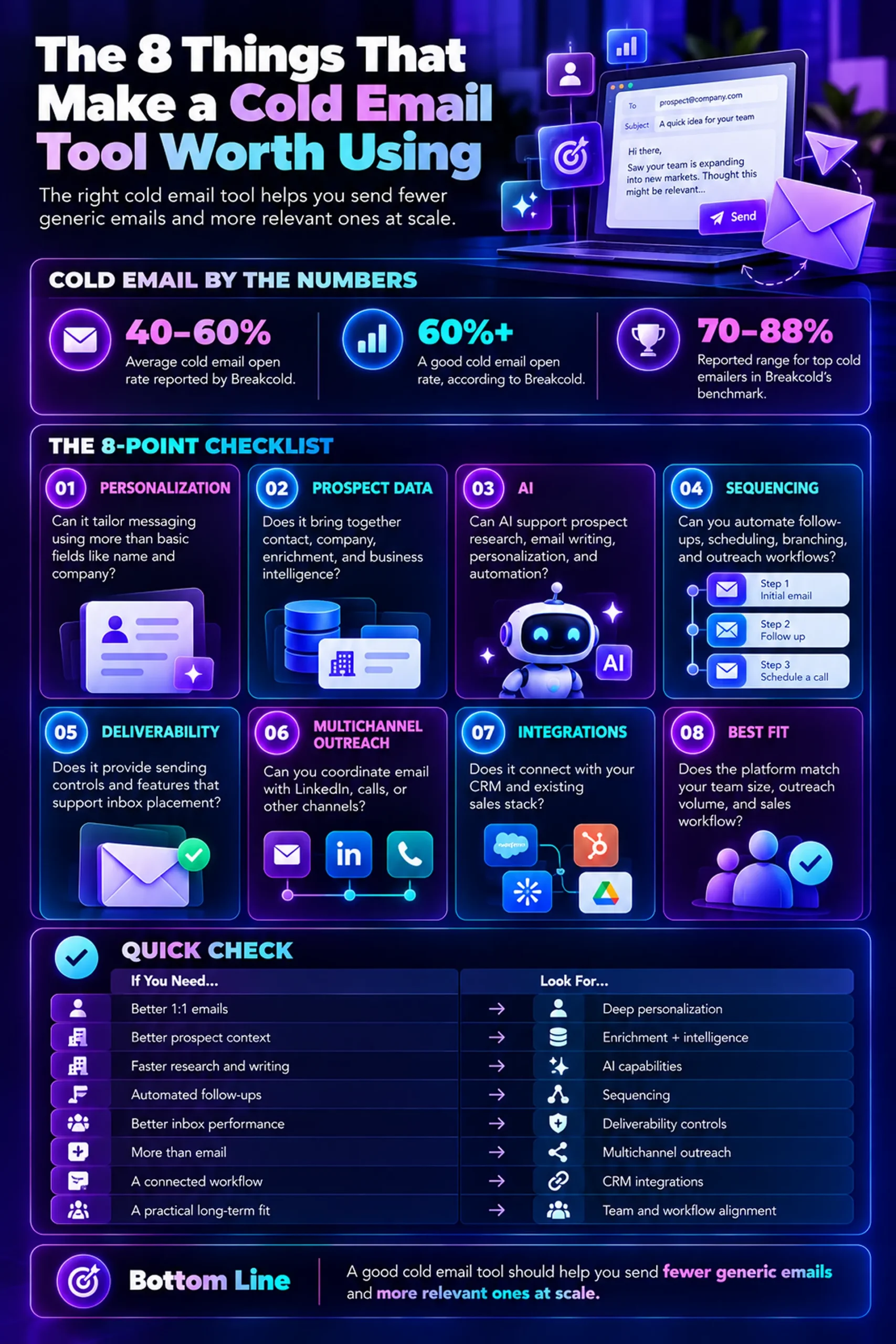
1. ReachGen: For AI-Powered Prospect Research and Personalized Outreach
ReachGen is an AI-powered prospecting and outreach platform designed to connect prospect discovery, account intelligence, contact research, and personalized outreach. Rather than treating email personalization as a standalone writing task, it connects the research behind prospect selection with the messaging used to approach potential buyers.
This approach is particularly relevant for B2B sales teams that need to identify ICP-fit accounts, understand decision-makers, and create outreach based on specific business contexts rather than relying only on standard email variables.
How ReachGen Works
ReachGen uses prospect and company information to research potential buyers and identify details that can make an outreach message more relevant.
Instead of relying only on fields such as name, job title, and company, the platform can use broader business context to inform the message. This makes the research behind an email part of the personalization process.
See how ReachGen uses prospect intelligence to support personalized outreach.
Example
Suppose a sales team is targeting VP-level revenue leaders at SaaS companies.
A generic campaign might pitch the same product to every VP with the prospect’s name and company inserted.
With deeper prospect research, the message can be adjusted based on the individual company and role. A VP at a rapidly growing SaaS company might receive messaging around scaling pipeline generation, while another prospect may be approached around improving sales efficiency.
The product stays the same. The business context changes the pitch.
Where ReachGen Stands Out
The biggest advantage is the connection between prospect intelligence and outreach.
A team targeting mid-market technology companies, for example, may want to identify organizations that fit a particular ICP, find relevant decision-makers, understand their business context, and then create messaging based on that context.
That is different from uploading a CSV of contacts and adding a custom variable to an email.
ReachGen is therefore a strong choice for teams looking at personalized cold email tools from the perspective of the entire prospecting workflow rather than email sending alone.
Best For
- B2B teams building ICP-driven outbound campaigns
- Teams that want AI-assisted prospect research
- Sales teams that need account and contact intelligence before outreach
- Businesses looking to connect prospecting with personalized messaging
What to Consider
ReachGen is most relevant when prospect research and contextual personalization are important parts of the outbound process. Teams primarily looking for a dedicated high-volume sending platform should also evaluate sending-account management, inbox rotation, deliverability controls, and campaign execution requirements.
Buyers should assess how well its research outputs align with their ICP, how much personalization can be controlled by sales teams, and how easily the workflow fits into their existing sales stack.
Verdict: A strong option for B2B teams that want to connect ICP-based prospecting, account research, and contextual email personalization within one outbound workflow.
2. Apollo: For Prospecting and Outbound in One Platform
https://www.apollo.io/_next/static/media/homepage-hero.17rsa~-g60iw0.webm
Apollo combines a large B2B prospect database with sales engagement tools, giving teams a way to find contacts, research prospects, and reach them without switching between multiple platforms. Its contact profiles can include professional details, role information, engagement history, and enrichment data.
Key Features to Know
- Add and maintain information on saved contacts and accounts.
- Generate or improve email messaging using prospect information and buyer signals.
- Combine automated emails with calls, LinkedIn actions, and other outreach steps.
- Track opens, clicks, replies, and other engagement signals.
- Manage sending infrastructure and monitor factors that can affect email delivery.
Where Apollo Fits Best
Apollo makes sense for teams that want prospecting data and outbound engagement in the same platform.
It is particularly useful when sales reps need to find contacts, narrow them down using ICP criteria, and move selected prospects directly into personalized outreach rather than exporting data into several other tools.
3. Instantly: For High-Volume Cold Email Campaigns
Instantly is built primarily for running cold email campaigns at scale. It combines sending-account management, email warmup, campaign creation, lead sourcing, personalization, and campaign analytics in one platform.
Instantly supports personalized outreach through custom variables, campaign-level messaging, and AI-assisted features. However, teams should distinguish between personalizing emails using information already available in their lead records and conducting deeper research to identify individual business priorities. The quality of personalization depends heavily on the information supplied to the campaign.
The Big Draw: Sending at Scale
Teams can manage multiple sending accounts, automate warmup, set sending limits, schedule campaigns, and track performance. This makes Instantly useful for running large outbound campaigns without managing each inbox separately.
Example
Basic Personalization:
“Hi Sarah, I wanted to reach out because our platform helps sales teams improve their prospecting process.”
Contextual Personalization:
“Hi Sarah, noticed your company is expanding its SDR team. As outbound activity increases, maintaining consistent prospect research and follow-up can become more difficult. I thought this might be relevant to your team.”
The second message uses a business development signal to create a more relevant opening. However, the quality of this personalization depends on whether the underlying hiring information is accurate and current.
4. ZoomInfo: For Data-Rich B2B Prospecting
ZoomInfo is a B2B intelligence platform that gives sales teams contact and company data for prospecting. Its database includes firmographic, technographic, organizational, and intent information.
Teams can use these insights to identify relevant accounts, find decision-makers, understand company activity, and add business context to outreach. For personalization, this data can help sales reps choose a relevant message instead of relying on basic contact fields.
Features to Know
- Contact Data: Find professional information on decision-makers and buying roles.
- Company Intelligence: Research firmographics, organizational details, and business activity.
- Technographic Data: See the technologies companies use to identify potential sales opportunities.
- Intent Signals: Identify accounts showing interest in relevant topics or solutions.
- AI-Powered Insights: Use AI capabilities to surface information and support prospecting and engagement.
5. Outreach: For Structured Sales Engagement
Outreach is a sales engagement platform built to help teams manage prospect communication across emails, calls, tasks, and follow-ups. Its strength lies in organizing sales engagement at scale, giving reps a structured way to execute outreach, manage conversations, and track engagement. Rather than focusing primarily on building a prospect database, Outreach is designed around executing and managing sales engagement.
Example
A sales rep is targeting 50 qualified accounts and wants each prospect to receive a series of relevant emails with scheduled follow-ups.
The rep can add prospects to a sequence, personalize the messaging, schedule follow-ups, and monitor engagement from one place. If a prospect responds, the rep can adjust the next action based on the conversation.
Who Benefits Most?
- Larger sales organizations
- Teams with defined outbound processes
- Organizations managing high volumes of prospect engagement
6. Drip: For Automated Customer and Email Journeys
Drip is an email marketing platform focused primarily on ecommerce brands and customer engagement. It helps businesses create personalized email campaigns based on customer behavior, purchase history, and lifecycle stage. Unlike traditional B2B cold email tools, Drip is designed more for engaging people who have already interacted with a brand than for finding and contacting new prospects.
Where It Can Fit
Drip works well when personalization depends on what a customer has already done. Businesses can use customer data and behavior to create targeted emails for different stages of the customer journey, from first purchase to repeat buying and re-engagement.
When It May Not Be the Right Fit
Drip may not be the best choice for sales teams focused on B2B cold prospecting, contact discovery, or outbound sales engagement. Its strengths are customer marketing and lifecycle communication rather than finding new prospects and starting sales conversations from scratch.
7. Customer.io: For Behavior-Based Personalization
Customer.io is a customer engagement platform that uses customer data and behavioral signals to deliver personalized messages. Teams can connect user actions with email, push, SMS, and other messaging channels, allowing communication to change based on what a person does rather than relying only on static profile information.
Unique Value
Its key strength is using real-time customer behavior as a personalization signal. Instead of sending the same message to everyone, teams can respond to actions such as page visits, product usage, email engagement, purchases, or inactivity.
Example
A prospect visits a pricing page, returns two days later, and then engages with a product email.
That sequence of actions can signal stronger interest than a basic contact record. The next message could address pricing questions, highlight relevant product benefits, or encourage the prospect to speak with sales.
8. Clay: For Custom Prospecting and Enrichment
Clay is a prospecting and data enrichment platform that helps teams source data, research companies and contacts, enrich records, identify relevant signals, and create personalized messaging. Its flexible setup lets teams combine multiple data sources and AI research capabilities to build a prospecting system around their specific targeting criteria.
Why Teams Choose Clay
Clay stands out for its flexibility. Instead of relying on a fixed set of prospecting steps, teams can choose the data sources, enrichment methods, research criteria, and AI actions they need. This makes it useful for teams with specific ICP requirements or complex research needs.
Trade-Off
Clay’s flexibility comes with a learning curve. Building highly customized prospecting setups can require more configuration and maintenance than using a platform with predefined capabilities.
9. Smartlead: For Automated Cold Email Outreach
Smartlead is a cold email outreach platform built around campaign automation, email sending, personalization, and managing multiple sending accounts. It helps sales teams run outbound campaigns at scale while handling tasks such as follow-ups, scheduling, inbox management, and campaign tracking.
Pros and Cons
| Pros | Cons |
|---|---|
| High-volume email campaigns | Sending scale does not equal personalization |
| Automated follow-ups | Requires campaign setup |
| Multiple sending accounts | Limited focus on deep prospect research |
| Campaign tracking | Quality data is still needed |
What To Consider
Smartlead makes sense for teams that have significant outbound volume and need operational control.
Agencies, lead-generation businesses, and outbound teams can use custom variables to create more individualized messages while maintaining campaign automation.
Its personalization becomes particularly useful when the data is already structured.
For example:
- Company: ABC
- Industry: Logistics
- Trigger: Expanded operations
- Personalization: Mentioned expansion
- Role: VP Sales
The campaign can use those fields to produce a more contextual message without requiring a salesperson to manually write every email.
10. Woodpecker: For Straightforward Cold Email Campaigns
Woodpecker is a cold email platform focused on campaign creation, personalization, automated follow-ups, and email tracking. Its straightforward approach makes it easier for teams to manage outbound campaigns without needing a large sales engagement stack.
What Makes It Useful
Woodpecker takes a more focused approach.
The platform is built specifically around cold email, follow-ups, deliverability, and personalization. It supports custom snippets, email validation, warm-up, inbox rotation, A/B testing, behavioral follow-up paths, and timezone-based sending.
Woodpecker also supports custom fields for information such as first name, company, website, and other prospect details.
Best Fit
Smaller teams that want straightforward cold email outreach without building a complex GTM stack.
11. Streak: For Cold Email Inside Gmail
Streak is a CRM built directly into Gmail, allowing users to manage contacts, deals, emails, and sales activities without leaving their inbox. This makes it different from dedicated outbound platforms that provide separate sales engagement environments.
Where Streak Stands Out
The Gmail experience.
If your team already lives inside Gmail and wants to track prospects, organize relationships, and manage sales pipelines without adopting a separate CRM, Streak can be appealing.
It is less suitable when the goal is large-scale cold email automation with sophisticated prospect research.
Think of Streak as a lightweight relationship-management layer rather than a full outbound engine.
Best For
- Small sales teams
- Founders
- Gmail-first businesses
- Relationship-based selling
- Teams that need lightweight CRM functionality
Verdict: Best for teams that want CRM and email management directly inside Gmail rather than a dedicated cold outreach stack.
Personalized Cold Email Tools At A Glance
| Tool | Primary Use Case | Personalization Approach | Main Strength | Main Consideration |
|---|---|---|---|---|
| ReachGen | Research-led B2B outreach | Prospect and company intelligence with contextual messaging | Connects prospect research with outreach | Evaluate workflow fit and sending requirements |
| Apollo | Prospecting and outbound | Contact data, enrichment, and AI-assisted messaging | Prospecting and engagement in one platform | Data coverage and feature requirements |
| Instantly | High-volume cold email | Custom variables and AI-assisted personalization | Sending-account and campaign management | Requires quality prospect data |
| ZoomInfo | B2B intelligence | Firmographic, technographic, and intent data | Extensive account and contact intelligence | Cost and data-package requirements |
| Outreach | Sales engagement | Personalized sequences and stakeholder messaging | Structured sales engagement | May require external data sources |
| Drip | Ecommerce email marketing | Purchase history and customer behavior | Customer lifecycle automation | Not designed for B2B cold prospecting |
| Customer.io | Behavioral messaging | User activity and behavioral triggers | Event-based customer engagement | Requires existing user or customer data |
| Clay | Prospect research and enrichment | Custom data sources and AI research | Flexible research and enrichment workflows | Configuration and maintenance |
| Smartlead | Cold email automation | Custom fields and campaign personalization | Multi-account campaign operations | Research depends on supplied data |
| Woodpecker | Cold email campaigns | Custom snippets and prospect fields | Straightforward campaign automation | Limited emphasis on deep prospect intelligence |
| Streak | Gmail-based CRM | Contact context and relationship history | CRM directly inside Gmail | Not a dedicated high-volume cold email platform |
How to Personalize Cold Emails Without Making Them Sound AI-Generated
AI can make prospect research and email creation faster, but poor personalization often makes messages feel generic or machine-written. Use these practices to keep cold emails relevant and natural:
1. Personalize Around a Real Business Context
Use information that explains why the prospect is relevant, such as a new hire, expansion, product launch, technology change, or role-specific challenge. Avoid adding personal details that have no connection to your offer.
2. Give the Personalization a Purpose
Do not mention a fact just to prove that you researched the prospect. Connect it directly to the reason you are reaching out.
Weak: “I saw that your company recently expanded.”
Better: “I noticed your sales team is expanding, which can make maintaining consistent prospect research harder.”
3. Avoid Overly Polished Language
AI-generated emails often rely on formal phrases, excessive praise, and long explanations. Use the same straightforward language a salesperson would use in a real conversation.
4. Keep One Clear Message
Do not combine several company insights into one email. Choose the most relevant observation and build the message around it.
5. Edit AI-Generated Copy
Review every AI-generated email before sending. Remove generic statements, repeated phrases, unnecessary adjectives, and claims that are not supported by your research.
6. Make the CTA Conversational
The final question should match the context of the email. A simple, relevant question usually feels more natural than a generic “Would you be open to a quick call?”
Bottom line: Good AI-assisted personalization should make the email feel more relevant, specific, and human, not simply more customized.
Conclusion
If your team knows which accounts fit the ICP, which people matter, what is happening inside those accounts, and why the conversation is relevant, the email becomes much easier to personalize.
That is where personalized cold email tools are heading: beyond simple mail merge toward platforms that combine prospect intelligence, research, AI, personalization, and outreach execution.
If personalization starts with identifying the right prospects and understanding their business context, a research-led platform such as ReachGen can be a strong fit. If the priority is sending at scale, campaign automation or sales engagement, other platforms may make more sense.
The real question is simple: Do you need a better way to send cold emails, or a better way to decide who deserves one?
Give every outreach decision better context with ReachGen. Let’s Connect! Talk to Us!
Explore ReachGen or email info@diggrowth.com to request a demo.
Ready to get started?
Increase your marketing ROI by 30% with custom dashboards & reports that present a clear picture of marketing effectiveness
Start Free Trial
Experience Premium Marketing Analytics At Budget-Friendly Pricing.

Learn how you can accurately measure return on marketing investment.
Lookalike Account Modeling for B2B Revenue Teams
Lookalike account modeling takes a different approach. It studies the attributes and outcomes of successful customers,...
Read full post post
You’re Targeting Your Ideal Customer. So Why Aren’t They Buying?
Your best customers reveal the traits associated with success. Your lost opportunities reveal where fit breaks...
Read full post post
How Predictive AI Will Transform Paid Media Strategy in 2026
Paid media isn’t a channel game anymore, it’s a chessboard. Search, social, programmatic, video, influencer, native,...
Read full post post