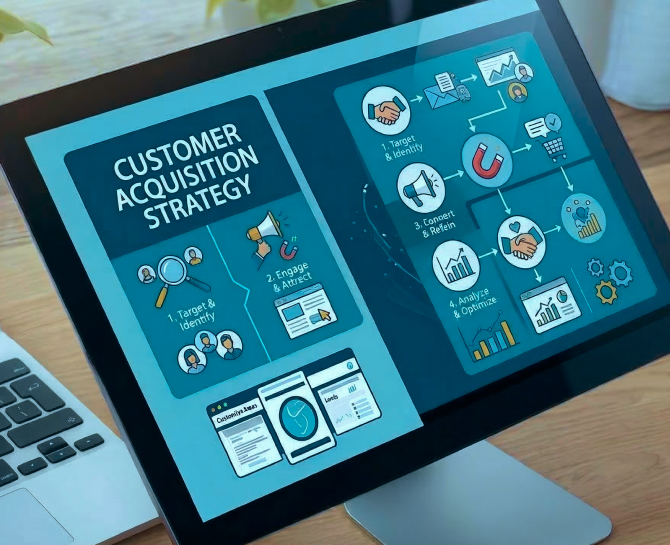
Customer Acquisition Strategy: Your Complete Framework for Sustainable Growth
A customer acquisition strategy is a systematic plan for attracting, engaging, and converting new customers in ways that are sustainable and scalable. Effective customer acquisition strategies combine targeting the right audiences, optimizing conversion funnels, balancing acquisition channels, and ensuring unit economics work at scale to create predictable, profitable growth.
A customer acquisition strategy is your roadmap for sustainably acquiring new customers. It defines who you target, how you reach them, what messaging resonates, which channels you use, how you optimize conversion, and how you ensure the economics work. Unlike random marketing tactics, a customer acquisition strategy creates a systematic, repeatable process that generates predictable growth while maintaining or improving unit economics over time.
Let me guess. Your customer acquisition “strategy” looks something like this:
Run some ads. Create content. Do some SEO. Send emails. Sponsor an event. Try that new channel everyone’s talking about. See what works. Do more of that. Repeat.
That’s not really a strategy. It’s a collection of tactics with no coherent framework connecting them.
A real customer acquisition strategy answers specific questions: Who exactly are you trying to acquire? Why would they choose you over alternatives? How will you reach them? What sequence of touches moves them from awareness to purchase? Which channels deliver the best returns? How do you scale what works without breaking unit economics?
Without clear answers to these questions, you’re spending money hoping something works rather than executing against a plan designed to work.
Key Takeaways
- Customer acquisition strategies require clear targeting, compelling positioning, optimized conversion funnels, and sustainable unit economics.
- Effective strategies balance multiple acquisition channels rather than relying on a single source.
- Successful customer acquisition balances growth with profitability by maintaining healthy CAC to LTV ratios.
- Testing and optimization should be systematic, not random, with clear hypotheses and success criteria.
- The best customer acquisition strategies create compound growth through retention, expansion, and referrals, not just new acquisition.
Core Components of a Customer Acquisition Strategy
Every effective customer acquisition strategy addresses these fundamental components.
1. Clear Target Customer Definition
Who exactly are you trying to acquire? “Small businesses” isn’t specific enough. What industry? What size? What problem are they experiencing? What’s their current solution?
Your customer acquisition strategy needs a precise definition based on who actually buys, not who you wish would buy. Look at your best customers and find the patterns.
2. Compelling Value Proposition
Why should your target customers choose you? What specific outcome do you deliver that they can’t get elsewhere or can’t get as easily?
Your customer acquisition strategy must articulate this clearly. Vague promises about “innovation” or “quality” don’t cut it. What concrete problem do you solve better than alternatives?
3. Channel Strategy
Which channels will you use to reach target customers? Your customer acquisition strategy should include a balanced mix of:
- Paid channels (search ads, social ads, display) for immediate reach
- Organic channels (SEO, content) for long-term compound growth
- Earned channels (PR, partnerships) for credibility and reach
- Owned channels (email, community) for efficiency
According to HubSpot’s 2025 State of Marketing Report, companies using 3-5 channels in their customer acquisition strategy see 52% better results than those relying on a single channel.
4. Conversion Funnel Optimization
How do you move prospects from awareness to purchase? Your customer acquisition strategy needs to define each stage:
- Awareness: How do prospects discover you?
- Interest: What makes them want to learn more?
- Consideration: How do they evaluate you against alternatives?
- Purchase: What triggers them to buy?
- Retention: How do you keep them buying?
Each stage needs specific tactics and content aligned with where prospects are in their journey.
5. Unit Economics
Your customer acquisition strategy must work financially. Can you acquire customers at a cost that leaves room for profit? Does the payback period allow for reinvestment?
Track these metrics closely:
- Customer Acquisition Cost (CAC)
- Customer Lifetime Value (LTV)
- CAC Payback Period
- LTV: CAC Ratio
Healthy SaaS businesses typically target LTV: CAC ratios of 3:1 or better and payback periods under 12 months.
Building Your Customer Acquisition Strategy: Step by Step
Creating an effective customer acquisition strategy requires systematic thinking, not random tactics.
Step 1: Define Your Ideal Customer Profile
Start by analyzing your best existing customers. Not your biggest necessarily, but those who:
- Close quickly without excessive sales effort
- Stay long-term with low churn risk
- Expand their relationship over time
- Refer others or provide great case studies
What characteristics do these customers share? Industry? Size? Technology stack? Geography? Pain points?
Build your customer acquisition strategy around attracting more customers who match this profile.
Step 2: Map the Customer Journey
Document the typical path from first awareness to closed customer. Interview recent customers to understand:
- How did they first hear about you?
- What made them interested enough to learn more?
- What content or touchpoints influenced their evaluation?
- What finally convinced them to buy?
- How long did the process take?
Your customer acquisition strategy should facilitate this natural journey, not fight against it.
Step 3: Identify Your Competitive Differentiation
Why do customers choose you over alternatives? What do you do better, differently, or uniquely?
Your customer acquisition strategy messaging needs to communicate this differentiation clearly and consistently across all channels.
Step 4: Select Your Channel Mix
Based on where your target customers spend time and what channels your best customers came from, select your primary acquisition channels.
Your customer acquisition strategy should typically include:
- 2-3 primary channels that get 60-70% of the budget
- 2-3 secondary channels that get 20-30% of the budget
- 10-15% reserved for testing new channels
Don’t spread resources too thin across too many channels. Focus on mastering a few.
Step 5: Create Channel-Specific Plans
Each channel in your customer acquisition strategy needs a specific plan:
- What’s the goal? (Awareness? Leads? Direct conversions?)
- What’s the budget?
- What content/creative is needed?
- Who’s responsible?
- How will you measure success?
- What’s your optimization process?
Generic “do some social media” doesn’t cut it. Each channel needs a real plan.
Step 6: Build Your Conversion Infrastructure
Your customer acquisition strategy needs the operational infrastructure to convert interest into customers:
- Landing pages optimized for conversion
- Lead capture and nurture systems
- Sales processes and enablement
- Customer onboarding and activation
- Tracking and analytics across the funnel
Many customer acquisition strategies fail not because they can’t generate interest, but because they can’t convert it efficiently.
Step 7: Set Metrics and Targets
Define success metrics for your customer acquisition strategy:
- New customer targets by month/quarter
- CAC targets by channel
- Conversion rate targets for each funnel stage
- Payback period targets
- LTV: CAC ratio targets
Without clear metrics, you can’t tell if your customer acquisition strategy is working.
Pro Tip : Build scenario models for your customer acquisition strategy. If conversion rates improve 20%, how does that affect growth? If CAC increases 30%, can economics still work? Understanding these dynamics helps you make better decisions.
Customer Acquisition Strategy by Growth Stage
What works for customer acquisition changes as your company grows.
Early Stage: Finding Product-Market Fit
At this stage, your customer acquisition strategy focuses on learning, not scale.
Goals: Validate that target customers actually want what you’re selling and will pay for it.
Tactics:
- Founder-led outreach to ideal customers
- Content that attracts early adopters
- Small paid tests to validate channels
- Heavy emphasis on customer interviews
Metrics: Qualitative feedback, initial retention, product usage, willingness to pay
Your customer acquisition strategy here prioritizes learning over efficiency.
Growth Stage: Scaling What Works
You’ve found product-market fit and proven that a few channels work. Now your customer acquisition strategy focuses on scaling them.
Goals: Increase customer acquisition volume while maintaining unit economics.
Tactics:
- Increase the budget on proven channels
- Build operational infrastructure for scale
- Hire specialists for each channel
- Implement marketing automation
- Optimize conversion systematically
Metrics: CAC, payback period, channel ROI, funnel conversion rates
Your customer acquisition strategy balances growth with profitability.
Expansion Stage: Diversification
You’ve maxed out initial channels and need new sources of growth. Your customer acquisition strategy diversifies.
Goals: Open new customer segments, geographies, or channels to maintain the growth rate.
Tactics:
- International expansion
- New market segments
- Channel diversification
- Partnership development
- Product expansion into adjacent markets
Metrics: Revenue from new segments/markets, CAC by segment, overall growth rate
Your customer acquisition strategy must balance maintaining existing channels while building new ones.
Balancing Paid, Organic, and Earned Channels
The best customer acquisition strategies use a mix of channel types.
Paid Channels: Speed and Control
Paid acquisition gives you immediate reach and precise targeting, but can be expensive and requires ongoing spend.
Include in your customer acquisition strategy:
- Google Ads for high-intent search traffic
- LinkedIn Ads for B2B targeting
- Facebook/Instagram Ads for consumer and SMB
- Display and retargeting for multi-touch journeys
Pros: Fast to launch, highly targetable, easy to measure. Cons: Costs rise over time, stop when spending stops, and are increasingly expensive
Organic Channels: Compound Growth
Organic acquisition requires upfront investment but delivers compound returns over time.
Include in your customer acquisition strategy:
- SEO and content marketing
- Social media organic (when you have a real audience)
- Community building
Product-led growth
Pros: Economics improve over time, build lasting assets, and credibility. Cons: Takes time to work, harder to measure, requires consistent investment.
Earned Channels: Credibility and Reach
Earned channels provide credibility and reach you can’t buy but are harder to control.
Include in your customer acquisition strategy:
- PR and media coverage
- Partnerships and integrations
- Affiliate and referral programs
- Influencer and analyst relations
Pros: High credibility, often low cost, extends reach. Cons: Difficult to control, unpredictable, hard to scale
A balanced customer acquisition strategy uses all three types, with the mix evolving based on growth stage and market dynamics.
Common Customer Acquisition Strategy Mistakes
Mistake 1: No Clear ICP
Trying to acquire “everyone” in a market means your customer acquisition strategy lacks focus. You end up with generic messaging that resonates with no one.
Define a specific ICP and build your customer acquisition strategy around attracting those customers.
Mistake 2: Channel Hopping
Jumping to new channels every quarter because the current ones “aren’t working” prevents you from ever mastering any channel.
Your customer acquisition strategy should give channels time to work (usually 6-12 months) before abandoning them
Mistake 3: Ignoring Unit Economics
Growing at any cost works until you run out of money. Your customer acquisition strategy must maintain healthy unit economics, or you’re building an unsustainable business.
Monitor CAC, LTV, and payback period constantly.
Mistake 4: No Conversion Optimization
Sending traffic to poorly converting landing pages wastes acquisition spend. Your customer acquisition strategy should include systematic conversion optimization.
Even small conversion improvements dramatically impact acquisition efficiency.
Mistake 5: Neglecting Retention
Acquiring customers is expensive. Losing them quickly makes acquisition investments worthless. Your customer acquisition strategy should connect to retention and expansion strategies.
The best customer acquisition is keeping the customers you already have.
Pro Tip : Calculate your break-even retention period. How long must customers stay to cover acquisition costs? Make sure actual retention exceeds this, or your customer acquisition strategy isn’t sustainable.
How DiGGrowth Enhances Your Customer Acquisition Strategy
DiGGrowth provides the data foundation and analytics needed to build and optimize your customer acquisition strategy.
Unified Customer Journey Tracking
DiGGrowth tracks prospects across all channels from first touch to customer, showing which touchpoints in your customer acquisition strategy actually contribute to conversions.
This visibility ensures your customer acquisition strategy invests in channels that work, not just those that get the last click.
Cohort Analysis
DiGGrowth’s cohort analysis shows how customer acquisition strategy changes affect long-term outcomes. Did customers acquired in Q2 retain better than in Q1? Is the payback period improving?
These insights help refine your customer acquisition strategy over time.
Channel Performance Comparison
DiGGrowth compares channel performance not just on acquisition cost but on customer quality, retention, and lifetime value. This shows which channels in your customer acquisition strategy deliver the best long-term returns.
Funnel Optimization
DiGGrowth identifies exactly where prospects drop off in your funnel, revealing specific optimization opportunities in your customer acquisition strategy.
Predictive Lead Scoring
DiGGrowth’s AI predicts which prospects are most likely to convert based on historical patterns, helping your customer acquisition strategy focus resources on high-probability opportunities.
Pro Tip : Use DiGGrowth to track cohort economics over time. This shows whether your customer acquisition strategy is improving, staying flat, or deteriorating, enabling proactive adjustments.
Conclusion
Random marketing tactics might generate some customers, but they don’t create predictable, scalable growth. That requires a real customer acquisition strategy with clear targeting, channel plans, optimized conversion, and sustainable economics.
The companies that grow efficiently have systematic customer acquisition strategies that balance immediate results with long-term compound growth. They know who they’re targeting, how to reach them, how to convert them, and how to do it all profitably.
DiGGrowth provides the analytics foundation to build and optimize your customer acquisition strategy with data instead of guesses. You see which channels drive quality customers, where to focus investment, and how to improve efficiency over time.
Ready to build a customer acquisition strategy that creates predictable growth? Let’s Talk!
Reach out to us at info@diggrowth.com to transform random tactics into a systematic acquisition engine.
Ready to get started?
Increase your marketing ROI by 30% with custom dashboards & reports that present a clear picture of marketing effectiveness
Start Free Trial
Experience Premium Marketing Analytics At Budget-Friendly Pricing.

Learn how you can accurately measure return on marketing investment.
You’re Targeting Your Ideal Customer. So Why Aren’t They Buying?
Your best customers reveal the traits associated with success. Your lost opportunities reveal where fit breaks...
Read full post post
How Predictive AI Will Transform Paid Media Strategy in 2026
Paid media isn’t a channel game anymore, it’s a chessboard. Search, social, programmatic, video, influencer, native,...
Read full post post
Don’t Let AI Break Your Brand: What Every CMO Should Know
AI isn’t just another marketing tool. It’s changing how we connect with customers, personalize content, and...
Read full post postFAQ's
A customer acquisition strategy is a systematic plan for attracting and converting new customers that defines target audiences, value proposition, acquisition channels, conversion processes, and unit economics. Unlike random marketing tactics, a customer acquisition strategy creates a repeatable, scalable system for predictable growth.
A customer acquisition strategy should include: a clear ideal customer profile definition, a compelling value proposition, a channel strategy and budgets, conversion funnel optimization, unit economics and targets, testing and optimization processes, and metrics for measuring success. Each component should be documented and assigned clear ownership.
Measure customer acquisition strategy success through: number of new customers acquired, customer acquisition cost by channel, conversion rates at each funnel stage, customer lifetime value, LTV: CAC ratio, payback period, and overall growth rate. Track these metrics by cohort to see if your customer acquisition strategy is improving over time.
Most effective customer acquisition strategies focus on 4-6 channels: 2-3 primary channels receiving 60-70% of the budget, 2-3 secondary channels receiving 20-30%, and 10-15% reserved for testing new channels. Focusing on fewer channels allows you to master them rather than spreading resources too thin.
Customer acquisition strategies evolve through growth stages. The early stage focuses on learning and validation with founder-led tactics. Growth stage scales proven channels and builds infrastructure. The expansion stage diversifies into new segments, markets, or channels. The balance of paid, organic, and earned channels also shifts based on company maturity.