
How to Enrich CRM Data: Boost Precision, Personalization, and Performance
Enrich CRM data with predictive analytics to spot sales-ready leads, prevent churn, and identify upsell potential. Transform your CRM into a proactive engine that anticipates customer needs and boosts performance.
Data enrichment refers to the process of enhancing raw customer data by supplementing it with additional, relevant information from external or internal sources. Within a CRM system, this means transforming incomplete or outdated contact records into rich, actionable profiles.
For sales and marketing teams, working with enriched CRM data eliminates guesswork. It ensures access to verified, current information-job titles, social profiles, firmographic details, and behavioral signals-all of which are necessary to engage leads at the right time and with the right message.
When CRM data is accurate and thoroughly enriched, customer experiences become seamless and highly personalized. Conversion rates climb as outreach becomes more relevant. Marketing campaigns hit tighter targets, which reduces budget waste and increases ROI across channels.
Exposing the Gaps: Understanding Your CRM Data Foundation
What Your CRM Is Already Capturing
Most CRMs come preconfigured to collect a standard set of customer attributes. These include:
- Basic Contact Information
– Names, email addresses, phone numbers, and mailing addresses.
- Interaction History
– Records of emails sent, calls made, meetings scheduled, and customer service tickets opened.
- Purchase Behavior
– Invoices, order history, transactional volumes, product preferences, and renewal patterns.
Taken at face value, this data provides a transactional map of the customer. But viewed critically, this is only the skeleton of a more complete customer profile. To produce precision targeting, predictive engagement, and meaningful segmentation, this foundation must be evaluated-and upgraded.
Common Structural Weaknesses in CRM Data
Even the most robust CRM implementations suffer from data gaps. These voids reduce the power of marketing campaigns and limit sales efficiency. Dig into a CRM, and the typical issues become clear:
- Missing Fields
– Job titles, industry sectors, or even key company details like employee count and revenue often go uncollected.
- Outdated Contact Information
– According to Salesforce, B2B data decays at an annual average rate of 30%, with email addresses and phone numbers expiring as people change roles or companies.
- Incomplete Demographic Data
– Without age, location, or channel preference, personalization collapses into guesswork.
These data blind spots stem from manual entry errors, unintegrated data sources, and silent churn within customer bases. They obstruct the creation of context-rich customer insights and hinder the ability to prioritize high-value opportunities.
Why Data Accuracy Directly Affects Campaign Effectiveness
Accurate CRM data transforms targeting from a generic message blast to a surgically precise outreach. When contact records contain verified job functions, updated interaction logs, and fresh purchasing signals, campaigns generate higher conversion rates.
HubSpot reports that personalized email campaigns can improve click-through rates by up to 14% and conversion rates by 10%. That uplift relies entirely on the integrity of the underlying data. A CRM riddled with inaccuracies won’t produce that effect-it dilutes messaging relevance and clogs sales pipelines with misqualified leads.
Outreach grounded in clean, complete, and current data drives stronger engagement. The correlation is direct: better data equals better outcomes.
Pro Tip- Schedule quarterly data health checks to identify missing fields, duplicates, and outdated contacts. Pair this with automated enrichment tools to keep records current without relying solely on manual updates. This proactive approach prevents data decay from quietly eroding campaign effectiveness.
Powerful Data Collection Techniques to Enrich CRM Records
Webforms and Lead Magnets for Data Acquisition
Webforms serve as frontline gates for capturing first-party data. The highest converting forms combine brevity with strategic intent. A 2019 Formstack study reported that multi-step forms increase conversion rates by up to 300% compared to single-step alternatives. Embedding these forms on high-traffic landing pages, blog posts, or gated content downloads enables structured data capture at scale.
Lead magnets-resources like downloadable PDFs, industry reports, or access to exclusive tools-trigger data exchange by offering clear value. High-performing lead magnets don’t just collect basic contact details; they prompt users for job roles, company names, purchase intent, or even budget estimates. This granular input directly supports lead scoring models and prioritization workflows within the CRM.
Integrating Email Marketing Tools to Capture Data Through Engagement
Email interactions reveal behavioral clues and intent data that elevate CRM intelligence. Modern platforms-such as HubSpot, Klaviyo, and Mailchimp-track metrics far beyond open and click rates. They monitor link heatmaps, behavioral triggers, and multi-email journey paths.
By syncing these tools with your CRM, every action-whether it’s a download, a webinar registration, or idle periods in a nurture sequence-adds context to the contact profile. Email preference centers also act as passive data collection hubs. When users self-select interests, communication frequency, or content formats, you acquire psychographic input with zero additional outreach.
Offline Data Collection Through Events or In-Person Sales Efforts
Trade shows, industry events, and face-to-face sales calls still outperform digital touchpoints in data richness. In these contexts, customers disclose nuanced information-current solution stack, budget cycles, decision-making timelines-that is not typically revealed through online forms.
Utilizing mobile CRM apps or data capture tools like iCapture or Eventbrite integrations allows sales teams to input and sync data immediately, preserving accuracy and context. Badge scanners or custom QR-coded registration systems also streamline attendee identification and real-time profile updates.
Post-event follow-ups function as secondary data layers. When attendees respond to feedback surveys or interact with recaps, they reveal preferences that refine CRM segmentation models.
- Maximize webform efficiency
by pre-populating fields for repeat visitors using cookies or CRM history.
- Design lead magnets
with segmented entry points tailored to buyer personas.
- Structure email campaigns
as branching logic journeys to trigger insights based on behavior, not just metadata.
- Train field teams
to collect strategic data points during in-person engagements using standardized input templates.
Pro Tip- Upload a controlled sample of your CRM or lead list and compare results across vendors, look for accuracy, enrichment depth, and bounce rate impact. This head-to-head evaluation helps cut through marketing claims and ensures you invest in a platform that truly matches your business needs.
Accelerating CRM Intelligence with Real-Time Data Updates
APIs as the Backbone of Dynamic CRM Data
Static CRM records erode value. APIs inject constant movement into your system by enabling real-time synchronization with multiple internal and external data sources. When connected correctly, APIs feed your CRM with the most current information-eliminating outdated contact info, modified purchase histories, or behavioral changes before they create friction. RESTful APIs, Webhooks, and GraphQL interfaces power this automation layer, letting your CRM adapt to changes the moment they happen.
Dynamic updates through APIs also unlock immediate actionability. When a prospect visits a pricing page, requests a demo, or attends a webinar, that event travels instantly into the CRM, updating lead scores, triggering workflows, and notifying sales reps without manual involvement.
Trigger-Based Updates that Drive Action
Several real-time triggers amplify the effectiveness of your CRM by converting raw signals into meaningful engagement opportunities. Here are core categories:
- Lead Scoring Adjustments:
When a lead downloads a whitepaper, revisits the website, or clicks an email CTA, event-driven updates adjust their score on-the-fly, allowing sales to act at peak interest.
- Sales Notifications:
Instant alerts notify account owners when a dormant lead suddenly becomes active, re-engages with campaigns, or hits a product usage milestone.
- Marketing Automation:
Live CRM data lets nurtures respond in the moment-sending highly specific content based on the user’s latest actions or status change.
These triggers aren’t theoretical. For instance, HubSpot’s event-based segmentation updates contact records immediately upon a form fill, enabling workflows that adapt within seconds. Salesforce’s Einstein Activity Capture integrates with email and calendars in real time, recording touchpoints without delay.
Maintaining Message Relevance in Motion
CRM communication thrives on timing. Real-time data inputs prevent scenarios where leads receive outdated messaging, wrong stage offers, or irrelevant promotions. As contact preferences shift or customer interactions play out across touchpoints, time-sensitive updates keep every department on the same page.
Consider an abandoned cart scenario. When the CRM logs that abandonment in real time, a personalized email sequence can trigger just minutes after the event-while intent remains fresh. Without that speed, the window of conversion narrows or closes entirely.
Real-time updates transform CRMs from retrospective databases into responsive engagement engines that align perfectly with customer behavior-as it unfolds.
Pro Tip- Upload a controlled sample of your CRM or lead list and compare results across vendors, look for accuracy, enrichment depth, and bounce rate impact. This head-to-head evaluation helps cut through marketing claims and ensures you invest in a platform that truly matches your business needs.
AI and Machine Learning for Smart Data Enrichment
Artificial intelligence and machine learning move CRM data enrichment from reactive to predictive. These technologies not only process massive datasets at scale-they also detect patterns, automate insights, and surface opportunities otherwise buried in manual workflows.
Predictive Modeling to Identify Potential Customers and Trends
Layering machine learning models over CRM datasets will forecast high-value leads, churn risks, or emerging market segments. By training algorithms on historical performance data-such as conversion rates, email open behaviors, or deal sizes-models highlight which contacts are most likely to convert or require follow-up. Sales teams no longer rely exclusively on gut instinct; they get statistic data, such as conversion rates, email open behaviors, or deal sizes, models ally backed prioritization lists driven by real behavior data.
In B2B environments specifically, predictive scoring models leverage firmographic and engagement data to qualify accounts with precision. For example, if companies with over $100 million in revenue and specific technographic stacks closed faster last quarter, the model recalibrates qualification logic to reflect that, surfacing others with similar characteristics.
Automating Anomaly Detection in CRM Data
CRM anomalies cost sales time and slow marketing cycles. AI addresses this through unsupervised learning models that automatically flag inconsistencies-such as duplicate entries, invalid email formats, or missing fields. Once detected, systems can trigger automated clean-up processes or route the errors to data quality teams for resolution. The result: a self-correcting feedback loop that improves data hygiene at scale without constant manual oversight.
Outlier detection models also identify unusual activity within customer interactions. A sudden drop in engagement from a top-tier lead? Or an influx in demo requests from a previously quiet segment? These shifts get spotlighted in real-time dashboards, pushing sales or success teams to act faster.
Recommending Content or Sales Actions Based on Machine Learning Insights
By correlating user behavior and profile data with historical outcomes, machine learning recommends next-best actions tailored to context. A mid-funnel lead who just downloaded a whitepaper on compliance? The system suggests sending case studies relevant to their industry. A dormant account that opened pricing emails after months of inactivity? AI flags it for an outbound call campaign.
Recommendation engines use collaborative filtering, decision trees, and neural networks to personalize outreach-down to tone, timing, and channel. Marketers receive content suggestions personalized to account personas. Sales reps get prompted with talk tracks that align with prospect behavior. The knowledge once siloed in top performers becomes scalable, embedded in CRM tools through AI orchestration.
- Lead Prioritization:
Models score leads daily based on likelihood to engage or convert.
- Opportunity Expansion:
AI identifies cross-sell and upsell potential by matching customers to product-use patterns.
- Sales Enablement:
Suggested talking points and personalized messages auto-populate CRM records based on contact activity.
With each interaction and data point, models refine themselves-becoming more precise, proactive, and context-aware over time. The CRM doesn’t just store information anymore; it evolves into a system of intelligence that drives high-impact decisions.
Pro Tip- Upload a controlled sample of your CRM or lead list and compare results across vendors, look for accuracy, enrichment depth, and bounce rate impact. This head-to-head evaluation helps cut through marketing claims and ensures you invest in a platform that truly matches your business needs.
CRM Integration with Marketing Automation and Sales Tools
Best Practices for Syncing Tools Like HubSpot, Salesforce, Marketo, and Pipedrive
Synchronizing marketing automation platforms and sales tools with your CRM system turns static records into dynamic triggers for action. To enable real-time updates and minimize data drift, most B2B organizations rely on native or API-based integrations. HubSpot, Salesforce, Marketo, and Pipedrive offer robust APIs that allow bi-directional sync of leads, activities, and custom field data.
- Use field mapping:
Align fields between platforms precisely, especially lead status, campaign source, and lifecycle stage, to prevent misrouting data.
- Define your source of truth:
Identify which system governs specific data types (e.g., Salesforce for account hierarchy, Marketo for behavioral scoring).
- Automate error handling:
Implement logic to catch and route failed syncs through alerts or automated workflows.
- Plan sync intervals:
Execute near real-time sync where responsive actions matter, like in lead routing or customer service escalations. Use daily batch syncs for volume-heavy objects like email interaction logs.
Examples of High-Impact Workflows
Integrated tools unlock goal-driven workflows that pivot CRM systems from passive databases into active engines of influence. Here are three workflows that consistently demonstrate measurable revenue impact:
- Lead Nurturing:
When a new inbound lead enters Pipedrive or HubSpot, the system cross-references demographics from the CRM and enriches with firmographic data. Based on qualification logic, the lead is automatically enrolled in a pre-built nurture flow via Marketo containing personalized email sequences and calls to action. Conversion status updates in real-time within the CRM.
- Automated Onboarding:
Once an opportunity is marked “closed-won” in Salesforce, workflow rules trigger an onboarding drip campaign. Marketo delivers setup instructions, while the CRM logs each engagement. Sales reps receive alerts if engagement rates drop, allowing early intervention.
- Win-Back Campaigns:
Using inactivity filters in CRM, dormant leads (e.g., no engagement in 90 days) automatically feed into reactivation campaigns orchestrated by marketing automation platforms. New behavioral signals, web visits, and content downloads are captured and re-scored in the CRM to redirect leads back into active sales paths.
Ensuring Consistent Messaging Across Touchpoints
Disjointed tools often lead to fragmented messaging. A unified integration stack eliminates that risk by enabling centralized control over content sequencing and timing. Campaign tags and behavioral triggers from the marketing platform must align with CRM-defined deal stages and contact preferences.
Cross-functional teams, sales, marketing, and operations gain full visibility into contact histories, ensuring continuity of message even as prospects change channels. Whether triggering a nurture email from Marketo or generating a follow-up task in HubSpot’s sales pipeline, every touchpoint sings in tune when CRM data governs orchestration.
Pro Tip- Don’t stop at syncing data, sync intent signals. Beyond demographic and firmographic details, pipe in behavioral triggers like webinar attendance, pricing page visits, or product usage milestones. These real-time intent signals, when unified in your CRM, help both sales and marketing teams prioritize actions that align with actual buyer readiness.
Predictive Analytics and Proactive Engagement: Driving Future-Focused CRM Outcomes
Identify Sales-Ready Leads Through Predictive Modeling
Predictive analytics algorithms analyze historical CRM patterns to determine which leads are most likely to convert. Instead of relying solely on manual scoring systems, businesses use machine learning models trained on thousands of attributes, such as email open rates, purchase history, website interactions, and demographic fit, to rank leads by conversion probability.
According to Salesforce’s State of Sales report (2022), high-performing sales teams are 4.9x more likely to use AI-powered lead scoring than underperforming ones. These models highlight signals such as timing, channel engagement, and deal velocity, which enable sales teams to focus outreach where it produces the best yield.
Anticipate Churn and Upsell Opportunities Before They Happen
Machine learning identifies customers who display behavioral markers of churn, often weeks before actual disengagement. For instance, a decline in usage frequency, an increase in support tickets, or changes in purchase cadence can trigger risk alerts. Armed with this insight, account managers can launch timely retention strategies, including loyalty offers, dedicated support, or exclusive content access, to keep value from walking out the door.
Conversely, predictive enrichment flags up potential upsell opportunities. A customer upgrading usage tiers, browsing expansion products, or showing increased activity often signals readiness for additional services. Algorithms cluster these cues, scoring them for upsell potential. This allows sales reps to strike while the intent is highest, not after interest has faded.
Launch Campaigns with Proactive Targeting
Predictive analytics doesn’t stop at individual leads; it scales across entire campaigns. By modeling who is likely to respond to specific offers, marketers can segment audiences dynamically and craft tailored journeys. These aren’t general blasts. They reflect real-time triggers, like lifecycle stage changes or a surge in product interest.
- Target repeat buyers during loyalty windows with premium bundle promotions.
- Deploy retention campaigns to low-engagement segments flagged for churn.
- Diversify content offers based on predicted need-state matches.
This approach optimizes campaign ROI. A study by McKinsey found organizations that use predictive analytics in their marketing efforts achieve 5-10% better conversion rates and 10-20% improvements in marketing efficiency.
Predictive insight shifts CRM from reactive data storage to an active revenue engine. What would change in your strategy if you could know what your customer will do next?
Pro Tip- Combine predictive analytics with closed-loop feedback. Feed campaign outcomes and sales results back into your models so they continuously recalibrate against real-world performance. This ensures your CRM predictions don’t just stay accurate in theory, they evolve with shifting customer behaviors, market dynamics, and sales strategies.
Future-Proofing Your CRM: Smarter Data, Greater Value
CRM enrichment transforms static records into active intelligence, increasing their utility across every customer-facing function. Precision targeting, automated workflows, relevant messaging, and smarter lead scoring all flow from enriched, structured, and continuously updated CRM datasets. Companies that invest in constant enrichment outperform reactive data maintenance by a wide margin.
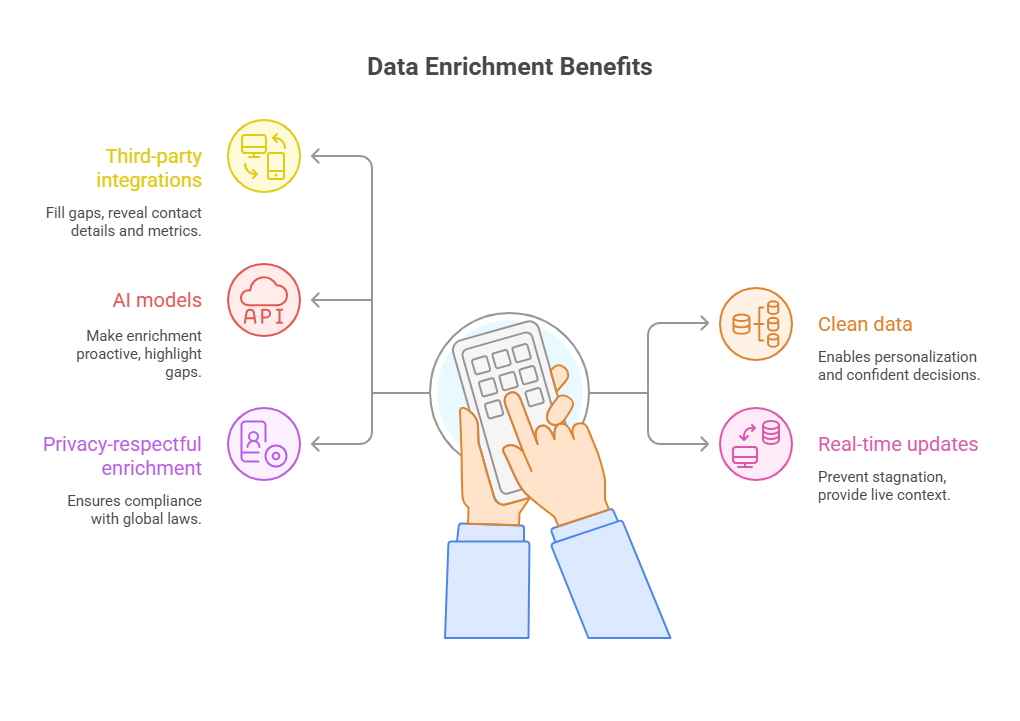
Data enrichment is entering a new phase, shaped by automation and expanding data sources. Several key developments are redefining what’s possible:
- Voice data from sales calls, service lines, and virtual assistants
unlocks contextual information impossible to gather through forms alone.
- AI-native enrichment tools
are replacing batch uploads with dynamic suggestions, real-time scoring, and lifecycle tagging.
- IoT-driven data
, especially for industries like logistics, manufacturing, and healthcare, adds geolocation, usage patterns, and sensor-inferred needs.
The next evolution of CRM won’t just track the customer journey, it will anticipate where that journey heads next, based on signals drawn from every corner of the digital ecosystem.
Key Takeaways
- Clean, enriched data transforms CRMs from static databases into intelligence engines, enabling hyper-personalized outreach and more accurate lead scoring.
- Missing fields, outdated contacts, and poor integrations limit campaign performance and sales efficiency. Enrichment eliminates these blind spots to unlock higher ROI.
- Machine learning, predictive analytics, and API-driven syncs keep CRM data fresh, enabling proactive engagement, churn prevention, and timely upsell opportunities.
- Connecting CRMs with marketing automation, sales tools, and third-party enrichment platforms ensures consistent messaging, seamless workflows, and smarter decision-making across teams.
Start with a frank internal audit. Is your CRM producing revenue-driving insights daily, or simply storing names and stale email lists? Talk to Us!
Just write to us at info@diggrowth.com and we’ll get back to you.
Ready to get started?
Increase your marketing ROI by 30% with custom dashboards & reports that present a clear picture of marketing effectiveness
Start Free Trial
Experience Premium Marketing Analytics At Budget-Friendly Pricing.

Learn how you can accurately measure return on marketing investment.

How Predictive AI Will Transform Paid Media Strategy in 2026
Paid media isn’t a channel game anymore, it’s a chessboard. Search, social, programmatic, video, influencer, native,...
Read full post post
Don’t Let AI Break Your Brand: What Every CMO Should Know
AI isn’t just another marketing tool. It’s changing how we connect with customers, personalize content, and...
Read full post post
From Demos to Deployment: Why MCP Is the Foundation of Agentic AI
A quiet revolution is unfolding in AI. And it’s not happening inside research labs. For decades,...
Read full post postFAQ's
CRM data enrichment is the process of enhancing raw CRM records by appending missing, updated, or contextual information. It fills in gaps like job titles, company size, technology stack, or buying intent, making customer profiles completer and more actionable.
Without enrichment, CRMs often contain outdated or incomplete records, leading to poor segmentation and wasted outreach. Enriched CRM data enables precise targeting, personalized campaigns, faster lead routing, and higher conversion rates, directly improving ROI.
Enrichment can be done in real-time (e.g., when a lead fills out a web form and additional attributes are appended instantly) or in batches (e.g., cleansing and updating thousands of records at once). Both methods can be combined in hybrid workflows depending on business needs.
Popular tools include Clearbit, ZoomInfo, Apollo, FullContact, and Leadspace. These platforms integrate directly with CRMs like Salesforce or HubSpot, pulling in firmographics, technographics, and intent data to strengthen lead and account intelligence.
Enrichment is not a one-time task. Best practice is to combine real-time enrichment for inbound leads with scheduled batch updates (monthly or quarterly) for existing records. This ensures data stays accurate as job roles, company structures, and market signals change.