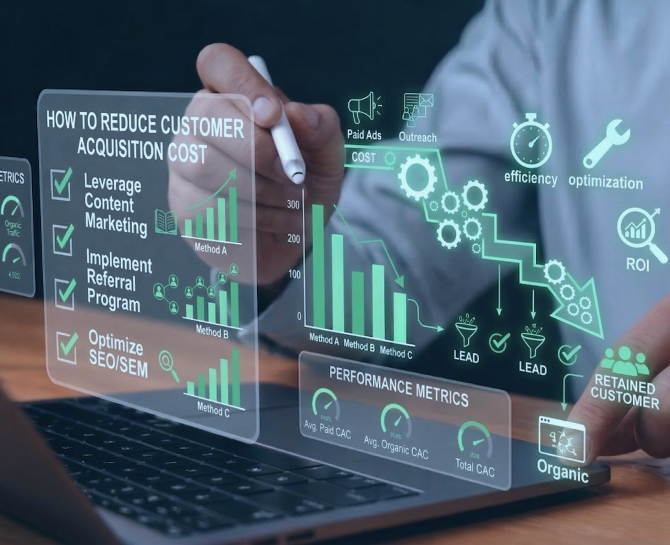
How to Reduce Customer Acquisition Cost Without Sacrificing Growth
Reducing customer acquisition cost (CAC) requires optimizing conversion rates, improving targeting accuracy, increasing customer lifetime value, and eliminating waste in marketing and sales processes. By focusing on high-converting channels, refining messaging, and improving retention, businesses can acquire customers more efficiently while maintaining or accelerating growth.
Customer acquisition cost (CAC) is the total amount spent on marketing and sales to acquire a single new customer. To reduce customer acquisition cost, businesses need to either decrease spending on acquisition efforts, increase conversion rates to get more customers from the same spend, or both. The most effective strategies to reduce customer acquisition cost focus on targeting the right audiences, optimizing conversion funnels, improving retention to increase lifetime value, and eliminating wasteful tactics that don’t generate returns.
Let’s be honest. Your customer acquisition cost is probably too high.
Not because you’re doing something dramatically wrong. Most companies just accept that customer acquisition is expensive and keep spending more as they try to grow. Marketing budgets increase. Sales teams expand. Ad costs go up every quarter. CAC climbs steadily, and everyone shrugs because “that’s just how it is.”
Except it doesn’t have to be that way.
The best-performing companies aren’t spending more on acquisitions. They’re spending smarter. They’ve figured out how to reduce customer acquisition cost by eliminating waste, improving conversion rates, and focusing resources on channels and tactics that actually deliver returns.
The strategies to reduce customer acquisition cost aren’t complicated or theoretical. They’re practical changes you can implement this quarter to start seeing results. Some will save you money immediately. Others will take a few months but deliver ongoing efficiency gains.
Key Takeaways
- Reducing customer acquisition cost requires both decreasing acquisition spend and increasing conversion efficiency.
- Improving targeting accuracy ensures marketing reaches people actually likely to buy, eliminating wasted spend.
- Conversion rate optimization multiplies the value of existing traffic without increasing ad budgets.
- Higher customer lifetime value makes acquisition costs more sustainable, even if they don’t decrease.
- Retention improvements reduce the need to constantly acquire new customers to replace churned ones.
Understanding Your Current Customer Acquisition Cost
Before you can reduce customer acquisition cost, you need to know exactly what you’re spending and where the money goes.
Calculate Your True CAC
Most companies calculate CAC too simply. They divide total marketing spend by new customers and call it done. But real CAC includes more than just ad spend.
True CAC = (Marketing spend + Sales salaries + Sales tools + Marketing salaries + Agency fees + Creative production + Any other acquisition-related costs) / Number of new customers acquired
Include everything that contributes to acquiring customers. If you’re only counting ad spend, you’re dramatically underestimating your actual cost to reduce customer acquisition cost effectively.
Break Down CAC by Channel
Your overall CAC number hides critical details. You might have an average CAC of $500, but one channel costs $200 while another costs $1,200. You can’t reduce customer acquisition cost intelligently without knowing which channels are efficient and which are burning money.
Calculate CAC separately for paid search, paid social, content marketing, SEO, email, events, partnerships, and any other channel you use.
Segment CAC by Customer Type
Different customer segments have different acquisition costs. Enterprise customers typically cost more to acquire than small businesses. Customers in competitive industries cost more than those in underserved markets.
Understanding these differences helps you decide where to focus efforts to reduce customer acquisition cost and which segments justify higher spend.
Track CAC Trends Over Time
Is your CAC increasing or decreasing? Seasonal fluctuations are normal, but if your CAC has been climbing steadily for months, you have a problem that needs addressing.
According to the 2026 SaaS CAC Benchmarks Guide, the median CAC for B2B SaaS companies increased by 60% between 2020 and 2025, making it critical to actively work to reduce customer acquisition cost.
Strategy 1: Improve Targeting to Reduce Customer Acquisition Cost
One of the fastest ways to reduce customer acquisition cost is to stop the practice of marketing to people who will never buy.
Define Your Ideal Customer Profile Based on Data
Most ICP definitions are guesses. “Mid-market companies in technology” isn’t specific enough. Look at your actual best customers. What industries? What size? What technologies do they use? What roles are involved in buying decisions?
Create a data-driven ICP that describes customers who close fast, stay long, and expand. Then target only those characteristics to reduce customer acquisition cost.
Use Negative Targeting to Exclude Bad Fits
It’s not just about who you target. It’s also about who you exclude. If small businesses churn at 80% annually while mid-market customers churn at 15%, stop spending acquisition budget on small businesses.
Use negative targeting in your ads to exclude company sizes, industries, or other attributes that correlate with poor outcomes.
Invest in Account-Based Marketing for High-Value Targets
For B2B companies, ABM focuses resources on specific high-value accounts rather than broad audiences. This approach to reduce customer acquisition cost spends more per account but wastes nothing on unqualified traffic.
Platforms like Demandbase, 6sense, and Terminus enable targeted ABM campaigns that significantly reduce customer acquisition cost per quality opportunity.
Leverage Lookalike Audiences
Platforms like Facebook, LinkedIn, and Google can identify new prospects who resemble your best customers. Lookalike audiences typically convert better than cold targeting, helping reduce customer acquisition cost.
Upload your customer list, and the platform finds similar users to target.
Pro Tip : Regularly update your lookalike audiences with recent customer data. The model improves as you add more examples of successful customers, continuously helping you reduce customer acquisition cost.
Strategy 2: Optimize Conversion Rates to Reduce Customer Acquisition Cost
If you double your conversion rate, you effectively cut customer acquisition cost in half without changing ad spend.
Fix Your Landing Pages
Most landing pages convert terribly. Too much text, weak headlines, confusing CTAs, slow load times, poor mobile experience. Even small improvements can significantly reduce customer acquisition cost.
Test different headlines, simplify copy, make CTAs more prominent, remove unnecessary fields from forms, and ensure pages load in under three seconds.
Improve Your Sales Process
Long sales cycles increase customer acquisition cost. Every additional week in the pipeline means more sales time, more touches, and more opportunities for deals to stall.
Identify where prospects get stuck. Is it during discovery? Evaluation? Negotiation? Address specific bottlenecks to reduce customer acquisition cost by moving deals faster.
Implement Marketing Automation
Automation keeps prospects engaged without requiring manual effort, helping reduce customer acquisition cost. When someone downloads a resource, automated sequences can nurture them toward conversion without sales involvement until they’re qualified.
Platforms like HubSpot, Marketo, and ActiveCampaign enable sophisticated nurture sequences that improve conversion while reducing acquisition cost.
Use Retargeting to Re-Engage Interested Prospects
Most website visitors don’t convert on their first visit. Retargeting brings them back at a fraction of the cost of acquiring new traffic, directly helping reduce customer acquisition cost.
Show targeted ads to people who visited specific pages, watched demos, or started but didn’t complete sign-ups.
Optimize for Mobile
If significant traffic comes from mobile but conversion rates are half of desktop, you’re wasting acquisition spend. Ensure your entire funnel works seamlessly on mobile to reduce customer acquisition cost.
Test forms, CTAs, page layouts, and checkout processes on actual mobile devices, not just responsive design previews.
Strategy 3: Increase Customer Lifetime Value
Sometimes the best way to reduce customer acquisition cost isn’t lowering CAC at all. It’s increasing how much customers are worth.
Improve Retention
Every point of improvement in retention compounds over time. If you can reduce annual churn from 20% to 15%, average customer lifetime increases from 5 years to 6.7 years, making acquisition costs more sustainable.
Use customer success programs, proactive support, and regular engagement to keep customers longer, indirectly helping reduce customer acquisition cost pressure.
Drive Expansion Revenue
Upsells and cross-sells increase customer value without additional acquisition cost. If you can grow accounts 20% annually through expansion, your effective customer acquisition cost decreases significantly.
Identify usage patterns that predict expansion readiness and reach out proactively with relevant offers.
Increase Pricing
Higher prices directly improve unit economics and make acquisition costs more sustainable. If you can raise prices 10% without significantly impacting conversion or retention, you’ve effectively reduced customer acquisition cost by 10%.
Test pricing changes with new customers or specific segments before rolling out broadly.
Bundle Products and Services
Bundling increases initial contract value and often improves retention. Customers who use multiple products are stickier than single-product users, making the acquisition investment more worthwhile.
Strategy 4: Focus on High-Performing Channels
Not all marketing channels are created equal when trying to reduce customer acquisition cost.
Calculate ROI by Channel
Some channels have great CAC but terrible customer quality. Others have higher CAC, but customers who stay twice as long and spend three times as much. Look at full customer value, not just acquisition cost.
Calculate payback period and lifetime ROI by channel to understand where to focus efforts to reduce customer acquisition cost while maintaining quality.
Double Down on What Works
Once you identify high-ROI channels, shift budget from underperforming channels. This seems obvious, but most companies continue spreading budget evenly across all channels instead of concentrating on winners.
If content marketing delivers $5 in LTV for every $1 spent, while paid social delivers $1.50, move the budget to content to reduce customer acquisition cost.
Kill Underperforming Channels
Sentimentality is expensive. Just because you’ve always sponsored that conference or run those ads doesn’t mean you should continue if they don’t deliver returns.
Ruthlessly cut channels that don’t meet minimum ROI thresholds to reduce customer acquisition cost overall.
Test New Channels Systematically
While focusing on proven channels, reserve 10-15% of the budget for testing new approaches to reduce customer acquisition cost. You might discover more efficient channels, but test rigorously with clear success criteria.
Strategy 5: Improve Organic and Owned Channels
Paid acquisition gets more expensive over time. Organic and owned channels can reduce customer acquisition costs dramatically.
Invest in SEO
Organic search typically has the lowest CAC of any channel because there’s no direct cost per click. The upfront investment in content and optimization pays dividends for years.
Create content targeting high-intent keywords that prospects actually search for when evaluating solutions.
Build Email Lists
Email marketing to owned lists costs almost nothing per send. Every subscriber represents a way to reduce customer acquisition cost for future campaigns.
Use lead magnets, content upgrades, and website CTAs to grow your email list consistently.
Create Referral Programs
Customers who refer others are your best acquisition channel. They pre-qualify prospects, provide social proof, and typically cost very little to incentivize, helping significantly reduce customer acquisition cost.
Make referrals easy with shareable links, clear incentives, and simple processes.
Develop Strategic Partnerships
Partner channels can deliver qualified leads at a lower cost than paid acquisition. Find companies serving similar customers with complementary products and create mutual referral arrangements.
Pro Tip : Calculate the long-term value of each organic channel investment. SEO might take 6-12 months to pay off, but once it does, it continues delivering qualified traffic to reduce customer acquisition cost for years.
Strategy 6: Reduce Sales Friction
Sales inefficiency directly increases customer acquisition cost.
Qualify Leads Better
Sales time wasted on unqualified leads is expensive. Implement better lead scoring to ensure sales only engage with prospects likely to close, helping reduce customer acquisition cost.
Use behavioral data, firmographics, and intent signals to identify qualified opportunities.
Shorten Your Sales Cycle
Every day a deal sits in the pipeline costs money. Identify and eliminate bottlenecks that slow deals down to reduce customer acquisition cost.
Can you simplify your proposal process? Speed up legal review? Reduce approval layers?
Improve Sales Enablement
Sales reps who fumble demos, can’t answer objections, or lack relevant case studies take longer to close deals. Better enablement improves win rates and cycle time, both reducing customer acquisition cost.
Implement Self-Service Options
For lower-value customers, self-service signup and onboarding eliminates sales cost entirely, dramatically helping reduce customer acquisition cost for that segment.
How DiGGrowth Helps Reduce Customer Acquisition Cost
DiGGrowth provides unified analytics that help identify exactly where to focus efforts to reduce customer acquisition cost.
Multi-Touch Attribution Shows True Channel Performance
DiGGrowth’s attribution reveals which channels actually contribute to conversions, not just which get the last click. This prevents cutting channels that appear inefficient in last-click attribution but actually play crucial roles earlier in the journey.
Understanding true channel contribution helps you reduce customer acquisition cost by investing in channels that actually work.
Conversion Funnel Analysis Identifies Drop-Off Points
DiGGrowth tracks prospects through every stage and shows exactly where they drop off. This pinpoints specific opportunities to improve conversion and reduce customer acquisition cost.
If 60% of prospects abandon during the demo request form, fixing that form could dramatically reduce customer acquisition cost.
Customer Segmentation Reveals High-Value Targets
DiGGrowth segments customers by acquisition cost, lifetime value, and other attributes to show which segments are profitable and which aren’t.
This enables better targeting decisions that reduce customer acquisition cost by focusing on profitable segments.
Real-Time Campaign Optimization
DiGGrowth monitors campaign performance in real time, allowing quick adjustments that prevent wasted spend and help reduce customer acquisition cost continuously.
Pro Tip : Use DiGGrowth’s cohort analysis to track how CAC and LTV trends change over time for different customer segments, enabling data-driven decisions to reduce customer acquisition cost sustainably.
Conclusion
Reducing customer acquisition cost isn’t about one magic tactic. It’s about systematically eliminating waste, improving conversion at every stage, focusing resources on channels that deliver returns, and increasing the value of customers you acquire.
Most companies accept rising CAC as inevitable. The ones that actively work to reduce customer acquisition cost through better targeting, conversion optimization, channel focus, and retention create sustainable competitive advantages.
DiGGrowth helps you identify exactly where to focus by revealing true channel performance, conversion bottlenecks, and customer segment profitability. You get the data needed to reduce customer acquisition cost without guessing.
Ready to reduce customer acquisition cost and improve unit economics? Let’s Talk!
Reach out to us at info@diggrowth.com ato discover where your acquisition spend is being wasted and how to fix it.
Ready to get started?
Increase your marketing ROI by 30% with custom dashboards & reports that present a clear picture of marketing effectiveness
Start Free Trial
Experience Premium Marketing Analytics At Budget-Friendly Pricing.

Learn how you can accurately measure return on marketing investment.
How Predictive AI Will Transform Paid Media Strategy in 2026
Paid media isn’t a channel game anymore, it’s a chessboard. Search, social, programmatic, video, influencer, native,...
Read full post post
Don’t Let AI Break Your Brand: What Every CMO Should Know
AI isn’t just another marketing tool. It’s changing how we connect with customers, personalize content, and...
Read full post post
From Demos to Deployment: Why MCP Is the Foundation of Agentic AI
A quiet revolution is unfolding in AI. And it’s not happening inside research labs. For decades,...
Read full post postFAQ's
Customer acquisition cost (CAC) is the total amount spent to acquire a single new customer. Calculate it by dividing all sales and marketing costs (including salaries, tools, ad spend, agencies, and production) by the number of new customers acquired in that period. To reduce customer acquisition cost, you need to either decrease these expenses or increase conversion efficiency.
A good CAC depends on your customer lifetime value. The general rule is that CAC should be less than one-third of LTV, meaning you earn back acquisition costs within 12 months and customers remain profitable for their lifetime. Focus efforts to reduce customer acquisition cost on maintaining or improving this ratio.
The fastest ways to reduce customer acquisition cost are improving conversion rates on existing traffic (which requires no additional ad spend), cutting underperforming channels immediately, and improving targeting to focus only on high-probability prospects. These changes can reduce customer acquisition cost within weeks.
Better retention increases customer lifetime value, which makes acquisition costs more sustainable. If customers stay twice as long, you can afford to spend more to acquire them while maintaining the same CAC: LTV ratio. Retention improvements also reduce the need to constantly acquire new customers to replace churned ones, indirectly helping reduce customer acquisition cost pressure.
Tools that help reduce customer acquisition cost include attribution platforms like DiGGrowth that show true channel performance, conversion optimization tools like Optimizely or VWO, marketing automation platforms like HubSpot that improve efficiency, and analytics tools that identify where prospects drop off in your funnel.