GA4 Predictive Analytics: How to Target High-Intent Customers Before They Convert
GA4 predictive analytics helps marketers target high-intent users, cut wasted ad spend, and reduce churn before it happens. Here's how to set it up and activate it.
What if you could predict which customers are ready to buy before visiting your website? For years, businesses have relied on historical data to guide marketing decisions, analyzing past conversions, campaign performance, and audience behavior. But by the time insights are gathered, the opportunity to act has often passed. Marketers end up reacting to trends rather than shaping them.
Ad budgets are routinely wasted on broad targeting instead of high-intent customers. Customer retention suffers because brands fail to identify churn risks in time. And marketing campaigns underperform when strategies are built on past data rather than future possibilities.
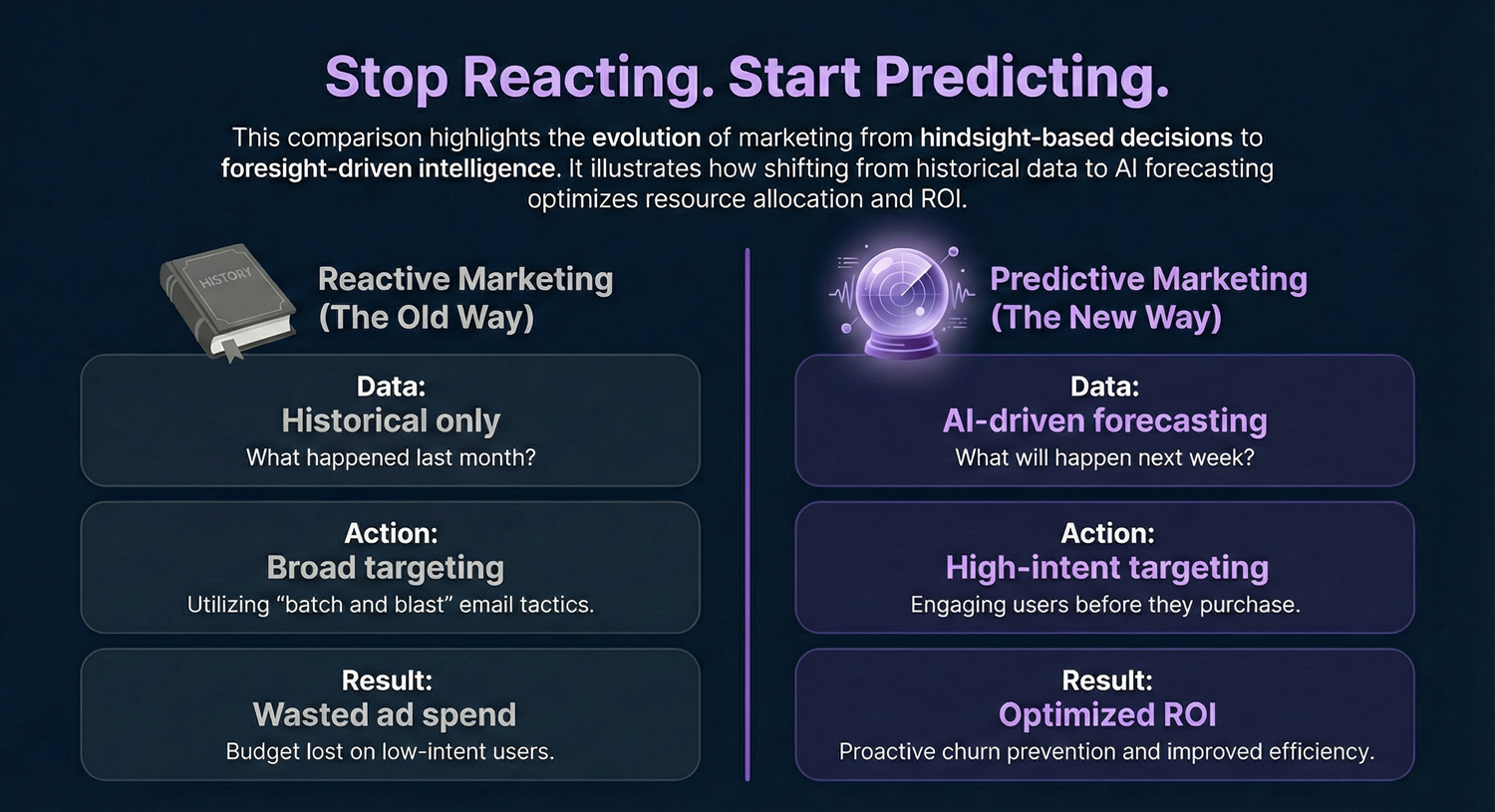
This is where Google Analytics predictive analytics becomes a game-changer. Instead of looking backward, it anticipates which users are most likely to convert, who might churn, and where marketing efforts will have the highest impact. Businesses that integrate predictive insights into their marketing strategies are not just optimizing, they are staying ahead of the competition.
By shifting from reactive to predictive marketing, companies can allocate resources more efficiently, personalize customer experiences, and drive higher conversions, before opportunities are lost.
Key Takeaways
- Predictive audience segmentation helps optimize email marketing campaigns by delivering hyper-personalized content, improving engagement and conversion rates.
- Marketing automation tools can leverage predictive analytics to trigger real-time ad campaigns, retargeting, and personalized website experiences.
- Businesses that implement predictive analytics effectively gain a competitive advantage by anticipating market trends, optimizing ad spend, and reducing customer churn.
Why GA4 Predictive Analytics Is Becoming Essential for Marketers
Traditional marketing decisions are based on past data, which often leads to missed opportunities. By the time trends are identified, consumer behavior has already changed. Predictive analytics eliminates this lag by forecasting future actions, allowing businesses to act before opportunities are lost.
Rather than running broad campaigns, marketers can now focus on high-intent users most likely to convert a concept GA4 surfaces through its purchase probability metric. Budgets can be allocated dynamically to reduce wasted ad spend on low-value audiences. Businesses can also identify potential churn risks early and implement targeted retention strategies for high-value customers, adjusting their approach in real time as predictive data updates.
As competition grows, businesses that rely on past data alone will struggle to keep up. Predictive analytics enables marketing teams to stay ahead by making informed decisions before trends unfold.
The Competitive Advantage: Spotting Market Trends Before They Peak
Market shifts do not happen overnight, but businesses that rely on historical data often fail to see them coming. By the time competitors react, the real opportunity has already passed. Google Analytics predictive analytics helps companies move beyond reactive decision-making by identifying early demand signals, allowing them to adjust strategies before market trends fully take shape.
Predictive insights allow businesses to detect rising demand for products or services before competitors recognize the shift. This extends to pricing and inventory predictive models help optimize stock levels ahead of fluctuations, preventing shortages or oversupply. Real-time budget reallocation becomes possible by directing marketing spend toward users who are most likely to convert at precisely the right moment, giving early movers a lasting advantage in competitive markets.
Note: Many businesses struggle to implement predictive analytics effectively because they remain too reliant on outdated decision-making processes or fail to integrate AI-driven insights into their workflows. Closing this gap is where the real competitive advantage lies.
Precision Targeting: Finding High-Value Customers Before They Convert
Most marketing campaigns cast a wide net, hoping to attract the right customers. This approach leads to wasted ad spend and lower conversion rates. Predictive analytics in Google Analytics changes this by identifying high-value prospects before they take action, allowing businesses to focus their efforts on the audiences most likely to convert.
Here is how predictive analytics enhances customer targeting:
- Identifying High-Intent Users: By analyzing behavioral patterns, predictive analytics pinpoints users who are most likely to complete a purchase or take a key action.
- Segmenting Audiences More Effectively: Instead of relying on generic demographics, businesses can create precise audience segments based on predicted behaviors and engagement likelihood.
- Personalizing Customer Journeys: Predictive insights enable businesses to deliver tailored messages and offers at the right stage of the customer’s decision-making process.
- Shortening the Sales Cycle: By targeting users who are already in the consideration phase, businesses can reduce the time and effort required to turn a prospect into a customer.
Pro Tip- Export your GA4 predictive audiences particularly “Likely 7-day purchasers” directly into Google Ads to run dedicated campaigns against users already primed to convert. This single integration can meaningfully reduce cost-per-acquisition without increasing budget.
Implementing Predictive Analytics with Google Analytics Software
Google Analytics 4 (GA4) integrates predictive analytics using machine learning to analyze user behavior and forecast future actions. However, leveraging these insights effectively requires careful setup and strategic implementation. From configuring event tracking to integrating predictive audiences with advertising platforms, businesses must ensure their data infrastructure supports actionable decision-making.
Steps to Set Up Google Analytics Predictive Analytics Features
- Enable Enhanced Measurement: GA4 automatically tracks key user interactions, including page views, scrolls, outbound clicks, and site searches. These data points form the foundation for predictive models. Navigate to your GA4 property settings and enable enhanced measurement to ensure comprehensive behavioral tracking.
- Define Key Events for Prediction: Google’s machine learning models rely on structured event data to make accurate forecasts. Businesses must identify critical conversion events such as purchases, sign-ups, form submissions, or video completions.
These events should be marked as conversions in GA4’s event configuration to contribute to predictive modeling accuracy. Capturing multi-channel interactions, including mobile app usage, website engagement, and offline data, further strengthens predictive insights. - Ensure Sufficient Data Volume for Model Activation: GA4 only activates predictive analytics if a property meets the required thresholds. At least 1,000 returning users must interact with a predictive-eligible event within 28 days. Without meeting this threshold, predictive metrics will not be generated.
- Access Predictive Metrics: Once the dataset meets Google’s requirements, businesses can access predictive metrics in GA4, including purchase probability, churn probability, and revenue prediction. These insights are available in explore reports, advertising reports, and predictive audiences.
- Create Predictive Audiences for Targeted Campaigns: Predictive analytics is most effective when applied to audience segmentation. Businesses should define audience segments based on probability scores, such as users with a high likelihood of purchasing. These segments can be exported to Google Ads, email platforms, or CRM systems for personalized marketing campaigns. A/B testing predictive audiences can help refine engagement strategies.
Custom Configurations for Tracking Specific User Actions
GA4’s default predictive analytics focuses on purchase probability and churn, but businesses with unique goals can enhance these insights through custom event tracking.
- Set Up Custom Events: Many valuable user interactions, such as adding items to a wishlist, repeat purchases, or subscription upgrades, are not automatically tracked in GA4. Businesses can define these as custom events using Google Tag Manager or GA4’s event setup assistant.
- Incorporate Event Parameters for Granular Insights: Adding custom parameters such as product category, engagement score, session frequency, or loyalty tier provides deeper context for predictive models, improving accuracy.
- Link to Google BigQuery for Advanced Predictive Modeling: While GA4 offers built-in predictive analytics, businesses looking for deeper insights can export raw GA4 data to BigQuery and apply advanced modeling techniques. SQL-based queries help detect patterns beyond GA4’s native predictions, while machine learning tools like TensorFlow or AutoML allow companies to build proprietary customer lifetime value and churn prediction models.
- Utilize Predictive Audiences in Google Ads: Businesses can enhance advertising efficiency by integrating GA4’s predictive audiences with Google Ads. This allows them to retarget high-intent users, prevent churn by offering exclusive deals, and expand audience reach by identifying lookalike users with high conversion potential.
- Monitor and Continuously Optimize Predictive Insights: GA4’s predictive capabilities improve over time as more data is collected. Businesses should regularly review predictive churn and likelihood to purchase reports, adjust segmentation criteria based on real-time performance data, and A/B test different engagement strategies to maximize conversion rates.
Integrating Predictive Analytics with Other Marketing Tools
Predictive analytics in Google Analytics 4 (GA4) becomes even more powerful when integrated with CRM systems, email marketing platforms, and automation tools. By combining predictive insights with these tools, businesses can create highly personalized, data-driven marketing strategies that drive engagement, increase conversions, and improve customer retention.
CRM Systems: Aligning Sales and Marketing with Predictive Insights
Customer Relationship Management (CRM) systems store valuable customer data, but predictive analytics takes it further by identifying high-value leads and churn risks. By integrating GA4’s predictive metrics with a CRM like Salesforce, HubSpot, or DiGGrowth, businesses can:
- Prioritize High-Intent Leads: Sales teams can focus on prospects with the highest probability of converting based on predictive scoring.
- Enhance Lead Nurturing: Predictive insights help marketers personalize follow-ups based on a customer’s likelihood to purchase.
- Reduce Customer Churn: CRM systems like DiGGrowth can trigger automated retention campaigns for customers flagged as high churn risks, ensuring proactive engagement.
Email Marketing Platforms: Hyper-Personalized Campaigns
Email marketing platforms such as Mailchimp, Klaviyo, or ActiveCampaign become significantly more effective when powered by predictive analytics. Businesses can:
- Segment Audiences More Effectively: Predictive analytics helps identify which customers are most likely to engage, purchase, or churn, allowing for highly targeted email segmentation.
- Send Trigger-Based Emails: DiGGrowth’s marketing automation capabilities can integrate predictive analytics to send personalized emails when a user reaches a critical predictive threshold (e.g., high purchase probability or high churn risk).
- Optimize Email Timing and Content: Predictive insights determine the best times to send emails and recommend content based on user behavior patterns, improving open and conversion rates.
Marketing Automation Tools: Seamless Cross-Channel Personalization
Automation platforms like Marketo, Zapier, or Pardot can use predictive analytics to enhance workflows across multiple channels. Businesses can:
- Automate Retargeting Campaigns: If a user is flagged as a high-purchase prospect, automation tools can trigger Google Ads retargeting or dynamic content changes on the website.
- Deliver Personalized Website Experiences: Predictive insights allow businesses to adjust website content, product recommendations, and offers in real-time based on a user’s predicted behavior.
- Optimize Social Media Ad Campaigns: Sync predictive audiences with Facebook Ads, LinkedIn Ads, or TikTok Ads for more effective targeting and higher ROI.
Conclusion
Predictive analytics is transforming marketing by enabling businesses to anticipate customer behavior and optimize engagement strategies. Google Analytics 4 (GA4) uses machine learning to identify high-intent users, predict churn risks, and enhance campaign targeting. When integrated with CRM systems, email marketing platforms, and automation tools like DiGGrowth, predictive insights become even more powerful, driving efficiency across multiple channels.
To remain competitive, businesses must move beyond reactive strategies and leverage data-driven predictions for smarter decision-making. Implementing predictive analytics today ensures better resource allocation, higher conversions, and improved customer retention.
Take the guesswork out of your marketing—harness the power of predictive analytics to drive real results!
For expert guidance on integrating predictive analytics into your marketing strategy, reach out at info@diggrowth.com.
Ready to get started?
Increase your marketing ROI by 30% with custom dashboards & reports that present a clear picture of marketing effectiveness
Start Free Trial
Experience Premium Marketing Analytics At Budget-Friendly Pricing.

Learn how you can accurately measure return on marketing investment.
How Predictive AI Will Transform Paid Media Strategy in 2026
Paid media isn’t a channel game anymore, it’s a chessboard. Search, social, programmatic, video, influencer, native,...
Read full post post
Don’t Let AI Break Your Brand: What Every CMO Should Know
AI isn’t just another marketing tool. It’s changing how we connect with customers, personalize content, and...
Read full post post
From Demos to Deployment: Why MCP Is the Foundation of Agentic AI
A quiet revolution is unfolding in AI. And it’s not happening inside research labs. For decades,...
Read full post postFAQ's
Predictive analytics helps identify high-value customers early, enabling personalized engagement, retention strategies, and targeted offers. This approach increases repeat purchases, reduces churn, and maximizes long-term revenue from each customer.
Predictive analytics identifies content preferences based on user behavior, helping businesses create highly relevant blogs, videos, and ads. It ensures content reaches the right audience at the right time, boosting engagement and conversions.
Predictive analytics enhances lead scoring by analyzing behavioral signals and engagement patterns. It ranks leads based on their conversion likelihood, allowing sales teams to focus on high-intent prospects for better efficiency and results.
Predictive analytics forecasts demand spikes and customer behavior patterns before peak seasons. Businesses can adjust inventory, refine ad targeting, and create timely promotions to maximize sales during high-traffic periods.
No, many platforms like Google Analytics 4 and DiGGrowth offer user-friendly predictive analytics tools with automated insights. While deeper customization may require coding, basic predictive features are accessible to marketers without technical expertise.