
Why Every Business Needs a Cost Attribution Model And How to Build One
A cost attribution model helps businesses understand where money is spent and which investments create value. Learn common attribution methods, practical examples, and implementation of best practices for AI, cloud, SaaS, and marketing costs.
A company can track every expense and still struggle to understand what those costs are actually creating. As businesses scale, spending becomes distributed across AI systems, cloud infrastructure, SaaS platforms, marketing channels, and shared resources, making cost visibility increasingly difficult.
A cost attribution model is a framework that connects business expenses with the teams, activities, or resources responsible for those costs. It provides a clearer view of cost drivers, resource allocation, and the impact those investments have on overall business performance.
For enterprise leaders, cost attribution creates a clearer foundation for budgeting, operational accountability, and strategic decision-making. By connecting costs with value, businesses can optimize resources and invest with greater confidence.
Key Takeaways
- A cost attribution model connects business expenses with the teams, products, channels, or activities that generate them, enabling more informed budgeting and investment decisions.
- Modern organizations should extend cost attribution beyond finance to include AI agents, LLMs, cloud infrastructure, SaaS platforms, marketing programs, and shared enterprise resources.
- Choosing the right attribution approach, whether direct, usage-based, activity-based, reciprocal, or fair share allocation, depends on your organization’s cost structure and operational complexity.
- Combining cost attribution with business outcomes, such as customer acquisition, revenue, or operational efficiency, helps leaders identify high-value investments and optimize spending.
What Is A Cost Attribution Model
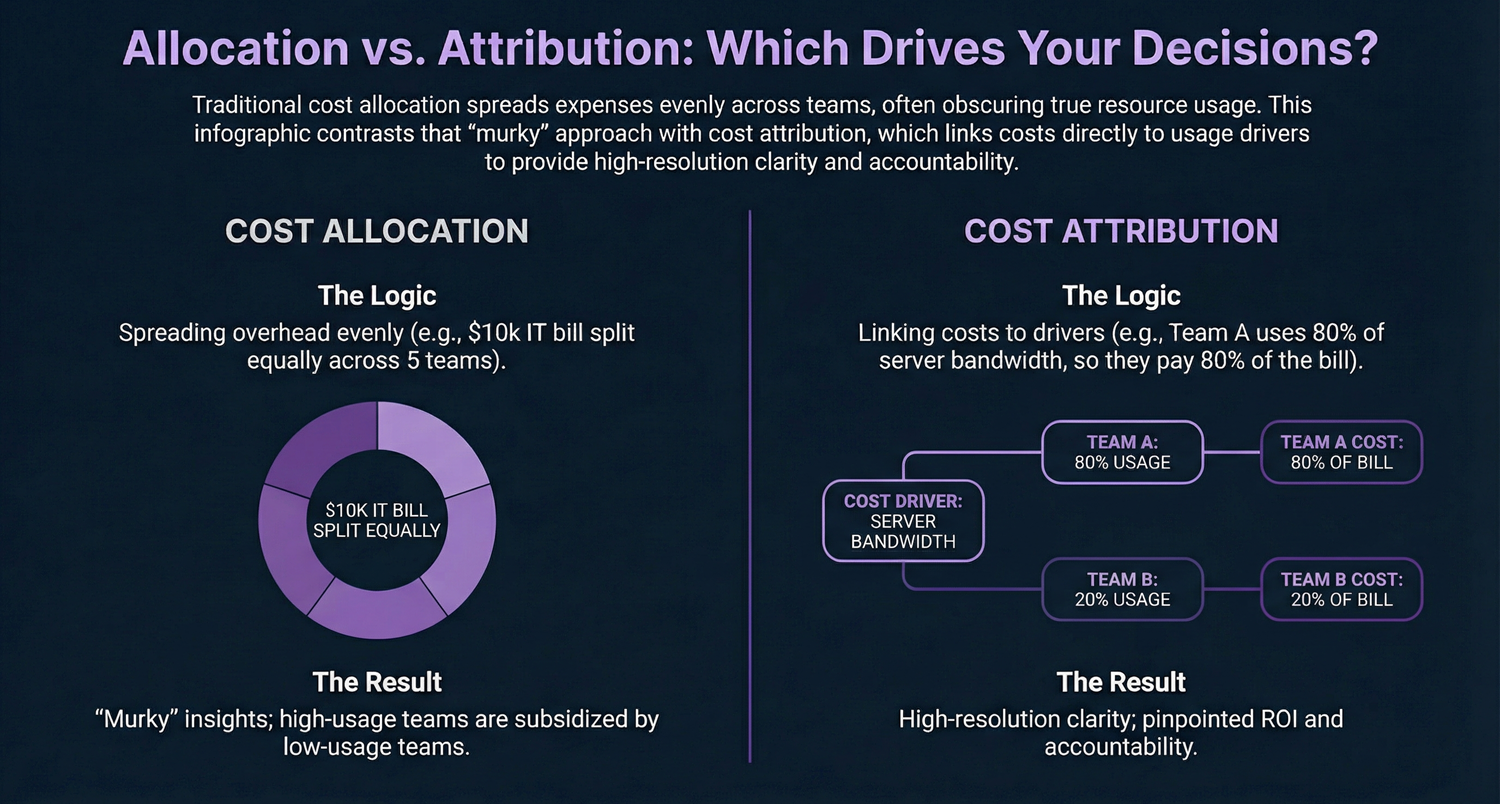
A cost attribution model is a structured method used to assign business expenses to their actual source. It links costs to specific activities, departments, products, or customers based on measurable usage or contribution.
This model ensures that each cost is attributed to its specific cause. It moves away from spreading expenses evenly or using arbitrary percentages. Instead, it uses data to reflect how resources are consumed across the organization.
Cost attribution and cost allocation are often confused with each other. Cost allocation spreads costs across departments or units using simple formulas. These might include headcount or revenue share, regardless of actual usage.
Cost attribution focuses on identifying the real driver behind each expense. It uses specific data to assign costs with greater accuracy. This approach creates a more realistic picture of business operations and performance.
Modern businesses face increasing cost complexity. Cloud platforms, global teams, and subscription models have altered the behavior of costs. Traditional allocation methods fail to capture this complexity, resulting in inadequate financial insights.
The cost attribution model addresses this issue. It offers clarity in a landscape where shared resources, indirect costs, and variable usage are common. It helps organizations gain control, reduce waste, and make smarter financial decisions.
Key Areas Where Businesses Need Cost Attribution
As spending becomes more distributed, leaders need visibility into where resources are being consumed and what business value they generate.
AI Agent and LLM Cost Attribution
AI spending does not follow the same pattern as traditional software costs. While a software subscription may have a predictable monthly fee, AI expenses can change based on model usage, request volume, computing requirements, and workflow complexity.
For enterprises using AI agents and large language models, costs can come from multiple areas:
- AI agent operations: Expenses related to running automated workflows, virtual assistants, and AI-driven systems.
- LLM API usage: Costs based on model requests, token consumption, and interaction volume.
- Model inference: Resources required to generate AI outputs and process requests.
- Compute resources: Infrastructure expenses related to GPUs, cloud processing, and model execution.
- Data processing: Costs associated with preparing and managing data for AI applications.
- AI-powered workflows: Expenses linked to business processes supported by AI automation.
How Businesses Can Attribute AI Costs Effectively
Organizations can create AI cost visibility by connecting usage data with:
- Applications or business workflows
- Teams or departments
- Customer-facing processes
- AI usage patterns and cost per interaction
This makes it easier for leaders to identify valuable AI initiatives, optimize spending, and decide where additional investment makes sense.
Cloud and SaaS Cost Attribution Through FinOps
AI is only one area where cost visibility matters. Cloud environments and SaaS ecosystems create similar challenges as organizations scale.
Multiple teams often share infrastructure, software tools, and platforms, making it difficult to assign ownership and understand whether spending aligns with business priorities.
FinOps brings financial accountability into cloud management by connecting finance, engineering, and business teams. It helps organizations understand consumption patterns, establish ownership, and improve technology investment decisions.
Cloud and SaaS cost attribution helps answer key business questions:
- Which teams are consuming the most resources?
- Are cloud investments supporting strategic priorities?
- Which software tools are creating measurable business value?
Cloud Cost Attribution Methods for Enterprise Teams
Common approaches include:
- Tagging resources by team, project, or environment
- Allocating costs based on usage or ownership
- Monitoring consumption trends
- Assigning accountability for resource decisions
SaaS Cost Attribution for Better Software Investment Decisions
SaaS attribution helps businesses evaluate whether software spending matches actual adoption and business outcomes.
Organizations can analyze:
- Underused subscriptions
- Adoption across teams
- Business impact of software investments
Cost Attribution in Marketing: Connecting Spend With Revenue Impact
Marketing teams invest across multiple channels, campaigns, and platforms, but understanding the actual impact of that spending can be challenging. A cost attribution model helps businesses connect marketing expenses with measurable outcomes by showing which investments contribute to customer acquisition and revenue growth.
Instead of looking only at campaign activity, organizations can evaluate how much they spend to generate customers, which channels perform efficiently, and where budgets should be adjusted. This gives marketing leaders and executives better visibility into the relationship between spending decisions and business results.
Key Marketing Costs to Attribute
A marketing cost attribution framework helps businesses measure:
- Customer acquisition cost (CAC) by channel: Understanding the investment required to acquire customers from different sources.
- Cost per acquisition (CPA): Measuring the cost associated with generating a customer or conversion.
- Campaign-level spending: Tracking expenses across individual marketing initiatives.
- Revenue contribution: Connecting marketing investments with the revenue they influence.
Why Connecting Cost and Revenue Matters
When marketing costs are analyzed alongside revenue impact, businesses gain a clearer understanding of which investments are driving profitable growth. For enterprise organizations managing complex marketing programs, cost attribution creates a stronger connection between spending, performance, and long-term growth.
Common Types Of Cost Attribution Models
Understanding which cost attribution model best suits your business operations is crucial for accurately allocating expenses and making informed, data-driven decisions. Each model offers a distinct approach to tracking and allocating costs, and selecting the right one can have substantial implications for financial planning, pricing strategies, and operational efficiency.
1. Direct Costing
Direct costing, also known as variable costing, only includes variable costs in calculating the cost of goods sold. These are costs that vary directly with production or service delivery, such as raw materials and labor directly associated with the production process. Fixed costs, such as rent or administrative salaries, are excluded from the cost structure in this model.
Key Features
- Allocates only variable costs to products or services, such as direct labor, raw materials, and manufacturing supplies.
- Excludes fixed costs such as overhead, utilities, and administrative costs.
- Provides a clearer view of how changes in production levels directly affect overall costs and profitability.
Best For: Direct costing is most beneficial for businesses focused on analyzing the immediate profitability of individual products or services based on their variable costs. It is particularly useful for short-term decision-making, such as evaluating whether to continue producing a product.
Why It Matters: This model helps businesses focus on operational efficiency and the marginal cost of production. By separating fixed and variable costs, companies can better understand how changes in production impact their bottom line. It is often used for decision-making regarding pricing, production volume, and cost control.
2. Absorption Costing
Absorption costing, also known as full costing, encompasses both fixed and variable costs in the calculation of the cost of goods sold. This method ensures that all costs, whether they change with production or not, are allocated to products or services. This model is commonly used for external financial reporting because it complies with accounting standards like GAAP (Generally Accepted Accounting Principles) or IFRS (International Financial Reporting Standards).
Key Features
- Includes both fixed and variable costs in the cost of production, such as factory overhead, wages of administrative staff, and office rent.
- Used for external financial reporting and required for businesses to comply with standard accounting practices.
- Ensures that all production costs are accurately reflected in pricing, helping to avoid underpricing or overpricing of goods or services.
Best For: Businesses that need to produce comprehensive financial statements for external stakeholders, including investors, regulators, and auditors. It is also beneficial for companies seeking a comprehensive view of their total cost structure.
Why It Matters: Absorption costing ensures that every cost related to the production of goods or services is accounted for in the pricing structure. This helps businesses avoid miscalculations in pricing and ensures that they do not undercharge for their products or services, which could impact profitability.
3. Activity-Based Costing (ABC)
Activity-Based Costing (ABC) allocates costs based on the specific activities that drive those costs. Instead of applying a blanket allocation rate for overhead, ABC assigns costs to activities (e.g., production runs, customer support, or product design) based on the resources they consume. The idea is to identify and track each activity’s cost driver, like time or labor hours, to understand cost behavior better.
Key Features
- Assigns costs based on activities (e.g., machine setup, customer service, production runs) and cost drivers (e.g., labor hours, machine hours, or material usage).
- Provides granular insights into how resources are consumed across different activities.
- More accurate than traditional costing methods for businesses with complex production processes or diverse product lines.
Best For: ABC is particularly valuable for complex organizations with diverse activities or product lines that require a detailed breakdown of costs. This model is effective in identifying areas where inefficiencies or waste exist.
Why It Matters: ABC allows businesses to optimize resource allocation by pinpointing costly activities or underutilized resources. By focusing on cost drivers, businesses can refine their operations, eliminate non-value-added activities, and improve profitability through better cost management.
4. Time-Driven Activity-Based Costing (TDABC)
Time-Driven Activity-Based Costing (TDABC) is a streamlined version of traditional Activity-Based Costing (ABC). Rather than tracking multiple cost drivers, TDABC focuses on time as the central cost driver. In this model, costs are allocated based on the amount of time each activity consumes, thereby simplifying the cost allocation process.
Key Features
- Uses time as the primary cost driver for allocating costs.
- Simplifies data collection by focusing on time instead of multiple cost drivers.
- Allocates costs based on the resources used over a specific period, making it easier to implement than traditional Activity-Based Costing (ABC).
Best For: TDABC is best for businesses that perform repetitive tasks or activities, such as manufacturing or service-based companies with well-defined processes. It is also a good option for businesses looking for a simpler approach than traditional ABC.
Why It Matters: TDABC simplifies cost allocation without sacrificing accuracy. By focusing on time, businesses can make real-time decisions about process improvement and resource optimization. It is particularly useful for companies looking to scale operations while maintaining cost efficiency.
5. Fair Share/Equitable Allocation
Fair Share or Equitable Allocation is used when shared costs, such as office space, utilities, or IT services, need to be allocated across multiple departments or units. Rather than assigning costs based on specific activities, this model uses a predefined allocation base, such as revenue, headcount, or square footage, to determine costs.
Key Features
- Allocates shared costs using an equitable formula, such as headcount, revenue, or space usage.
- Often used for overhead costs or services that benefit multiple departments (e.g., IT support, office rent).
- Ensures that all departments contribute a fair share of the shared costs.
Best For: This model works well for organizations with centralized services that support multiple departments. It is particularly useful for companies that share common resources and want to allocate those costs fairly across all departments.
Why It Matters: Fair Share Allocation is important for transparency and accountability. By using a predefined formula, this method ensures that no department is unfairly burdened with shared costs. It promotes fairness and fosters collaboration among departments.
6. Step-Down Allocation
Step-Down Allocation is a method where service department costs are allocated to production departments or other service departments in a fixed order. The process starts with one department, and the costs are progressively allocated to others. This model is simpler than reciprocal allocation but does not fully account for the mutual services provided by service departments.
Key Features
- Allocates service department costs sequentially, starting with the first department and moving in a step-down order.
- Does not fully account for interdependencies between service departments, resulting in less accurate allocation compared to reciprocal allocation.
- Provides a simplified method for allocating indirect costs across departments.
Best For: Step-Down Allocation is ideal for businesses with a small number of service departments or those seeking a simpler approach to cost allocation. It is especially useful for organizations with clear and non-interdependent service functions.
Why It Matters: Step-Down Allocation is an efficient and cost-effective method for allocating service department costs. Though it may lack precision compared to other methods, it provides a good balance between simplicity and accuracy, making it a solid choice for many organizations.
7. Reciprocal Allocation
Reciprocal allocation is a cost attribution method used when multiple departments or shared services rely on and support each other. Unlike simpler allocation methods that distribute costs in only one direction, this approach accounts for the mutual exchange of services between departments.
For example, an IT team may support the finance department, while the finance team may provide services that support IT operations. Reciprocal allocation considers these interactions to create a more accurate distribution of shared costs.
Key Features
- Accounts for cost-sharing relationships between departments or business functions.
- Allocates shared service costs by considering both direct usage and internal dependencies.
- Provides a more precise view of expenses in complex organizational structures.
Best For: Reciprocal allocation works best for large enterprises with interconnected departments, shared technology platforms, or centralized services that support multiple business units.
Why It Matters: This model gives organizations a clearer understanding of how shared resources contribute to overall costs. By recognizing the impact of internal service relationships, businesses can improve accountability, resource planning, and cost visibility across departments.
Pro Tip : Selecting the appropriate cost attribution model depends on several key factors, including the complexity of your operations, the level of accuracy required for informed decision-making, and your business objectives. Understanding the strengths and limitations of each model enables you to make more informed decisions about cost allocation, which in turn enhances pricing strategies, resource optimization, and overall business profitability.
How to Choose the Right Cost Attribution Model
The best model depends on the business environment. Companies with straightforward cost structures may benefit from direct attribution, while enterprises with shared infrastructure and complex operations may need usage-based, activity-based, or reciprocal allocation methods.
It is to create enough visibility to understand where money is spent, who is responsible, and what value those investments create.
Cost Attribution Model Comparison: Accuracy vs. Effort vs. Best Use Cases
A startup with simple expenses may only need direct tracking, while a large enterprise managing shared cloud environments, AI systems, and multiple business units may require a more detailed approach.
The best model depends on how much visibility a business needs, how complex its cost structure is, and how much effort it can dedicate to maintaining accurate allocation rules.
| Cost Attribution Model | Accuracy | Effort Required | Best Use Case |
|---|---|---|---|
| Direct Costing | Medium | Low | Evaluating costs where variable expenses can be directly linked to products or services |
| Absorption Costing | High | Medium | Organizations needing a complete view of direct and indirect costs |
| Activity-Based Costing (ABC) | High | High | Enterprises that need deeper cost visibility across different functions, processes, and resource inputs. |
| Time-Driven Activity-Based Costing (TDABC) | Medium to High | Medium | Teams allocating costs based on time spent on activities |
| Fair Share Allocation | Medium | Low | Distributing shared expenses across departments using predefined rules |
| Step-Down Allocation | Medium | Medium | Organizations managing shared departmental costs where services follow a clear allocation sequence. |
| Reciprocal Allocation | Very High | High | Enterprises managing shared services, interconnected teams, and common resources |
Pro Tip : The goal of cost attribution is not to create unnecessary complexity. It is to build enough financial visibility to understand resource usage, improve accountability, and make better investment decisions.
A Worked Example: Building a Cost Attribution Model With Real Numbers
A cost attribution model becomes valuable when it helps businesses make actual spending decisions. Consider a B2B software company that uses AI tools, cloud infrastructure, SaaS platforms, and marketing channels to support growth.
The company wants to understand how much each business function is consuming and whether those expenses are contributing to measurable outcomes.
Scenario: Allocating Monthly Business Costs
The company has the following monthly expenses:
| Cost Category | Monthly Spend | Primary Users |
|---|---|---|
| Cloud infrastructure | $40,000 | Product and Engineering teams |
| AI and LLM services | $20,000 | Customer Support, Product, Sales |
| SaaS tools | $15,000 | Multiple departments |
| Marketing programs | $100,000 | Marketing team |
The total monthly operating cost across these areas is $175,000 .
The challenge is that not every cost belongs to a single team. Shared resources need a logical allocation method.
Step 1: Separate Direct and Shared Costs
The company first identifies which expenses have clear ownership.
Direct costs:
- A dedicated analytics tool used only by the marketing team: $5,000
- A cloud environment supporting one product line: $15,000
These costs are assigned directly to the responsible teams.
Shared costs:
- SaaS platforms used across teams
- Shared cloud resources
These require allocation rules.
Step 2: Define Allocation Rules for Shared Costs
The company reviews usage data and assigns costs based on actual consumption.
AI and LLM Costs: $20,000
Usage analysis shows:
| Department | AI Usage Share | Allocated Cost |
|---|---|---|
| Customer Support | 50% | $10,000 |
| Product Team | 30% | $6,000 |
| Sales Team | 20% | $4,000 |
Instead of recording AI spending as a single technology expense, the company now understands which teams are driving consumption.
SaaS Costs: $15,000
The company allocates SaaS expenses based on active users:
| Department | Usage Share | Allocated Cost |
|---|---|---|
| Sales | 40% | $6,000 |
| Marketing | 30% | $4,500 |
| Customer Success | 30% | $4,500 |
This highlights whether software investments match actual adoption.
Step 3: Connect Marketing Spend With Revenue Impact
The marketing team spends $100,000 per month across three channels:
| Channel | Monthly Spend | Customers Acquired | Cost per Customer |
|---|---|---|---|
| Paid Search | $40,000 | 40 | $1,000 |
| Content Marketing | $25,000 | 50 | $500 |
| Events | $35,000 | 20 | $1,750 |
The company finds that content marketing has the lowest acquisition cost, while events require a higher investment per customer.
Step 4: Use Attribution Insights for Decisions
After applying the model, leadership gains a clearer view:
- AI spending can be optimized by identifying high-value use cases and unnecessary consumption.
- SaaS costs can be reviewed based on actual adoption rather than subscription count.
- Teams become accountable for the resources they consume.
A cost attribution model goes beyond splitting expenses across teams or functions; it helps businesses understand the drivers behind spending. It is to create a reliable connection between spending decisions and business outcomes. When built around real usage data and clear ownership, it gives leaders the visibility needed to invest resources where they create the greatest impact.
Conclusion
Cost attribution has evolved beyond allocating expenses for financial reporting. Today, it gives organizations the visibility to understand how AI investments, cloud infrastructure, SaaS platforms, marketing programs, and shared resources contribute to business performance.
The right cost attribution model does more than organize spending. It equips leaders to improve accountability, optimize investments, and make decisions backed by reliable data instead of assumptions.
If your organization is looking to build a cost attribution framework that aligns financial visibility with business growth, the experts at DiGGrowth can help. Reach out to us at info@diggrowth.com to discuss a solution tailored to your operations.
Ready to get started?
Increase your marketing ROI by 30% with custom dashboards & reports that present a clear picture of marketing effectiveness
Start Free Trial
Experience Premium Marketing Analytics At Budget-Friendly Pricing.

Learn how you can accurately measure return on marketing investment.

You’re Targeting Your Ideal Customer. So Why Aren’t They Buying?
Your best customers reveal the traits associated with success. Your lost opportunities reveal where fit breaks...
Read full post post
How Predictive AI Will Transform Paid Media Strategy in 2026
Paid media isn’t a channel game anymore, it’s a chessboard. Search, social, programmatic, video, influencer, native,...
Read full post post
Don’t Let AI Break Your Brand: What Every CMO Should Know
AI isn’t just another marketing tool. It’s changing how we connect with customers, personalize content, and...
Read full post postFAQ's
Yes, even small businesses gain value from cost attribution. It helps them control spending, price accurately, and make data-informed decisions, especially as operations grow more complex.
A model should be reviewed quarterly or when significant operational changes occur. Regular updates ensure accuracy and alignment with current business processes, pricing, and resource use.
Not always. While software improves efficiency and accuracy, smaller businesses can start with spreadsheets. As complexity increases, automated tools become more valuable for tracking and analyzing cost data.
Common challenges include incomplete data, unclear cost drivers, and internal resistance. Addressing these requires cross-departmental collaboration, data transparency, and leadership support during implementation.
Yes. By identifying cost-heavy or resource-intensive activities, businesses can reduce waste, improve efficiency, and align operational decisions with environmental sustainability targets.