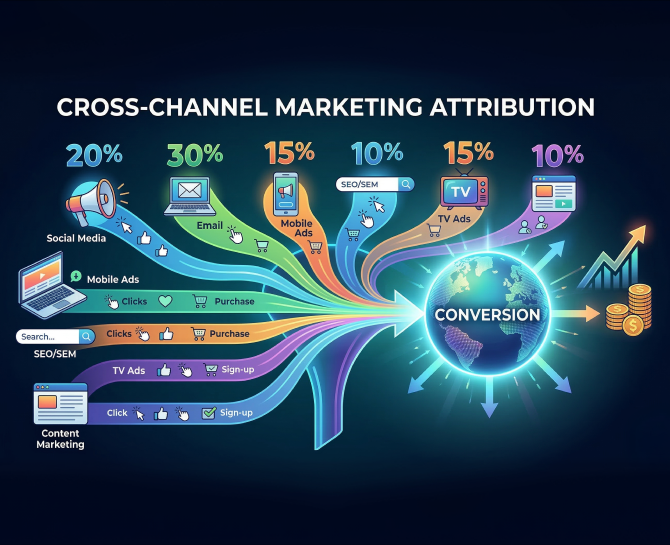
Cross-Channel Marketing Attribution: Connecting Every Marketing Touchpoint
Cross-channel marketing attribution tracks and measures how different marketing channels work together to drive conversions. Instead of crediting a single channel, cross-channel marketing attribution distributes credit across all touchpoints in the customer journey, revealing which channel combinations deliver the best results and how channels influence each other throughout the buying process.
Cross-channel marketing attribution is the practice of tracking customer interactions across multiple marketing channels and assigning credit to each touchpoint that contributed to a conversion. Unlike single-channel attribution that only measures one platform in isolation, cross-channel marketing attribution connects social media, email, paid ads, organic search, content, and other channels to show how they work together to move prospects through the buying journey and generate revenue.
You’re probably making budget decisions based on incomplete information.
Your paid search dashboard shows that those ads drove 200 conversions last month. Great, time to increase that budget, right? Except what the dashboard doesn’t show is that 150 of those people first discovered you through organic content, engaged with three emails, and visited your pricing page twice before finally clicking that paid ad and converting.
Was it really the paid ad that drove the conversion? Or did content, email, and your website do the heavy lifting while paid search just happened to get the last click?
Single-channel reporting makes every channel look like a hero in isolation. Your email platform shows that email drove 300 conversions. Your social ads dashboard claims social drove 250. Your SEO tool says organic brought in 400. Add those up, and you’ve apparently driven 950 conversions when you actually only got 500.
The math doesn’t work because these channels aren’t operating independently. They’re working together in ways that single-channel reporting completely misses. Cross-channel marketing attribution fixes this by showing the real story of how channels collaborate to drive results.
Key Takeaways
- Cross-channel marketing attribution tracks interactions across all platforms to show how channels work together, not just individually.
- Single-channel reporting creates false attribution by giving each channel credit for conversions other channels helped create.
- Effective cross-channel marketing attribution requires integrating data from all marketing systems into a unified view.
- Multi-touch attribution models distribute credit across touchpoints rather than giving everything to one channel.
- Platforms like DiGGrowth automate cross-channel marketing attribution by connecting all data sources and calculating contribution accurately.
Why Single-Channel Attribution Fails
Most marketers are stuck in channel silos. They look at Facebook Ads Manager to see how social is performing. Check Google Analytics for organic traffic. Review their email platform for campaign results. Each system reports in isolation.
Every Channel Claims Credit for the Same Conversions
Here’s the fundamental problem with single-channel reporting: every platform uses last-click attribution within its own ecosystem. Facebook claims credit if someone clicks a Facebook ad before converting. Google claims credit if they clicked on a Google ad. Your email platform claims credit if they click on an email.
If someone interacted with all three before converting, all three platforms claim 100% credit for that one conversion. Your cross-channel total shows 300% attribution for a single customer. Without proper cross-channel marketing attribution, you can’t see this overlap.
You Can’t See How Channels Influence Each Other
Maybe your LinkedIn ads don’t directly drive many conversions, but people who see those ads are three times more likely to open your emails. That’s valuable, but single-channel reporting shows LinkedIn as underperforming because it doesn’t get credit for enabling email success.
Cross-channel marketing attribution reveals these interaction effects that single-channel views completely miss.
Budget Decisions Get Made on Incomplete Data
When each channel reports separately, you make budget decisions without understanding how they work together. You might cut spending on a channel that appears inefficient but actually plays a crucial role in supporting other channels.
Cross-channel marketing attribution prevents these mistakes by showing true contribution across the entire marketing mix.
You Waste Money on Overlap
Without cross-channel marketing attribution, you might be running redundant campaigns across channels, paying multiple times to reach the same people. Proper attribution reveals this waste so you can eliminate it.
According to Gartner’s 2025 Marketing Data and Analytics Survey, 68% of marketing organizations cite a lack of cross-channel marketing attribution as a major barrier to optimizing marketing spend.
What Cross-Channel Marketing Attribution Actually Measures
Cross-channel marketing attribution goes beyond tracking individual channel performance to show how channels work together.
The Complete Customer Journey Across All Touchpoints
Cross-channel marketing attribution maps every interaction a customer has with your brand: social media impressions, email opens, website visits, content downloads, ad clicks, webinar attendance, and sales calls. Everything.
This complete view shows the real path customers take, not just isolated channel interactions.
Channel Interaction Effects
Cross-channel marketing attribution reveals how channels influence each other. Do people who engage with content convert better when they also receive emails? Do paid ads work better for people who’ve already visited your site organically?
These interaction effects are invisible in single-channel reporting but crucial for optimization.
True Channel Contribution
Instead of each channel claiming 100% credit for shared conversions, cross-channel marketing attribution distributes credit based on actual contribution. You see which channels genuinely drive results versus which just happen to get the last touch.
This enables smarter budget allocation based on real performance.
Optimal Channel Sequences
Cross-channel marketing attribution shows which sequences of channel touches convert best. Maybe prospects who see social ads, then read content, then get emails convert at twice the rate of other paths.
Identifying these high-performing sequences lets you design campaigns that guide more prospects along proven paths.
Channel Efficiency at Different Journey Stages
Cross-channel marketing attribution reveals that different channels perform better at different stages. Paid social might excel at awareness. Organic content at consideration. Email at conversion. Understanding this lets you deploy each channel where it creates the most value.
Cross-Channel Marketing Attribution Models Explained
Different cross-channel marketing attribution models distribute credit differently. Choosing the right model depends on your sales cycle and business model.
Linear Cross-Channel Marketing Attribution
Linear attribution gives equal credit to every touchpoint. If someone had five interactions across three channels, each gets 20% credit.
This cross-channel marketing attribution approach is simple and acknowledges every touchpoint matters, but it doesn’t account for some touches being more influential than others.
Time Decay Cross-Channel Marketing Attribution
Time decay gives more credit to recent touches and less to earlier ones. This cross-channel marketing attribution model assumes recent interactions have more influence on conversion decisions.
Best for businesses where recency genuinely matters more, but it undervalues awareness-building touches.
U-Shaped (Position-Based) Cross-Channel Marketing Attribution
U-shaped attribution gives more credit to the first and last touches (typically 40% each), with remaining credit split among middle touches (20% total).
This cross-channel marketing attribution recognizes that both introducing prospects to your brand and closing them matter most.
W-Shaped Cross-Channel Marketing Attribution
W-shaped extends U-shaped by also crediting the middle “opportunity creation” touch. First touch gets 30%, opportunity creation gets 30%, last touch gets 30%, and remaining touches split 10%.
This cross-channel marketing attribution model works well for B2B with clear opportunity stages.
Data-Driven (Algorithmic) Cross-Channel Marketing Attribution
Data-driven models use machine learning to analyze which touchpoints actually correlate with conversions in your specific data. The algorithm assigns credit based on statistical contribution rather than predetermined rules.
This cross-channel marketing attribution approach is most accurate but requires significant data volume to work effectively.
Pro Tip : Don’t rely on a single cross-channel marketing attribution model. Run multiple models simultaneously to see different perspectives on channel contribution. Where all models agree, you can be confident. Where they differ, dig deeper to understand why.
Building Cross-Channel Marketing Attribution: Step by Step
Implementing effective cross-channel marketing attribution requires connecting disparate data sources and choosing the right measurement approach.
Step 1: Inventory All Your Marketing Channels
List every channel you use: paid search, paid social, display ads, organic search, content marketing, email, webinars, events, partnerships, referrals, direct mail, retargeting. Everything.
Cross-channel marketing attribution only works if you’re tracking all channels, not just digital ones.
Step 2: Ensure Consistent Tracking Across Channels
Every channel needs proper tracking. Use UTM parameters consistently for all campaigns. Implement tracking pixels on your website. Ensure your CRM captures source data for leads and customers.
Inconsistent tracking creates blind spots in your cross-channel marketing attribution.
Step 3: Integrate Data into a Unified Platform
This is the hardest part. Your cross-channel marketing attribution data lives in Google Analytics, Facebook Ads, LinkedIn Campaign Manager, your email platform, your CRM, and various other systems.
You need to integrate all these sources into one platform that can track individuals across channels. Options include:
DiGGrowth integrates all marketing and sales data sources to provide unified cross-channel marketing attribution with multiple model options.
Google Analytics 4 offers basic cross-channel marketing attribution for digital channels but struggles with offline touchpoints and custom models.
HubSpot provides cross-channel marketing attribution for customers using its full marketing and sales platform.
Bizible (Adobe Marketo Measure) specializes in B2B cross-channel marketing attribution with CRM integration.
Step 4: Choose Your Attribution Model
Decide which cross-channel marketing attribution model best fits your business. For most B2B companies with multi-touch journeys, data-driven or W-shaped models work best.
Test multiple models initially to understand how different approaches change your view of channel performance.
Step 5: Set Up Automated Reporting
Manual cross-channel marketing attribution analysis doesn’t scale. Set up automated dashboards that show channel contribution, optimal sequences, and budget recommendations.
Update these dashboards regularly as new data comes in to keep your cross-channel marketing attribution current.
Step 6: Train Teams on Interpretation
Cross-channel marketing attribution data can be misinterpreted. Train marketing, sales, and leadership teams on how to read attribution reports and what the numbers actually mean.
Ensure everyone understands that attribution models are analytical tools, not an absolute truth about causation.
Common Cross-Channel Marketing Attribution Challenges
Even with the right tools, cross-channel marketing attribution presents challenges.
Challenge 1: Cross-Device Tracking
Customers use multiple devices. They might see your ad on mobile, research on desktop, and convert on tablet. Tracking individuals across devices is technically difficult but essential for accurate cross-channel marketing attribution.
Modern platforms use probabilistic matching and login data to connect cross-device activity, but it’s never 100% accurate.
Challenge 2: Privacy Regulations and Cookie Limitations
GDPR, CCPA, and browser changes limiting third-party cookies make cross-channel marketing attribution harder. You can’t track users across channels as easily as you could a few years ago.
Focus on first-party data collection and server-side tracking to maintain cross-channel marketing attribution capabilities.
Challenge 3: Offline Touchpoints
Phone calls, in-person events, direct mail, and other offline touches are crucial parts of many customer journeys, but difficult to track for cross-channel marketing attribution.
Use call tracking software, event registration systems, and unique codes in offline materials to capture these touchpoints.
Challenge 4: Long Sales Cycles
B2B companies with 6-12 month sales cycles struggle with cross-channel marketing attribution because touchpoints span long periods, and tracking can break down over time.
Ensure your attribution lookback window is long enough to capture your full sales cycle for accurate cross-channel marketing attribution.
Challenge 5: Multiple Decision-Makers
In B2B, different people influence purchases. One person might engage with content while another attends webinars, and a third takes demos. Standard cross-channel marketing attribution struggles with these multi-stakeholder journeys.
Account-based attribution that tracks all contacts within a target account provides better cross-channel marketing attribution for B2B.
How DiGGrowth Powers Cross-Channel Marketing Attribution
DiGGrowth was built specifically to solve cross-channel marketing attribution challenges that generic analytics tools can’t handle.
Automatic Data Integration
DiGGrowth connects to all your marketing platforms, your CRM, your website analytics, and your sales tools automatically. No manual data exports or complex integration projects.
This gives you the unified data foundation required for accurate cross-channel marketing attribution.
Identity Resolution Across Channels
DiGGrowth’s identity resolution connects anonymous website visitors, email subscribers, social media engagers, and CRM contacts into unified customer profiles.
This cross-device, cross-channel identity matching is essential for cross-channel marketing attribution accuracy.
Multiple Attribution Models
DiGGrowth supports linear, time decay, U-shaped, W-shaped, and custom data-driven cross-channel marketing attribution models. You can compare models side-by-side to understand how different methodologies affect your view of channel performance.
Account-Based Attribution for B2B
For B2B companies, DiGGrowth provides account-level cross-channel marketing attribution that tracks all touchpoints across all contacts within target accounts.
This shows which marketing touches influenced the entire buying committee, not just individual contacts.
Real-Time Attribution Updates
DiGGrowth updates cross-channel marketing attribution in real time as new touchpoints occur. You don’t wait for monthly reports to see which channels are contributing.
This enables faster optimization and budget reallocation.
Automated Insights and Recommendations
DiGGrowth’s AI analyzes your cross-channel marketing attribution data to surface insights you might miss. It identifies undervalued channels, inefficient spend, and optimal budget allocations automatically.
Pro Tip : Use DiGGrowth’s scenario modeling to see how different budget allocations would affect outcomes based on your cross-channel marketing attribution data. This helps make confident reallocation decisions.
Using Cross-Channel Marketing Attribution to Optimize Marketing
Having cross-channel marketing attribution data is one thing. Using it to improve results is another.
Identify Undervalued Channels
Cross-channel marketing attribution often reveals channels that appear inefficient in last-click reporting but actually play crucial roles earlier in the journey.
Protect the budget for these channels even if they don’t get conversion credit in simpler models.
Find Optimal Channel Combinations
Cross-channel marketing attribution shows which channel combinations convert best. Use this to design integrated campaigns that intentionally sequence touches across channels.
For example, if prospects who see paid ads and then engage with content convert at 3x the rate, create campaigns where ads promote content rather than direct conversion.
Eliminate Redundant Spend
Cross-channel marketing attribution reveals when you’re paying multiple times to reach the same people across channels. Eliminate this overlap to reduce wasted spend.
Optimize Budget Allocation
Shift the budget from channels with low cross-channel marketing attribution contribution to those with high contribution. Even small reallocations based on attribution data can significantly improve ROI.
Personalize Cross-Channel Experiences
Cross-channel marketing attribution data shows which channels each customer segment prefers. Use this to personalize outreach, sending content through channels where specific segments are most likely to engage.
Cross-Channel Marketing Attribution Best Practices
Follow these practices to get the most value from cross-channel marketing attribution.
Start with Clean, Consistent Data
Garbage in, garbage out. Before building sophisticated cross-channel marketing attribution, ensure you’re tracking everything consistently with proper UTM parameters, tracking codes, and CRM hygiene.
Choose Realistic Lookback Windows
Your cross-channel marketing attribution lookback window should match your actual sales cycle. Too short and you miss early touchpoints. Too long, and your credit touches that had no real influence.
Update Attribution Models as Your Business Changes
What worked for cross-channel marketing attribution when you were small and focused might not work as you grow and diversify. Revisit your attribution model annually.
Don’t Ignore Qualitative Context
Cross-channel marketing attribution shows what happened, not always why. Combine quantitative attribution data with qualitative customer feedback to understand the full story.
Test Attribution-Based Budget Changes Carefully
Don’t make massive budget shifts based on new cross-channel marketing attribution overnight. Test changes with 10-20% of the budget first, measure results, then scale.
Pro Tip : Create a cross-functional attribution working group with representatives from each marketing channel. This prevents siloed interpretation of cross-channel marketing attribution data and ensures coordinated action.
Conclusion
Single-channel reporting is lying to you. Not maliciously, but systematically, by showing each channel’s performance in isolation without revealing how they work together. Cross-channel marketing attribution fixes this by showing the real story of how your marketing drives results.
Companies that implement proper cross-channel marketing attribution make smarter budget decisions, eliminate wasted spend, and optimize channel combinations based on data instead of guesses. They understand which channels actually drive results versus which just happen to get the last touch.
DiGGrowth provides the unified data foundation, identity resolution, and flexible modeling needed for accurate cross-channel marketing attribution. You get clear visibility into how all your marketing channels work together to drive revenue.
Ready to see how your channels really perform together? Let’s Talk!
Reach out to us at info@diggrowth.com to implement cross-channel marketing attribution that reveals your true marketing ROI.
Ready to get started?
Increase your marketing ROI by 30% with custom dashboards & reports that present a clear picture of marketing effectiveness
Start Free Trial
Experience Premium Marketing Analytics At Budget-Friendly Pricing.

Learn how you can accurately measure return on marketing investment.

How Predictive AI Will Transform Paid Media Strategy in 2026
Paid media isn’t a channel game anymore, it’s a chessboard. Search, social, programmatic, video, influencer, native,...
Read full post post
Don’t Let AI Break Your Brand: What Every CMO Should Know
AI isn’t just another marketing tool. It’s changing how we connect with customers, personalize content, and...
Read full post post
From Demos to Deployment: Why MCP Is the Foundation of Agentic AI
A quiet revolution is unfolding in AI. And it’s not happening inside research labs. For decades,...
Read full post postFAQ's
Cross-channel marketing attribution tracks customer interactions across all marketing channels (social media, email, paid ads, organic search, content, etc.) and assigns credit to each touchpoint that contributed to conversion. Unlike single-channel reporting, cross-channel marketing attribution shows how channels work together throughout the customer journey.
Cross-channel marketing attribution is important because customers interact with multiple channels before converting, but single-channel reporting gives each channel credit for the same conversions, leading to inflated numbers and poor budget decisions. Cross-channel marketing attribution reveals true channel contribution and interaction effects.
The best cross-channel marketing attribution model depends on your business. For B2B companies with long sales cycles, W-shaped or data-driven models work well. For shorter cycles, time decay or U-shaped models may be sufficient. Most sophisticated marketers use multiple models to see different perspectives on cross-channel marketing attribution.
Implement cross channel marketing attribution by: (1) ensuring consistent tracking across all channels, (2) integrating data from all marketing systems into a unified platform, (3) choosing an appropriate attribution model, (4) setting up automated reporting, and (5) using insights to optimize channel mix and budget allocation.
Effective cross-channel marketing attribution requires platforms that can integrate data from all your marketing channels, resolve identities across devices and touchpoints, and apply attribution models. Tools like DiGGrowth, Adobe Marketo Measure, and HubSpot provide these capabilities, while basic options like Google Analytics 4 offer limited cross-channel marketing attribution for digital-only touchpoints.