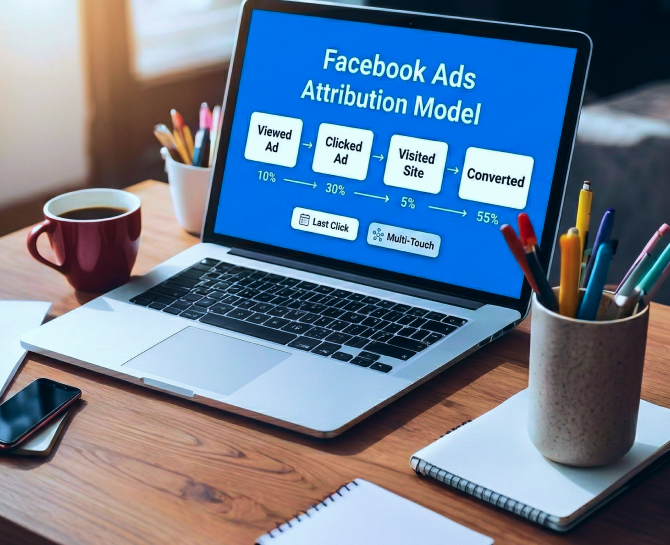
Facebook Ads Attribution in 2026: Understanding the New Rules of the Meta Black Box
Facebook Ads attribution now defaults to a 7-day click and 1-day view window. The 28-day window is gone, CAPI is no longer optional, and the gap between your Meta dashboard and your CRM has never been bigger. Here's what changed and what to do about it.
There was a period, not that long ago, when Meta’s attribution reporting felt almost too good. The 28-day click window meant that a conversion happening nearly a month after someone saw your ad still got credited back to your campaign. ROAS numbers looked strong. Leadership was happy. Budgets kept flowing.
Then the windows got shorter. iOS 14.5 arrived. The Conversions API became a requirement rather than a recommendation. And for a lot of advertisers, the reported numbers started telling a story that didn’t quite match what was happening in the bank account.
According to Meta’s own advertiser documentation updated in 2025, the default attribution window is now 7-day click and 1-day view, a significant reduction from the windows many advertisers had been relying on for years. For brands with longer consideration cycles, this single change can make a campaign look far less effective than it actually is.
Understanding what changed, why it changed, and what to do about it isn’t optional for any team running meaningful Meta spend. Here’s how the Meta black box actually works in 2026.
Key Takeaways
- Meta’s default is now 7-day click and 1-day view. The 28-day window is gone, meaning conversions beyond a week after a click no longer count by default.
- iOS 14.5 cut Meta’s off-platform conversion visibility by up to 50% for some advertisers. The Pixel alone isn’t enough anymore. CAPI is the fix.
- Advantage+ automates targeting and placements using AI. It often performs well, but reduces transparency into who you’re actually reaching.
- The gap between Meta’s reported conversions and your CRM data is structural, not accidental. Every platform measures itself generously. Your CRM is the honest arbiter.
- True ROAS isn’t Meta’s number. It’s CRM-attributed revenue from Meta-sourced customers divided by actual spend, connected independently outside the platform.
What Happened to the Facebook Ads 28-Day Attribution Window?
For years, the 28-day click attribution window was the standard for Meta campaigns. It meant that if someone clicked your ad on a Monday and converted three weeks later, that conversion was still credited to your campaign.
For products with longer consideration cycles, this was genuinely meaningful. A B2B software buyer researching options over several weeks would still show up as an attributed conversion even if the decision took time. For a lot of advertisers, this was the number that justified the budget.
When Apple’s App Tracking Transparency framework launched in 2021, it fundamentally changed what Meta could see. Without the ability to track users across apps and
websites at the individual level, Meta lost visibility into a significant portion of off-platform conversions. Attributing a conversion 28 days after a click requires following that user across 28 days of browsing and purchasing behavior. When that tracking is broken, the 28-day window becomes unreliable rather than just optimistic.
Meta’s response was to move to shorter, more defensible windows. The current default of 7-day click and 1-day view reflects what the platform can actually observe with reasonable confidence given current privacy constraints. It’s a more honest number. It’s also a smaller one, and that has caught a lot of advertisers off guard.
If your ROAS appears to have dropped significantly in the past two years without a corresponding drop in actual sales, this window change is very likely part of the explanation.
| Attribution Window | What it captures | Best for |
|---|---|---|
| 1-day click | Conversions within 24 hours of a click | Direct response, impulse purchases |
| 7-day click (default) | Conversions within a week of a click | Standard e-commerce, short B2B cycles |
| 1-day view | Conversions within 24 hours of seeing an ad | Brand awareness measurement |
| 28-day click (deprecated) | Conversions up to 28 days after a click | Was used for long B2B cycles, no longer available by default |
The Rise of Meta Advantage+ and AI-Driven Campaign Targeting
While the attribution window changes were driven by external privacy pressure, the rise of Advantage+ campaigns represents Meta’s own strategic direction for the platform.
Advantage+ Shopping Campaigns and Advantage+ App Campaigns automate large portions of campaign setup that advertisers previously controlled manually. Targeting, placements, creative combinations, and bid strategies are all managed by Meta’s AI, optimizing toward your stated conversion objective using signals from across its platform.
In practice, Advantage+ campaigns often perform well on Meta’s own metrics. The algorithm is genuinely good at finding people likely to convert, particularly for e-commerce brands with a clean purchase signal. But performance on Meta’s metrics and performance in your actual business aren’t always the same thing.
The transparency tradeoff is real. With manual campaigns, you know who you targeted, which placements ran, and which creative drove conversions. With Advantage+, much of that is abstracted away. For brands that need to understand not just the volume of customer acquisition but its composition, that opacity creates a genuine measurement challenge.
This isn’t an argument against using Advantage+. It’s an argument for making sure your independent measurement infrastructure is strong enough to evaluate what Advantage+ is actually delivering, rather than relying on Meta’s dashboard to make that judgment for you.
Why Meta Reported ROAS and CRM Revenue Don’t Always Match
This is the question that makes finance teams nervous and marketing teams defensive. The Meta dashboard shows strong ROAS. The CRM tells a quieter story. Who’s right?
Usually, both are telling a partial truth.
Meta’s dashboard counts every conversion that occurred within its attribution window from someone who interacted with your ad. That includes people who would have converted anyway without seeing the ad. It includes people who converted on a different device where Meta couldn’t confirm the connection. And it includes conversions that other platforms are simultaneously claiming credit for.
Your CRM shows actual closed revenue with real customer records. It doesn’t know which marketing channels influenced those customers unless you’ve built that connection explicitly. It undercounts marketing’s contribution. Meta overcounts it. The truth lives somewhere between the two numbers, and finding it requires deliberately building the bridge between them.
The practical implication is that you need both views. Meta’s reporting tells you how your campaigns are performing relative to each other within the platform. Your CRM tells you which customers actually paid and what they were worth. Connecting Meta-sourced leads to CRM outcomes is what gives you a number you can genuinely defend in a budget conversation.
Why Meta Conversions API (CAPI) Is No Longer Optional
The Meta Pixel works by placing JavaScript on your website that fires when a user takes an action and sends that event data back to Meta. For years, this was sufficient. It isn’t anymore.
Browser-based tracking is blocked by ad blockers, restricted by browser privacy settings, and affected by iOS consent changes. Depending on your audience composition, a meaningful percentage of conversions may be happening in environments where the Pixel simply can’t fire reliably.
The Conversions API solves this by sending conversion event data directly from your server to Meta, bypassing the browser entirely. Because the signal originates from your own infrastructure, it’s not subject to the same privacy restrictions. The data is more complete, more reliable, and more useful for Meta’s optimization algorithms.
The practical impact of implementing CAPI properly is typically a meaningful recovery in attributed conversions, not because more conversions are happening, but because more of the ones that were already happening are now being reported accurately. In 2026, running Meta ads without CAPI means running them with a significant measurement handicap. It’s not a technical nicety. It’s a foundational requirement.
The DiGGrowth Edge: True ROAS
The gap between Meta’s reported ROAS and your actual business outcomes isn’t a bug in the system. It’s a structural feature of how platform-native reporting works.
Every platform measures itself from the inside, using its own attribution logic, its own conversion windows, and its own incentives.
DiGGrowth bridges the gap between Meta’s reporting and your actual CRM data to surface True ROAS. Rather than accepting Meta’s attribution at face value, DiGGrowth connects Meta-sourced interactions to actual closed revenue in your CRM, deduplicates conversions being claimed across multiple platforms simultaneously, and surfaces the revenue contribution Meta advertising is actually delivering rather than what it claims to deliver.
For teams managing significant Meta budgets, this distinction isn’t academic. Decisions about whether to scale a campaign, shift creative direction, or reallocate budget should be based on actual revenue impact, not platform-reported metrics that systematically overstate contribution.
Conclusion
Meta’s attribution model in 2026 is more constrained, more automated, and more opaque than it was three years ago. The 28-day window is gone. CAPI is essential. Advantage+ has reduced manual control in exchange for algorithmic performance. And the gap between what the dashboard shows and what your CRM confirms is a structural reality, not a reporting error.
None of this means Meta advertising doesn’t work. For many brands, it remains one of the most efficient channels available. It means that running it well in 2026 requires a more sophisticated measurement setup than it did before.
Understand the window changes. Implement CAPI properly. Build the bridge between Meta’s data and your CRM outcomes. And measure True ROAS rather than reported ROAS. That’s the difference between running Meta advertising and actually understanding what it’s doing for your business.
Ready to get started?
Increase your marketing ROI by 30% with custom dashboards & reports that present a clear picture of marketing effectiveness
Start Free Trial
Experience Premium Marketing Analytics At Budget-Friendly Pricing.

Learn how you can accurately measure return on marketing investment.

How Predictive AI Will Transform Paid Media Strategy in 2026
Paid media isn’t a channel game anymore, it’s a chessboard. Search, social, programmatic, video, influencer, native,...
Read full post post
Don’t Let AI Break Your Brand: What Every CMO Should Know
AI isn’t just another marketing tool. It’s changing how we connect with customers, personalize content, and...
Read full post post
From Demos to Deployment: Why MCP Is the Foundation of Agentic AI
A quiet revolution is unfolding in AI. And it’s not happening inside research labs. For decades,...
Read full post postFAQ's
The default is 7-day click and 1-day view. The 28-day click window has been deprecated due to Apple's iOS privacy changes, which have limited Meta's ability to track off-platform user behavior reliably over longer periods.
CAPI sends conversion data directly from your server to Meta, bypassing browser restrictions. It recovers conversions the Pixel misses due to ad blockers, iOS limitations, and privacy settings. In 2026 it's a foundational requirement for accurate Meta reporting.
Meta counts all conversions within its attribution window, including those other platforms also claim. Your CRM shows actual closed revenue. Connecting Meta-sourced leads directly to CRM outcomes is what produces a ROAS number you can genuinely defend.