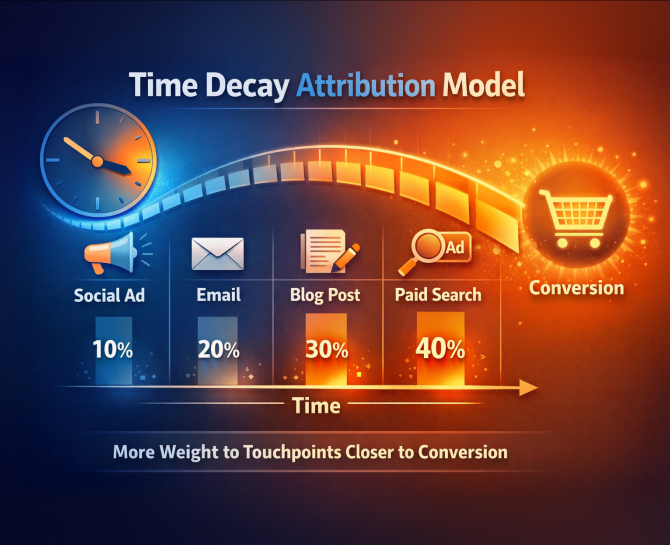
Time Decay Attribution Model: Moving Beyond Last-Click Attribution
The Time Decay Attribution Model assigns more credit to touchpoints closer to conversion while still valuing early interactions. Unlike last-click attribution, it recognizes the full customer journey, making it ideal for complex B2B sales cycles where multiple touchpoints influence buying decisions.
A time-decay attribution model is a marketing measurement approach that distributes credit across all customer touchpoints, with recent interactions receiving progressively greater weight than earlier ones. Unlike last-click attribution, which gives 100% credit to the final touchpoint, time decay attribution models recognize that every interaction in the customer journey contributes to conversion, while acknowledging that recent touchpoints often have a stronger influence on final decisions.
Think about your last major B2B deal. The customer probably didn’t just show up and buy. They read a blog post three months ago. Downloaded a whitepaper six weeks later. Attended a webinar. Visited your pricing page twice. Then, finally requested a demo.
If you’re using last-click attribution, that demo request gets all the credit. Everything else might as well not have happened. The blog post that introduced them to your brand? Invisible. The whitepaper that moved them from curious to interested? Doesn’t count. The webinar that addressed their main objection? Forgotten.
This creates a warped view of what’s actually working. You end up cutting budgets from channels that are genuinely building your pipeline because they don’t show up in last-click reports. Meanwhile, you’re pouring money into bottom-funnel tactics that only work because of all the groundwork laid earlier.
Time decay attribution models fix this by giving credit where it’s actually due, across the entire journey, while still recognizing that what happened recently probably mattered more than what happened three months ago.
Key Takeaways
- Time decay attribution models distribute credit across all touchpoints, with recent interactions weighted more heavily than earlier ones.
- Unlike last-click attribution, time decay models recognize the full customer journey instead of just the final conversion touchpoint.
- These models work best for high-consideration B2B sales cycles with multiple touchpoints over weeks or months.
- AI-powered time decay attribution adjusts decay rates based on actual customer behavior instead of static formulas.
- Implementing time decay attribution requires tracking all touchpoints and choosing platforms that support flexible decay configurations.
Why Last-Click Attribution Is Lying to You
Last-click attribution operates on faulty logic: whoever touched the customer last deserves all the glory. Someone clicks a retargeting ad and converts? That ad gets 100% of the credit. Everything before becomes irrelevant.
Here’s the problem with that thinking.
It Completely Ignores How B2B Buyers Actually Behave
B2B purchasing decisions don’t happen impulsively. People research for weeks or months. They compare vendors, read reviews, consult with colleagues, and evaluate options carefully. According to Gartner’s 2025 B2B Buying Journey report, B2B buyers interact with an average of 11 touchpoints before making a purchase decision.
When you attribute everything to the last click, you’re pretending those other 10 interactions didn’t matter. But they absolutely did. Each one moved the buyer incrementally closer to conversion.
It Punishes Channels That Build Awareness and Consideration
Content marketing, educational webinars, brand campaigns, and thought leadership rarely generate immediate conversions. Their job is building awareness, establishing credibility, and starting relationships. Last-click attribution makes these efforts look ineffective because they don’t directly precede conversions.
Marketing teams looking at last-click data often slash budgets from channels that are actually filling the pipeline. They see low attribution numbers and conclude the channel isn’t working, when the real problem is that the measurement method can’t capture what these channels actually do.
It Overvalues Bottom-Funnel Tactics That Get the Last Touch
Retargeting ads, promotional emails, and free trial reminders often get the last click because they reach people already close to converting. Last-click attribution makes these tactics look like revenue drivers when they’re frequently just finishing what earlier touchpoints started.
This distortion leads to terrible budget allocation. Teams pour money into retargeting while starving the awareness channels that introduced prospects to the brand in the first place.
It Creates Dangerous Short-Term Thinking
Last-click attribution rewards whatever happened most recently, creating bias toward short-term tactics. Marketing teams start optimizing for the final interaction instead of building a sustainable pipeline. You end up with a fragile system that collapses the moment you stop spending on bottom-funnel ads.
How the Time Decay Attribution Model Actually Works
Time decay attribution models flip the script by acknowledging that multiple touchpoints contribute to conversion, just not equally. Interactions closer to the conversion event receive more credit, while earlier touchpoints receive progressively less.
Think of it like a relay race. The anchor leg crossing the finish line matters, but they only got there because of everyone who ran before them. Time decay attribution gives the anchor more credit while still recognizing earlier runners’ contributions.
Recent Interactions Get More Weight, Earlier Ones Get Less
In a time decay attribution model, credit is distributed across all touchpoints in the customer journey. The most recent interaction before conversion might receive 40% of the credit. The one before that gets 25%. Earlier touchpoints receive smaller percentages, but they still count.
This reflects a reasonable assumption: recent interactions are fresh in the buyer’s mind and likely had more direct influence on the final decision. But it doesn’t completely dismiss how earlier touchpoints built awareness and consideration.
The Decay Rate Controls How Quickly Credit Drops Off
The “decay rate” in time decay attribution models determines how fast credit diminishes as you move backward in time. A steep decay rate means recent touchpoints dominate. A gentler decay rate spreads credit more evenly across the journey.
Most traditional time decay attribution models use a fixed decay rate, often based on a half-life principle. For example, a touchpoint might lose half its value every seven days. This creates a predictable curve where recent interactions matter most but earlier ones still register.
It Naturally Adapts to Different Journey Lengths
One major advantage of time decay attribution models is that they automatically adjust to both short and long sales cycles. If a customer converts after three touchpoints over two weeks, the model distributes credit across those three interactions. If another customer takes six months and 15 touchpoints, the model adjusts accordingly.
This flexibility makes time decay attribution models more realistic than approaches that assume all customer journeys follow identical patterns.
When to Use a Time Decay Attribution Model
Time decay attribution models aren’t right for every business or campaign. They work best in specific situations where the customer journey is genuinely complex and final touchpoints carry legitimate extra weight.
Long B2B Sales Cycles with Multiple Touchpoints
B2B purchases, especially enterprise software, consulting services, or complex solutions, involve extended evaluation periods. Prospects attend demos, read case studies, compare vendors, and consult with stakeholders before deciding.
In these scenarios, time decay attribution models reflect reality better than last-click. They acknowledge that while the final sales call or proposal might have sealed the deal, earlier interactions built the necessary foundation.
SaaS Products with Free Trial Periods
SaaS companies offering free trials see prospects engage multiple times before converting to paid plans. They might sign up after reading a blog post, activate features after watching a tutorial, and convert after receiving a strategic product email.
Time decay attribution models give appropriate weight to the conversion trigger while still crediting the content and communications that kept prospects engaged throughout the trial period.
Marketing Campaigns with Extended Nurture Sequences
Marketing automation campaigns that nurture leads over weeks or months benefit from time decay attribution models. If you’re running drip campaigns with educational content, case studies, and product demos, you want to understand which touchpoints contributed most without ignoring earlier messages’ roles.
Time decay attribution helps you see which parts of your nurture sequence drive the most impact while recognizing that the entire sequence plays a role.
Industries Where Recency Genuinely Matters More
In some markets, recent interactions legitimately carry more weight because buyer intent shifts quickly. Technology purchases, seasonal products, or solutions tied to specific business events often see heightened influence from recent touchpoints.
Time decay attribution models capture this recency bias while still providing visibility into the earlier journey stages.
When NOT to Use Time Decay, Attribution Models
Time decay attribution models are less useful for impulse purchases, low-consideration products, or single-touchpoint conversions. If most customers convert immediately after discovering your product, simpler models like first-click or linear attribution might make more sense.
They’re also not ideal if you need to justify a budget for top-of-funnel brand campaigns. Time decay attribution models will always undervalue early touchpoints compared to models that distribute credit more evenly.
AI-Powered Time Decay Attribution: The DiGGrowth Advantage
Traditional time decay attribution models rely on fixed decay rates set by marketers. You might decide touchpoints lose half their value every seven days, and that rule applies universally. The problem? Not all customer journeys follow the same timeline.
AI changes everything about time decay attribution.
Dynamic Decay Rates Based on Real Customer Behavior
AI-powered time decay attribution platforms like DiGGrowth analyze actual customer behavior to determine optimal decay rates. Instead of using one-size-fits-all rules, the system learns from historical data about how quickly influence decays in your specific sales cycles.
For example, if your data shows touchpoints older than 30 days rarely influence conversions in your business, the AI can apply steeper decay after that threshold. If early touchpoints consistently matter more than standard time decay attribution models suggest, the AI adjusts accordingly.
Segment-Specific Time Decay Attribution
Different customer segments behave differently. Enterprise buyers might take six months to convert with dozens of touchpoints, while small business buyers move faster with fewer interactions. AI can apply different decay rates to different segments, creating more accurate time decay attribution for each.
DiGGrowth’s platform automatically segments by deal size, industry, buyer role, or any other attribute, then applies the time decay attribution logic that best fits each segment’s actual behavior.
Continuous Learning and Automatic Adjustment
Static time decay attribution models stay the same until someone manually changes them. AI-powered time decay attribution continuously learns from new data, adjusting decay rates as customer behavior evolves.
If your sales cycle length changes, if new touchpoints become more influential, or if buyer behavior shifts due to market conditions, the AI adapts automatically. You get time decay attribution that stays accurate over time without constant manual tuning.
Eliminating Guesswork in Decay Configuration
One of the biggest challenges with traditional time decay attribution models is deciding on the right decay rate. Set it too steep, and you’re basically back to last-click. Set it too gently, and recent touchpoints don’t get deserved credit.
AI removes this guesswork by testing different configurations against actual outcomes and selecting the approach that best predicts conversions. You don’t need to become an attribution expert to get accurate time decay attribution results.
Pro Tip : When implementing AI-powered time decay attribution, start by comparing its recommendations against your current fixed-rate model. The differences will reveal where your assumptions about customer behavior might be wrong.
Implementing Time Decay Attribution Models: Step-by-Step
Getting time decay attribution models working requires the right data infrastructure, attribution platform, and process for acting on insights.
Step 1: Track All Customer Touchpoints
Time decay attribution models only work if you capture the full customer journey. This means tracking website visits, email opens, content downloads, webinar attendance, ad clicks, sales calls, and any other interaction that might influence purchasing decisions.
Most companies have tracking gaps. Marketing automation might capture email engagement but miss sales calls. CRM systems track meetings but not web behavior. Close these gaps before implementing time decay attribution.
Step 2: Choose Your Time Decay Attribution Platform
You’ll need a tool that supports time decay attribution models and can integrate with your marketing and sales systems. Options include:
DiGGrowth offers AI-powered time decay attribution with automatic decay rate optimization and segment-specific attribution.
Google Analytics 4 includes time decay attribution as a standard model but uses fixed decay rates without AI optimization.
HubSpot supports time decay attribution for customers on higher-tier plans, with manual configuration of decay rates.
Salesforce Pardot provides time decay attribution for B2B marketing campaigns with CRM integration.
Step 3: Configure Your Decay Rate
If using a traditional platform, you’ll need to define your decay rate for the time decay attribution model. Common approaches include:
- Seven-day half-life (touchpoints lose 50% of their value every seven days)
- 30-day half-life for longer B2B sales cycles
- Custom rates based on your average sales cycle length
If using an AI platform like DiGGrowth, you can skip this step and let the system determine optimal rates based on your data.
Step 4: Run Parallel Attribution Models
Don’t immediately replace your existing attribution model with time decay attribution. Run both simultaneously for at least one full sales cycle. Compare results to understand how the shift in methodology changes which channels and campaigns appear most valuable.
This comparison reveals where last-click was misleading you and helps build internal buy-in for the new time decay attribution approach.
Step 5: Adjust Budget and Strategy Based on Time Decay Attribution Insights
Once you trust your time decay attribution data, use it to guide resource allocation. Channels that were undervalued in last-click attribution might deserve more budget. Tactics that only worked because of earlier touchpoints might need to be paired with stronger top-of-funnel efforts.
The goal isn’t finding a “winning channel” but understanding how different touchpoints work together in the time decay attribution model to drive conversions.
Pro Tip : Create dashboard views that show time decay attribution by journey stage (awareness, consideration, decision) rather than just by channel. This helps teams understand the role each tactic plays in the overall journey.
Common Time Decay Attribution Model Mistakes to Avoid
Even when properly implemented, time decay attribution models can mislead if you fall into these traps.
Mistake 1: Using the Same Decay Rate Across All Segments
A product with a two-week sales cycle needs a different decay rate than one with a six-month cycle. Applying the same time decay attribution logic to both creates distorted results. Segment your time decay attribution by product line, deal size, or customer type.
Mistake 2: Ignoring Offline Touchpoints in Your Time Decay Attribution Model
If your sales team makes calls, sends proposals, or meets prospects in person, those interactions need inclusion in your time decay attribution data. Excluding offline touchpoints makes digital channels look more influential than they actually are.
Mistake 3: Treating Time Decay Attribution as Absolute Truth
No attribution model is perfect. Time decay attribution models make assumptions about how influence decays over time, but those assumptions might not match every customer’s experience. Use time decay attribution alongside other models to get a fuller picture.
Mistake 4: Forgetting About Unmeasured Influences
Time decay attribution models only measure trackable interactions. They can’t capture brand awareness from PR, word-of-mouth referrals, or offline impressions. Time decay attribution will still miss these influences, so don’t let it become your only lens for understanding revenue drivers.
Mistake 5: Overreacting to Weekly Fluctuations
Time decay attribution data will fluctuate week to week. Don’t make major budget shifts based on small changes in results. Look for consistent patterns over multiple sales cycles before making significant strategy changes based on your time decay attribution model.
Conclusion
Last-click attribution creates a fundamentally distorted view of what drives revenue. It ignores the complexity of B2B buying journeys and punishes marketing efforts that build awareness and consideration. Time decay attribution models offer a more realistic alternative by crediting the full journey while recognizing that recent interactions often carry more weight.
The difference between traditional time decay attribution and AI-powered approaches comes down to accuracy. Fixed decay rates apply identical logic to every customer, regardless of how they actually behave. AI adjusts time decay attribution rates based on real patterns in your data, creating attribution that reflects your specific sales cycles and buyer behavior.
DiGGrowth’s AI-powered time decay attribution automatically optimizes decay rates, applies segment-specific logic, and continuously learns from new data. You get time decay attribution that stays accurate as customer behavior evolves, without manual tuning or guesswork.
Ready to stop lying to yourself about what drives conversions? Let’s Talk!
Reach out to us at info@diggrowth.com to see how AI-powered time decay attribution models can reveal the true drivers of your revenue.
Ready to get started?
Increase your marketing ROI by 30% with custom dashboards & reports that present a clear picture of marketing effectiveness
Start Free Trial
Experience Premium Marketing Analytics At Budget-Friendly Pricing.

Learn how you can accurately measure return on marketing investment.

How Predictive AI Will Transform Paid Media Strategy in 2026
Paid media isn’t a channel game anymore, it’s a chessboard. Search, social, programmatic, video, influencer, native,...
Read full post post
Don’t Let AI Break Your Brand: What Every CMO Should Know
AI isn’t just another marketing tool. It’s changing how we connect with customers, personalize content, and...
Read full post post
From Demos to Deployment: Why MCP Is the Foundation of Agentic AI
A quiet revolution is unfolding in AI. And it’s not happening inside research labs. For decades,...
Read full post postFAQ's
A time decay attribution model is a marketing measurement approach that distributes conversion credit across all customer touchpoints, with recent interactions receiving more weight than earlier ones. Unlike last-click attribution, which gives 100% credit to the final touchpoint, time decay attribution recognizes the full customer journey while acknowledging that recent touchpoints often have a stronger influence.
Last-click attribution gives 100% credit to the final touchpoint before conversion, while time decay attribution models distribute credit across all touchpoints with progressively more weight on recent interactions. Time decay attribution recognizes the full journey instead of just the last step, making it more accurate for complex B2B sales cycles.
It depends on your sales cycle length. B2B companies with long cycles often use 30-day half-life decay rates in their time decay attribution models, while shorter cycles might use seven-day half-life. AI-powered platforms like DiGGrowth can determine optimal time decay attribution rates automatically based on your actual customer data.
Yes, but time decay attribution is less valuable for single-touchpoint or very short journeys. If most customers convert immediately after discovering your product, simpler attribution models might be more appropriate. Time decay attribution shines when multiple touchpoints occur over extended periods.
AI analyzes historical customer behavior to determine optimal decay rates for different segments in your time decay attribution model, automatically adjusts as behavior changes, and eliminates the guesswork involved in setting fixed decay rules. This creates time decay attribution that better reflects actual customer journeys rather than arbitrary assumptions.