
Types of Marketing Attribution Models That Deliver Real Results
Marketing attribution goes beyond tracking clicks, it reveals which touchpoints actually influence your customers’ decisions. This guide breaks down every major attribution model, from first-touch and last-touch to AI-powered systems, helping marketers uncover hidden value in their campaigns and invest where it counts.
Marketing attribution tracks the path customers take before making a purchase and analyzes which touchpoints had the greatest influence. Whether it’s social media engagement, an email campaign click, or a paid search ad, every interaction adds up. Attribution models decode this journey by assigning a weighted value to each channel, revealing where your strategy is performing and where it’s leaking potential.
Campaign analytics without attribution modeling tells only half the story. You might know what converted a user, but not what built trust along the way. Attribution models reveal the nuances, identifying which channels drive awareness, nurture intent, or close the deal. This insight shapes decisions on budget allocation, content prioritization, and channel investments.
Incorporating the right attribution model doesn’t just fine-tune conversion paths; it also optimizes them. It boosts revenue predictability, clarifies ROI across platforms, and guides long-term marketing scalability with precision. Let’s explore the models that make that possible.
Key Takeaways
- Models expose the customer journey’s critical influences, revealing what actually leads to conversion, not just what happens at the beginning or end.
- Select an attribution framework that aligns with your customer lifecycle and buying process, and marketing teams can allocate budget with surgical precision, guide media mix modeling, and tighten alignment with sales.
- While advanced models, such as data-driven attribution, offer granular insights, even basic approaches like first-touch or linear attribution can deliver actionable value. Complexity without operational readiness muddies insight instead of sharpening it.
- Begin with straightforward models. As you gather cleaner multi-channel data and refine tracking capabilities, adopt more nuanced attribution logic to extract deeper signals from the noise.
Why Attribution Models Matter in Marketing
Integrating Attribution into Multi-Channel Campaign Strategies
Modern consumers interact with brands across an increasingly fragmented ecosystem, organic search, paid ads, email campaigns, social media, mobile apps, and more. Without a clear attribution framework, marketers operate in the dark. Attribution models bring structure to this complexity, assigning measurable value to each customer touchpoint. That value translates directly into smarter strategic planning. When a campaign spans five or more channels, understanding which combination leads to conversions is crucial in determining the difference between scaling profitably and wasting spend.
Defining the Relationship Between Performance and ROI
Return on investment doesn’t exist in a vacuum. Attribution models dissect the customer journey, revealing how each interaction, whether significant or marginal, contributes to the overall result. By analyzing which engagements generate high returns and which underperform, teams can reallocate resources in real-time. A 2022 Nielsen report found that marketing campaigns utilizing advanced attribution insights experienced a sales lift improvement of up to 15%. Clear attribution closes the loop between marketing execution and financial return.
Refining Budget Allocation and Streamlining Sales Funnels
Marketers make better financial decisions when attribution data exposes hidden inefficiencies. Why continue investing in a display campaign that introduces traffic but rarely converts? With model-backed evidence, marketing budgets shift away from low-impact touchpoints and gravitate toward high-converting interactions. This optimization not only trims waste but sharpens the entire sales funnel. Fewer dead ends, more productive motion. Campaigns move prospects forward, not sideways.
Pro Tip : Regularly validate your attribution model against real conversion data. As campaign dynamics and consumer behaviors evolve, yesterday’s high-performing channels may lose influence. Quarterly model audits ensure your insights remain grounded in reality and your budget continues to chase true ROI drivers, not outdated assumptions.
Attribution Modeling Approaches Explained
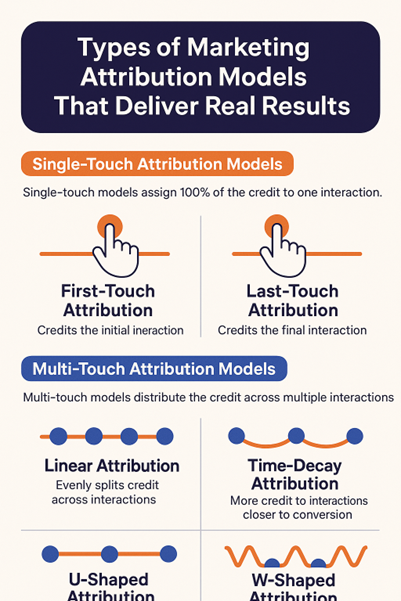
Not all conversion paths follow the same trajectory, and attribution models reflect that diversity. Marketing teams rely on different approaches to connect conversions to marketing touchpoints. These approaches fall into two major categories: single-touch attribution models and multi-touch attribution models. Over the past few years, advanced techniques such as data-driven attribution and AI-powered attribution have emerged as well-structured, algorithmic alternatives to rule-based models.
Single-Touch Attribution Models
Single-touch models assign 100% of the conversion credit to a single interaction. Either the first touch or the last touch claims all recognition, depending on the chosen setup. These models are easy to implement and interpret, making them a frequent entry point for teams beginning their attribution journey.
- First-touch attribution credits the initial interaction that brought a user into the marketing funnel.
- Last-touch attribution recognizes only the final touchpoint that immediately preceded the conversion.
While convenient, single-touch approaches often oversimplify complex buyer journeys and overlook the impact of mid-funnel engagements.
Multi-Touch Attribution Models
In contrast, multi-touch attribution models distribute credit across several interactions. This method acknowledges that decisions rarely occur after encountering just a single touchpoint.
- Linear attribution evenly splits credit across all touchpoints in the journey.
- Time-decay attribution assigns more value to recent interactions as the moment of conversion approaches.
- U-shaped and W-shaped models assign defined weight to critical stages in the funnel, including the first, middle, and last touchpoints.
- Full-path attribution extends this structure to include the point of customer handoff to the sales team.
Multi-touch models capture the nonlinear reality of user behavior, making them suitable for campaigns running across multiple channels and platforms.
Advanced Attribution: Data-Driven and AI-Powered Models
When rule-based models fail to provide sufficient nuance, teams turn to data-driven and artificial intelligence-powered attribution approaches. These utilize algorithmic analysis and machine learning to assign credit based on actual journey data, rather than predefined logic.
- Data-driven attribution analyzes historical user paths and assigns weight to touchpoints based on their statistically modeled impact on conversions.
- AI-powered models take it a step further by dynamically adapting attribution in real-time using behavioral signals, contextual patterns, and evolving customer journeys.
Both approaches eliminate guesswork by grounding decisions in observable data. They scale with complexity and deliver more reliable insights, especially for omni-channel strategies operating across web, mobile, search, and offline touchpoints.
First-Touch Attribution: Spotlight on the Starting Line
First-touch attribution assigns 100% of the credit for a conversion to the initial interaction a customer has with a brand. Whether it’s a paid ad click, an organic search result, or a downloaded white paper, this model pinpoints the spark that ignited the journey.
Where the First-Touch Model Works Best
Marketers tracking top-of-funnel campaigns use first-touch attribution to identify which channels or tactics are most effective in generating initial awareness. It’s particularly effective when the goal is demand generation, brand discovery, or expanding reach.
Key Advantages
- Unambiguous visibility into entry points: This model focuses on the moment a lead first encounters the brand, which directly informs future budget allocation for awareness strategies.
- Simplified attribution setup: With only a single touchpoint to measure, implementation is technically straightforward and requires less complex tracking infrastructure.
Critical Limitations
- Disregards the rest of the buyer’s journey: Mid-funnel engagement, nurturing content, and bottom-of-funnel activity, such as retargeting or conversion-focused messaging, receive no recognition. This insight is skewed when longer, multi-touch sales cycles are involved.
- Produces one-dimensional data: In isolation, first-touch outputs may misleadingly elevate channels good at creating awareness but weak in driving revenue.
Pro Tip : Use first-touch attribution as a diagnostic lens, not a standalone decision-maker. Pair it with a multi-touch or data-driven model to validate whether the channels driving initial awareness also contribute meaningfully to conversion. This dual-model perspective helps you avoid over-investing in vanity traffic and ensures your top-of-funnel insights connect to bottom-line results.
Measuring the Final Push: Last-Touch Attribution
Last-touch attribution assigns 100% of the conversion credit to the final interaction a customer has before making a purchase or completing a goal. Whether it’s clicking a Facebook ad, opening a promotional email, or conducting a branded Google search at the end of the journey, that last engagement gets full recognition.
This model focuses solely on the moment closest to the finish line. It disregards every prior touchpoint, no matter how vital those earlier steps may have been in building interest or trust. Last-touch attribution maps the point of conversion back to a single, definitive interaction, making it simple, straightforward, and data-friendly.
Best Fit: Short, Direct Journeys
Marketers running campaigns with fast, linear funnels often favor last-touch attribution. Think flash sales, limited-time offers, or pay-per-click campaigns designed for immediate action. In these cases, customers may convert after a single or minimal set of interactions; therefore, prioritizing that final step reflects real behavioral patterns.
Advantages of Last-Touch Attribution
- Simplicity in tracking: With a single touchpoint to monitor, setup becomes clean, and implementation is almost instant.
- Ease of interpretation: Results are clear-cut, no need for complex modeling or subjective weighting.
- Real-time optimization: Campaigns can be adjusted based on immediate results from tracked final engagement sources.
Limitations That Skew the Full Story
- Unrecognized early-stage influences: Organic search, social engagement, content downloads, and email nurturing steps are often overlooked entirely.
- Unfit for complex funnels: Brands with longer sales cycles or multiple engagement stages often see skewed data when only the final click is counted.
- Attribution bias: Channels that frequently close conversions, such as branded search or remarketing, appear more valuable than they actually are in the broader context.
Are your customers clicking one ad and converting immediately? Or are they engaging with video, reading reviews, and comparing products over weeks? The nature of your funnel determines whether last-touch attribution provides valuable insights or an illusion.
Pro Tip : Treat last-touch attribution as a performance snapshot, not the full story. Use it to evaluate closing efficiency, but always cross-check with upstream data. Pairing last-touch insights with a multi-touch or time-decay model helps distinguish true conversion drivers from channels that simply capture the credit at the finish line.
Linear Attribution: Equal Weight to Every Touch
What Is Linear Attribution?
Linear attribution assigns equal credit to every touchpoint in the customer journey. Whether a user first discovers your brand through a blog post, clicks a retargeting ad, attends a webinar, or finally converts through a sales call, each interaction receives the same value. This model assumes all touchpoints contribute equally to the conversion, regardless of their order or perceived influence.
When Linear Attribution Succeeds
Linear attribution performs well in marketing funnels that involve extensive engagement across multiple channels. Businesses in sectors with long conversion cycles, such as SaaS, enterprise software, or high-value B2B services, leverage this model to track complex behavior at each stage of the funnel. It gives structure to what could otherwise be an amorphous string of interactions.
Advantages of Linear Attribution
- Balanced credit distribution: Every campaign and channel involved in the conversion gets a fair share of the recognition.
- Highlighting supporting roles: Mid-funnel touchpoints like email sequences, nurture campaigns, or in-app messages are not overshadowed by the first or last click.
- Simplified reporting: This model avoids the overcomplication of algorithmic approaches while still acknowledging the multi-touch nature of modern marketing.
Limitations to Consider
- Equal credit may mask impact: Not all interactions contribute equally to a customer’s decision to convert. Treating them as such dulls insight into high-performing touchpoints.
- Lacks prioritization cues: Marketers struggle to identify which channels are critical versus supportive, making budget allocation more challenging.
Pro Tip : Use linear attribution as your baseline fairness model, a starting point for understanding how all touchpoints work together. Then, layer in time-decay or data-driven models to reveal which interactions actually accelerate conversions. This hybrid view prevents overgeneralization and helps refine your spend toward channels that do more than just participate; they influence.
Time-Decay Attribution: Rewarding the Closer Touchpoints
In the time-decay attribution model, more weight is assigned to marketing interactions that occur nearer to the actual conversion. This model acknowledges that as a prospect progresses down the funnel, each subsequent touchpoint becomes increasingly influential in shaping the final decision.
When to Use Time-Decay Attribution
Time decay works especially well for products or services with longer sales cycles, such as enterprise software, B2B services, or high-investment consumer goods. In these scenarios, prospects typically engage with multiple channels across an extended timeline. Direct emails, retargeting ads, or one-on-one demos that happen near the point of conversion tend to carry more persuasive power. This model accounts for that influence dynamically.
Advantages of Time-Decay Attribution
- Recognizes the pacing of influence: By increasing credit allocation toward recent touchpoints, this model rewards channels that help close deals, such as remarketing campaigns, live chat consultations, or limited-time offers.
- Highlights mid-funnel and bottom-funnel impact: Channels involved in nurturing, such as email sequences, direct sales outreach, or final-stage webinars, get the attention they deserve under this model.
- Aligns with customer behavior patterns: Prospects typically become more engaged as they approach a decision. Time-decay mirrors that progression mathematically.
Limitations of Time-Decay Attribution
- Devalues awareness-stage efforts: Early interactions, like social media ads, influencer campaigns, or educational blog content, receive minimal credit, despite their impact on initial interest.
- Can skew budget allocation: Marketers may overly focus on bottom-funnel tactics, potentially underinvesting in channels that drive top-of-funnel discovery.
Time-decay attribution favors recency. It doesn’t ignore earlier efforts, but it systematically tilts the scale toward the interactions that happened just before the lead converted. For strategy builders focused on closing efficiency, this model sharpens clarity on which final pushes deliver results.
U-Shaped (Position-Based) Attribution: Balancing First Impressions and Final Touches
Not every marketing interaction carries the same level of importance. U-Shaped attribution, also known as Position-Based attribution, recognizes this reality by assigning
- 40% of the conversion credit to the first touchpoint, the moment the lead first interacts with your brand.
- 40% to the last touchpoint, the final interaction before conversion.
- The remaining 20% is distributed evenly among all the middle points of contact.
This distribution offers a structured yet flexible lens for analyzing the customer journey, particularly in campaigns designed to cultivate leads over time.
Best Fit: Lead Generation Campaigns
U-Shaped attribution aligns especially well with lead generation efforts. These campaigns often hinge on nurturing prospects through a multi-step funnel, where both the initial engagement and the final conversion step hold considerable importance. The model validates the effort of top-of-funnel activities while still crediting the sale-enabling touchpoint at the end.
Advantages of the U-Shaped Model
- Illuminates entry and exit dynamics: By heavily weighting the first and last interactions, the model surfaces which campaigns capture attention and which strategies close the deal.
- Improves alignment between marketing and sales: This dual-focus attribution highlights how marketing attracts interest and how sales (or direct-response assets) convert it.
- Encourages a balanced content strategy: Marketers can optimize top-of-funnel educational content and bottom-funnel call-to-actions simultaneously.
Limitations to Consider
- Undervalues mid-funnel engagement: Touch points such as webinars, case studies, retargeting ads, or comparison pages often play a vital role in preparing prospects to commit, yet in this model, they receive only 20% of the credit, regardless of their impact.
- Assumes equal value across middle interactions: A lightweight product email gets the same weight as a deep product demo; nuance is lost.
Think about a campaign sequence that includes a paid ad click, a whitepaper download, a product page visit, and finally, a free trial sign-up. U-Shaped attribution will credit the ad click and trial sign-up with 40% each, while the whitepaper and product page split the last 20%. If you’re looking to understand the hooks and closers in your funnel, this model clarifies them.
W-Shaped Attribution: Focused Weight on Pipeline-Defining Touchpoints
W-Shaped attribution assigns 90% of the credit to three specific moments in a buyer’s journey: the first interaction, the stage where a lead is created, and the final touchpoint before the deal enters an opportunity stage. Each of these critical stages receives 30% of the attribution. The remaining 10% is distributed evenly across all other touchpoints in the customer journey.
Ideal Use Case: Complex B2B Sales Funnels
This model aligns best with B2B marketing funnels where multiple stakeholders, longer buying cycles, and lead qualification stages dominate the buyer’s path. In this environment, isolating the first meaningful interaction, the lead-creation trigger, and the closing engagement provides high-utility visibility into what moves prospects through the pipeline.
Advantages That Matter
- Pinpoints high-leverage actions: The model highlights three decisive inflection points that have a significant influence over conversion, enabling marketing teams to scale what works across acquisition, nurturing, and closing.
- Supports sales-marketing alignment: By spotlighting the lead-creation stage, it directly connects marketing performance to pipeline generation, a critical interface between marketing efficiency and sales outcomes.
- Handles mid-funnel complexity better than simpler models: Linear and U-shaped models overlook opportunity-creation events, which are cardinal in B2B scenarios. W-shaped fills that gap.
Known Limitations
- Fixed weight allocation flattens nuance: The 30-30-30 split doesn’t adapt based on context, behavior, or industry. If a mid-funnel webinar had unusually high engagement, it still gets bumped into the remaining 10%, potentially undervaluing its role.
- Ignores post-opportunity influence: Once a lead hits the opportunity stage, W-shaped stops tracking. No credit is given to nurturing or sales touches that happen closer to deal closure.
Pro Tip : Use W-shaped attribution as your pipeline performance lens, but don’t stop there. Combine it with full-path or data-driven models to capture post-opportunity interactions and closing dynamics. This layered approach gives marketing and sales teams a unified, end-to-end view of what truly drives revenue, not just what gets deals into the pipeline.
Multi-Touch Attribution (MTA): Mapping the Full Customer Journey
Recognizing Every Touchpoint Along the Way
Multi-Touch Attribution (MTA) models assign credit to every interaction a customer has with a brand, including those that occur before conversion. Instead of focusing solely on the first or last touch, MTA considers the entire sequence, including email clicks, search ads, social media interactions, website visits, and more. Each step receives a portion of the conversion value, reflecting its influence in guiding the prospect toward a decision.
Rules-Based vs. Algorithmic: What Sets MTA Apart from Data-Driven Attribution
MTA relies on a rules-based structure. That means marketers define how credit should be distributed across channels, using predefined patterns, such as linear, time-decay, or position-based methods. In contrast, Data-Driven Attribution (DDA) enables algorithms to analyze historical data, detect patterns, and assign weights based on actual performance.
While both evaluate multiple interactions, MTA operates under a fixed framework, offering more control but less adaptability. DDA adjusts based on data trends, automatically recalibrating weights as customer behavior evolves.
Capturing the Complexity of Modern Digital Journeys
Customers rarely convert after a single touch; they jump across platforms, devices, and content types over days or even weeks. MTA accommodates this reality by revealing how each channel contributes to momentum. It tracks multiple touchpoints simultaneously, delivering a clearer picture of how users engage across display ads, organic search, retargeting, affiliate links, and beyond.
- Cross-device alignment: MTA captures interactions across multiple devices, including mobile, desktop, and tablet environments.
- Channel synergy: It illustrates how channels interplay and reinforce each other, like how an email click warms up an eventual paid search conversion.
- Campaign performance clarity: Marketers can see which combinations of touches drive results most effectively, not just which ones happen first or last.
Want to See Where Credit Really Belongs?
Pull up your current conversion paths. Are you only crediting the final step, or are you evaluating the entire journey? Multi-Touch Attribution answers a sharper question: not just “what converted,” but “what contributed to converting, how, when, and how much?”
Pro Tip : Treat Multi-Touch Attribution as your narrative map, a living blueprint of how prospects truly move through your ecosystem. Revisit and refine your credit distribution quarterly to reflect evolving customer paths and channel performance. When paired with DDA insights, MTA transforms from a static model into a dynamic strategy tool that uncovers not just where conversions happen, but why they happen.
The Role of AI and Machine Learning in Attribution
Precision at Scale: How AI Enhances Attribution Accuracy
Artificial intelligence eliminates the guesswork that once plagued attribution. Machine learning algorithms absorb volumes of customer interaction data, ad impressions, clickstreams, and purchase behavior, and uncover statistically significant patterns. These patterns reveal how each touchpoint contributes to conversion outcomes, even when the buyer journey spans weeks and multiple platforms.
With traditional rules-based models, misattribution often skewed budget decisions. AI shifts this dynamic by dynamically assigning fractional credit based on actual performance. For example, Google’s data-driven attribution utilizes conversion modeling and counterfactual simulation to assess the likelihood of a conversion occurring without a specific ad interaction. This level of rigor ensures the model doesn’t overvalue the first or last touch by default.
Real-Time Decision Making from Behavioral Signals
Machine learning models track and interpret behavior fast enough to inform action during the customer journey itself. Dynamic ad sequencing changes in response to user intent signals, informed by AI-driven projections of where the buyer is in the funnel. Pages visited, dwell time, and re-engagement patterns inform predictive models that refine budget allocation in near real-time.
This level of responsiveness eliminates the lag between insight and action. Brands can continuously reassign value as campaigns evolve rather than waiting for discrete post-campaign analysis. AI doesn’t just report on attribution, it drives it.
Tools Executing Advanced Attribution with AI
- Google Analytics 4: Uses a machine learning-driven data-driven attribution model that distributes conversion credit based on modeled counterfactuals and historic user behavior across touchpoints.
- Adobe Attribution AI (within Adobe Experience Platform): Applies time series analysis and algorithmic modeling to predict the impact of each campaign interaction on a predefined success metric.
- Rockerbox: Offers multi-touch attribution powered by machine learning that evaluates touchpoints across digital and offline channels, including TV, direct mail, and programmatic advertising.
- Segment Data Lake integrations: Enable custom machine learning attribution models using first-party data pipelines and predictive modeling in cloud environments, such as Snowflake, AWS, or BigQuery.
These platforms don’t just automate attribution; they continuously learn from new data to refine their distribution of credit. Over time, models self-optimize, uncovering correlations that static models miss entirely.
Ready to see which channels truly drive your growth? Let our experts build a custom attribution roadmap for your campaigns. Drop us a line atinfo@diggrowth.com to get started.
Ready to get started?
Increase your marketing ROI by 30% with custom dashboards & reports that present a clear picture of marketing effectiveness
Start Free Trial
Experience Premium Marketing Analytics At Budget-Friendly Pricing.

Learn how you can accurately measure return on marketing investment.

How Predictive AI Will Transform Paid Media Strategy in 2026
Paid media isn’t a channel game anymore, it’s a chessboard. Search, social, programmatic, video, influencer, native,...
Read full post post
Don’t Let AI Break Your Brand: What Every CMO Should Know
AI isn’t just another marketing tool. It’s changing how we connect with customers, personalize content, and...
Read full post post
From Demos to Deployment: Why MCP Is the Foundation of Agentic AI
A quiet revolution is unfolding in AI. And it’s not happening inside research labs. For decades,...
Read full post postFAQ's
Marketing attribution identifies which marketing touchpoints contribute most to conversions. It helps businesses understand how different channels, such as email, paid ads, and social media, work together to influence customer decisions. With accurate attribution, marketers can allocate budgets wisely, improve ROI, and scale campaigns based on proven performance rather than assumptions.
Attribution models fall into two main categories: single-touch and multi-touch. Single-touch models, like first-touch and last-touch attribution, assign all credit to one interaction. Multi-touch models, including linear, time-decay, U-shaped, and W-shaped, spread credit across several touchpoints, offering a more complete view of customer behavior and campaign impact.
AI-powered attribution uses machine learning to analyze large volumes of behavioral data and automatically assign credit based on actual influence. Unlike rule-based models, which follow fixed formulas, AI models adapt in real time as customer journeys evolve. This results in more precise insights and better optimization across complex, omni-channel marketing ecosystems.
The right model depends on your sales cycle and marketing complexity. For short, simple funnels, single-touch models can provide quick clarity. For longer B2B or multi-channel journeys, multi-touch or AI-driven attribution delivers deeper insight. The key is to match your model to your funnel’s structure and data maturity.
Attribution modeling reveals which channels truly drive conversions, helping teams cut wasteful spending and double down on what works. By identifying the touchpoints with the highest influence, marketers can refine targeting, craft stronger campaigns, and forecast returns more accurately, resulting in a measurable boost in overall marketing ROI.