Marketing Mix Modeling vs Platform Attribution: When to Look at the Forest and When to Count the Trees
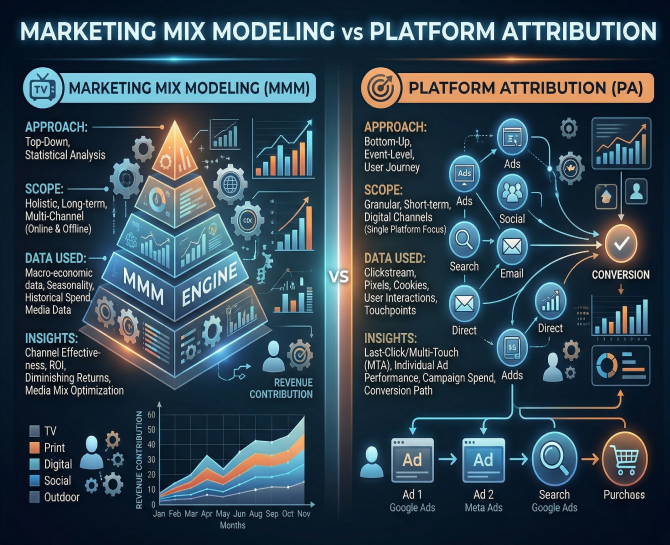
Marketing mix modeling (MMM) and platform attribution are two different measurement tools that answer different questions about marketing performance. MMM uses statistical modeling of aggregate data, including offline channels, to explain how your total media mix drives long-term revenue. Platform attribution tracks individual user journeys across digital touchpoints for day-to-day campaign decisions. Neither replaces the other. The confusion comes from treating them as competitors.
There’s a conversation that happens in marketing teams everywhere, and it usually surfaces around budget season.
The digital team wants to know which specific ad drove the click last Tuesday. Leadership wants to know whether the overall marketing investment is actually growing the business this year. Both are valid questions. And both teams are frustrated because neither question gets answered properly by the other person’s tool.
MMM vs attribution is a revenue decision. In 2026, marketing leaders are evaluating what drives incremental revenue, improves efficiency, and strengthens forecast reliability. MMM informs strategic allocation while attribution supports execution. Organizations seeing measurable results are not choosing between the two. (Source: Marrina Decisions, March 2026)
According to a July 2025 EMARKETER and TransUnion survey, 46.9% of US marketers plan to invest more in MMM over the next year, and 27.6% named it the most reliable measurement methodology. That growth isn’t happening because platform attribution stopped being useful. It’s happening because teams have realized they need both views to make budget decisions they can actually defend.
Key Takeaways
- Platform attribution zooms in on individual user journeys and is built for tactical decisions: which campaign to scale, which creative to pause, where to shift spend this week.
- MMM zooms out to show how your total media mix, including TV, events, and offline spend, drives long-term revenue using aggregate data that doesn’t depend on individual user tracking.
- Companies using MMM allocate budgets 23% more efficiently and achieve significantly higher returns than those relying on platform-reported metrics alone, according to an analysis of 2,400 e-commerce brands. (Source: ConvertMate, April 2026)
- Platform attribution has a structural problem: every platform claims credit independently and generously, so adding reported conversions across platforms almost always exceeds your actual sales.
- The practical division of labor: MMM for your annual big-picture planning, platform attribution for your week-to-week campaign optimization. Different tools for different jobs.
What Is Platform Attribution and How Does It Work?
What is platform attribution?
Platform attribution is the measurement system built into your ad platforms (Google Ads, Meta Ads Manager, LinkedIn Campaign Manager) and analytics tools that track individual user interactions and assign credit to specific touchpoints that came before a conversion.
When someone clicks your LinkedIn ad, reads your blog, receives a nurture email, and books a demo two weeks later, your attribution model is trying to figure out which of those interactions deserves credit. Depending on which model you’re using, the answer could be the LinkedIn ad (first-touch), the email (last-touch), all of them equally (linear), or some weighted combination based on how recently they happened (time-decay).
Attribution modeling is great for understanding what is happening at the customer level right now, so teams can adjust campaigns quickly. Marketing mix modeling works at a broader level, helping brands understand long-term trends, seasonal shifts, and market forces that shape performance over time.
The issue is not just inaccurate reporting. It is how the system is designed. Each ad platform is incentivized to claim as much credit as possible, so the same conversion often gets counted by more than one channel. And since attribution reports look only at what has already happened, they are not very useful for deciding what is likely to work next.
What Is Marketing Mix Modeling and How Does It Work?
What is marketing mix modeling (MMM)?
Marketing mix modeling is a statistical analysis method that uses historical aggregate data to measure how different marketing channels, including offline media, contribute to overall revenue. Rather than following individual users, MMM looks at patterns across total spend, total impressions, seasonality, pricing, and economic conditions to estimate how much each marketing input drove business outcomes.
You feed the model historical data: weekly spend by channel, TV and event investment, pricing changes, competitive activity, and sales results.
The statistical analysis then estimates how much each variable contributed to revenue over that period. The output answers questions that platform attribution simply can’t touch: What’s the true incremental contribution of our brand campaign? If we shifted 20% of paid search budget to LinkedIn, what would happen to the pipeline over the next two quarters?
In 2026, MMM is doing much more than explaining past performance. It helps organizations see how channels work together, understand where returns start to taper off, and plan future scenarios with more confidence than attribution models usually allow. It has shifted from a static historical report to a working model for real planning.
MMM is also privacy-safe by design. It uses aggregate data rather than individual user tracking, so cookie deprecation, iOS privacy changes, and evolving data regulations don’t affect it.
How Do MMM and Platform Attribution Compare?
| Feature | Platform Attribution | Marketing Mix Modeling |
|---|---|---|
| Perspective | Bottom-up: individual user journeys | Top-down: aggregate market data |
| Data privacy | High sensitivity requires user-level tracking | Cookie-independent, uses aggregated data |
| Granularity | Keyword, creative, audience level | Channel level |
| Speed of insight | Real-time to weekly | Weekly to quarterly |
| Offline channels | Cannot measure | Full visibility |
| Best for | Daily ad optimization, creative testing | Annual budget planning, long-term strategy |
| The blind spot | Over-credits via walled garden reporting | Can miss short-term viral spikes |
When Does Platform Attribution Give You the Best Information?
Platform attribution is the right tool when you need specific answers about campaigns that need to happen fast.
Which creative is actually converting this week? Which audience segment has the lowest cost per qualified lead? Is this retargeting campaign still generating positive returns? These decisions need recent, granular data, and platform attribution delivers it.
There’s also a practical reason to keep attribution data clean and flowing back to platforms: when Meta and Google receive accurate, enriched conversion data through server-side integrations, their machine learning algorithms improve. The attribution data makes the targeting better, not just the reporting.
Use platform attribution for campaign-level decisions. Use it weekly for optimization and creative testing. Trust it for relative comparisons within a single platform. Just don’t use it for comparing channels against each other or setting an annual budget strategy, because that’s where the overlapping credit problem actively misleads.
When Does MMM Give You Better Information?
MMM earns its value on bigger, slower questions that require a longer view of the business.
How should we divide our overall budget between brand building and performance marketing next year? What’s the true incremental contribution of our offline event spending? If we reduced paid social by 20% and put that money into content, what would the revenue impact look like over two quarters?
MMM adoption surged 212% since 2023, driven by privacy regulations, cookie deprecation, and the failure of last-click attribution to capture the full customer journey. (Source: ConvertMate, April 2026) The launch of free open-source tools like Google Meridian and Meta Robyn has also dropped the barrier significantly, making MMM accessible to mid-market teams who previously couldn’t justify the investment.
Why the Best Teams Use Both
A strong measurement framework brings together MMM for the big-picture view, attribution for ongoing campaign optimization, and incrementality testing to prove whether marketing is actually creating incremental results.
In practice, combining the two looks like this. Use MMM at the start of the year to set your overall media mix direction: how much goes to brand versus performance, what proportion flows to each channel. Then use platform attribution throughout the year to optimize execution within those channels: which campaigns, creatives, and audiences are performing best right now.
MMM answers: ‘How much should we put into LinkedIn versus paid search versus TV this year?’
Platform attribution answers: ‘Within our LinkedIn budget, which campaigns and creatives are performing best this week?’
Different altitudes. Different time horizons. When you try to force one to answer the other’s question, you get bad advice.
The DiGGrowth Edge: Both Views Without the Reconciliation Headache
The historical friction in combining MMM and platform attribution wasn’t conceptual. Most teams understood why they needed both. The problem was two separate tools, two different skill sets, and outputs that were difficult to reconcile against each other.
DiGGrowth integrates granular click-level attribution data alongside big-picture market trend analysis in a single platform. Your digital team gets real-time campaign-level attribution. Leadership gets the macro view of how the overall investment is tracking against long-term revenue goals. Both views update continuously rather than waiting for a quarterly refresh that lands after the decisions were already made.
Ready to get started?
Increase your marketing ROI by 30% with custom dashboards & reports that present a clear picture of marketing effectiveness
Start Free Trial
Experience Premium Marketing Analytics At Budget-Friendly Pricing.

Learn how you can accurately measure return on marketing investment.

How Predictive AI Will Transform Paid Media Strategy in 2026
Paid media isn’t a channel game anymore, it’s a chessboard. Search, social, programmatic, video, influencer, native,...
Read full post post
Don’t Let AI Break Your Brand: What Every CMO Should Know
AI isn’t just another marketing tool. It’s changing how we connect with customers, personalize content, and...
Read full post post
From Demos to Deployment: Why MCP Is the Foundation of Agentic AI
A quiet revolution is unfolding in AI. And it’s not happening inside research labs. For decades,...
Read full post postFAQ's
MMM is a statistical method that uses aggregate historical data to measure how different marketing channels, including offline media, contribute to total revenue. It doesn't track individual users, making it resilient to privacy changes and best suited for strategic budget planning.
Platform attribution tracks individual user journeys across digital channels and assigns credit to specific touchpoints before a conversion. It provides granular, real-time insights for campaign optimization but suffers from walled garden reporting bias and privacy-driven tracking gaps.
Platform attribution tracks individual clicks for tactical campaign decisions. MMM uses aggregate data to measure the long-term impact of the entire media mix, including offline channels. One optimizes daily execution. The other guides the annual strategy. Both are needed for the full picture.
Use MMM for strategic questions: annual budget allocation, long-term channel contribution, offline spend impact, and media mix planning. Use platform attribution for weekly campaign optimization, creative testing, and short-term spend decisions within a specific channel.