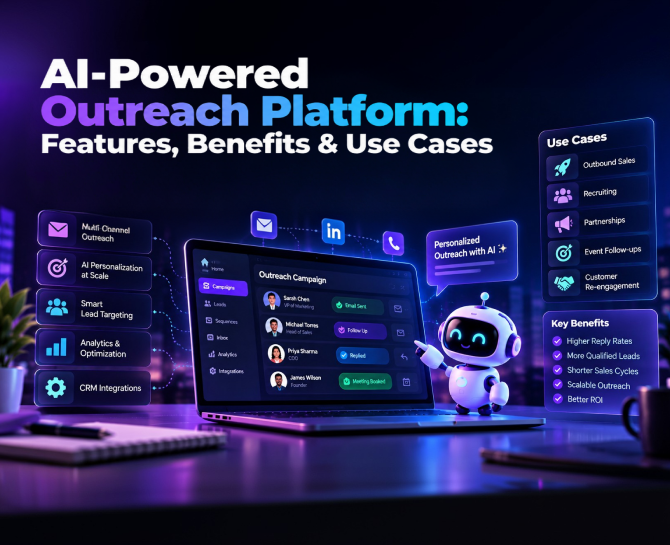
AI-Powered Outreach Platform: Features & Benefits
An AI-powered outreach platform brings prospect intelligence, buying signals, personalization, prioritization, and outreach automation into a connected sales process. Instead of focusing only on sending more messages, these platforms help teams decide who to contact, what context matters, and when outreach makes sense. Read on.
Your sales team can send hundreds of emails in a day and still miss the prospects that matter.
The problem is not always outreach volume. It is knowing who to contact, what to say, and when to reach out. Generic templates and rigid sequences rarely account for the context behind a prospect.
AI is changing that process. Statista projects global revenue from AI used in marketing to reach about $47 billion in 2025 and exceed $107 billion by 2028.
An AI-powered outreach platform can bring prospect data, buying signals, personalization, and automated follow-up into one workflow. It can help sales teams spend less time researching accounts and more time having relevant conversations.
But adding AI to outreach does not automatically make the process better. The quality of the data, signals, personalization, and workflows still matters.
Let us look at what these platforms actually do and where they can make a difference.
Key Takeaways
- AI-powered outreach platforms help sales teams identify, prioritize, and engage relevant prospects with greater context.
- Strong prospect data gives AI better information for account research, personalization, and outreach recommendations.
- AI personalization works best when messages reflect roles, business events, intent, and account priorities.
- Sales teams should measure outreach by qualified meetings, opportunities, pipeline, revenue, and efficiency, not activity alone.
- The best platform should connect prospect intelligence with sales actions while keeping human
What Is an AI-Powered Outreach Platform?
An AI-powered outreach platform uses artificial intelligence to identify promising prospects, research accounts, personalize messages, prioritize outreach, and automate follow-ups. It combines data and AI-driven recommendations to help sales teams make better outreach decisions.
Unlike basic email automation, an AI-powered platform can use context such as CRM data, contact information, buyer intent, engagement history, firmographics, and technographics. This context helps determine who to contact, what message to send, and when to follow up.
How Does AI-Powered Outreach Work?
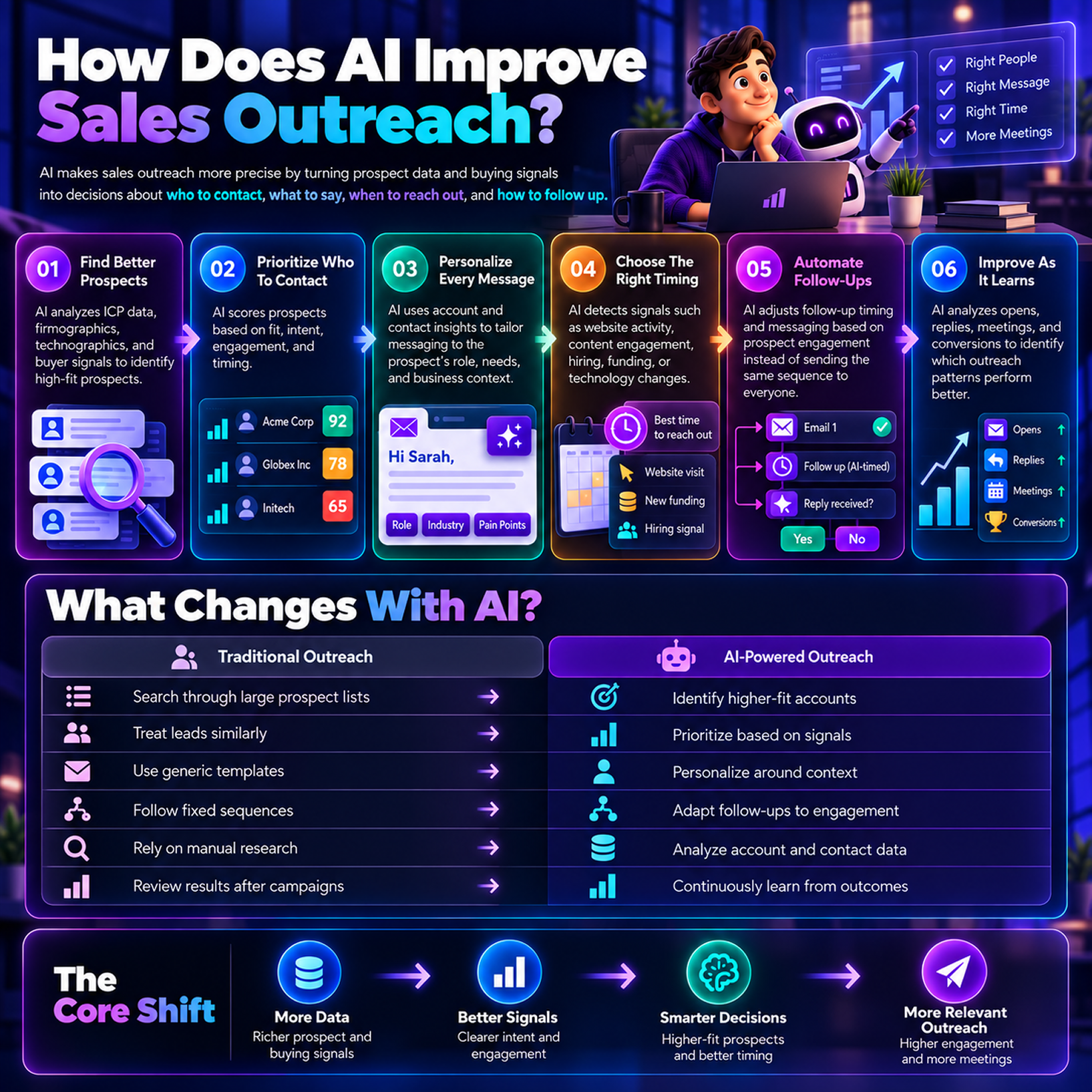
AI-powered outreach typically follows six steps:
- Collect data: Gather CRM, contact, company, and engagement data.
- Analyze signals: Assess ICP fit, intent, behavior, and engagement.
- Prioritize prospects: Rank accounts and contacts based on relevance and buying potential.
- Personalize messaging: Generate or recommend messages using prospect and account context.
- Automate outreach: Trigger email, LinkedIn, calls, and other sales actions.
- Analyze responses: Use engagement data to inform the next action.
What Features Should an AI-Powered Outreach Platform Have?
A strong AI-powered outreach platform should do more than automate email. It should connect prospect data, account context, buying signals, personalization, outreach, and performance data so sales teams can make better decisions at each stage.
AI Prospect Research And Account Intelligence: Bring company, contact, firmographic, technographic, and behavioral data together so sales representatives can quickly understand an account, its people, technology environment, and recent activity.
AI-Powered Personalization: Use prospect roles, company priorities, business events, pain points, engagement, and intent signals to create messaging that reflects the prospect’s situation rather than relying on basic name and company fields.
Multichannel Outreach: Coordinate email, LinkedIn, calls, and other supported channels so sales teams can engage prospects through the channels that fit their outreach strategy.
Automated Outreach Sequences: Automate email scheduling, follow-ups, branching, and task creation while adjusting the sequence based on prospect responses and engagement instead of following the same path for every contact.
Buying Intent And Behavioral Signals: Monitor website activity, content engagement, research behavior, hiring, funding, leadership changes, job changes, and technology updates to identify accounts showing relevant signs of potential interest.
AI Lead And Account Prioritization: Evaluate prospects using ICP fit, intent, engagement, account characteristics, and other relevant signals to help sales teams focus their time on accounts and contacts with stronger potential.
CRM And Sales Stack Integrations: Connect CRM, enrichment, sales engagement, analytics, and workflow tools so account records, prospect activity, outreach history, and engagement data remain connected across the sales process.
Outreach Analytics And Performance Tracking: Track positive replies, meetings, conversions, sequence performance, opportunities, pipeline contribution, and revenue-related outcomes to show whether outreach is producing meaningful sales results.
How Can Sales Teams Use AI Outreach Platforms?
Sales teams can use AI outreach platforms to find suitable accounts, identify buying signals, reach relevant stakeholders, personalize outreach, and adapt follow-up. The value becomes easier to see when you follow one prospect from identification to sales conversation.
Consider a B2B SaaS company that sells sales intelligence software to mid-market and enterprise businesses. The company wants to enter a new market, but manually researching thousands of accounts could take weeks. An AI outreach platform can connect several parts of that process.
Start With The Right Accounts
The sales team first defines what a strong-fit account looks like: companies with 500 or more employees, established sales teams, a B2B business model, and a need for better prospecting data.
Instead of building a massive contact list, the platform can identify companies that match these criteria. It can combine company size, industry, technology usage, and other account data to narrow the market.
The sales team gets a more useful starting point: which accounts deserve attention first?
Prioritize Accounts Showing Relevant Signals
Fit alone does not tell the team when to reach out. A company may match the ICP but have no immediate reason to consider a new sales intelligence platform.
The AI outreach platform can add signals such as hiring activity, leadership changes, website engagement, or relevant research behavior. Suppose one target company recently expanded its sales team, hired a new VP of Sales, and increased activity around sales prospecting topics.
Those signals do not prove that the company is ready to buy. They do give the salesperson a stronger reason to investigate the account now.
Find The People Behind The Account
Once an account becomes a priority, the next question is: who should the salesperson contact?
The platform can identify relevant stakeholders based on role, seniority, department, and account structure. For the sales intelligence company, that could mean finding a VP of Sales, a Sales Operations leader, and sales managers who may use the product.
Enterprise purchases often involve several people. Reaching relevant stakeholders can give the sales team a clearer path into the buying process.
Build Outreach Around Account Context
The salesperson now has more than a name and email address. They have a reason to start the conversation.
Suppose the target company has grown its sales organization from 80 representatives to 150 within a year. The salesperson could frame the outreach around maintaining prospecting quality and account coverage as the team expands.
AI can turn that context into a first-draft email or sequence. The salesperson can then review the message, remove weak assumptions, and adjust the tone before sending it.
Adapt Follow-Up Based On Engagement
The conversation does not end with the first email.
If the prospect responds, the salesperson can take over. If there is no response, the platform can manage scheduled follow-ups. If new account signals appear, the team can adjust the outreach instead of continuing with the same message.
For example, another round of sales hiring could give the representative a fresh reason to reconnect. The follow-up now reflects something that changed at the account rather than another generic “just checking in” message.
Turn Prospecting Into A Connected Process
In this example, the AI outreach platform does more than automate email. It connects account selection, signal detection, stakeholder identification, personalization, and follow-up.
That gives sales representatives more time to evaluate opportunities and decide how to turn relevant account signals into productive conversations.
What Are the Benefits of an AI-Powered Outreach Platform?
An AI-powered outreach platform can improve sales productivity by helping teams spend less time on repetitive prospecting and more time on qualified opportunities. The biggest gains come from better targeting, stronger context, and faster execution.
Reduce Manual Research
AI can collect and organize account, contact, firmographic, technographic, and behavioral data that sales representatives would otherwise research manually.
A representative can start with a clearer prospect profile instead of opening multiple tabs to understand a company, find relevant contacts, and check recent business activity.
Improve Prospect Targeting
AI can compare prospects against ICP criteria and relevant buying signals to identify accounts that deserve more attention.
For example, two companies may match the same industry and employee range. If one is also expanding its sales team and researching sales intelligence, the sales team has a stronger reason to prioritize it.
Create More Relevant Outreach
AI can use account context, job roles, business events, and engagement signals to shape messaging around a prospect’s situation.
This moves personalization beyond inserting a first name or company name into a standard template.
Respond Faster to Buying Signals
Relevant signals can lose value if sales teams notice them days or weeks later. AI can surface changes such as hiring activity, website engagement, leadership moves, or renewed research and help representatives act while the context is still useful.
Scale Outreach Without Losing Context
Sales teams can reach more prospects without researching every account from scratch. AI can handle repetitive tasks while representatives review important messages and focus on conversations that require human judgment.
Improve Sales Efficiency
The strongest benefit is not simply sending more outreach. It is giving sales representatives better information before they decide where to spend their time.
That can reduce research effort, improve prioritization, and shift more of the team’s attention toward qualified conversations and pipeline opportunities.
What Are the Limitations of AI Outreach Platforms?
AI outreach platforms can improve prospecting and sales execution, but they do not remove every challenge. Poor data, weak personalization, incorrect assumptions, and excessive automation can reduce the quality of outreach.
Poor Data Can Produce Poor Recommendations
AI relies on the information available to it. Outdated contact details, incomplete CRM records, duplicate accounts, or incorrect firmographic data can lead the platform toward the wrong prospects.
Solution: Maintain clean CRM records and use reliable data enrichment and verification. Review important account information before launching large outreach campaigns.
AI Personalization Can Miss the Context
AI can create a message that sounds personalized without actually understanding the prospect’s situation. Mentioning a recent company announcement does not make an email useful if the event has no connection to the recipient’s responsibilities.
Solution: Give AI clear ICP criteria, messaging guidelines, and relevant account context. Ask sales representatives to review high-value messages before they go out.
AI Can Misinterpret Buying Signals
A website visit or content download does not always mean a prospect is ready to buy. AI may also connect unrelated signals and assign too much importance to weak activity.
Solution: Combine multiple signals with account fit and engagement history. Treat intent as a reason to investigate an account, not as proof of purchase intent.
Too Much Automation Can Hurt Outreach Quality
Sending more messages does not necessarily create more conversations. Excessive follow-ups, repetitive messaging, and poorly timed sequences can frustrate prospects and damage engagement.
Solution: Set frequency limits, use clear sequence exit rules, and stop automated outreach when a prospect replies or shows a negative signal. Keep human involvement in important conversations.
AI-Generated Content Can Contain Errors
AI may make incorrect assumptions about a company, prospect, product, or business event. A polished message can still contain inaccurate information.
Solution: Use approved data sources and add human review for strategic accounts, executive outreach, and messages containing specific business claims.
AI Does Not Replace Sales Judgment
AI can surface patterns and recommend actions, but sales representatives understand conversations, relationships, objections, and account dynamics that data may not capture.
Solution: Treat AI as a decision-support layer rather than a replacement for sales judgment. Let the platform handle repetitive work while representatives make the final call on important outreach.
Deliverability Still Depends on Outreach Practices
An AI platform cannot guarantee that emails will reach the inbox. Sending volume, domain reputation, message quality, authentication, bounce rates, and recipient engagement all influence deliverability.
Solution: Use proper email authentication, maintain clean contact lists, monitor bounce and complaint rates, control sending volume, and remove contacts that no longer engage.
How Does ReachGen Fit Into AI-Powered Outreach?
ReachGen brings AI-assisted prospecting and outreach into a connected process, helping sales teams move from identifying suitable accounts to engaging relevant prospects.
A sales team can start with its ICP, identify accounts that fit those criteria, and use account and contact intelligence to understand who may be relevant. The team can then consider available buying signals and business context before deciding which prospects deserve outreach.
The important distinction is how these capabilities work together. A sales representative does not have to treat account research, prospect identification, prioritization, and outreach as completely separate tasks.
For example, a company may fit the target market, but recent hiring activity, sales-team expansion, or other relevant signals could make it more interesting right now. That context can inform who the salesperson contacts and how the message is framed.
ReachGen can also support AI-assisted personalization and outreach, giving sales teams a way to use prospect and account context when preparing messages rather than relying only on basic fields such as name, company, or job title.
For teams evaluating AI outreach platforms, ReachGen illustrates an important consideration: the value of AI depends on how well prospect intelligence connects with the actions that follow.
How to Choose an AI-Powered Outreach Platform
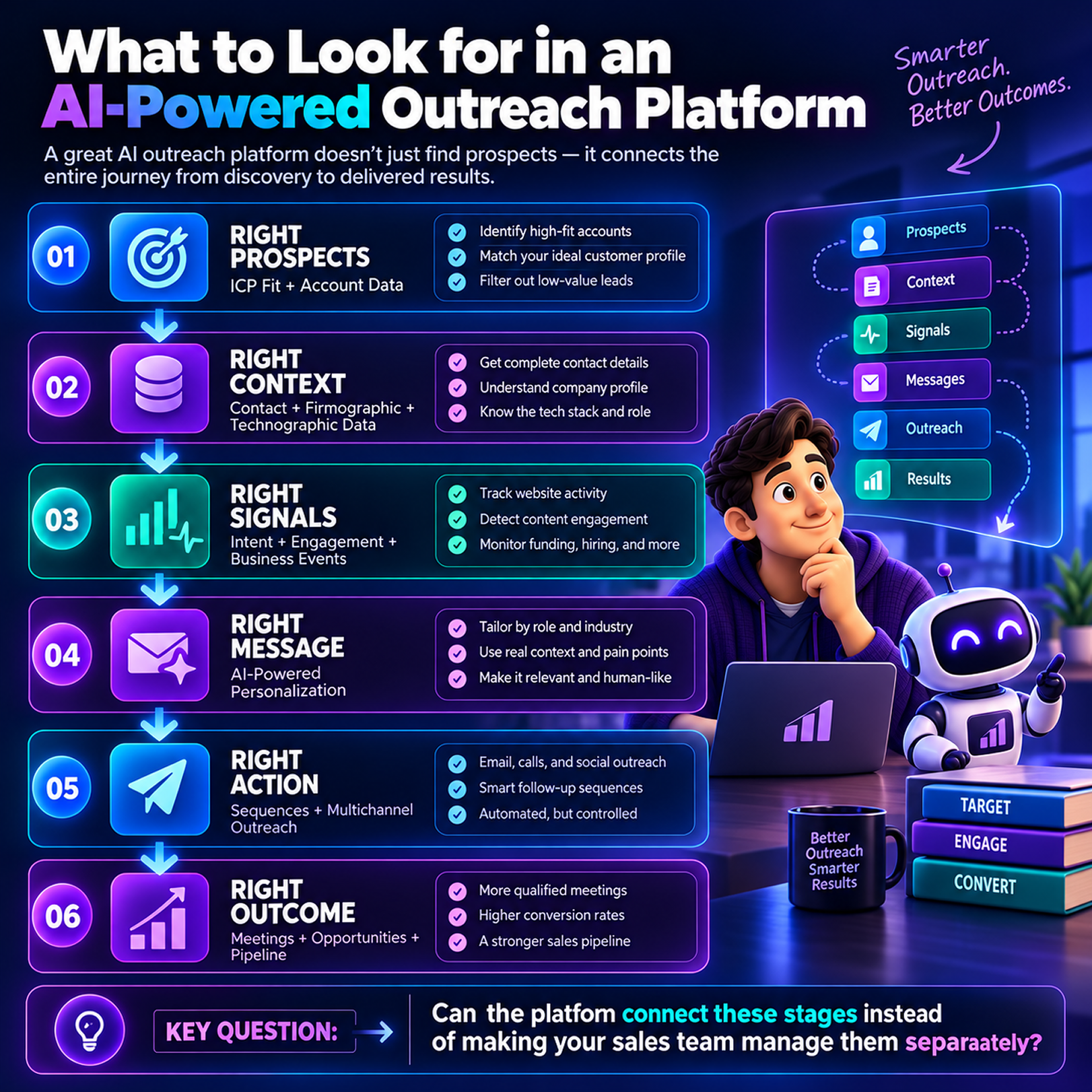
The right AI-powered outreach platform should help your team identify relevant prospects, understand account context, personalize outreach, and act on buying signals. Evaluate it across these key areas.
Evaluate Prospect Data Quality: Check data coverage, freshness, enrichment, and verification. Poor-quality data can lead to inaccurate prospect selection and AI recommendations.
Test AI Personalization: Look beyond names and company fields. Check whether AI can use roles, account context, business events, and relevant signals to create useful messaging.
Check Intent And Prioritization: Review the available signals and how they influence prioritization. The platform should combine ICP fit, intent, and engagement to identify prospects worth contacting first.
Review Outreach Workflows: Assess sequences, follow-ups, triggers, branching, and supported channels. Look for flexibility rather than one automated sequence for every prospect.
Check CRM Integrations: Confirm that the platform integrates with your CRM and sales tools while keeping prospect and engagement data connected.
Measure Business Impact: Focus on qualified meetings, opportunities, pipeline, revenue, and time saved rather than activity metrics alone.
ReachGen as an AI-Powered Outreach Example
ReachGen connects ICP-based prospecting, account and contact intelligence, intent signals, AI-assisted personalization, and outreach.
Teams can define their ICP, identify relevant accounts and contacts, assess buying signals, and use that context to prioritize prospects and personalize outreach.
This makes ReachGen an example of what to look for in an AI-powered outreach platform: connecting prospect intelligence with the next sales action.
AI Outreach Platform Evaluation Checklist
- Assess data quality and coverage
- Test AI personalization
- Review intent and behavioral signals
- Evaluate multichannel capabilities
- Check CRM integrations
- Test workflow flexibility
- Review reporting depth
- Assess deliverability controls
- Verify human approval options
- Compare pricing with expected pipeline impact
How Should Businesses Measure AI Outreach Performance?
Measure AI outreach using metrics that connect prospecting activity to actual sales outcomes.
| Stage | Metrics |
|---|---|
| Prospecting | Qualified accounts, ICP match, relevant contacts |
| Engagement | Positive reply rate, qualified meetings |
| Conversion | Opportunities created, meeting-to-opportunity rate |
| Pipeline | Pipeline generated, influenced pipeline |
| Revenue | Closed-won revenue, ROI |
| Efficiency | Research time saved, cost per meeting |
Pro Tip- Open rates and clicks show activity, but positive replies, qualified meetings, pipeline, and revenue give a clearer picture of outreach quality.
Conclusion
AI-powered outreach works best when it makes sales decisions more informed, not simply more automated. The real opportunity lies in connecting the right prospect with the right context and giving sales representatives a stronger reason to start a conversation.
That also means choosing technology based on how well it fits the way your team actually sells. A platform should reduce research friction, improve targeting, and give representatives useful context without taking judgment out of the process.
For teams looking to make prospecting more focused and actionable, DiGGrowth brings these capabilities together through ReachGen. See how it can fit your sales process and turn better prospect intelligence into better conversations.
Ready to Get Started? Talk to Us!
See ReachGen in action: Get a Free Demo or email info@diggrowth.com.
Ready to get started?
Increase your marketing ROI by 30% with custom dashboards & reports that present a clear picture of marketing effectiveness
Start Free Trial
Experience Premium Marketing Analytics At Budget-Friendly Pricing.

Learn how you can accurately measure return on marketing investment.
Lookalike Account Modeling for B2B Revenue Teams
Lookalike account modeling takes a different approach. It studies the attributes and outcomes of successful customers,...
Read full post post
You’re Targeting Your Ideal Customer. So Why Aren’t They Buying?
Your best customers reveal the traits associated with success. Your lost opportunities reveal where fit breaks...
Read full post post
How Predictive AI Will Transform Paid Media Strategy in 2026
Paid media isn’t a channel game anymore, it’s a chessboard. Search, social, programmatic, video, influencer, native,...
Read full post post