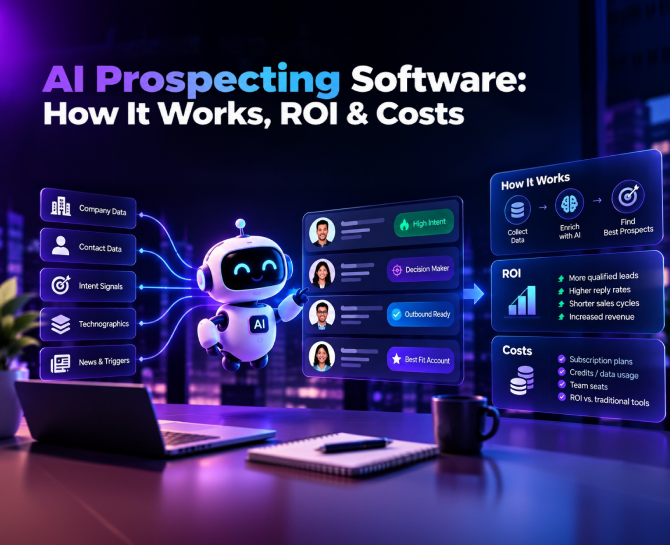
AI Prospecting Software: Everything You Need to Know
AI prospecting software uses account data, contact intelligence, buying signals, and predictive scoring to identify prospects that fit a company’s ICP and show potential buying activity. This article explains its workflow, limitations, ROI metrics, costs, evaluation criteria, and role in modern sales teams.
Your sales team can spend hours prospecting and still end up with accounts that go nowhere.
The problem is not a lack of data. Reps have access to more prospect information than ever, but finding the right accounts, identifying the right contacts, and spotting genuine buying intent can still take hours. AI prospecting software is changing how teams approach that problem.
Without the right process, sales teams often face:
- Too Many Prospects: Large databases make it easy to build lists but difficult to know who deserves attention.
- Scattered Intelligence: Account, contact, intent, and engagement data often live across different tools.
- Manual Research: Reps spend valuable selling time piecing together information before reaching out.
- Noisy Signals: A website visit, job change, or content download does not always indicate buying intent.
AI can bring these signals together, helping sales teams identify better-fit prospects, understand what is happening inside an account, and prioritize the opportunities that deserve a closer look. The shift is not simply toward more automated prospecting, but toward more informed decisions about where sales effort goes.
Key Takeaways
- AI prospecting software goes beyond finding contacts by combining ICP fit, account intelligence, buying signals, and engagement data.
- Better prospecting depends on strong data, clear targeting, relevant signals, and human judgment, not automation alone.
- AI can shift SDR and BDR time from list building toward account research, prioritization, and meaningful conversations.
- AI prospecting ROI should be measured through productivity, targeting quality, pipeline, conversion, and financial outcomes.
- The strongest AI prospecting workflows connect data, intelligence, decisions, execution, and feedback instead of treating each task separately.
What Is AI Prospecting Software?
AI prospecting software uses artificial intelligence to find, research, qualify, and prioritize potential customers for sales outreach. It analyzes account data, contact information, buying signals, and engagement activity to help sales teams identify the prospects most worth pursuing.
A traditional lead database mainly helps reps find contact records. AI prospecting software can take that data further by analyzing multiple signals and surfacing prospects based on factors such as ICP fit, recent company activity, engagement, and potential buying intent.
The category can overlap with other sales technologies, but the core purpose differs:
- Traditional Lead Databases: Help sales teams find and filter contact records.
- Sales Intelligence Platforms: Add deeper company, contact, firmographic, technographic, and intent data.
- Sales Engagement Software: Manage outreach sequences, calls, emails, and follow-ups.
- AI Sales Agents: Perform prospecting and other sales tasks with a higher level of autonomy.
- CRM-Based Lead Scoring: Rank leads or accounts using rules or predictive models within the CRM.
AI prospecting software can bring several of these capabilities together. A typical workflow starts by finding accounts that match the ICP, researching the people and companies involved, identifying relevant buying signals, prioritizing prospects, and triggering or supporting outreach.
How AI Prospecting Software Works
AI prospecting software helps B2B SaaS teams identify ideal accounts, find decision-makers, and personalize outreach at scale. It combines customer data, intent signals, and automation to help sales teams focus on prospects with stronger buying potential.
1. Defines The Ideal Customer Profile
The process starts with an ideal customer profile (ICP). Teams define it using factors such as industry, company size, revenue, location, technology stack, and growth stage.
For example, a CRM SaaS company may target mid-market technology firms with 100 to 500 employees that already use marketing automation tools.
A clear ICP gives AI the criteria it needs to find relevant accounts. It also helps distinguish ICP fit from buying readiness. An account can match your ideal customer profile without having an immediate reason to buy.
2. Finds And Enriches Prospect Data
AI tools collect data from CRMs, company websites, LinkedIn profiles, business databases, job postings, and public sources. They enrich records with details such as job titles, business emails, company size, funding, and technology usage.
This gives sales teams richer prospect data without extensive manual research.
3. Identifies Buying Signals
The software monitors activities that may indicate a potential need, such as:
- Raising new funding
- Rapidly hiring relevant teams
- Hiring a new executive
- Adopting complementary technology
- Visiting pricing or product pages
- Engaging with emails or content
A customer-support automation company, for example, may prioritize businesses rapidly expanding their support teams.
4. Scores And Prioritizes Leads
AI evaluates factors such as ICP fit, engagement, company activity, and historical conversion patterns to rank prospects. Sales teams can then focus on accounts that fit their market and show stronger buying signals.
5. Personalizes Outreach
Generative AI helps turn prospect research into personalized outreach messages. It can draft cold emails, LinkedIn messages, follow-up emails, and call scripts using details from a prospect’s role, company news, industry challenges, and prior interactions.
For example, instead of sending a generic message such as:
“Hi Sean, I would like to show you our software.”
The platform might draft:
“Hi Sean, I noticed your team is expanding its customer-support function. As you scale, keeping response times consistent can become difficult. Our platform helps support teams automate routine queries while maintaining a personalized customer experience.”
The difference is context. AI can generate the first draft quickly, but sales representatives should review it before sending, especially for high-value accounts. The best results usually come from combining AI speed with human judgment, brand knowledge, and genuine relationship-building.
6. Automates Follow-Ups And CRM Tasks
AI prospecting software can schedule follow-ups, log CRM activities, summarize calls, classify responses, and alert sales reps when intent increases.
This cuts repetitive administrative work while keeping high-potential opportunities from slipping through the cracks.
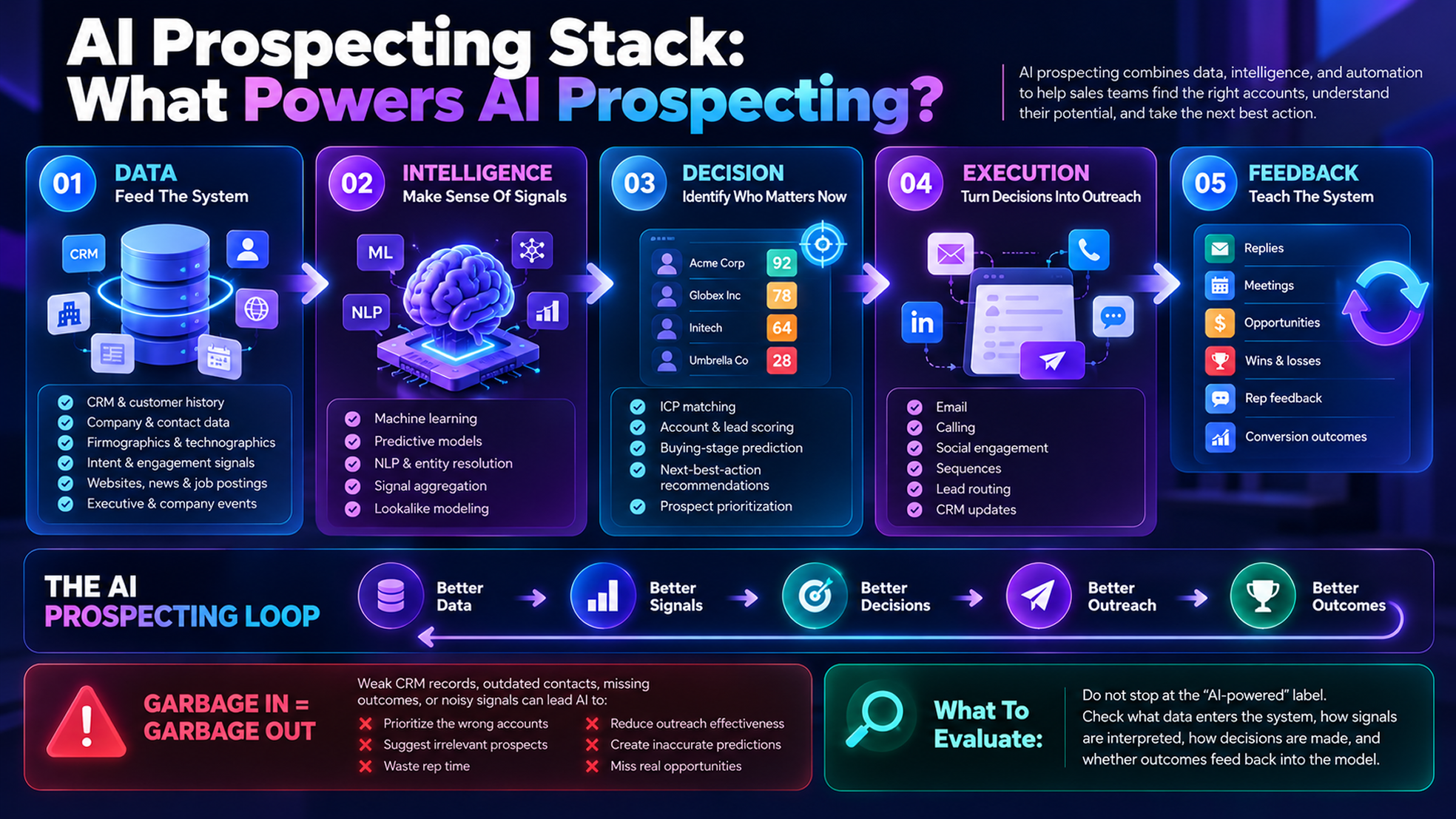
Where AI Prospecting Software Can Get It Wrong
AI can make prospecting faster, but it cannot fix weak targeting or poor data by itself. A few common gaps can quickly affect the quality of the prospects it recommends.
- Poor ICP Definitions: AI can scale an unclear targeting strategy and fill your pipeline with accounts that look relevant but are not a strong fit.
- Stale or Incorrect Data: Outdated job titles, contact details, company information, or technology data can lead to inaccurate recommendations.
- Signal Noise: Funding, hiring, website visits, or content engagement can indicate activity without indicating genuine buying intent.
- False Positives and Negatives: AI may prioritize accounts that are not ready to buy or overlook valuable prospects that do not match historical customer patterns.
- Generic AI Personalization: Adding a company name or recent event to a template is not meaningful personalization. Good messaging connects a relevant signal to a real business need.
- Over-Automation: Strategic accounts and complex deals often need human review. Automating every prospecting action can remove the context that makes outreach effective.
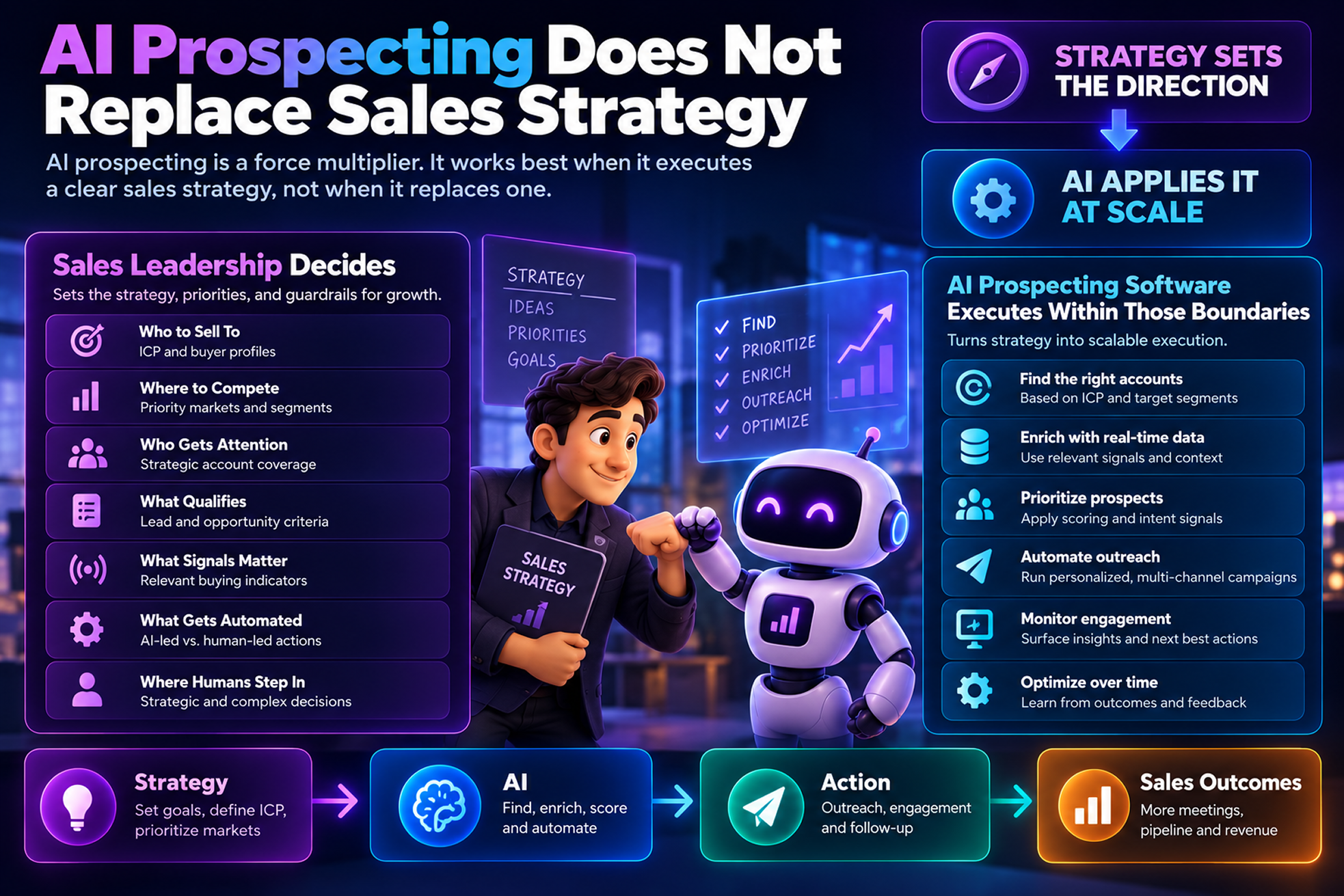
How AI Prospecting Changes the Sales Team Operating Model
AI prospecting changes more than individual sales tasks. It can shift how teams divide prospecting work, where decisions happen, and which activities require human involvement.
SDRs and BDRs: From List Building to Account Engagement
Traditional prospecting often puts SDRs on repetitive work: finding contacts, checking company information, researching accounts, and building lists.
AI can take over much of that preparation. Reps can then spend more time interpreting why an account is showing interest, choosing the right contact, and adapting outreach to the situation.
Account Executives: Better Context Before the Conversation
AEs often receive an account after much of the prospecting work has already happened. AI can package relevant account information, recent signals, previous interactions, and potential stakeholders before the AE steps in.
This can make the handoff more useful and reduce the time an AE spends rebuilding account context.
RevOps: Governing the Intelligence Layer
AI prospecting introduces new operational responsibilities for RevOps. The team needs to determine whether the data is reliable, whether scoring reflects the company’s ICP, and whether automated workflows are producing useful outcomes.
RevOps can also compare AI-driven prospecting activity with pipeline and conversion data to identify what is actually working.
Marketing: Connecting Engagement to Account Priority
Marketing teams can use engagement and intent signals to identify accounts showing increased interest. Instead of treating every target account equally, campaigns can be adjusted around accounts that are becoming more active.
This creates a stronger feedback loop between marketing engagement and sales prioritization.
Sales Leadership: Measuring Capacity, Not Just Activity
For sales leaders, the biggest change is how productivity gets measured. AI can increase the number of accounts a team can research and work, but that does not automatically mean more revenue.
Leadership should look at metrics such as qualified pipeline per rep, conversion rates, sales cycle time, and selling hours recovered through automation.
Pro Tip- Start by automating the prospecting tasks that consume the most rep time, then measure whether the saved hours translate into more high-quality conversations and qualified pipeline.
How to Measure the ROI of AI Prospecting Software
Measuring AI prospecting ROI only through reply rates or leads generated can give leadership the wrong picture. A platform may help reps contact more people without improving the quality of pipeline.
A better approach is to measure the impact across four levels:
1. Productivity Metrics
Measure whether AI is actually giving reps more selling capacity.
- Research time per account
- Accounts researched per rep
- Time spent on administrative work
- Prospects worked per rep
2. Targeting Metrics
Measure whether AI is improving the quality of prospects entering the sales process.
- ICP match rate
- High-score conversion rate
- Signal-to-opportunity rate
- False-positive rate
- False-negative rate
3. Pipeline Metrics
Measure whether better targeting translates into stronger sales outcomes.
- Meetings booked
- Meeting-to-opportunity conversion
- Pipeline generated
- Opportunity velocity
- Win rate
- Average deal value
4. Financial Metrics
Connect prospecting improvements to the economics of the sales organization.
- Pipeline generated per SDR
- Cost per qualified opportunity
- Revenue per rep
- CAC efficiency
- Technology cost per opportunity
- Total cost of ownership
Pro Tip- Do not make “emails sent” or “leads found” your headline KPI. Those numbers measure activity, not business impact. A smaller pool of well-matched prospects that generates more qualified pipeline can be far more valuable than thousands of additional contacts.
AI Prospecting Software: How to Calculate the Total Cost
A realistic evaluation should account for the technology, data, people, and operational costs required to run the prospecting workflow.
| Cost Area | What to Include | Why It Matters |
|---|---|---|
| Software | Licenses, seats, usage fees | Determines the base platform cost |
| Data | Data credits, contact data, enrichment, intent | Adds costs as prospecting volume grows |
| Existing Tools | Sales engagement, databases, intent platforms | May create overlapping subscription costs |
| Implementation | Setup, migration, integrations | Requires technical and operational resources |
| People | Training, RevOps administration, human review | AI still requires oversight and management |
| Infrastructure | Email domains, inboxes, deliverability tools | Supports automated outbound activity |
| Automation Risk | Poor targeting, inaccurate data, wasted outreach | Creates hidden productivity and pipeline costs |
A broader platform may replace several point solutions, while a specialized tool may require additional databases, enrichment providers, engagement software, and integrations. Comparing the total technology and operating cost gives leadership a more realistic view of the investment.

Where ReachGen Fits Into the AI Prospecting Workflow
https://diggrowth.com/wp-content/uploads/2026/04/Banner-Video-Reachgen.mp4
A common problem with modern prospecting is fragmentation. One tool finds accounts, another enriches contacts, another surfaces intent, and a separate platform handles outreach. Reps then have to connect those pieces before they can act.
ReachGen approaches this workflow through an AI agent model. Instead of treating prospecting as a series of disconnected tasks, the agent can work through multiple steps using the targeting criteria and context provided by the sales team.
The workflow can look like this:
The ReachGen Workflow
Set the Target
↓
Find the Right Accounts
↓
Find the Right People
↓
Build the Reason to Reach Out
↓
Take the Next Action
↓
Feed Outcomes Back
Here is where ReachGen fits into that process:
- Start With the ICP: The team defines the type of company and buyer it wants to target.
- Find Relevant Prospects: The AI agent identifies accounts and contacts that align with those criteria.
- Build Context: It gathers relevant information about the prospect and company rather than relying on a contact record alone.
- Identify the Reason to Engage: Signals and account context can inform why a prospect may be worth contacting.
- Support Outreach: The agent can use that context to move prospects into relevant outreach workflows.
- Keep Humans in the Loop: Sales teams can review recommendations, refine targeting, and apply judgment where account complexity or deal value warrants it.
AI prospecting is moving beyond individual tasks such as finding an email address or generating a message. Agents like ReachGen can connect discovery, research, prioritization, and outreach into a more continuous workflow, while sales teams remain responsible for the strategy and decisions that require human judgment.
What the Future of AI Prospecting Looks Like
The next phase of AI prospecting is less about generating more activity and more about improving the decisions behind that activity. The shift is already moving the category beyond static databases and basic AI-assisted tasks.
From Lead Lists to Dynamic Buying Maps
Prospecting will increasingly move beyond individual contact records. AI can connect accounts, buying groups, relationships, intent signals, and timing to create a more complete picture of where an opportunity may be developing.
From Personalization to Contextual Decisioning
Generating a unique email for every prospect will become less of a differentiator. The bigger advantage will be deciding who deserves attention, why now, and what should happen next based on the context around the account.
From Copilots to Controlled Autonomy
AI will take on more prospecting actions, but companies will need clear boundaries. Teams can define which actions AI can recommend, which require approval, and which can be executed automatically.
From Isolated Tools to Connected Agents
AI prospecting will increasingly connect with CRM, enrichment, intent, analytics, and sales engagement systems. Instead of moving information manually between tools, agents can coordinate tasks across the existing revenue stack.
From Activity Metrics to Revenue Outcomes
The focus will shift away from measuring emails sent, contacts found, or tasks completed. Sales leaders will increasingly evaluate incremental pipeline, conversion quality, rep capacity, opportunity velocity, and revenue efficiency.
Conclusion
AI prospecting is becoming less about finding more people and more about knowing where sales attention deserves to go. The real advantage comes from connecting reliable data with meaningful signals, sound sales strategy, and actions that move opportunities forward.
For revenue teams, that makes the buying decision bigger than comparing features or counting automated tasks. The right platform should fit the way your team sells, improve the quality of decisions, and create measurable gains in pipeline efficiency without removing the judgment that complex sales still require.
The next step is to assess where your current prospecting process loses time, context, or opportunity, then determine where AI can make a measurable difference.
Ready to Get Started? Talk to Us!
See what smarter prospecting can look like with DiGGrowth. Get a free demo or email info@diggrowth.com.
Ready to get started?
Increase your marketing ROI by 30% with custom dashboards & reports that present a clear picture of marketing effectiveness
Start Free Trial
Experience Premium Marketing Analytics At Budget-Friendly Pricing.

Learn how you can accurately measure return on marketing investment.
You’re Targeting Your Ideal Customer. So Why Aren’t They Buying?
Your best customers reveal the traits associated with success. Your lost opportunities reveal where fit breaks...
Read full post post
How Predictive AI Will Transform Paid Media Strategy in 2026
Paid media isn’t a channel game anymore, it’s a chessboard. Search, social, programmatic, video, influencer, native,...
Read full post post
Don’t Let AI Break Your Brand: What Every CMO Should Know
AI isn’t just another marketing tool. It’s changing how we connect with customers, personalize content, and...
Read full post post