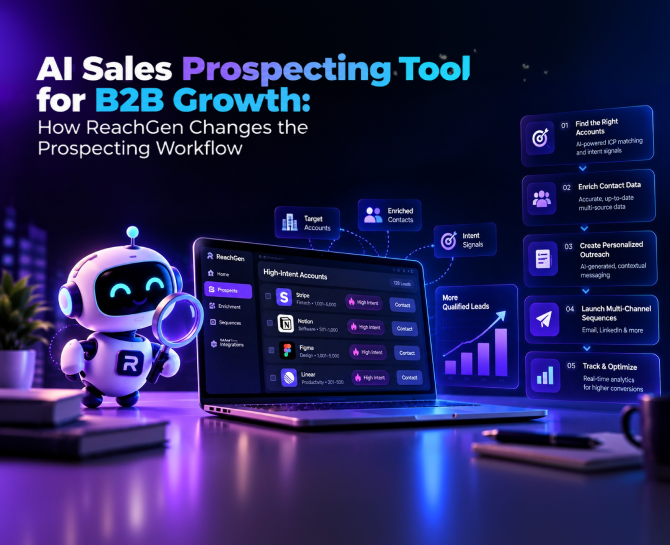
AI Sales Prospecting Tool for B2B Growth: How ReachGen Changes the Prospecting Workflow
B2B sales teams need more than large contact databases. An AI sales prospecting tool can help teams identify better-fit accounts, prioritize sales attention, and connect account intelligence with outreach. This blog explains how ReachGen approaches that process for more focused B2B growth.
Your sales team probably does not need another database.
It needs a better answer to a much harder question:
Which accounts deserve the team’s attention right now?
That question becomes surprisingly difficult when the addressable market contains thousands or millions of companies. A CRM may contain years of customer information. A sales intelligence platform may contain millions of contacts. Marketing may have intent signals. RevOps may have firmographic and technographic data. Yet sales representatives can still spend hours figuring out which accounts to research and who to contact.
The problem is no longer access to data.
It is turning scattered data into a confident prospecting decision.
An AI sales prospecting tool can address this problem by analyzing account and contact information, identifying companies that fit a target market, enriching prospect records, finding relevant decision-makers, and helping sales teams prioritize their attention.
ReachGen takes this concept further by combining ICP-based account discovery, enrichment, dynamic segmentation, account intelligence, contact identification, and AI-assisted personalized outreach. It also connects with Salesforce and HubSpot so prospect information can move into the systems sales teams already use.
But the interesting question is not whether AI can find another contact.
What happens when AI changes the quality of the decisions made before a salesperson ever sends an email?
That is where the real B2B growth opportunity begins.
Key Takeaways
- An AI sales prospecting tool should improve account selection, prioritization, and sales decisions, not just generate more contacts.
- Better account selection helps sales teams focus limited capacity on prospects with stronger commercial potential.
- ReachGen connects ICP-based discovery, enrichment, segmentation, account intelligence, stakeholder identification, and personalized outreach.
- AI can reduce manual prospecting work while keeping human judgment involved in ICP governance, opportunity validation, and strategic messaging.
- The real measure of AI prospecting is its impact on qualified opportunities, sales efficiency, and pipeline growth.
What Is AI Sales Prospecting?
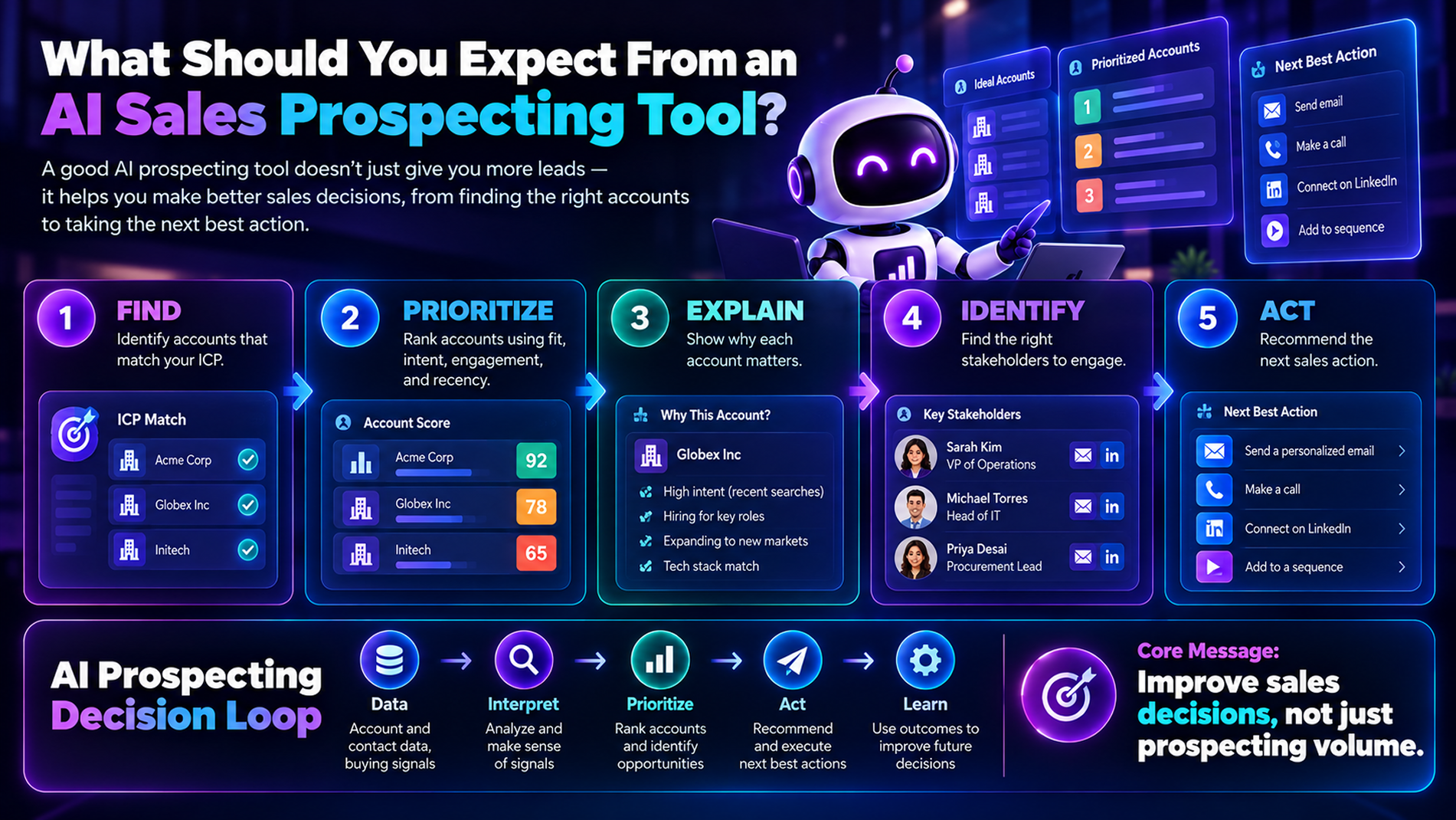
AI sales prospecting is not simply a faster way to build a contact list. It uses account, contact, and behavioral data to help sales teams identify which companies fit their target market, which people matter inside those accounts, and which prospects deserve attention.
Traditional prospecting often leaves reps to piece this information together themselves. AI can bring these signals together, helping teams move from searching through accounts to deciding which accounts are worth pursuing.
That distinction matters because the value of AI sales prospecting is not the number of records it can produce. It is the quality of the sales decisions those records can support.
Why Better Account Selection Matters
A large prospect list does not tell sales where to focus. It only shows what is available.
The real challenge is narrowing that market to accounts that have a strong fit with the company, relevant business conditions, and a reason to engage. Without that filtering, sales representatives can spend hours researching companies that were never strong opportunities to begin with.
As the number of potential accounts grows, this becomes a capacity problem. A team cannot give the same level of attention to every company, so better account selection becomes the foundation for better sales prioritization.
This is where an AI sales prospecting tool can add value. Instead of simply finding more contacts, it can evaluate account characteristics, enrich available data, identify relevant stakeholders, and surface the signals that indicate which accounts deserve closer attention.
For example, a market with 50,000 potential companies may contain only a few thousand that closely match the ICP. An even smaller group may show the intent, engagement, or business conditions that justify immediate sales attention.
The objective is therefore not to create the biggest prospect list.
It gives sales teams a more informed starting point.
That shift changes prospecting from a volume exercise into a process of identifying which accounts are worth the time, research, and outreach required to create pipeline.
The Biggest Mistake: Treating AI Prospecting as a Lead Generation Project
Many organizations evaluate AI prospecting with questions such as:
- How many leads can it generate?
- How quickly can it build lists?
- How many emails can it personalize?
- How much research can it automate?
Those questions are useful at an operational level.
They are incomplete at an executive level.
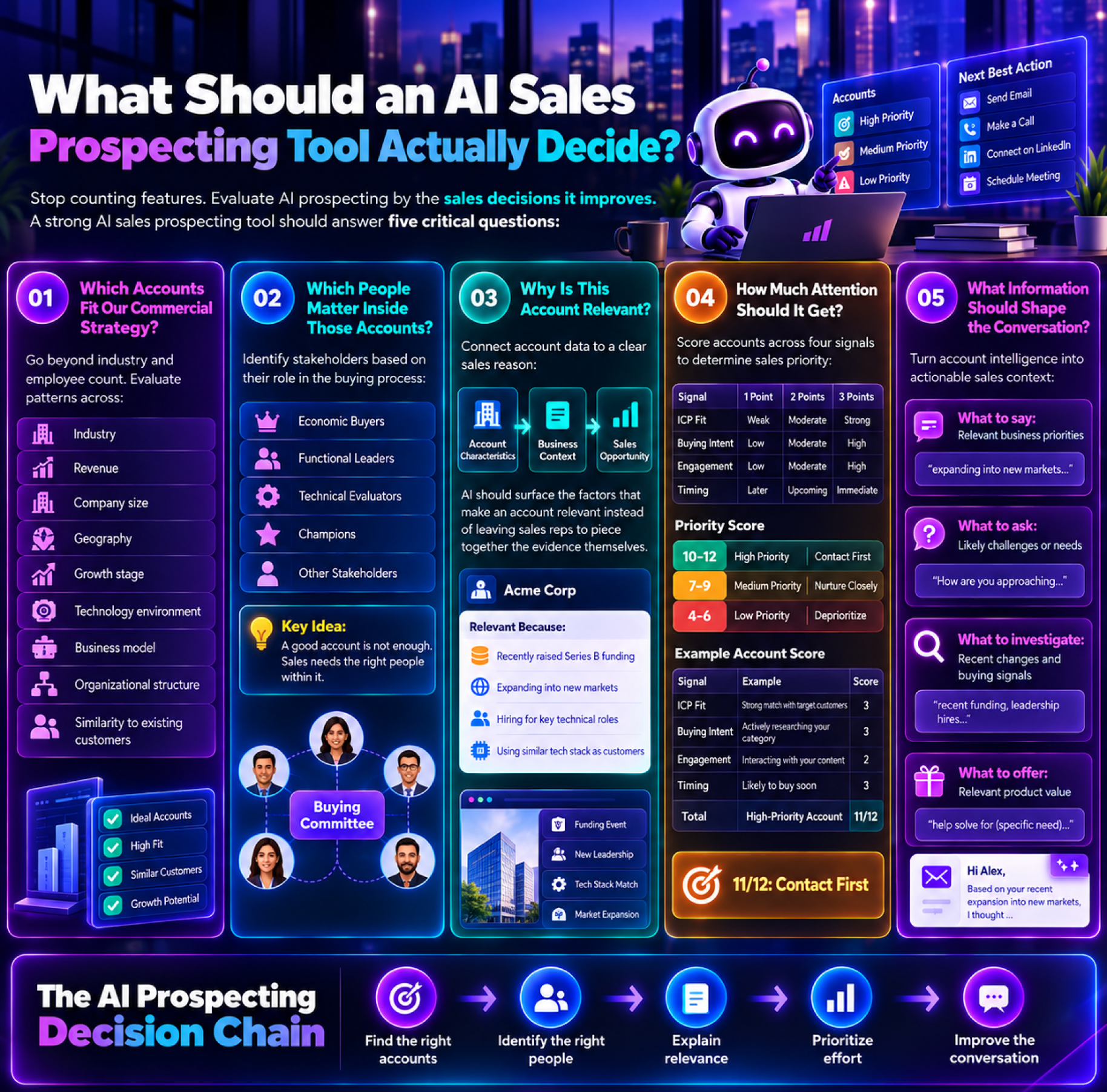
A leadership team should also ask:
- Are we targeting the right accounts?
- Are our salespeople spending time on the right opportunities?
- Can the system explain why an account was prioritized?
- Are the signals timely enough to influence sales action?
- Are reps accepting or rejecting the recommendations?
- Are prioritized accounts producing more qualified meetings?
- Are those meetings producing pipeline?
- Are the results improving our understanding of the ICP?
This reframes AI prospecting from an activity-generation project into a decision-quality project.
That distinction is critical.
Generating more sales activity is not necessarily growth.
Generating better sales decisions can create the conditions for growth.
Pro Tip: AI can scale poor targeting just as efficiently as good targeting. Before increasing automation, validate the ICP, priority signals, qualification criteria, and desired sales outcomes.
How ReachGen Changes the B2B Prospecting Workflow
Traditional prospecting often requires sales teams to move between multiple sources to find accounts, research companies, identify contacts, understand buying context, and prepare outreach. ReachGen brings these activities together around the target account, so sales teams can spend less time assembling prospect information and more time evaluating where to focus.
1. Start With the ICP
ReachGen starts prospecting with the characteristics that define a valuable customer. Sales teams can use ICP criteria to identify accounts that fit their target market instead of beginning with a broad contact database.
This creates a more focused pool of companies for sales teams to evaluate and prioritize.
2. Enrich Accounts With Relevant Data
An ICP match is only the starting point. Sales teams need enough information to understand whether an account is genuinely worth pursuing.
ReachGen enriches account records with relevant firmographic, technographic, and other company information. This gives sales representatives more context for evaluating an account without having to gather basic information manually from multiple sources.
3. Segment Accounts by Relevance
Not every account that matches the ICP deserves the same level of sales attention.
ReachGen can segment accounts based on characteristics and signals that matter to the sales strategy. This helps separate accounts that warrant immediate attention from those that may be better suited for continued nurturing or lower-priority outreach.
4. Identify the Right Stakeholders
Finding the right company is only half the prospecting challenge. Sales also needs to know who inside that company is relevant to the purchase.
ReachGen helps identify contacts based on their roles and potential involvement in the buying process, including decision-makers, functional leaders, technical evaluators, and other stakeholders.
5. Add Account Intelligence
Contact information alone does not explain why a company should be contacted.
ReachGen adds account-level context that can help sales representatives understand what is happening within a target company and why it may be relevant. This gives reps a stronger basis for deciding whether an account deserves attention and what they should investigate before reaching out.
6. Support Personalized Outreach
Personalization becomes more useful when it is based on actual account context.
ReachGen can use the information gathered during prospecting to support AI-assisted outreach that reflects the account, its potential priorities, and the reason for engagement. This moves personalization beyond simply inserting a prospect’s name or job title into an email.
7. Connect Prospecting Data With the CRM
Prospecting should not end with information sitting in a separate tool or spreadsheet.
ReachGen integrates with Salesforce and HubSpot, allowing relevant prospect and account information to move into the systems sales teams already use. This connects prospect discovery with the rest of the sales process and reduces the need to manually transfer information between systems.
Takeaway: The difference is that ReachGen does not treat prospecting as simply finding more contacts. It connects account selection, enrichment, segmentation, stakeholder identification, intelligence, and outreach so sales teams can make better decisions about where to spend their attention.
Example: How a B2B SaaS Company Could Use ReachGen
Imagine a B2B SaaS company selling sales intelligence software to mid-market and enterprise revenue teams.
The company has:
- A clearly defined ICP
- Several thousand accounts in its total addressable market
- A sales development team
- A CRM containing historical account and opportunity data
- Multiple sources of prospect and company information
- Limited rep capacity for manual research
The sales team currently follows a familiar process.
A manager provides a target account list.
Reps research companies individually.
They check company size, industry, technology, leadership, recent activity, and relevant contacts. They then decide whether the account is worth pursuing and begin researching the right message.
The problem is that the team spends too much time converting data into decisions.
Before ReachGen
A rep might spend significant time:
- Finding a target company
- Checking whether it fits the ICP
- Researching recent company activity
- Finding relevant stakeholders
- Checking available signals
- Determining whether timing appears favorable
- Preparing outreach context
- Entering the information into the sales workflow
Multiply that process across hundreds of accounts and the research burden becomes substantial.
With ReachGen
The team can begin with its ICP and use ReachGen to identify relevant accounts, build prospect context, surface useful signals, and prioritize prospects for sales attention.
Instead of starting with:
- Company name
- Job title
- Contact details
the rep can start with:
- Account fit
- Relevant context
- Key stakeholders
- Prioritization reasons
That changes the role of the salesperson.
The rep is no longer spending the majority of the preparation stage assembling basic intelligence. The rep can spend more time deciding whether the opportunity is commercially meaningful and determining how to approach the account.
What Leadership Should Look For
The executive question is not:
“How many accounts did ReachGen find?”
It is:
“ Did ReachGen improve opportunity quality while helping the team use its limited sales resources more effectively?“
That is the measurement standard that matters.
Where Human Judgment Still Matters
AI can process information at a scale that individual sales representatives cannot match. It does not mean every prospecting decision should become fully autonomous. Some decisions require commercial judgment.
ICP Governance
Sales and marketing leaders should define what makes an account strategically valuable.
AI can operationalize those criteria, but the organization needs to own the criteria themselves.
Opportunity Validation
AI can identify evidence that an account may be relevant. Sales professionals still need to validate whether the business problem, buying environment, and commercial circumstances make sense.
Strategic Messaging
AI can provide context for personalization, but strategic accounts may require messaging that reflects relationship history, competitive dynamics, or broader business priorities.
Exception Handling
Large enterprise accounts, complex organizational structures, new markets, and unusual buying patterns may not fit neatly into standard prospecting rules.
Feedback
Sales teams should continuously review which recommendations turn into meaningful opportunities and which do not.
Human oversight is therefore not the opposite of AI-driven prospecting.
It is part of a well-designed AI prospecting system.
Conclusion
The value of AI prospecting becomes clearer when sales teams stop treating data as the end goal. The real opportunity is using that data to make sharper decisions about where sales attention should go and which accounts deserve a serious conversation.
For growing B2B companies, this shift can change how sales capacity is used. The better question is not how many prospects a system can produce, but whether it helps the team focus on accounts with genuine commercial potential.
ReachGen brings account intelligence, prospect context, and sales action closer together, giving teams a more informed way to decide where their effort belongs.
Put better prospecting decisions into action with ReachGen.
Ready to get started?
Increase your marketing ROI by 30% with custom dashboards & reports that present a clear picture of marketing effectiveness
Start Free Trial
Experience Premium Marketing Analytics At Budget-Friendly Pricing.

Learn how you can accurately measure return on marketing investment.
You’re Targeting Your Ideal Customer. So Why Aren’t They Buying?
Your best customers reveal the traits associated with success. Your lost opportunities reveal where fit breaks...
Read full post post
How Predictive AI Will Transform Paid Media Strategy in 2026
Paid media isn’t a channel game anymore, it’s a chessboard. Search, social, programmatic, video, influencer, native,...
Read full post post
Don’t Let AI Break Your Brand: What Every CMO Should Know
AI isn’t just another marketing tool. It’s changing how we connect with customers, personalize content, and...
Read full post post