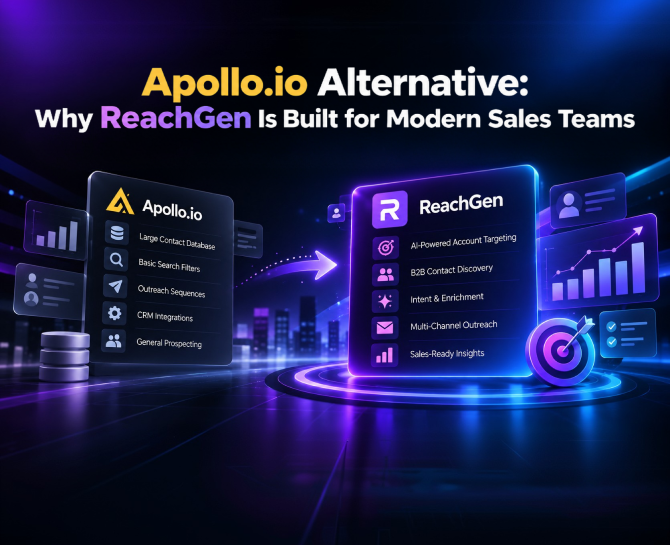
Apollo.io Alternative: Why ReachGen Is Built for Modern Sales Teams
Apollo and ReachGen take different approaches to prospecting. This guide breaks down their workflows, from finding and qualifying accounts to enriching contacts, verifying data, researching prospects, and engaging buyers, so you can choose the platform that fits your sales process.
Key Takeaways
- Apollo is a strong choice for teams that want broad prospect discovery and sales engagement in one platform.
- ReachGen takes a more ICP-driven approach to account discovery, enrichment, verification, segmentation, and prospect intelligence.
- The right choice depends on where your sales team has the most friction.
- Database size alone does not tell you whether a prospecting platform is right for your team.
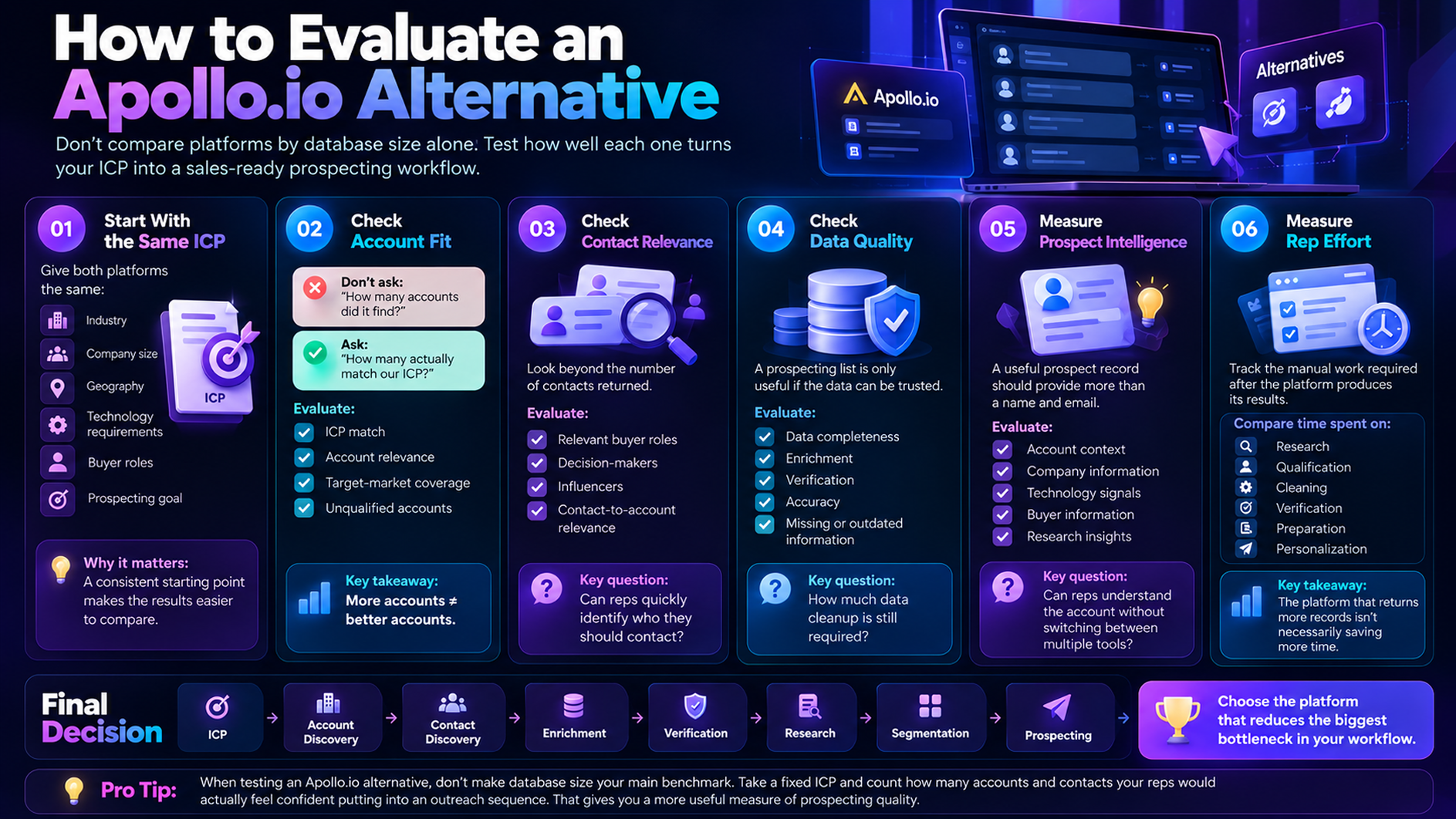
- A fair comparison starts with the same ICP, prospecting brief, and expected output on both platforms.
If you are looking for an Apollo.io alternative, the real question is not whether another platform has more contacts. It is whether it can help your team find the right accounts and buyers faster, with enough context to act on them confidently.
Apollo is built around a broad prospecting workflow that combines B2B data, contact discovery, intent signals, AI capabilities, and sales engagement. ReachGen takes a more account-focused approach, bringing together ICP targeting, account and contact discovery, enrichment, verification, segmentation, account intelligence, and personalized outreach.
The difference matters when your team is struggling with a specific part of the prospecting process. You may need stronger ICP-based account discovery, more reliable prospect data, better account context, or a workflow that connects research and outreach more closely.
This comparison breaks down Apollo vs ReachGen across those core capabilities, including what each platform does best, where their workflows differ, and which one may be a better fit for your sales process.
Apollo.io Alternative: Why are Sales Teams Looking Beyond Apollo?
Apollo gives sales teams broad access to prospect and company data. That can be useful when the goal is to find potential buyers and move them into an outbound workflow. The challenge is different for teams with a narrowly defined ICP. They need to reduce a large prospect universe to accounts that are actually worth pursuing.
More Prospect Data Does Not Always Mean Better Prospecting
A large database tells you which companies and contacts exist. It does not automatically tell you which ones deserve a sales rep’s attention.
Consider a B2B SaaS company targeting US businesses with 200–2,000 employees, a specific technology stack, and particular buyer roles. A broad search may still return a long list. The team then has to determine:
- Which accounts actually fit the ICP?
- Which contacts are relevant?
- Whether the data is complete?
- Which accounts deserve priority?
- What additional research is needed?
That creates familiar problems: irrelevant accounts, manual qualification, list cleaning, research-heavy workflows, and low-confidence outreach lists. The real issue is not access to data. It is turning that data into a prospect list that sales reps can trust.
What Sales Teams May Want From an Apollo.io Alternative
Teams may evaluate alternatives when they need:
- More precise ICP targeting
- Better account discovery
- Contact discovery within relevant accounts
- Data enrichment and verification
- Account and prospect context
- Segmentation
- Prospect research
- More focused prospecting workflows
These needs also provide a useful framework for comparing Apollo with other prospecting platforms. For example, ReachGen puts greater emphasis on connecting ICP discovery with account and contact enrichment, verification, segmentation, account intelligence, and personalized outreach. Looking at these capabilities side by side helps clarify whether its more account-focused workflow addresses the gaps a team is trying to solve.
What Should an Apollo.io Alternative Offer?
A strong Apollo.io alternative should do more than provide a large database of contacts. It should help your sales team identify the right accounts, find relevant buyers, validate the data, and build enough context to support effective outreach.
ICP and Account Targeting
Start with the account. A useful platform should help translate criteria such as industry, company size, geography, technology usage, and business characteristics into practical targeting criteria.
The key question is simple: can the platform help your team find companies that resemble your best customers?
Account and Contact Discovery
Finding the right account and finding the right person within that account are separate tasks.
The workflow should support both:
Account discovery → Contact discovery
This keeps reps from building a large contact list first and then spending time qualifying the companies behind those contacts.
Data Enrichment and Verification
Look at how the platform handles missing or incomplete information.
Important considerations include:
- Company details
- Contact details
- Firmographic information
- Technographic information
- Data completeness
- Verification
The less time reps spend cleaning and checking lists, the more time they can spend on actual selling activities.
Prospect and Account Intelligence
Contact information rarely gives a rep enough context to write a useful message.
Sales teams may need to understand the company, the buyer, relevant business information, and why the account could be worth contacting. That context can help reps move beyond generic outreach and make better decisions about where to spend their time.
Segmentation and Prioritization
Not every ICP-fit account deserves the same treatment.
Teams may want to segment accounts by industry, company size, technology, buyer role, territory, or sales priority. The point is not to create more categories. It is to create smaller, more useful prospecting groups that reps can act on.
Outreach and Sales Activation
Prospecting intelligence eventually needs to support action. The platform should help teams build focused lists, prepare for outreach, personalize messaging, and move qualified prospects into the next stage of the sales workflow.
Apollo is particularly strong on this side of the process, with sequences, email, calling, LinkedIn tasks, and other sales engagement capabilities.
Where Does Apollo.io Fall Short for ICP-Driven Prospecting?
Apollo is not simply a database. Its platform combines prospect and account search, enrichment, buying intent, lead scoring, AI capabilities, and sales engagement.
The question is not whether Apollo has useful prospecting capabilities. It does. The question is whether its broad approach matches the specific problem your sales team is trying to solve.
Apollo’s Strength is Broad Prospecting and Sales Engagement
Apollo is built to help teams find and engage prospects at scale.
Its capabilities include:
- B2B contact and account discovery
- Search and filtering
- Data enrichment
- Buying intent
- Lead scoring
- AI-assisted research
- Multichannel sales engagement
For teams that want prospecting and engagement closely connected, this can be a major advantage.
Broad Prospecting Can Still Leave Qualification Work to the Team
A broad prospect universe still needs to be narrowed down.
Sales teams may need to determine:
- Which accounts fit the ICP
- Which accounts deserve attention first
- Which contacts matter
- What research is relevant
- Whether the available data is sufficient
Apollo provides tools that support these activities. However, teams that want an account-first, ICP-driven workflow may prefer a platform built around that specific requirement.
When Apollo May Not Be the Best Fit
Apollo may be less aligned with teams whose primary requirement is:
- Highly focused account discovery
- ICP-first targeting
- Deep account qualification
- Verified prospect data
- Contextual prospect research
- A focused account-to-prospect workflow
That does not make Apollo a bad choice. It means its broad prospecting and engagement model may not match every team’s priorities.
How Does ReachGen Approach Prospecting Differently?
ReachGen starts with the account rather than the contact list. Its workflow connects ICP discovery with enrichment, verification, segmentation, account intelligence, and personalized outreach.
Start With the ICP, Not the Contact List
The starting question changes from:
“Which contacts can we reach?”
to:
“Which companies fit our ICP, and which people should we contact?”
That puts the ICP directly into the prospecting process instead of leaving it as a separate strategy document.
Discover Relevant Accounts
ReachGen’s ICP discovery capability is designed to surface high-fit accounts and decision-makers based on defined criteria.
This gives teams a more focused starting point before they begin evaluating individual contacts.
Find and Enrich Relevant Contacts
Once relevant accounts are identified, teams can find the people who matter within them.
ReachGen enriches records with information such as job title, company size, funding status, and technology stack.
Verify Data Before Outreach
Targeted prospecting only works when the underlying data can be trusted.
ReachGen says its enriched records are continuously validated through real-time checks across verified sources. This can reduce the amount of manual checking required before outreach.
Add Context Before Prospecting
A rep needs more than a name and job title.
They may also need to understand:
- What the company does
- Why it could be a fit
- Who the buyer is
- What business context could make outreach relevant
ReachGen’s DiGGi-GPT is designed to turn enriched account information into insights and context-aware messaging.
Segment and Prepare Accounts for Targeted Outreach
Teams can organize accounts into dynamic groups based on criteria such as industry, company size, and technology stack.
That makes it easier to build focused campaigns instead of treating every prospect the same way.
Apollo vs ReachGen: What is the Core Difference?
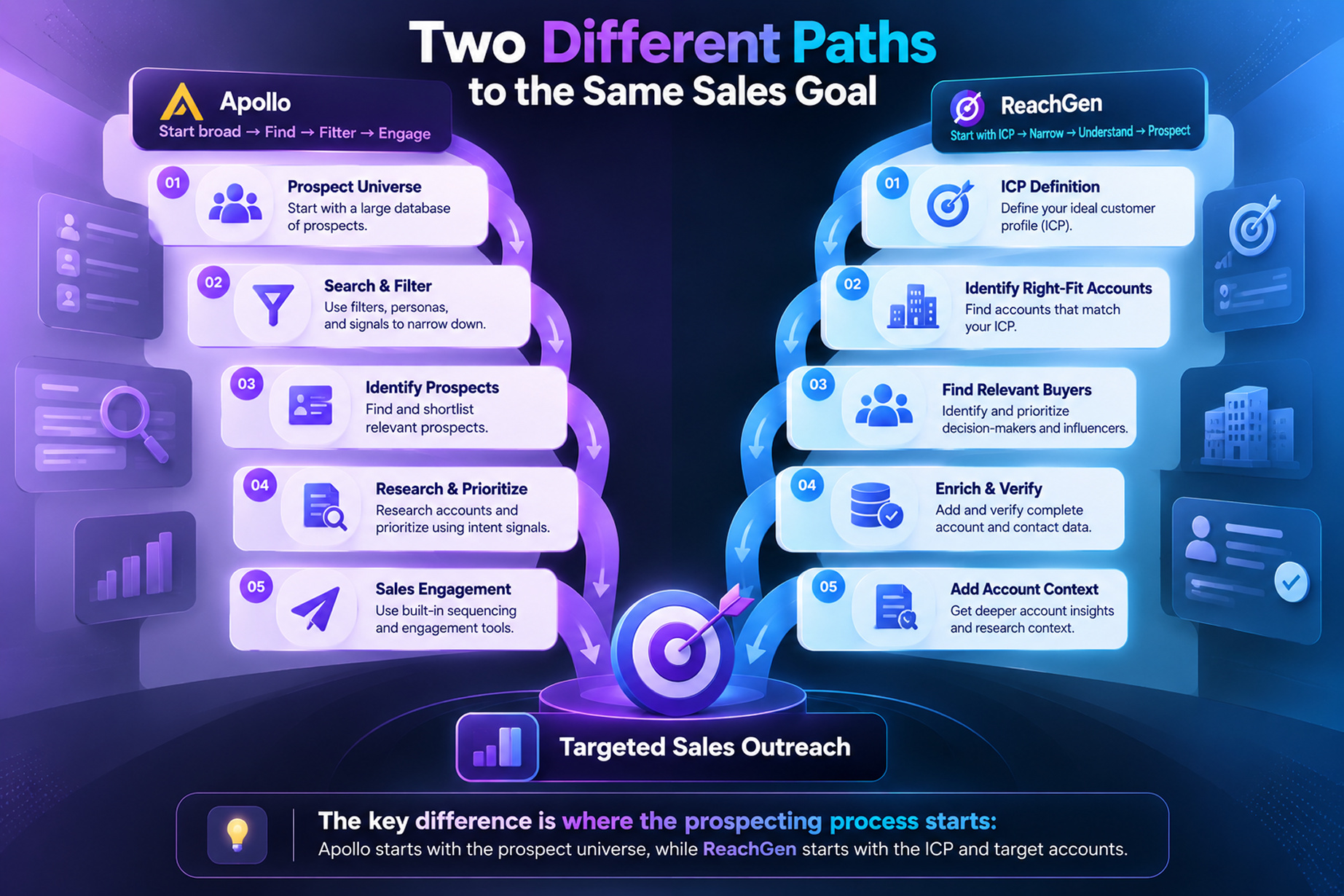
The two platforms overlap in several areas, but their emphasis is different. Apollo combines prospecting data with intelligence and sales engagement, while ReachGen puts greater emphasis on ICP-driven account discovery and the intelligence work that happens before targeted prospecting.
Apollo at a Glance
Apollo focuses on:
- Broad B2B prospect and contact discovery
- Search and filtering
- Data enrichment
- Buying intent
- Lead scoring
- AI-assisted research
- Sales engagement
ReachGen at a Glance
ReachGen focuses on:
- ICP-driven account discovery
- Contact discovery
- Account and contact enrichment
- Data verification
- Segmentation
- Account intelligence
- Prospect research
- Personalized outreach
The Difference in One Sentence
Apollo is built for teams that want broad prospecting and sales engagement, while ReachGen is built for teams that want to identify and understand the right-fit accounts and prospects before outreach.
Quick Comparison
| Criteria | ReachGen | Apollo |
|---|---|---|
| Core focus | ICP-driven prospect intelligence | Prospecting and sales engagement |
| Primary strength | Finding and qualifying relevant prospects | Finding and engaging prospects at scale |
| Account targeting | ICP-driven | Search and filter driven |
| Data workflow | Discovery → enrichment → verification → research | Discovery → enrichment → engagement |
| Best suited for | Focused account targeting | Broad outbound prospecting |
ReachGen vs Apollo: What Does This Look Like in Practice?
A practical example makes the difference easier to see. Consider a B2B SaaS company that wants to sell to mid-market businesses in a specific industry and needs both the right accounts and the right buyers.
The Scenario: Finding Prospects for a B2B SaaS Company
The company’s ICP looks like this:
- Company size: 200–2,000 employees
- Industry: A specific vertical
- Geography: North America
- Technology: Uses selected technologies
- Buyer roles: VP Marketing, RevOps, or similar leaders
- Goal: Build a focused outbound account list
How ReachGen Could Support the Use Case
The workflow could look like:
ICP → Account Discovery → Contact Discovery → Enrichment → Verification → Segmentation → Research → Targeted Prospecting
The team can identify relevant accounts, find buyers, enrich records, verify data, segment accounts, and research prospects before preparing outreach.
How Apollo Could Support the Same Use Case
The workflow could look like:
Database Search → Filtering → Contact Discovery → Research/Intent → Outreach
The team can search for companies and contacts, apply filters, research prospects, use buying intent where relevant, create lists, and move prospects into outbound engagement.
What the Example Tells You
The practical distinction is:
Account precision and focused prospecting → ReachGen
Broad prospecting and engagement at scale → Apollo
Is ReachGen the Right Apollo.io Alternative for Your Team?
If your main prospecting challenge is not finding more contacts but finding better-fit accounts and the right buyers within them, ReachGen can be a stronger alternative to Apollo.
Choose ReachGen If Your Priority Is:
- ICP-based account discovery
- Focused prospect targeting
- Contact discovery within relevant accounts
- Account and prospect enrichment
- Data verification
- Dynamic account segmentation
- Contextual prospect research
- Personalized prospecting
ReachGen is particularly suited to teams with complex ICPs that need to move from ICP definition → account discovery → contact discovery → enrichment → verification → segmentation → outreach in a more connected workflow.
Why ReachGen May Be the Better Fit
Apollo is built for broad prospecting and sales engagement. ReachGen is more focused on helping teams identify which accounts to pursue, which buyers matter, and what context reps need before outreach.
If your reps spend too much time filtering accounts, validating data, researching prospects, or building usable target lists, ReachGen’s account intelligence and ICP-driven approach can reduce that manual work.
For teams prioritizing precision over prospect volume, ReachGen offers a more focused path from target-market definition to actionable prospecting.
Why Is ReachGen Built for the Next Stage of B2B Prospecting?
B2B prospecting is moving beyond the question of “How many contacts can we find?” Sales teams increasingly need to know which accounts deserve attention, which buyers are relevant, and what information can help reps act on that insight.
That shift moves prospecting from static contact databases toward account prioritization, usable intelligence, AI-assisted research, and more targeted workflows.
From Contact Volume to Account Prioritization
A large contact database can give reps plenty of options without helping them decide where to focus. When every account requires manual qualification, more data can actually increase the workload.
Modern prospecting puts greater emphasis on:
- ICP fit and account quality
- Account prioritization
- Relevant buyer identification
- Data confidence
- Actionable account context
The goal is to help reps spend more time on accounts with a genuine reason to engage.
From Static Data to Usable Intelligence
Knowing that a company or contact exists is only the starting point. Sales teams need context that helps them understand why an account matters and what to do next.
This is where prospect intelligence, enrichment, and AI-assisted research become valuable. Instead of manually piecing together information from multiple sources, reps can use richer account and prospect context to prepare for outreach.
From ICP Strategy to Targeted Workflows
An ICP becomes more valuable when it directly shapes daily prospecting:
ICP → Account Prioritization → Contact Discovery → Enrichment → Verification → AI-Assisted Research → Targeted Outreach
This creates a more focused workflow where intelligence supports action instead of sitting in a strategy document.
Conclusion: Choosing the Right Apollo.io Alternative
Choosing an Apollo.io alternative should come down to the kind of prospecting workflow your sales team needs, not simply the number of contacts or features a platform offers.
Apollo is a broad prospecting and sales engagement platform. ReachGen takes a more focused approach to ICP-driven prospecting, helping teams identify the right accounts, discover relevant buyers, enrich and verify data, and build the context reps need before outreach.
That makes ReachGen particularly relevant for teams that want to move beyond contact volume and make account fit, prospect intelligence, and targeted prospecting a bigger part of their sales process.
If your team is spending too much time finding the right accounts, validating prospects, or researching buyers, ReachGen can help create a more focused path from ICP to actionable outreach.
If that is the gap you are trying to solve, explore ReachGen or contact info@diggrowth.com to discuss your prospecting requirements.
Ready to get started?
Increase your marketing ROI by 30% with custom dashboards & reports that present a clear picture of marketing effectiveness
Start Free Trial
Experience Premium Marketing Analytics At Budget-Friendly Pricing.

Learn how you can accurately measure return on marketing investment.
Lookalike Account Modeling for B2B Revenue Teams
Lookalike account modeling takes a different approach. It studies the attributes and outcomes of successful customers,...
Read full post post
You’re Targeting Your Ideal Customer. So Why Aren’t They Buying?
Your best customers reveal the traits associated with success. Your lost opportunities reveal where fit breaks...
Read full post post
How Predictive AI Will Transform Paid Media Strategy in 2026
Paid media isn’t a channel game anymore, it’s a chessboard. Search, social, programmatic, video, influencer, native,...
Read full post postFAQ's
Common reasons include poor account fit, data quality concerns, manual qualification, research-heavy prospecting, and a need for more precise ICP targeting. The first step is to identify which part of the current workflow is creating the most friction.
Look at your ICP complexity, prospecting volume, data requirements, research needs, sales engagement requirements, existing GTM stack, and the amount of manual work reps currently perform.
ReachGen's ICP discovery capability is designed to surface high-fit accounts and decision-makers based on defined criteria. It also connects account discovery with enrichment and segmentation. This gives teams a path from ICP definition to target-account discovery rather than starting with a broad contact list.
The workflow connects account discovery, enrichment, verification, segmentation, research, and prospecting. DiGGi-GPT can also surface account insights and create context-aware messages from enriched information.
ReachGen fits into the account intelligence and prospecting layer of the GTM stack. It supports account discovery, enrichment, verification, segmentation, research, and personalized outreach, with native Salesforce and HubSpot integrations.