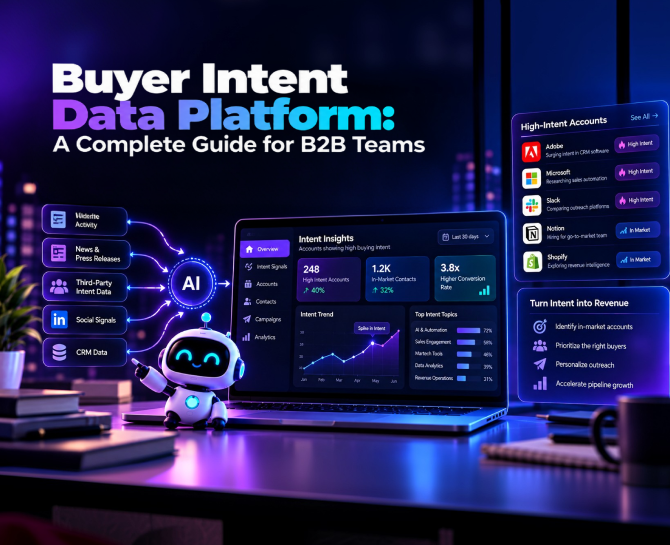
Buyer Intent Data Platform: How it Works and How to Evaluate It
Buyer intent data platforms analyze research behavior to identify B2B accounts exploring relevant topics. Read the blog to learn how intent signals are collected, scored, validated, and activated, along with the limitations and evaluation criteria that matter when selecting a platform.
Two B2B companies can match your ideal customer profile (ICP) equally well, yet show very different levels of interest in your product category. One may have no recent engagement, while the other is researching relevant software, comparing vendors, or investigating implementation options.
Buyer intent data platforms analyze these behavioral signals to identify accounts that may warrant closer attention. Depending on the provider, they can combine activity from a company’s own digital properties with research signals collected across external websites and content networks.
Intent data does not confirm that a company is ready to buy. Its value depends on the relevance and freshness of the signals, the accuracy of account matching, and how well the information aligns with your ICP.
This article explains how these platforms collect and score signals, how teams activate them, and what to evaluate before choosing one.
Key Takeaways
- A buyer intent data platform turns research behavior into account-level signals.
- First-party and third-party data show different parts of an account’s research activity.
- Intent scores can reflect recency, frequency, topic relevance, and changes from normal behavior.
- Intent indicates research activity, not confirmed purchase readiness.
- Evaluate signal quality, freshness, account matching, and activation, not just signal volume.
What is a Buyer Intent Data Platform?
A buyer intent data platform analyzes behavioral signals to identify accounts researching relevant topics, products, services, or business problems. Contact data identifies an individual and provides details such as their name, job title, email, and phone number. Lead data describes a potential buyer in the sales process, including their qualification status and engagement. Intent data indicates what an account may be researching.
Traditional B2B data describes an account; intent data adds a behavioral layer.
| Data Type | What it Tells You |
|---|---|
| Contact data | Identify account contacts and how to connect with them |
| Firmographic data | What the company looks like |
| Technographic data | What technologies it uses |
| Lead data | Information about a prospect and its engagement |
| Intent data | What an account appears to be researching |
For example, firmographic data may show that a company has 500 employees and operates in financial services. Technographic data may show that it uses Salesforce. Intent data could indicate that people from the company are researching sales intelligence software.
This context can improve prioritization, but intent is evidence of activity, not proof of a buying decision.
What Can a Buyer Intent Data Platform Tell You?
A buyer intent data platform can help teams understand:
- Which accounts are researching relevant topics
- What they are researching
- How recently the activity occurred
- Whether research activity is increasing
- If multiple people from the same account are active
- Which accounts combine strong ICP fit with relevant intent
Intent adds behavioral and timing context to account intelligence.
How Does a Buyer Intent Data Platform Work?
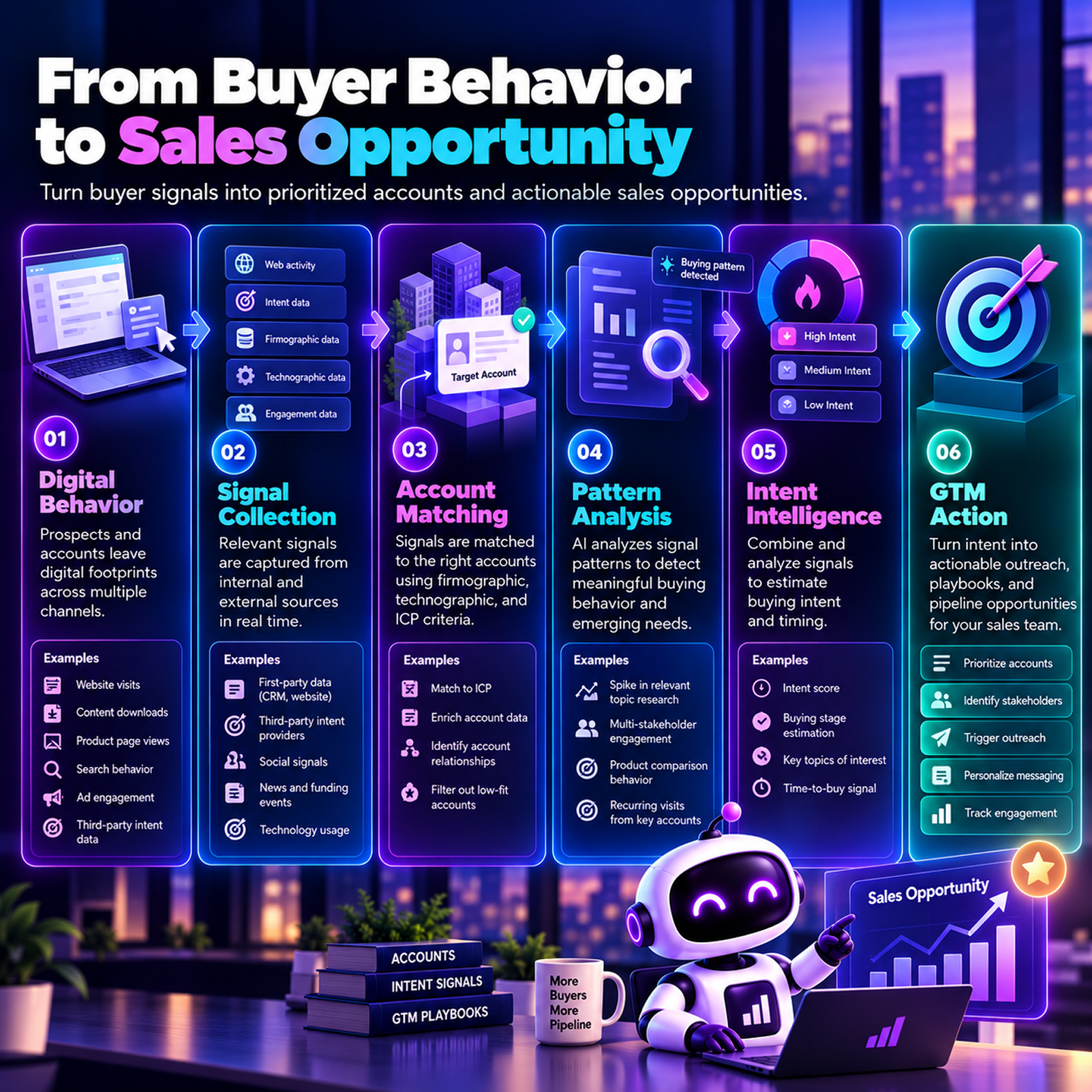
A buyer intent data platform converts digital activity into account-level signals through six stages. The process helps teams interpret research behavior, but the resulting insights indicate potential interest rather than confirmed buying intent.
Digital behavior → Signal collection → Account matching → Pattern analysis → Prioritization → Activation and measurement
Collect Signals From Digital Behavior
Platforms collect behavioral signals from different sources to understand what topics or solutions accounts may be researching.
- Websites and product pages
- Content and publisher networks
- Search activity
- Review sites
- Industry publications
- Advertising engagement
- A company’s own digital properties
First-party intent data comes from interactions with your own digital properties, such as pricing-page visits, content downloads, and demo requests. Third-party intent data comes from external sources, such as publisher networks and review sites, and can reveal research activity beyond your website.
The visibility and reliability of these signals depend on the provider’s data sources, collection methods, and coverage.
Match Activity to Accounts
Much online research is anonymous. Platforms try to link observed activity to a company so teams can interpret it in a B2B context.
Depending on the provider, account matching may use:
- IP-to-company matching
- Digital identifiers
- Company databases
- Firmographic information
- Identity resolution
Matching is not always accurate, and an account-level signal does not necessarily identify the individual who performed the research.
Account-level analysis can still help teams understand broader buying activity.LinkedIn’s 2024 SaaS Buyer Survey found that the average buying group had six members, while 44% of buyers said their buying group had grown over the previous three years.
Analyze Research Patterns
Platforms analyze collected signals to assess whether an account’s activity suggests meaningful interest in a relevant topic. Depending on the provider, this analysis can consider:
- Repeated activity around related topics
- Consumption of related content
- Activity from multiple people
- Changes in normal account behavior
- Research across different sources
A single article view provides limited evidence of buying interest. Repeated research on pricing, integrations, and competing solutions may indicate a stronger pattern, although it does not establish purchase readiness.
Prioritize Accounts Using Intent and Fit
Platforms can use analyzed signals to help teams prioritize accounts for further investigation. Common outputs include:
- Intent scores and topic-level insights
- Prioritized account lists
- Account alerts
- CRM updates and sales notifications
- Marketing audiences
Teams should interpret these outputs alongside ICP fit, account context, and signal freshness. A high intent score alone does not establish that an account is a suitable prospect or is ready to buy.
Activate Signals and Measure Outcomes
Once accounts are prioritized, teams can use intent insights to guide sales and marketing actions, such as targeted outreach, account-based marketing campaigns, or account research.
Platforms may support CRM integrations, alerts, audience creation, and automated workflows. Teams should then measure whether these actions generate relevant engagement, qualified meetings, or pipeline opportunities.
The objective is to evaluate whether intent-informed actions improve prioritization and results, not simply whether the platform detects more activity.
What Data Powers a Buyer Intent Data Platform?
Buyer intent platforms combine different data sources to understand account research. Each source offers a different level of visibility, coverage, and context, so teams should understand its strengths and limitations before interpreting intent signals.
First-Party Intent Data
First-party intent data comes from your own digital properties and systems.
Examples include:
- Website and product-page visits
- Pricing-page visits
- Content downloads
- Demo activity
- Email engagement
Its main strength is direct visibility into engagement with your brand. However, its coverage is limited to activity your systems can observe, so it may miss research happening elsewhere.
Third-Party Intent Data
Third-party intent data comes from activity outside your own website and marketing systems.
Potential sources include:
- Review sites
- Publisher networks
- Industry publications
- Content networks
- External research platforms
This can reveal research activity before an account engages with your brand. However, coverage depends on the provider’s source network, and account matching may be imperfect.
Search and Topic Signals
Search behavior and content consumption can provide clues about the subjects an account is investigating, including:
- Business problems and software categories
- Competitors and product alternatives
- Implementation questions and pricing
- Industry challenges
These signals can reveal the topics attracting attention, but visibility varies by provider and source. A single interaction does not necessarily indicate buying interest; repeated, relevant activity provides stronger evidence.
Account Context and Supporting Signals
Intent is easier to interpret alongside:
- Firmographic and technographic data
- Hiring activity and funding events
- Company expansion and leadership changes
- CRM activity and existing customer relationships
These signals help teams assess whether research is relevant to their business. However, company attributes and business developments provide context rather than direct evidence of purchase intent.
Comparing Intent Data Sources
| Source Type | Coverage | Visibility | Main Limitation |
|---|---|---|---|
| First-party data | Activity across owned digital properties and systems | Direct engagement with your brand | Misses research outside your properties |
| Third-party data | Research across external publisher, content, and review networks | Activity beyond your own channels | Depends on source coverage and account-matching accuracy |
| Search and topic signals | Selected searches and content interactions available to the provider | Topics and potential research interests | Individual actions can be ambiguous or incomplete |
| Account context | Company attributes, developments, and CRM records | Business fit and relevant account circumstances | Context does not confirm active buying intent |
No single source provides a complete picture of buyer intent. Combining relevant behavioral signals with reliable account context can improve prioritization, but teams should validate signal quality, freshness, and ICP fit before acting.
How is Buyer Intent Data Scored?
Intent scoring helps platforms assess the meaningfulness of an account’s research activity.
There is no universal scoring formula. Providers use different sources and methods, so scores should not be compared directly across platforms.
What Factors Influence an Intent Score?
Common factors include:
- Recency: How recently did the activity happen?
- Frequency: How often is the account researching the topic?
- Research volume: How much relevant activity is occurring?
- Engaged people: How many people from the account are active?
- Topic relevance: How closely does the activity match the selected topic?
- Signal strength: How meaningful is the behavior?
- Change from baseline: Is activity higher than normal?
These factors help distinguish casual browsing from stronger research patterns.
What is an Intent Spike?
An intent spike is a noticeable increase in research activity around a relevant topic.
For example:
Account A: One employee reads an article about your category.
Account B: Several employees repeatedly research the category, related problems, and competitors over a short period.
Account B shows a stronger pattern, but a spike reveals a change in activity, not its cause.
Can Intent Data Indicate Buying Stage?
Behavioral patterns may provide clues about an account’s research stage:
- Early research: Exploring a problem or category
- Category research: Consuming multiple resources about possible solutions
- Vendor comparison: Researching specific providers
- Competitive evaluation: Comparing alternatives
- Later-stage consideration: Researching pricing, implementation, or vendors
These are behavioral inferences, not direct insight into an account’s internal buying process.
Pro Tip- Do not treat every intent spike as a sales opportunity. Check ICP fit, topic relevance, research consistency, and engagement from multiple people before making the account a sales priority.
How Do Teams Use Buyer Intent Data to Create Sales Opportunities?
Intent data becomes useful when it helps sales teams decide which accounts to prioritize, when to reach out, and what to discuss.
Prioritize Accounts That Are Both a Fit and in Market
A target-account list can contain hundreds of companies that meet your ICP. Adding intent creates another prioritization layer:
- High fit + no relevant activity: Monitor or nurture
- High fit + rising category interest: Consider prioritizing
- High fit + sustained research: Investigate further
Intent does not replace ICP analysis. It adds behavioral context to it.
Improve the Timing of Sales Outreach
Recent or increasing research activity can provide a reason to reconsider timing.
Instead of treating every target account equally, sales can give greater attention to accounts showing current, relevant activity. Intent should be one factor in deciding whether an account deserves attention now.
Personalize Sales Conversations
Relevant research topics can inform:
- Conversation starters
- Outreach angles
- Useful resources
- Account research
- Sales messaging
The signal should inform the conversation rather than become the conversation.
Support Account-Based Marketing
Marketing teams can use intent to:
- Build account audiences
- Adjust campaign priorities
- Personalize content
- Trigger targeted advertising
- Coordinate sales and marketing
Identify Competitive and Expansion Opportunities
Competitive opportunities can emerge when accounts research competing products or alternatives. Expansion opportunities can emerge when existing customers begin researching new areas relevant to your products.
Pro Tip- Use intent to change the timing or type of action. A high-fit account with rising category interest may warrant outreach, while an existing customer researching a new solution area may deserve an expansion conversation.
How ReachGen Helps Turn Account Intelligence Into Action
Buyer intent data identifies accounts that may warrant further investigation, but sales teams still need to determine whether those accounts fit their ICP, identify relevant contacts, and prepare for outreach.
ReachGen can support the prospecting work that follows account prioritization, including account discovery, contact research, enrichment, and outreach preparation, where those capabilities are included in the relevant product offering. It should be positioned as a complementary prospecting solution, not as a dedicated buyer intent data provider unless that capability is independently verified.
Start With ICP-Based Account Discovery
ReachGen can help teams define and apply ICP criteria to identify accounts that match their target profile. Instead of treating every account showing intent as equally valuable, teams can focus on accounts that exhibit the characteristics they care about.
ICP fit + relevant intent → higher-priority accounts
The intent signal provides behavioral context, while the ICP helps determine whether that behavior is relevant to the business.
Enrich Accounts and Contacts With Relevant Context
Once high-fit accounts are identified, sales teams need enough information to understand the company and who may be relevant to the buying process.
ReachGen supports account and contact enrichment with information such as:
- Company size
- Industry
- Funding status
- Technology usage
- Job titles
- Contact information
- Other relevant company and prospect attributes
This gives sales teams more context rather than leaving them with an intent signal alone.
Find and Prioritize Relevant Decision-Makers
An account-level intent signal does not automatically tell a sales rep whom to contact.
ReachGen can help identify relevant decision-makers within target accounts and organize prospects based on ICP and account criteria. Teams can then narrow broad account lists into focused groups for specific campaigns or sales motions.
The workflow becomes:
Intent signal → ICP-fit account → Relevant decision-makers → Enriched prospect profile
Verify Data Before Outreach
Outdated contact information can reduce the value of otherwise strong prospect intelligence.
ReachGen includes real-time verification as part of its enrichment workflow, helping teams work with more current account and contact information before outreach.
The goal is not simply to find more contacts. It is to give sales teams information they can use with greater confidence.
Use Account Intelligence to Personalize Sales Outreach
ReachGen can use enriched account and contact information, along with contextual information such as company developments and industry insights, to support personalized outreach. This helps sales teams create messaging that reflects the prospect’s company and role.
Instead of treating a high-intent account as another name on a list, a sales rep can use its ICP fit, company information, relevant contact details, and available context to determine an appropriate outreach angle.
From Intent Signal to Sales Action
When a buyer intent data platform identifies accounts showing relevant research activity, sales teams still need to assess account fit, identify suitable contacts, and prepare relevant outreach. ReachGen can support these prospecting steps using its ICP-based account discovery, account and contact enrichment, decision-maker identification, and verification capabilities.
The process can follow this sequence:
Intent signals from an external source → ICP-fit account prioritization → Account and contact enrichment → Decision-maker identification → Data verification → Personalized outreach
Intent signals help indicate which accounts warrant further review. ReachGen supports the next steps by helping teams assess account fit, find relevant decision-makers, and use available company and contact context to prepare outreach. This connects behavioral insights from an intent data source with a more focused prospecting process, without treating research activity as confirmed buying intent.
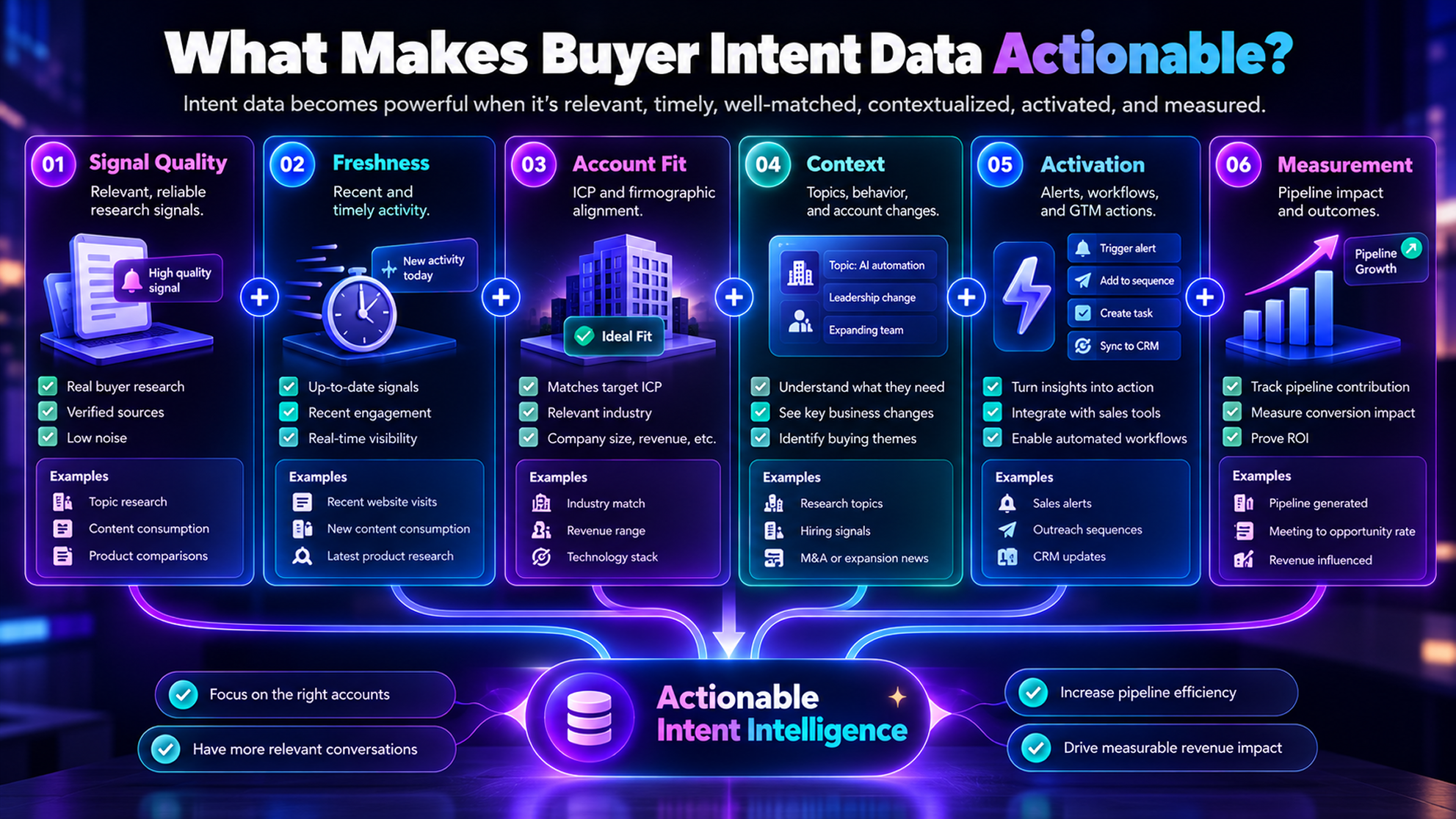
Key Things to Check in a Buyer Intent Data Platform
More signals do not necessarily mean better intent intelligence. Look beyond signal volume and evaluate how relevant, fresh, accurate, and actionable those signals are for your target accounts.
| Capability | What to Evaluate | Why it Matters |
|---|---|---|
| Signal coverage | First- and third-party sources | Expands visibility into research |
| Topic intelligence | Relevant, customizable topics | Shows what accounts are researching |
| Account matching | Company identification accuracy | Makes anonymous activity useful |
| Scoring | Clear methodology | Supports account prioritization |
| ICP filtering | Account and firmographic filters | Reduces irrelevant signals |
| Data freshness | Signal update frequency | Keeps information current |
| Integrations | CRM and GTM connections | Brings intent into existing workflows |
| Activation | Alerts, audiences, workflows | Makes signals actionable |
| Analytics | Pipeline and performance reporting | Helps measure impact |
| Privacy | Transparent data practices | Supports responsible data use |
Evaluate Signal Quality, Not Just Signal Volume
A platform can produce thousands of signals without producing useful intelligence. Assess:
- Source reliability
- Topic relevance
- Account coverage
- False positives
- Signal freshness
- Consistency across sources
Ask how the provider identifies meaningful research, updates signals, and handles weak or ambiguous activity. Gartner recommends combining multiple intent signals to identify real buying activity. A smaller set of relevant signals can be more valuable than a large volume of noisy data.
Look for Intent That Connects With Account Fit
Intent answers: “Is this account researching a relevant topic?”
Account intelligence adds: “Is this account worth pursuing?”
Evaluate whether the platform lets you combine intent with the criteria your team already uses to prioritize accounts, such as industry, company size, technology environment, geography, or ICP.
This helps separate useful opportunities from accounts researching a relevant topic but not fitting your target profile.
Consider How Easily Teams Can Activate the Data
Intent data has limited value if sales and marketing teams cannot easily use it.
Check whether the platform supports:
- CRM systems
- Sales engagement platforms
- Marketing automation
- Advertising platforms
- Account prioritization workflows
Also consider what happens after a signal appears. Can teams create alerts, assign accounts, trigger campaigns, or update account records without extensive manual work?
Test the Platform Against Accounts You Already Know
Before choosing a platform, test its data against accounts where you already understand the buying history. Use a sample of:
- Existing customers
- Open opportunities
- Recently won accounts
- Recently lost opportunities
- Accounts that never converted
Then ask:
- Did relevant research appear before known buying events?
- How early did meaningful activity become visible?
- Were the topics connected to the eventual opportunity?
- How many irrelevant signals appeared?
- Could a sales rep have taken useful action?
Pro Tip- Run a small proof of concept before committing. Compare intent-prioritized accounts with a similar ICP-only group, then track positive replies, meetings, opportunities, signal relevance, and false positives.
What Are the Limitations of Buyer Intent Data Platforms?
Buyer intent data platforms help teams identify accounts researching relevant topics, but interpreting these signals comes with limitations. Research activity does not confirm purchase readiness, anonymous behavior can limit visibility into individual buyers, and outdated or irrelevant signals can lead to poor prioritization. Understanding these constraints helps teams evaluate intent data more carefully and use it effectively in sales and marketing decisions.
Intent Does Not Equal Purchase Readiness
Research can be exploratory, related to a future project, driven by competitive research, or conducted by someone outside the buying committee. Intent is evidence of activity, not confirmation of a purchase decision.
False Positives Can Affect Prioritization
A single-page visit or broad topic search may have little connection to an active buying process. Teams can reduce false positives by considering multiple signals alongside account context.
Anonymous Activity Limits Person-Level Visibility
Many intent platforms primarily provide account-level information. A platform may identify the company associated with research without identifying the individual who performed it.
Intent Signals Can Become Stale
Research activity changes quickly. An account showing strong interest several weeks ago may no longer be evaluating the category. Data freshness should therefore be an important evaluation criterion.
Intent Data Needs a Clear Activation Strategy
Even strong signals have limited value when teams:
- Do not trust the data
- Do not understand the scoring
- Lack follow-up processes
- Keep intent outside the CRM
- Interpret signals inconsistently
- Do not measure outcomes
Teams also need clear rules for interpreting and acting on intent.
Buyer Intent Data Platforms vs. Traditional Lead Generation
Buyer intent data and lead generation answer different questions.
| Buyer Intent Data Platforms | Traditional Lead Generation |
|---|---|
| Focus on active research behavior | Focuses on identifying potential prospects |
| Adds a behavioral layer | Often starts with demographic or firmographic criteria |
| Provides clues about timing | Usually provides less timing insight |
| Helps prioritize active accounts | Can create broader prospect pools |
| Provides research context | May require additional research to understand interest |
Lead generation helps answer:
Who could we potentially sell to?
Intent data adds:
Which of those accounts may be researching something relevant now?
Intent complements lead generation, prospecting, ABM, demand generation, and account intelligence. The strongest view combines who the account is, whether it fits, and what it is doing now.
Conclusion
Buyer intent data matters when it helps sales teams decide where to focus and what action to take next. A signal alone does not tell you whether an account is worth pursuing.
Combining intent with ICP fit, account context, contact intelligence, and verified data gives teams a clearer picture of potential opportunities.
ReachGen helps GTM teams identify high-fit accounts, find decision-makers, enrich and verify prospect data, and personalize outreach using account context. Teams can use these capabilities to support prospecting decisions after identifying accounts worth reviewing.
The goal is not to collect more intent signals. It is to turn those signals into focused sales action and better account prioritization.
Ready to Get Started? Talk to Us!
To put buyer intent into action with ReachGen, connect with the DiGGrowth team at info@diggrowth.com.
Ready to get started?
Increase your marketing ROI by 30% with custom dashboards & reports that present a clear picture of marketing effectiveness
Start Free Trial
Experience Premium Marketing Analytics At Budget-Friendly Pricing.

Learn how you can accurately measure return on marketing investment.
You’re Targeting Your Ideal Customer. So Why Aren’t They Buying?
Your best customers reveal the traits associated with success. Your lost opportunities reveal where fit breaks...
Read full post post
How Predictive AI Will Transform Paid Media Strategy in 2026
Paid media isn’t a channel game anymore, it’s a chessboard. Search, social, programmatic, video, influencer, native,...
Read full post post
Don’t Let AI Break Your Brand: What Every CMO Should Know
AI isn’t just another marketing tool. It’s changing how we connect with customers, personalize content, and...
Read full post post