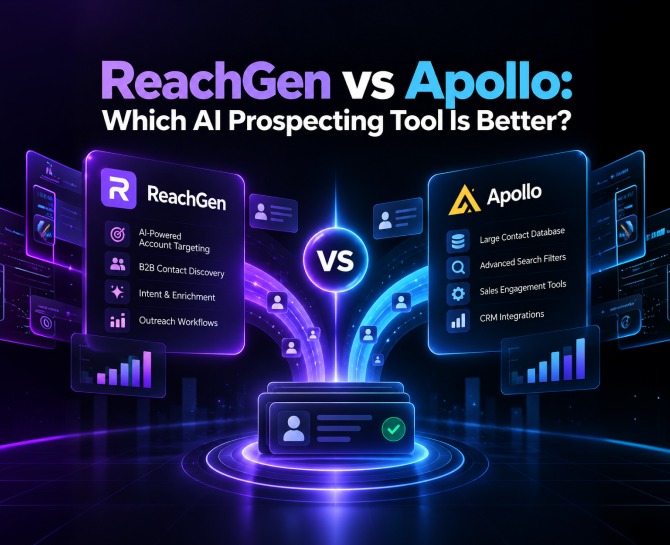
ReachGen vs Apollo: Which AI Prospecting Tool Is Better?
ReachGen and Apollo take different approaches to B2B prospecting. ReachGen focuses on ICP-driven account intelligence, enrichment, verification, and account research, while Apollo combines prospect discovery with AI research, buying intent, and sales engagement. This comparison explains how the two platforms differ and which type of GTM workflow each is better suited to support.
A larger contact database doesn’t automatically mean a better prospecting process. The real challenge for B2B teams is often knowing which accounts to target, which prospects matter, and how to turn that information into meaningful outreach.
This is where the choice of prospecting platform can make a difference. The right tool should not only help teams find prospects but also support the process of identifying high-fit accounts, understanding them, and deciding how to engage them. That’s what makes the ReachGen vs Apollo comparison relevant. Instead of choosing a platform based on database size or feature count alone, teams need to consider how each tool fits into their actual prospecting workflow and helps them identify, research, qualify, and engage the right prospects.
ReachGen places a strong focus on ICP-driven account intelligence, automated contact and account enrichment, verification, segmentation, and prospect research. Apollo, on the other hand, takes a broader approach by combining B2B prospecting with AI research, buying intent, and sales engagement.
When deciding between the two, this distinction is crucial. A team trying to build a list of high-fit accounts may have very different needs from an SDR team that wants to find contacts, build sequences, and manage outreach in the same place.
This comparison looks at the areas that matter most when choosing between the two, including account and contact discovery, ICP targeting, enrichment, firmographic and technographic data, AI research, segmentation, buying intent, outreach, sequencing, and CRM integrations.
Key Takeaways
- ReachGen is centered on ICP-driven account intelligence, enrichment, verification, segmentation, and prospect research.
- Apollo combines a large B2B database with AI research, buying intent, prospecting, and sales engagement.
- ReachGen makes more sense for teams that start prospecting with account fit and ICP criteria.
- Apollo is worth considering if you want prospecting and outbound execution in one platform.
- A bigger database doesn’t automatically produce better prospects.
- Your CRM, existing sales tools, data requirements, and GTM process should all factor into the decision.
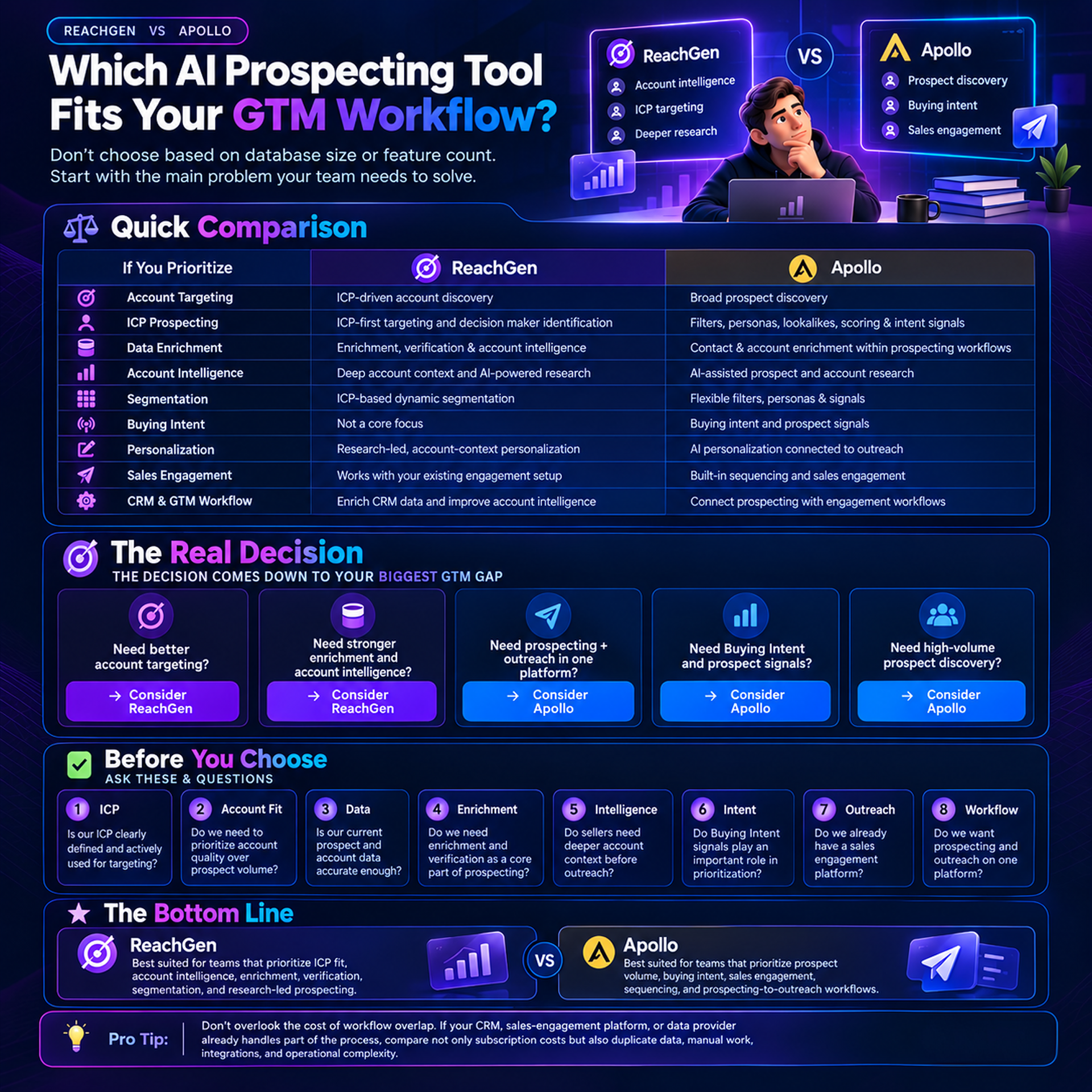
ReachGen vs Apollo: At a Glance
| Factor | ReachGen | Apollo |
|---|---|---|
| Core focus | Account intelligence & prospecting | Prospecting & sales engagement |
| Account & contact discovery | Yes | Yes |
| ICP-based targeting | Core workflow | Filters, personas & signals |
| Decision Maker identification | Yes | Yes |
| Automated Contact & Account Enrichment | Yes | Yes |
| Firmographic & Technographic Data | Yes | Yes |
| AI research | DiGGi-GPT | Apollo AI |
| Segmentation | ICP-oriented lists | Filters, personas & signals |
| Buying Intent | Not a core focus | Yes |
| Personalized outreach | Yes | Yes |
| Sales sequencing | Evaluate based on needs | Yes |
| CRM integrations | Salesforce & HubSpot | Salesforce & HubSpot |
| Primary strength | ICP-focused account intelligence | Prospecting-to-engagement workflow |
In short : ReachGen is more account- and ICP-focused, while Apollo covers a broader prospecting-to-outreach workflow.
How Are ReachGen and Apollo Different?
The primary difference lies in where each platform starts. ReachGen begins with an ICP-first approach, while Apollo starts with a broad prospecting database.
ReachGen
ReachGen starts by helping teams identify accounts that match their Ideal Customer Profile (ICP). Teams can then find relevant buyer personas and decision makers, enrich and verify their information, research the accounts, and organize them into segments for outreach.
ReachGen focuses on finding the right accounts, understanding them, and identifying the right people to contact.
| Pros | Cons |
|---|---|
| ICP-focused prospect discovery | May require an existing sales engagement or sequencing platform |
| Account intelligence and AI-assisted research | Requires compatibility checks with current outreach tools |
| Automated contact and account enrichment | Enrichment volume should match team requirements |
| Real-time data verification | Data requirements may vary by team and use case |
| Context-aware personalized outreach |
Apollo
Apollo starts with a large database of companies and contacts. Teams can use filters to find prospects, enrich their records, research them, identify signals, personalize messages, and move prospects into sales sequences and outreach.
Apollo focuses on finding prospects, prioritizing them, and moving them through the outreach process.
| Pros | Cons |
|---|---|
| 240M+ contact database | Offers more features than most teams will actually use |
| Extensive search and filtering | A large database doesn’t guarantee strong ICP fit |
| Data enrichment | A clear ICP and targeting strategy are still necessary |
| AI research | Pricing, credits, usage, and workflow requirements should be evaluated before adoption |
| Buying intent | |
| Personalized messaging | |
| Prospecting-to-outreach workflow |
Takeaway : The key difference is that ReachGen puts account fit and intelligence at the center of prospecting, while Apollo connects prospect discovery with sales engagement in a broader workflow.
ReachGen vs Apollo: Feature-by-Feature Comparison
| Feature | ReachGen | Apollo | Best Fit |
|---|---|---|---|
| Account & Contact Discovery | ICP-first account and decision maker discovery with dynamic lists | 240M+ contacts with 65+ filters | ReachGen for account fit; Apollo for prospect volume |
| ICP-Based Prospecting | ICP Discovery focused on high-fit accounts and decision makers | Filters, personas, lookalike companies, scoring, and intent signals | ReachGen for ICP-driven targeting, high-fit account identification, and decision maker discovery |
| Automated Contact & Account Enrichment | Enrichment with firmographic, technographic, funding, and job data plus verification | Contact and account enrichment with firmographic data, signals, and AI research | ReachGen for account intelligence; Apollo for broader prospecting |
| Firmographic & Technographic Data | Used for ICP-based account qualification and segmentation | Used for prospecting, filtering, and enrichment | ReachGen for ICP-focused targeting |
| AI-Powered Research | DiGGi-GPT for account intelligence, insights, and contextual outreach | Apollo AI for research, prioritization, prospecting, and personalization | ReachGen for account context; Apollo for prospecting |
| Prospect Segmentation | Dynamic lists based on ICP, industry, company size, and technology | Filters, personas, attributes, and intent signals | ReachGen for ICP segmentation; Apollo for flexible filtering |
| Buying Intent | Not a core focus | Buying Intent and research signals for account prioritization | Apollo for prioritizing accounts based on buying intent and research signals that indicate potential interest |
| Personalized Outreach | AI-assisted messaging based on enriched account context | AI personalization connected to engagement tools | ReachGen for research-led personalization; Apollo for execution |
| Sales Engagement & Sequencing | Focuses on intelligence, research, and personalized outreach | Multi-step sequences, email/phone engagement, follow-ups, and tracking | Apollo for multi-step engagement, sequencing, and outreach execution |
| CRM & GTM Integrations | Salesforce and HubSpot integration for enriched data | Salesforce and HubSpot integration with prospecting workflows | ReachGen for enriching CRM data; Apollo for integrating prospecting and engagement workflows |
1. Account and Contact Discovery
Which is better for finding the right accounts and contacts?
Both tools support account and contact discovery, but their approaches differ. ReachGen puts ICP criteria first, helping teams find high-fit accounts and decision-makers and organize them by industry, company size, and technology stack.
Apollo offers a broader prospecting environment with 240M+ contacts and 65+ filters.
Best Fit: ReachGen for ICP-focused discovery; Apollo for broader prospecting and filtering.
2.ICP-Based Prospecting
Which is better for ICP-driven prospecting?
ReachGen takes an ICP-first approach through its ICP discovery capability, helping identify accounts and decision-makers that match a defined Ideal Customer Profile (ICP).
Apollo supports ICP targeting through filters, personas, lookalike companies, scoring, and intent signals.
Best Fit: ReachGen when ICP is central to prospecting; Apollo when ICP criteria are part of a broader prospecting workflow.
3. Automated Contact & Account Enrichment
Which provides the stronger data foundation?
ReachGen uses automated contact & account enrichment to quickly gather details on your target leads and companies. It can add job, firmographic, technographic, funding, and other account information, followed by real-time verification.
Apollo also enriches contact and account records with firmographic data, verified contact details, signals, and AI-assisted research.
Best Fit: ReachGen for account-focused enrichment; Apollo for enrichment within a broader prospecting platform.
4. Firmographic and Technographic Data
Which platform is better for firmographic and technographic targeting?
Firmographic data covers attributes such as industry, company size, revenue, location, and funding, while technographic data shows the technologies a company uses. These data points can help teams define ICPs, qualify accounts, and build targeted segments.
ReachGen uses firmographic and technographic data as part of account enrichment and ICP-focused targeting. Teams can use these attributes to identify companies that match specific account criteria and organize them into relevant segments.
Apollo incorporates firmographic and technographic data into its broader prospecting and enrichment environment. Teams can use these attributes as filters alongside other prospecting criteria to identify and prioritize potential accounts and contacts.
Best Fit: ReachGen for tightly defined ICP-based account targeting; Apollo for broader prospecting and filtering.
5. AI-Powered Account and Prospect Research
AI can help sellers understand an account without manually researching multiple sources.
ReachGen uses DiGGi-GPT for account intelligence, insights, and contextual outreach. Apollo AI supports prospect research, prioritization, decision maker discovery, lookalike accounts, natural-language searches, and personalization.
Best Fit: ReachGen for account context; Apollo for AI research connected to prospecting and engagement.
6. Prospect Segmentation
ReachGen supports dynamic lists based on factors, such as industry, company size, and technology stack. Apollo offers filters, attributes, personas, and intent signals for building targeted prospect lists.
Both can support ABM, demand generation, outbound campaigns, territory planning, and market expansion.
Best Fit: ReachGen for ICP-based segmentation; Apollo for flexible filtering and direct prospecting.
7. Buying Intent and Prospect Signals
Which is better for identifying prospects that may be ready to buy?
Apollo has the clearer buying intent offering. Its capability uses online research behavior and other signals to identify companies that may be actively researching relevant topics. This adds another layer to targeting:
Does the company fit our ICP, and is there a reason to engage now?
ICP establishes fit, while intent can indicate potential interest.
Best Fit: Apollo when buying intent is important to your prospecting strategy.
8. Personalized Outreach
ReachGen uses enriched account and contact information to support personalized messaging. Its AI can draw on industry, company news, recent events, and other account details.
Apollo also supports AI-powered personalization using company, role, and recent-insight data, with those messages connected to its engagement tools.
Best Fit: ReachGen for research-led personalization; Apollo for personalization tied to broader outreach execution.
9. Sales Engagement and Sequencing
Which platform does more after the prospect has been identified?
Apollo has the stronger sales-engagement offering, with multi-step sequences, email and phone engagement, follow-ups, tracking, and CRM workflows.
ReachGen focuses more on account intelligence, enrichment, research, segmentation, and personalized outreach. Teams that already use a sales-engagement platform may find this approach suitable.
Best Fit: Apollo for teams looking to combine prospecting and outbound execution.
10. CRM and GTM Integrations
ReachGen integrates with Salesforce and HubSpot, allowing enriched data to feed into existing GTM workflows. Apollo also supports Salesforce and HubSpot and can synchronize prospect information with those systems.
When evaluating these integrations, consider:
Can data sync automatically?
Can enrichment update existing records?
Can prospects be routed to sales?
Can segmentation influence campaigns?
Does the integration reduce manual work?
The right integration is the one that removes unnecessary work from your GTM process.
Which Tool Is Better for Different GTM Use Cases?
For ABM
ReachGen is a strong fit when ABM starts with ICP-driven account selection and continues through enrichment, buyer persona identification, decision maker discovery, and segmentation.
For Outbound Prospecting
Apollo has an advantage for teams that want prospect discovery, enrichment, AI research, personalization, sequences, and multichannel engagement connected in one workflow.
For Demand Generation
ReachGen fits teams building account-level audiences around ICP, firmographic, and technographic characteristics.
Apollo makes more sense when those audiences need to connect directly with prospecting and outbound execution.
For New-Market Expansion
ReachGen works well when entering a new market starts with defining target-account characteristics and finding companies that match them.
Apollo is attractive when the expansion also calls for prospect discovery at scale and a direct route into outreach.
For Account Research
ReachGen is well suited to account-focused research through enrichment and DiGGi-GPT.
Apollo is useful when research needs to lead directly into prospect prioritization and sales activity.
For CRM Enrichment
ReachGen is a strong option when enrichment and verification are central requirements.
Apollo is useful when CRM enrichment needs to sit alongside prospect discovery, signals, and outbound execution.
ReachGen vs Apollo: Which Tool Should You Choose?
The better choice depends on what your team needs from a prospecting platform. If the priority is identifying high-fit accounts through ICP-driven intelligence and enrichment, ReachGen may be the stronger fit. If you want a broader platform that combines prospect discovery, a large contact database, and sales engagement, Apollo may make more sense.
Who Should Use ReachGen vs Apollo?
B2B Sales Teams
ReachGen makes sense when sellers need ICP fit, account context, enrichment, and research before starting a conversation.
Apollo is a better match when sales reps want prospect discovery, signals, personalization, and sales engagement in one system.
Marketing and Demand Generation Teams
ReachGen can help marketing teams build ICP-based audiences and segments for ABM and demand generation.
Apollo is useful when those prospect lists need to connect closely with sales prospecting and outbound activity.
RevOps Teams
RevOps should pay close attention to enrichment, verification, CRM synchronization, data quality, and workflow consistency.
ReachGen can support a CRM-centered data strategy through enrichment and verification. Apollo combines those data capabilities with prospecting and engagement.
Growth and GTM Leaders
Growth leaders should look beyond individual features and consider the role the platform will play in the broader GTM model.
ReachGen puts more emphasis on account intelligence. Apollo covers a wider range of prospecting, intent, and engagement activities.
A Practical Framework for Choosing
Score each platform from 1–5 across five criteria:
| Criterion | Question |
|---|---|
| ICP Fit | Can it identify accounts likely to become valuable customers? |
| Data Quality | Can we trust the prospect and account information? |
| Account Context | Can sellers understand accounts and decision makers? |
| Buying Signals | Can we identify useful intent signals? |
| Execution | Can we move efficiently from discovery to outreach? |
For an ABM-led team, give more weight to ICP fit and account context.
For an outbound-led SDR team, put more emphasis on execution and buying signals.
For a RevOps-led organization, focus on data quality, enrichment, verification, and CRM integration.
This keeps the evaluation tied to the problem you actually need to solve rather than turning the decision into a feature-counting exercise.
Conclusion
There is no universal winner in the ReachGen vs Apollo comparison. The right choice depends on the problem your team is trying to solve and how you want prospecting to fit into your overall GTM workflow.
If your priority is identifying, qualifying, and understanding the right accounts before engaging them, ReachGen may be the better fit. It is designed around ICP-driven account intelligence, automated contact & account enrichment, verification, segmentation, and contextual prospect research.
If your priority is combining prospect discovery with sales engagement in one platform, Apollo may be the better fit. It brings together B2B prospecting, AI research, buying intent, personalization, sequences, and outreach capabilities.
The decision ultimately comes down to your team’s workflow. Look at how you identify, qualify, research, and activate accounts, and choose the platform that best supports the process you need.
If you’re evaluating Apollo alternatives, avoid making the decision based on feature count alone. Consider which platform addresses your team’s specific prospecting challenges and supports your broader GTM strategy.
If you’re exploring ways to turn your ICP into actionable account intelligence, reach out to the DiGGrowth team at info@diggrowth.com to learn more about how ReachGen can fit into your GTM strategy.
Ready to get started?
Increase your marketing ROI by 30% with custom dashboards & reports that present a clear picture of marketing effectiveness
Start Free Trial
Experience Premium Marketing Analytics At Budget-Friendly Pricing.

Learn how you can accurately measure return on marketing investment.
How Predictive AI Will Transform Paid Media Strategy in 2026
Paid media isn’t a channel game anymore, it’s a chessboard. Search, social, programmatic, video, influencer, native,...
Read full post post
Don’t Let AI Break Your Brand: What Every CMO Should Know
AI isn’t just another marketing tool. It’s changing how we connect with customers, personalize content, and...
Read full post post
From Demos to Deployment: Why MCP Is the Foundation of Agentic AI
A quiet revolution is unfolding in AI. And it’s not happening inside research labs. For decades,...
Read full post post