
The Future of Business Intelligence: Best Dashboard Tools for Businesses in the AI Era
In 2025, dashboards are more than charts—they are growth engines. This article highlights the best dashboard tools for businesses, showing how AI and predictive analytics transform raw data into actionable strategies, improve collaboration, and optimize revenue. From DiGGrowth’s AI assistant DiGGi-GPT to user-friendly platforms like Tableau and Power BI, readers will understand which tools deliver real-time insights, streamline operations, and give companies a competitive edge.
Your dashboard is lying to you.
Not because the numbers are wrong, but because most dashboards only scratch the surface. They tell you what happened but not why it happened, or what is about to happen next. And in 2025, that is the difference between a business that grows and a business that gets left behind.
Here is the uncomfortable truth: while you are still piecing together reports in spreadsheets, your competitors are already running on AI-driven dashboards that predict churn before it happens, highlight hidden revenue leaks, and tell their teams exactly where to focus.
You probably think your current dashboard is “good enough.”
It is not.
The best dashboard tools for businesses in the AI era are not just reporting tools, they are growth engines. And once you see how they work, you will never look at your data the same way again.
Key Takeaways
- AI-powered dashboards move beyond numbers to provide actionable insights and predictive intelligence.
- DiGGrowth, with DiGGi-GPT, transforms data into clear guidance for marketing, sales, and leadership teams.
- Real-time dashboards from tools like Domo and Power BI ensure decisions are based on the latest information.
- Associative analytics in Qlik Sense and AI assistants like Zia in Zoho Analytics reveal hidden trends and optimize workflows.
- Cloud-based platforms like Google Looker Studio and Domo enable collaboration and accessibility across the organization.
1. DiGGrowth
From predictive analytics to automated workflows, AI is helping companies move faster and smarter. Yet, when it comes to dashboards, many organizations are still stuck in the past. They rely on outdated reporting tools that show what happened but fail to explain why it happened or what to do next.
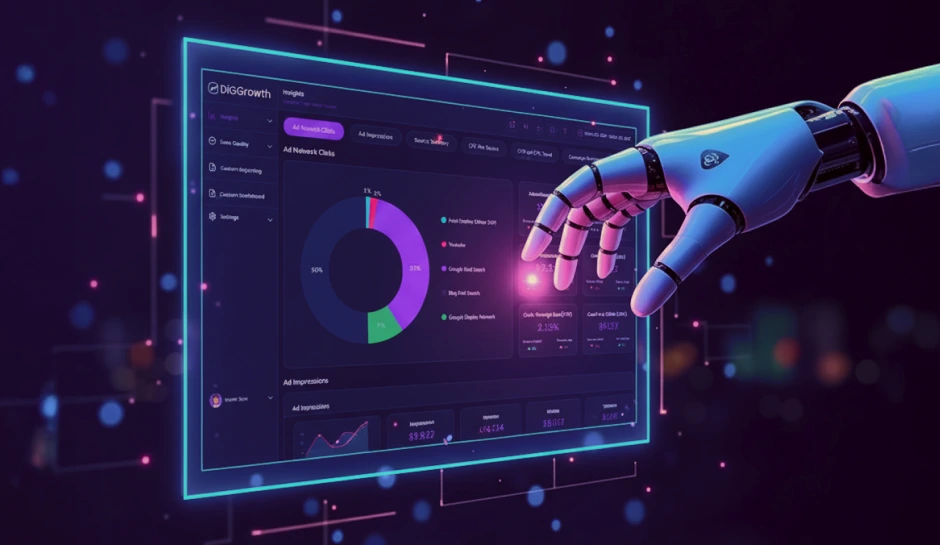
This is where DiGGrowth stands out as one of the most powerful dashboard tools for businesses. Unlike traditional platforms, it combines advanced analytics with attribution modeling to connect every activity directly to revenue. Instead of siloed metrics, you get a single source of truth that reveals where growth is coming from and where resources are being wasted.
At the core of this innovation is DiGGi-GPT, DiGGrowth’s AI assistant. It does more than just answer questions in natural language. It learns from your data, predicts outcomes, and offers clear guidance. Whether you want to identify underperforming campaigns, reallocate spend, or forecast pipeline revenue, DiGGi-GPT turns complex data into simple, actionable insights.
How DiGGrowth Can Be The Future Of Business Intelligence
DiGGrowth redefines dashboards by moving beyond surface-level analytics. Instead of just visualizing KPIs, it provides organizations with predictive intelligence, conversational insights, and attribution clarity that drive real decision-making. This makes it not only a reporting tool but a growth enabler for modern businesses.
Key Capabilities
- Conversational AI with DiGGi-GPT: A natural language interface that makes data accessible for all teams.
- Predictive Lead and Account Scoring: Helps sales and marketing focus efforts on opportunities most likely to convert.
- Media Mix Modeling: Identifies high-performing channels and removes wasted ad spend.
- Custom KPI Frameworks: Dashboards built around the unique objectives of each business.
Real-World Impact
Imagine a marketing team spending weeks building manual reports to understand campaign ROI. With DiGGrowth, those insights appear instantly. A sales leader wondering why conversion rates are dropping can ask DiGGi-GPT directly and get not only an answer but a recommended action. For leadership, this means faster, data-backed decisions without waiting for analysts or second-guessing assumptions.
Organizations that use DiGGrowth consistently report better budget allocation, stronger sales and marketing alignment, and faster growth cycles.
How DiGGrowth Elevates Your Organization
- For Marketing Teams: Quick campaign insights, better ROI tracking, and faster optimizations.
- For Sales Teams: AI-powered lead and account scoring to focus efforts on high-converting opportunities.
- For RevOps and Leadership: Unified dashboards that link every activity to revenue outcomes.
- For the Entire Organization: A culture of data-driven decisions accessible to everyone, not just analysts.
Pro Tip- Do not treat DiGGrowth as just another dashboard. Integrate DiGGi-GPT into your daily workflow. Start by asking it the hard questions about your pipeline, campaigns, or revenue leaks. The more you use it, the more powerful it becomes in uncovering insights that drive growth.
2. Tableau
When businesses think about data visualization, Tableau is often the first name that comes to mind. Known for its user-friendly interface and powerful visualization capabilities, Tableau helps organizations turn raw data into interactive dashboards that are easy to explore and share.
Unlike tools that require heavy technical expertise, Tableau makes it possible for both analysts and business users to build dashboards through drag-and-drop functionality. This accessibility has made it one of the most widely adopted platforms in the business intelligence space.
Key Features of Tableau
- Drag-and-Drop Dashboards: Build interactive visualizations without coding.
- Integration Capabilities: Connects with multiple data sources including SQL, Google Analytics, Salesforce, and more.
- Real-Time Analytics: Updates dashboards automatically when connected to live data.
- Collaboration-Friendly: Share dashboards across teams with Tableau Online or Tableau Server.
Pros and Cons
Pros
- Intuitive interface suitable for non-technical users.
- Strong integration support for multiple data environments.
Cons
- Advanced analytics may require technical add-ons.
- Performance may slow down with very large datasets.
3. Power BI
Microsoft’s Power BI has become a go-to tool for businesses that want to combine data visualization with enterprise-level integration. It is especially popular among organizations already using Microsoft products, thanks to its seamless compatibility with Excel, Azure, and Office 365.
Power BI is designed for scalability, making it equally useful for small businesses testing analytics and large enterprises managing complex datasets.
Key Benefits of Power BI
- Seamless Microsoft Integration: Works smoothly with Excel, Teams, Azure, and Dynamics 365, allowing businesses to leverage existing workflows.
- AI-Enhanced Insights: Built-in AI features help users detect trends, anomalies, and predictive patterns without advanced technical skills.
- Data Security and Compliance: Enterprise-grade security with sensitivity labeling and compliance certifications.
- Custom Dashboards: Enables organizations to tailor KPIs and metrics to their specific business needs.
How Organizations Use Power BI
- Finance Teams: Automating financial reporting and analyzing cash flow trends in real time.
- Marketing Teams: Monitoring campaign effectiveness by pulling data directly from Google Analytics, LinkedIn Ads, or CRM systems.
- Operations: Tracking supply chain performance and identifying inefficiencies across regions.
4. Google Looker Studio
For businesses that want a free, cloud-based dashboard solution, Google Looker Studio is a popular choice. It allows organizations to pull data from multiple sources, visualize it in interactive dashboards, and share insights across teams with minimal setup.
Looker Studio is especially effective for businesses that rely heavily on Google products like Google Analytics, Google Ads, and BigQuery, making reporting more streamlined and actionable.
Key Benefits
- Cost-Effective: Completely free to use, making it ideal for startups and small businesses.
- Easy Integration: Direct connections to Google ecosystem tools plus the ability to connect to other platforms via connectors.
- Real-Time Reporting: Dashboards automatically update as new data comes in, ensuring decisions are based on the latest information.
- Collaborative Workflows: Multiple users can view and edit dashboards simultaneously, improving team alignment.
Use Cases
- Marketing Teams: Track campaign performance across Google Ads, social media, and web analytics in one place.
- SMBs: Monitor sales, customer engagement, and website metrics without investing in expensive BI software.
- Digital Agencies: Create client-ready dashboards quickly and maintain transparency with stakeholders.
Pro Tip- Combine multiple data sources in Looker Studio to get a unified view of your marketing and sales efforts. Use scheduled email reports to keep stakeholders updated automatically.
5. Qlik Sense
If your organization struggles to understand complex datasets, Qlik Sense is built to solve that problem. Unlike traditional dashboards that only show a snapshot of data, Qlik Sense uses associative analytics to reveal hidden relationships across multiple data sources.
This makes it ideal for businesses that need deeper insights to uncover trends and make informed decisions faster.
Unique Capabilities
- Associative Data Model: Explore all your data freely without being constrained to predefined hierarchies.
- Smart Visualizations: AI-powered suggestions help create the most effective visuals for your datasets.
- Embedded Analytics: Qlik Sense can be integrated into business applications to provide contextual analytics directly where decisions are made.
- Augmented Intelligence: Predictive insights and natural language queries allow teams to ask questions and receive intelligent responses.
Real-World Example
A financial services firm used Qlik Sense to analyze customer transactions across multiple branches. By identifying hidden patterns in spending behavior, they were able to cross-sell products more effectively and reduce churn.
6. Domo
In a business world where speed and clarity determine success, Domo stands out as a cloud-based platform that turns data into instant insights. Unlike traditional dashboards, Domo brings your entire organization’s data into one unified space, updated in real time, so teams can act immediately instead of waiting for static reports.
Why Domo Is Different
- Cloud-Native Platform: Access dashboards anywhere without complex setups.
- Pre-Built Connectors and Apps: Connect hundreds of data sources, from CRM to marketing tools, without relying on IT teams.
- Real-Time Insights: Visualizations refresh automatically, allowing decisions based on the latest data.
- Collaboration Built In: Comment, share, and make decisions directly within dashboards.
How Domo Can Transform Your Organization
- Marketing Teams: Monitor campaigns in real time and adjust strategies immediately when trends shift.
- Sales Teams: Track pipeline and opportunities continuously, avoiding missed revenue chances.
- Leadership: Get a consolidated view of the entire organization and make confident decisions quickly.
Real-World Impact
A global retail brand used Domo to integrate sales, inventory, and marketing data across multiple regions. By using real-time dashboards and alerts, managers optimized stock levels, improved campaign targeting, and reduced operational inefficiencies, resulting in measurable revenue growth.
7. Zoho Analytics
Many small and medium businesses struggle to make sense of multiple data sources. Zoho Analytics solves this problem by combining advanced analytics with simplicity and affordability. It is a cloud-based BI and reporting platform that turns complex data into actionable insights without requiring a full data science team.
At the heart of Zoho Analytics is Zia, an AI-powered assistant that can answer natural language questions about your data, detect trends, and even predict outcomes. This ensures teams spend less time digging through reports and more time making informed decisions.
Why Zoho Analytics Stands Out
- AI-Powered Insights: Zia provides instant answers, forecasts, and anomaly detection.
- Multi-Source Integration: Pull data from spreadsheets, CRM, cloud apps, and databases into a unified dashboard.
- Customizable Dashboards: Build dashboards tailored to business goals and share them easily across teams.
- Affordable and Scalable: Suitable for SMBs while scaling to enterprise needs without heavy investment.
Conclusion
Businesses that embrace AI-driven dashboards are no longer just reporting on the past, they are making decisions that shape the future. The right tools connect every activity to measurable outcomes, empower teams with predictive insights, and provide clarity in areas that were previously opaque. Integrating platforms like DiGGrowth ensures your organization is not just tracking metrics but actively driving growth, improving alignment, and making smarter resource allocation decisions every day.
Are you ready to transform your business intelligence into actionable growth? Talk to Us!
Our experts at DiGGrowth can help your team implement AI-powered dashboards, leverage DiGGi-GPT for predictive and conversational analytics, and create a data-driven culture that accelerates revenue growth. Reach out to us today at info@diggrowth.com and we’ll get back to you.
Ready to get started?
Increase your marketing ROI by 30% with custom dashboards & reports that present a clear picture of marketing effectiveness
Start Free Trial
Experience Premium Marketing Analytics At Budget-Friendly Pricing.

Learn how you can accurately measure return on marketing investment.
How Predictive AI Will Transform Paid Media Strategy in 2026
Paid media isn’t a channel game anymore, it’s a chessboard. Search, social, programmatic, video, influencer, native,...
Read full post post
Don’t Let AI Break Your Brand: What Every CMO Should Know
AI isn’t just another marketing tool. It’s changing how we connect with customers, personalize content, and...
Read full post post
From Demos to Deployment: Why MCP Is the Foundation of Agentic AI
A quiet revolution is unfolding in AI. And it’s not happening inside research labs. For decades,...
Read full post postFAQ's
Businesses should evaluate integration capabilities, real-time data access, scalability, user-friendliness, and AI features that provide predictive insights and actionable guidance.
Yes, AI dashboards help small businesses optimize workflows, predict trends, and make data-driven decisions without needing a large analytics team.
Most cloud-based tools offer enterprise-grade security, including encryption, access controls, and compliance certifications, ensuring sensitive business data remains protected.
Many modern dashboards are designed for non-technical users, offering drag-and-drop interfaces, AI assistants, and pre-built templates for easy adoption.
AI dashboards provide shared insights, alerts, and recommendations, enabling teams to align on strategy, act on data quickly, and make collaborative decisions efficiently.