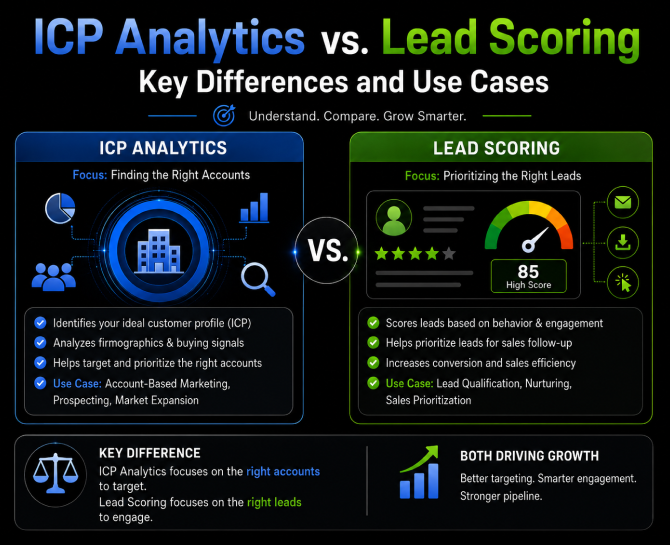
ICP Analytics vs. Lead Scoring: Key Differences and Use Cases
ICP Analytics and lead scoring address different parts of B2B prioritization. ICP Analytics evaluates whether an account matches your ideal customer profile, while lead scoring assesses individual engagement and buying signals. Using both can give Sales and Marketing teams better context for account and contact prioritization.
Your CRM can be full of leads, yet your sales team may still struggle to find the accounts worth pursuing.
ICP Analytics measures account fit. Lead scoring measures individual engagement and buying readiness. That difference matters when Sales and Marketing teams need to decide where to focus limited time and resources.
A highly engaged contact does not always belong to a company that fits your Ideal Customer Profile. At the same time, a strong-fit account may show little activity because its buying process has not started.
For B2B teams running ABM programs or complex sales cycles, separating these signals can improve account prioritization and lead qualification.
Read on to see where each model fits and how the two can work together.
What Is ICP Analytics?
ICP Analytics measures how closely an account matches your Ideal Customer Profile (ICP) using company-level data and customer patterns. It helps revenue teams identify which businesses are more likely to become valuable customers.
Instead of looking at individual actions first, ICP Analytics starts with the account. It examines characteristics shared by your best customers and compares those patterns with companies in your target market.
How Does ICP Analytics Measure Account Fit?
ICP Analytics can evaluate several types of account data, including:
- Firmographic Data : Industry, company size, revenue, location, and growth stage
- Technographic Data : Software, platforms, and technologies used by the company
- Business Characteristics : Business model, operating structure, and market focus
- Customer Patterns : Similarities between target accounts and existing high-value customers
- Revenue Potential : Signals associated with stronger Customer Lifetime Value (CLV), deal size, or retention
For example, a B2B software company may find that its strongest customers are large financial services firms using a specific technology stack and operating across multiple regions. ICP Analytics can identify other accounts that share those characteristics.
What Questions Does ICP Analytics Answer?
ICP Analytics helps teams answer questions such as:
- Which accounts closely match our ICP?
- Which companies deserve priority in our Total Addressable Market (TAM)?
- Which accounts resemble our highest-value customers?
- Which companies should Sales and Marketing target through Account-Based Marketing (ABM)?
What Is Lead Scoring?
Lead scoring ranks individual prospects based on their characteristics, behavior, and buying signals. It helps Sales and Marketing teams determine which contacts show enough interest or fit to warrant closer attention.
Unlike ICP Analytics, which primarily evaluates the account, lead scoring focuses on the person interacting with your business. A score can increase when someone visits key pages, downloads content, attends a webinar, requests a demo, or engages with sales.
How Does Lead Scoring Measure Prospect Readiness?
A lead scoring model typically combines two types of information:
- Fit Signals : Job title, seniority, industry, company size, and other attributes that indicate relevance.
- Engagement Signals: Website visits, email interactions, content downloads, event attendance, product activity, and demo requests.
- Intent Signals: Research behavior that suggests a prospect may be evaluating a product, category, or solution.
For example, a VP of Operations from a target industry who visits your pricing page, attends a product webinar, and requests a demo may receive a high lead score. Those actions indicate stronger buying activity than a contact who only downloads a general industry report.
What Questions Does Lead Scoring Answer?
Lead scoring helps teams determine:
- Which contacts are showing meaningful engagement?
- Which prospects are becoming sales-ready?
- Which leads should receive immediate follow-up?
- Which contacts should remain in a nurture program?
- Which leads have reached an MQL or SQL threshold?
ICP Analytics vs. Lead Scoring: Key Differences at a Glance
ICP Analytics measures account fit, while lead scoring measures individual prospect engagement and buying readiness. Both can prioritize opportunities, but they operate at different levels and support different revenue decisions.
| Factor | ICP Analytics | Lead Scoring |
|---|---|---|
| Primary Purpose | Evaluate account fit | Evaluate prospect readiness |
| Primary Level | Account | Contact or lead |
| Core Question | Does this company fit our ICP? | Is this prospect showing buying interest? |
| Main Data | Firmographic and technographic data | Behavioral, engagement, and intent data |
| Typical Use | Account prioritization and ABM | Lead qualification and sales follow-up |
| Funnel Role | Targeting | Qualification |
| Key Teams | Sales, Marketing, and RevOps | Marketing and Sales |
| Typical Output | Account fit score | Lead or contact score |
Why These Models Are Not Interchangeable
A lead can show strong engagement without representing a valuable account. For example, an individual may attend webinars, download multiple resources, and request a demo, but their company may fall outside your target industry, size range, or technology requirements.
The reverse can also happen. A large enterprise account may closely match your ICP but show little digital activity because its buying process involves multiple stakeholders and a longer evaluation cycle.
That is why ICP Analytics vs. Lead Scoring is not simply a choice between two scoring methods. Each model answers a different prioritization question, and using the right signal at the right stage can give revenue teams a more accurate view of opportunity.
Fit vs. Engagement: The Core Distinction Between the Two Models
Fit shows whether an account belongs in your target market. Engagement shows how actively a prospect is interacting with your business. These signals can point to the same opportunity, but they do not measure the same thing.
ICP Analytics focuses on the characteristics that make an account commercially relevant. Lead scoring focuses on actions that indicate interest or buying activity.
What Does Fit Tell Revenue Teams?
Account fit helps teams determine if a company resembles the customers they want to win and retain. Strong fit may come from factors such as:
- Industry and company size
- Revenue and growth stage
- Technology stack
- Geographic market
- Business model
- Customer Lifetime Value (CLV)
- Strategic relevance
A strong fit suggests that an account could become a valuable customer. It does not necessarily mean that the company is ready to buy today.
What Does Engagement Tell Revenue Teams?
Engagement reveals how a prospect is interacting with your brand or product. Common signals include:
- Visiting product or pricing pages
- Downloading content
- Attending webinars
- Opening or responding to emails
- Requesting a demo
- Using product features
- Interacting with sales
These actions can indicate growing interest, but engagement alone does not confirm that the account is worth pursuing.
Why High Engagement Does Not Always Mean High Fit
Consider two accounts. One matches your ICP closely but has shown little activity. Another falls outside your preferred customer profile but has several highly engaged contacts.
A lead scoring model may prioritize the second account because its contacts are active. ICP Analytics may prioritize the first because the company has stronger commercial fit.
That distinction becomes especially useful in Account-Based Marketing (ABM), where teams need to identify valuable accounts before deciding which contacts and buying signals deserve attention.
Account-Level Scoring vs. Contact-Level Scoring
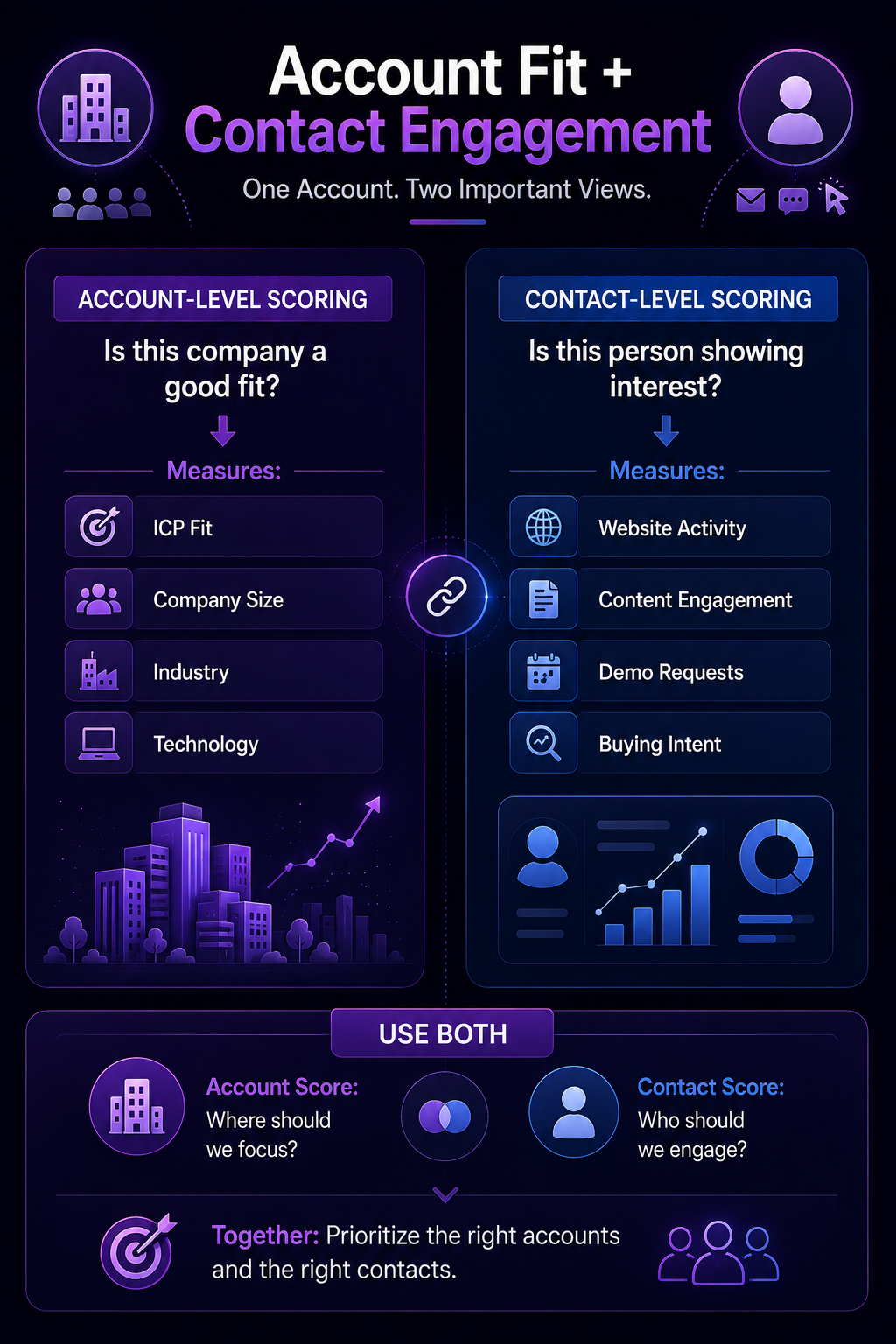
ICP Analytics typically evaluates accounts, while lead scoring typically evaluates individual contacts. This difference matters because B2B purchases rarely involve just one person.
An account-level view looks at the company as a potential customer. A contact-level view looks at the person interacting with your business. Together, they can reveal both the opportunity and the people influencing it.
What Does Account-Level Scoring Reveal?
Account-level scoring can show how closely a company matches your Ideal Customer Profile and how attractive that account may be for the business.
Teams can use it to assess:
- Industry and company size
- Revenue and growth
- Technology adoption
- Geographic fit
- Strategic value
- Similarity to existing customers
- Potential Customer Lifetime Value (CLV)
This view is particularly useful for ABM, territory planning, account prioritization, and sales strategy.
What Does Contact-Level Scoring Reveal?
Contact-level scoring focuses on the actions and characteristics of an individual prospect. It can show whether someone is becoming more engaged or moving closer to a sales conversation.
For example, a contact may:
- Visit product and pricing pages
- Download several resources
- Attend a webinar
- Request a demo
- Respond to sales outreach
- Interact with product content
These signals can indicate interest, but they do not explain the full potential of the account.
Data Inputs Compared: Firmographics and Technographics vs. Behavioral and Intent Signals
ICP Analytics focuses on company-level fit through firmographic and technographic data, while lead scoring emphasizes behavioral, engagement, and intent signals.
Firmographic Data for ICP Analytics
Firmographics describe the company and help determine whether it matches your ideal account profile.
- Revenue : Indicates company scale and spending potential.
- Employee Count : Defines organization size.
- Industry : Identifies relevant market segments.
- Location : Supports geographic targeting.
- Growth Rate : Highlights expanding businesses.
- Business Model : Shows how the company operates and generates revenue
Technographic Data for ICP Analytics
Technographics show the technologies an account uses and whether its environment aligns with your offering.
- Software Stack : Identifies existing applications.
- Cloud Infrastructure : Shows relevant cloud environments.
- CRM : Identifies sales and customer systems.
- Marketing Platforms : Reveals marketing technology.
- Relevant Technologies : Highlights tools related to your solution.
- Technology Adoption Patterns : Shows changes in technology usage.
Behavioral Data for Lead Scoring
Behavioral signals show how actively a prospect is engaging with your brand.
- Page Visits
- Email Interactions
- Content Downloads
- Webinar Attendance
- Demo Requests
- Product Activity
These signals become more meaningful when analyzed through First-Party Data rather than isolated actions.
Intent Data for Buying Signal Detection
Intent Data looks beyond direct engagement with your brand. It can indicate that an account is researching a particular topic, category, technology, or business problem across relevant digital sources.
For example, an account repeatedly researching topics related to marketing attribution may not have visited your website yet. An intent signal can still suggest that the organization is actively investigating the category.
That distinction matters because intent data can surface accounts before they become identifiable leads. Lead scoring can then combine intent with first-party engagement, while ICP Analytics can determine whether those accounts are worth prioritizing in the first place.
ICP Analytics vs. Lead Scoring: Where Each Fits in the Funnel
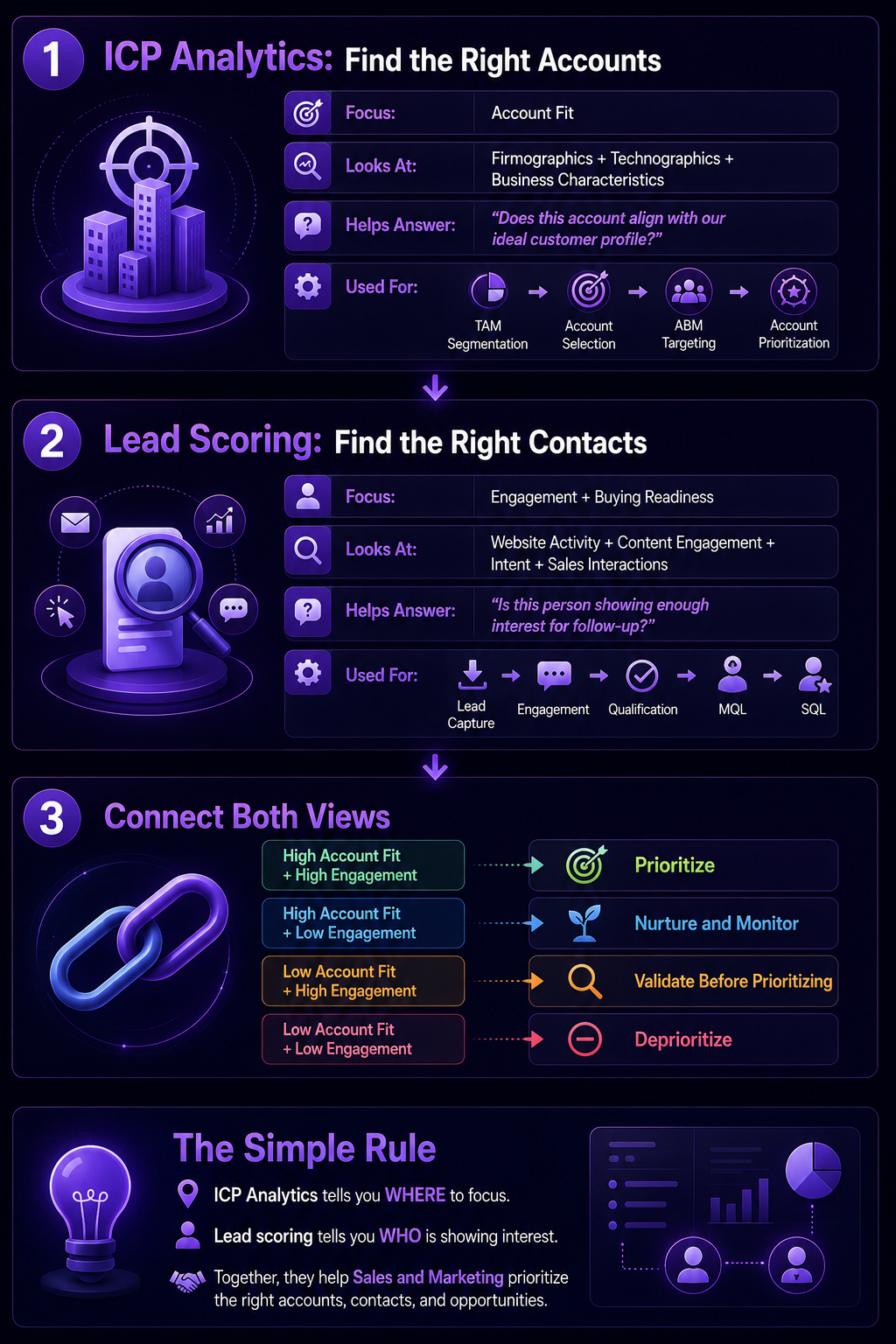
B2B teams make two different decisions during the buyer journey: which accounts are worth targeting and which contacts are showing buying interest. ICP Analytics supports the first decision by measuring account fit. Lead scoring supports the second by tracking individual engagement and readiness.
How to Build a Combined Fit + Engagement Scoring Framework
A combined scoring framework starts with account fit, adds contact engagement, and uses both signals to determine priority. The framework should reflect your actual customers and revenue outcomes rather than rely on arbitrary scoring rules.
1. Define Your ICP Criteria
Start with the characteristics shared by your best customers. Consider:
- Industry
- Company size
- Revenue
- Technology stack
- Growth stage
- Geographic market
Use these factors to create a clear account fit score.
2. Add Contact Engagement Signals
Next, track actions that indicate growing interest, such as:
- Product page visits
- Content downloads
- Webinar attendance
- Demo requests
- Sales interactions
These signals form the engagement score.
3. Add Intent Signals
Layer in Intent Data when available. Research activity around your category or solution can add useful context, particularly when multiple contacts from the same account show interest.
4.Combine the Scores
A simple framework can look like:
Account Fit + Contact Engagement + Intent = Priority
For example, a high-fit account with several engaged contacts should generally receive more attention than a low-fit account with one highly active contact.
5. Validate and Refine
Compare scores against real outcomes such as opportunity creation, win rate, deal size, sales cycle, and Customer Lifetime Value (CLV).
If high-scoring accounts rarely create opportunities, revisit the criteria. A scoring model should evolve as your customers, market, and buying behavior change.
Common Mistakes When Choosing Between ICP Analytics and Lead Scoring
The biggest mistake is treating account fit and prospect engagement as the same signal. They answer different questions, and confusing them can lead Sales and Marketing teams toward the wrong priorities.
1. Treating Engagement as ICP Fit
A contact can download multiple resources and request a demo while working at a company that falls outside your target market.
High engagement may signal interest, but it does not automatically indicate strong commercial fit.
2. Ignoring the Account Behind the Lead
A contact-level score can look impressive without showing the bigger account picture. Enterprise teams should consider the company’s industry, size, technology, and revenue potential before prioritizing the contact.
3. Using Too Many Signals
Adding every available data point can make a scoring model difficult to understand and maintain. Focus on signals that have a clear connection to qualification, pipeline creation, or revenue.
4. Relying on Poor-Quality Data
Outdated firmographic records, incomplete contact information, and unreliable behavioral data can distort scores. Regular Data Enrichment and CRM validation can improve scoring accuracy.
5. Never Recalibrating the Model
Customer profiles and buying behavior change. Review scoring criteria against actual outcomes such as win rate, deal size, sales cycle, and Customer Lifetime Value (CLV).
6. Creating Scores Sales Teams Cannot Use
A score should lead to a clear action. Sales teams need to understand why an account or contact is prioritized and what they should do next.
The strongest approach is simple: use ICP Analytics to determine which accounts deserve attention, then use lead scoring to determine which contacts deserve follow-up.
Conclusion
The right scoring approach depends on the decision your revenue team needs to make. If the challenge is identifying valuable accounts, ICP Analytics gives you a stronger starting point. If the challenge is deciding which contacts deserve immediate attention, lead scoring adds the engagement context you need.
The bigger opportunity comes from connecting these views instead of forcing one model to do both jobs. When account fit, contact engagement, and buying signals point in the same direction, Sales and Marketing can spend more time on opportunities that have a stronger reason to move forward.
That shift can make prioritization more deliberate without making the process unnecessarily complicated. For enterprise teams managing large markets and multiple stakeholders, a connected scoring strategy can turn scattered signals into clearer action.
Identify better-fit accounts and act on buying signals with ICP Analytics. Get a free demo at info@diggrowth.com
Ready to get started?
Increase your marketing ROI by 30% with custom dashboards & reports that present a clear picture of marketing effectiveness
Start Free Trial
Experience Premium Marketing Analytics At Budget-Friendly Pricing.

Learn how you can accurately measure return on marketing investment.
How Predictive AI Will Transform Paid Media Strategy in 2026
Paid media isn’t a channel game anymore, it’s a chessboard. Search, social, programmatic, video, influencer, native,...
Read full post post
Don’t Let AI Break Your Brand: What Every CMO Should Know
AI isn’t just another marketing tool. It’s changing how we connect with customers, personalize content, and...
Read full post post
From Demos to Deployment: Why MCP Is the Foundation of Agentic AI
A quiet revolution is unfolding in AI. And it’s not happening inside research labs. For decades,...
Read full post postFAQ's
Use ICP Analytics when the main challenge is identifying which companies fit your target market. It is useful for account selection, ABM, territory planning, and prioritizing high-fit accounts.
Yes. A lead can show strong engagement while coming from an account that does not match your ICP. Reviewing account fit alongside engagement can prevent Sales teams from spending time on contacts with limited commercial potential.
ICP Analytics can identify high-fit accounts first, while lead scoring can identify engaged contacts within those accounts. This combination gives Sales and Marketing teams context about both where to focus and who to engage.
Use signals that relate directly to your business outcomes. ICP Analytics can consider firmographics, technographics, industry, and revenue, while lead scoring can include behavioral activity, engagement, and intent signals.
Review scoring criteria regularly against actual outcomes such as opportunity creation, win rate, deal size, sales cycle, and Customer Lifetime Value. Recalibration becomes necessary when your ICP or buyer behavior changes.