
Ideal Customer Profile Explained: Identify the Right B2B Customers Faster
An ideal customer profile (ICP) identifies the type of company most likely to generate long-term value for your business. Built using customer and revenue insights, it enables better targeting, stronger sales and marketing alignment, and more predictable growth. Read on.
Why are your highest-paying customers so different from the majority of companies in your pipeline?
Why do some accounts move through the buying process with confidence while others consume months of sales effort and never convert?
If those questions keep surfacing in revenue meetings, the issue may not be your campaigns, pricing, or sales execution. It may be the way your business decides who to pursue in the first place.
Many B2B organizations invest heavily in generating more leads, assuming volume will translate into growth. More often than not, the opposite happens. Sales teams spend time on poor-fit prospects, marketing budgets stretch further than they should, and leadership is left wondering why revenue is not keeping pace with pipeline growth.
The businesses that consistently grow are selective long before the first sales conversation begins. They define the types of companies that create the most value for the business and use that understanding to guide every marketing, sales, and expansion decision.
An ideal customer profile provides that clarity. Rather than chasing every opportunity, it helps teams identify the organizations that are most likely to become profitable, long-term customers.
Key Takeaways
- An ideal customer profile helps you prioritize the right companies, improving lead quality and long-term revenue potential.
- An ICP defines the right business to target, while a buyer persona identifies the right people to engage within that business.
- Build your ICP using real customer and revenue data instead of assumptions to improve targeting accuracy.
- Use your ICP across marketing, sales, and Account-Based Marketing (ABM) to align teams around the same high-value accounts.
- Review and refine your ICP regularly to keep pace with changing customer behavior, markets, and business goals.
What Is an Ideal Customer Profile (ICP)?
An Ideal Customer Profile (ICP) is a clear description of the type of company that is the best fit for your product or service. These companies get the most value from your solution and are more likely to become long-term customers. An ICP focuses on business details such as industry, company size, budget, and business needs, not on individual people.
A well-defined ICP helps businesses to:
Improve lead quality by focusing on companies that closely match their best customers.
Increase sales efficiency by reducing time spent on low-fit prospects.
Improve customer retention by attracting organizations with long-term growth potential.
Support more predictable revenue through consistent customer acquisition.

Ideal Customer Profile vs. Buyer Persona: What’s the Difference?
Many people use Ideal Customer Profile (ICP) and buyer persona interchangeably, but they answer different questions and serve different purposes.
An Ideal Customer Profile defines the type of company that is the best fit for your business. It focuses on firmographic and business-level characteristics such as industry, company size, revenue, location, technology stack, growth stage, and buying potential. An ICP helps businesses decide which accounts to target before any individual conversations begin.
A buyer persona focuses on the people involved in the purchasing decision within those target companies. It explores their job roles, responsibilities, priorities, challenges, decision-making criteria, and preferred communication channels. Buyer personas help marketing and sales teams create messages that resonate with specific stakeholders.
Think of it this way:
| Ideal Customer Profile | Buyer Persona |
|---|---|
| Defines the ideal company to target | Identifies the key contacts who participate in the buying journey |
| Focuses on business characteristics | Focuses on personal motivations and responsibilities |
| Guides account selection and prioritization | Guides messaging, content, and sales conversations |
| Used early in account targeting | Used throughout lead nurturing and the buying journey |
The two work best together. Your Ideal Customer Profile identifies which businesses deserve your attention, while buyer personas explain how to engage the people who influence the purchase. Without an ICP, teams may pursue the wrong accounts. Without buyer personas, even qualified opportunities can be difficult to convert.
Why Your B2B Business Needs an Ideal Customer Profile
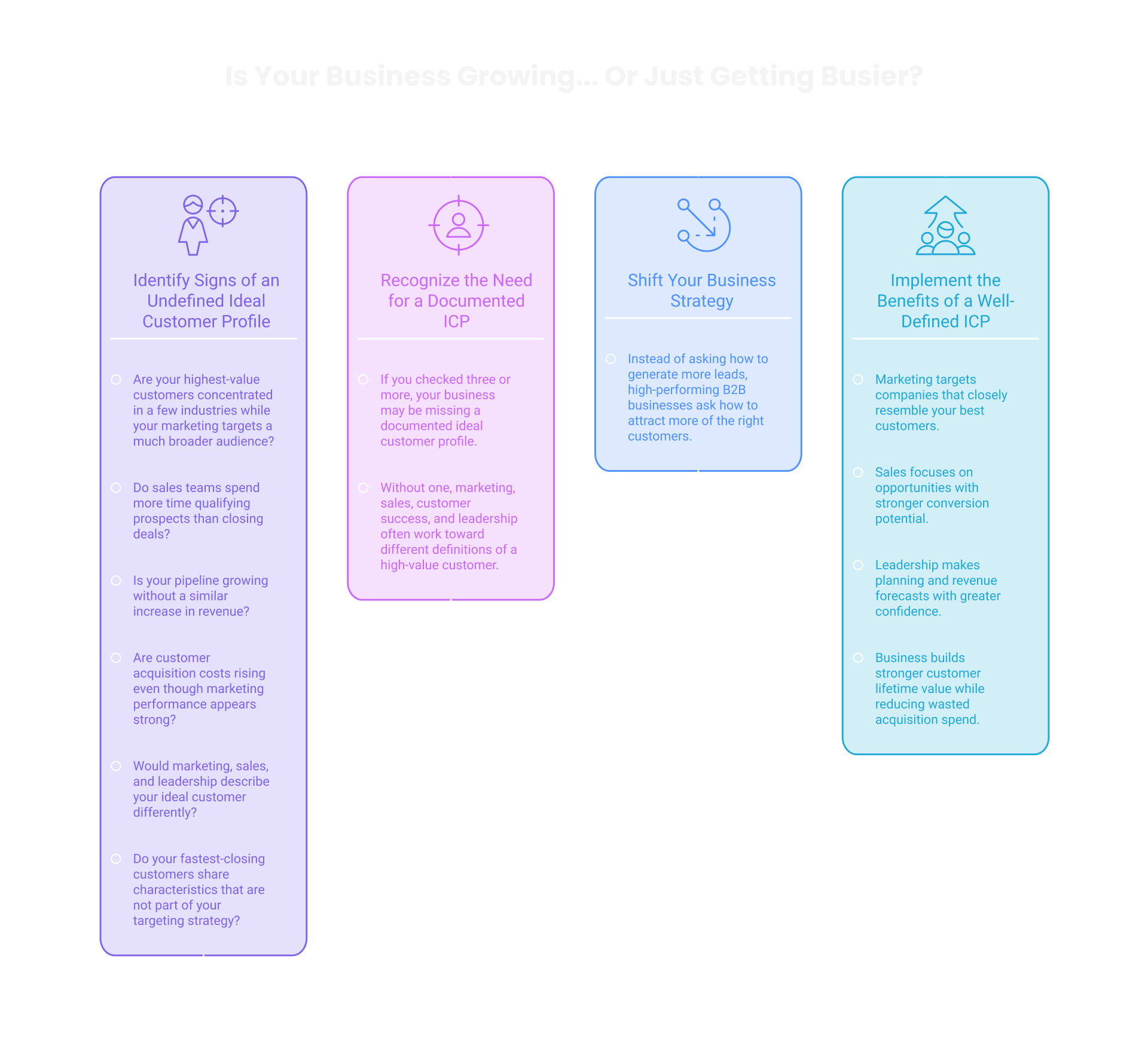
Without a clear ideal customer profile, marketing and sales often operate on assumptions. One team focuses on generating as many leads as possible, while the other spends time qualifying prospects that were never likely to become valuable customers. The result is longer sales cycles, rising acquisition costs, and inconsistent revenue.
An ICP creates alignment before the first conversation happens. It gives every team a shared definition of what a high-value customer looks like, making it easier to prioritize opportunities that support long-term growth.
Key Components
A strong ideal customer profile is based on real customer data, not assumptions. Instead of gathering every detail, focus on the traits your highest-value customers consistently share.
- Company Characteristics: Industry, company size, annual revenue, location, and growth stage. These factors identify businesses that naturally fit your offering.
- Technology Environment: Existing software, infrastructure, integration needs, and digital maturity. A compatible tech stack often leads to faster adoption.
- Business Challenges: Common pain points such as improving efficiency, reducing costs, scaling operations, meeting compliance requirements, or replacing outdated processes. Shared challenges often define your ideal customer profile.
- Buying Potential: Budget, decision-making readiness, growth plans, and long-term partnership potential. The best-fit customers are both qualified and prepared to invest.
Pro Tip : The most effective ideal customer profile reflects patterns found in your best customers, including their business characteristics, technology, challenges, and buying intent.
A Step-by-Step Process for Building an Ideal Customer Profile
There is no template that automatically produces an accurate ideal customer profile. The most reliable ICPs are discovered by studying customer patterns, validating them with data, and refining them as the business evolves.
Step 1: Start With Customers You Would Want Again
Imagine you could duplicate a handful of your existing customers. Which ones would you choose?
Do not base the answer on revenue alone. Look for companies that adopted your solution quickly, achieved measurable results, expanded their relationship over time, and required fewer resources to support.
Those customers usually represent the strongest starting point for your ICP.
Step 2: Find The Patterns Hidden Across Those Customers
You can notice that many operate in the same industry, share a similar company size, face comparable business challenges, or invest in similar technologies.
The goal is not to collect dozens of characteristics. It is to identify the few patterns that appear consistently across your best customer relationships.
Step 3: Separate Assumptions From Evidence
It is easy to believe you know your ideal customer. The data does not always agree.
Review CRM records, closed deals, customer interviews, onboarding insights, and even lost opportunities. When the same characteristic consistently appears across your best customers, it is worth including in your ICP. If it only appears occasionally, it is probably not a defining trait.
An effective ICP reflects evidence, not opinions.
Step 4: Turn Your Findings Into A Shared Playbook
An ICP should not live in someone’s notebook or inside a spreadsheet that no one opens.
Document the characteristics that matter most, including:
- The industries you want to target.
- The business challenges your solution solves best.
- The types of companies that see the fastest results.
- The warning signs that indicate a prospect is unlikely to be a good fit.
The clearer the document, the easier it becomes for every team to make consistent decisions.
Step 5: Put Your ICP To The Test
A well-built ICP should influence real decisions.
Use it when selecting target accounts, qualifying new opportunities, launching campaigns, or prioritizing sales outreach. If teams keep ignoring the profile because it feels unrealistic or incomplete, revisit it and identify what needs to change.
The strongest ICPs earn trust because they consistently lead teams toward better opportunities.
How to Use Your ICP in Account-Based Marketing and Sales Strategy
An ideal customer profile should influence every stage of your go-to-market strategy. Rather than treating it as a one-time exercise, use it to guide decisions across marketing, sales, and revenue planning.
Your ICP can help you:
- Prioritize high-value accounts by identifying companies that closely match your best customers.
- Strengthen Account-Based Marketing (ABM) by building target account lists based on customer fit rather than assumptions.
- Improve sales prospecting by qualifying opportunities earlier and reducing time spent on low-fit accounts.
- Create more relevant marketing campaigns by combining your ICP with customer segmentation to deliver messaging that resonates with different account groups.
- Allocate resources more effectively by focusing budget and effort on opportunities with greater revenue potential.
- Increase forecast accuracy by building a pipeline around companies that are more likely to convert, renew, and expand.
When used consistently, an ICP becomes more than a customer profile. It becomes a framework for making smarter growth decisions across the business
How to Measure and Refine Your ICP Over Time
An ideal customer profile should evolve as your business grows. Reviewing it regularly ensures your targeting reflects the customers that deliver the greatest long-term value rather than relying on outdated assumptions.
| Review This | What It Tells You | When to Act |
|---|---|---|
| Conversion rates | Whether high-fit accounts are progressing through the sales pipeline. | When conversions begin to decline. |
| Customer retention | Which types of customers stay and continue to invest. | When renewals or expansion slow down, |
| Customer acquisition cost (CAC) | Whether your targeting remains cost-effective. | When acquisition costs continue to rise. |
| New customer trends | Whether your best customers now share different characteristics. | After entering a new market or industry. |
| Customer feedback | How well your solution aligns with evolving business needs. | During regular customer reviews and surveys. |
| Business strategy | Whether your ICP still supports current growth goals. | After launching new products or changing direction. |
The goal is not to update your ICP on a fixed schedule. Update it whenever your customers, market, or business strategy changes enough that your definition of a high-value customer no longer reflects reality.
Common Mistakes to Avoid When Building an ICP
Even a well-intentioned ideal customer profile can produce poor results if it is built on assumptions or left unchanged over time.
Mistake #1: Chasing Volume Instead of Customer Quality
A broad target audience may generate more leads, but it often reduces lead quality and stretches marketing and sales resources too thin.
Solution
Focus on the companies that consistently become your most profitable, long-term customers instead of trying to appeal to every potential buyer.
Mistake #2: Building an ICP Around Assumptions
Many businesses define their ideal customer based on opinions rather than evidence, leading to inconsistent targeting and missed opportunities.
Solution
Use customer data, sales insights, and successful account patterns to validate every characteristic included in your ICP.
Mistake #3: Confusing an ICP With a Buyer Persona
An ICP identifies the companies your business should pursue, while buyer personas explain the people involved in the purchasing decision.
Solution
Use your ICP to decide which organizations to target, then build buyer personas to tailor messaging for the stakeholders within those organizations.
Ideal Customer Profile Examples
Every business defines its ideal customer profile differently, but the process becomes far more reliable when it is backed by customer and revenue data instead of assumptions.
The examples below illustrate how businesses can use ICP analytics to uncover the characteristics of their highest-value customers and make better targeting decisions.
Example 1: Finance & Accounting Software Company
Business Challenge
The marketing team was generating a steady flow of leads, but sales noticed that many prospects lacked the budget, operational maturity, or urgency to move forward.
What ICP Analytics Revealed
After analyzing closed-won accounts, the company discovered its strongest customers consistently shared these characteristics:
- Mid-market businesses with 200–1,000 employees
- Multi-location operations
- Cloud-based financial systems already in place
- Leadership focused on reducing manual financial reporting
Business Outcome
Instead of targeting every finance team, campaigns focused on companies matching this profile, improving lead quality and allowing sales to prioritize higher-value opportunities.
Example 2: Marketing Agency
Business Challenge
The agency attracted businesses from many industries, but long-term client retention remained inconsistent.
What ICP Analytics Revealed
Customer analysis showed that the agency’s highest-value clients were businesses that:
- Had dedicated marketing teams
- Already invested in CRM and marketing automation
- Focused on revenue growth rather than one-off campaigns
- Measured marketing performance beyond vanity metrics
Business Outcome
The agency refined its outreach strategy around these characteristics, leading to more qualified conversations and longer client relationships.
Example 3: Compliance and Risk Management Platform
Business Challenge
Sales teams spent months pursuing organizations that delayed buying decisions or never moved beyond initial discussions.
What ICP Analytics Revealed
The most successful customers consistently came from organizations that:
- Operated in highly regulated industries
- Managed multiple compliance requirements
- Had executive sponsorship for digital transformation
- Planned technology investments within the current financial year
Business Outcome
By prioritizing similar accounts, sales reduced time spent on low-fit prospects and focused on organizations with stronger buying intent.
The Bigger Picture
These examples have one thing in common: the businesses did not redefine their ideal customer profile through guesswork. They identified recurring customer patterns by analyzing real business data.
That is where DiGGGrowth’s ICP Analytics adds value. Instead of manually reviewing customer records and relying on assumptions, it helps businesses uncover the characteristics of their highest-value customers, refine their ICP over time, and give marketing and sales teams a shared foundation for smarter growth decisions.
Conclusion
An ideal customer profile should never be based on assumptions or remain static as your business grows. The strongest B2B organizations continuously refine their ICP using customer, pipeline, and revenue data, ensuring every marketing and sales decision is focused on the accounts most likely to drive long-term growth.
Instead of relying on manual analysis or outdated customer profiles, let AI uncover the patterns behind your highest-value customers. DiGGGrowth’s ICP Analytics identifies your best-fit accounts, reveals lookalike opportunities, and continuously refines your ICP as new data flows into your business.
Start with the complimentary ICP assessment today and discover which accounts are most likely to become your next best customers.
Ready to get started?
Increase your marketing ROI by 30% with custom dashboards & reports that present a clear picture of marketing effectiveness
Start Free Trial
Experience Premium Marketing Analytics At Budget-Friendly Pricing.

Learn how you can accurately measure return on marketing investment.
You’re Targeting Your Ideal Customer. So Why Aren’t They Buying?
Your best customers reveal the traits associated with success. Your lost opportunities reveal where fit breaks...
Read full post post
How Predictive AI Will Transform Paid Media Strategy in 2026
Paid media isn’t a channel game anymore, it’s a chessboard. Search, social, programmatic, video, influencer, native,...
Read full post post
Don’t Let AI Break Your Brand: What Every CMO Should Know
AI isn’t just another marketing tool. It’s changing how we connect with customers, personalize content, and...
Read full post postFAQ's
An ideal customer profileis a business-level framework used in B2B marketing to identify the organizations that best align with your solution. Rather than targeting every potential prospect, it helps teams focus on companies that are more likely to become profitable, long-term customers.
Think of an ICP and a buyer persona as two different levels of decision-making. An ICP determines whether a company is worth pursuing, while a buyer persona helps you understand the people responsible for evaluating and approving the purchase. One guides account selection; the other shapes communication.
An effective ICP combines the characteristics that repeatedly appear among your best customers. This may include the industries they operate in, their business size, growth stage, technology environment, operational priorities, and signs that indicate they are ready to invest in a solution like yours.
Without a clear ICP, marketing and sales often pursue opportunities that are unlikely to create long-term value. An ICP provides a shared standard for deciding which companies deserve attention, allowing teams to concentrate on opportunities with stronger revenue potential instead of simply increasing lead volume.
An ICP acts as the starting point for Account-Based Marketing (ABM) by narrowing the list of target accounts before campaigns begin. Instead of selecting companies based on assumptions, teams use the ICP to focus on organizations that closely resemble existing high-value customers, making outreach more relevant and increasing the likelihood of meaningful engagement.