Best AI Sales Prospecting Tools in 2026
AI prospecting platforms help sales teams identify target accounts, find relevant contacts, enrich data, research prospects, and prioritize who to approach. The best AI tools for sales prospecting vary in how they support these tasks, from targeted account discovery and intent analysis to sales engagement and AI-led workflows.
The prospecting challenge is not simply finding more leads. It is knowing which accounts are worth pursuing, who to contact, and what matters before reaching out.
Sales teams often spend hours filtering accounts, finding the right contacts, checking data, researching prospects, and deciding where to focus first. AI sales prospecting tools can reduce that manual work by supporting account discovery, contact enrichment, prospect research, prioritization, personalization, and outreach.
However, these platforms do not solve prospecting in the same way. Some focus on ICP-based targeting, while others emphasize data enrichment, research, buying signals, sales engagement, or AI-led sales workflows. The right choice depends on where your prospecting process needs the most improvement.
In this guide, we compare 10 leading AI prospecting tools based on their primary use cases, core capabilities, best-fit teams, and the factors worth considering before you choose one.
Key Takeaways
- There is no single best AI prospecting tool. The right choice depends on your team’s biggest prospecting bottleneck.
- Different tools solve different problems, from ICP-based targeting and data enrichment to intent, outreach, and AI-led execution.
- A larger database does not guarantee better prospects. Data accuracy, freshness, coverage, and ICP fit matter more.
- AI can reduce manual prospecting work, but the level of automation varies from research assistance to AI-led sales execution.
- Test tools with your real ICP and workflow to see which one improves prospect quality, rep productivity, and pipeline outcomes.
Best AI Sales Prospecting Tools at a Glance
| Tool | Best For | Core Strength | Main Consideration |
|---|---|---|---|
| ReachGen | ICP-driven prospecting | Account and contact intelligence | Best suited to targeted prospecting |
| Apollo | All-in-one prospecting | Data, research, and engagement | Broad platform with many use cases |
| Clay | Custom prospecting and enrichment | Flexible research and workflows | Requires more setup |
| ZoomInfo | Enterprise sales intelligence | B2B data and intelligence | Better fit for larger teams |
| 6sense | Intent and prioritization | Predictive account intelligence | Strong fit for ABM teams |
| Cognism | Contact intelligence | B2B contact data and signals | Coverage varies by market |
| LinkedIn Sales Navigator | LinkedIn-led prospecting | Professional and relationship data | Often paired with other sales tools |
| Amplemarket | Prospecting and engagement | Signals and outbound execution | Best for teams connecting discovery and outreach |
| HubSpot Breeze Prospecting Agent | CRM-native prospecting | AI research and outreach | Best suited to HubSpot users |
| Salesforce Agentforce | Agent-led prospecting | CRM-connected AI agents | Broader than dedicated prospecting software |
What Can AI Do in Sales Prospecting?
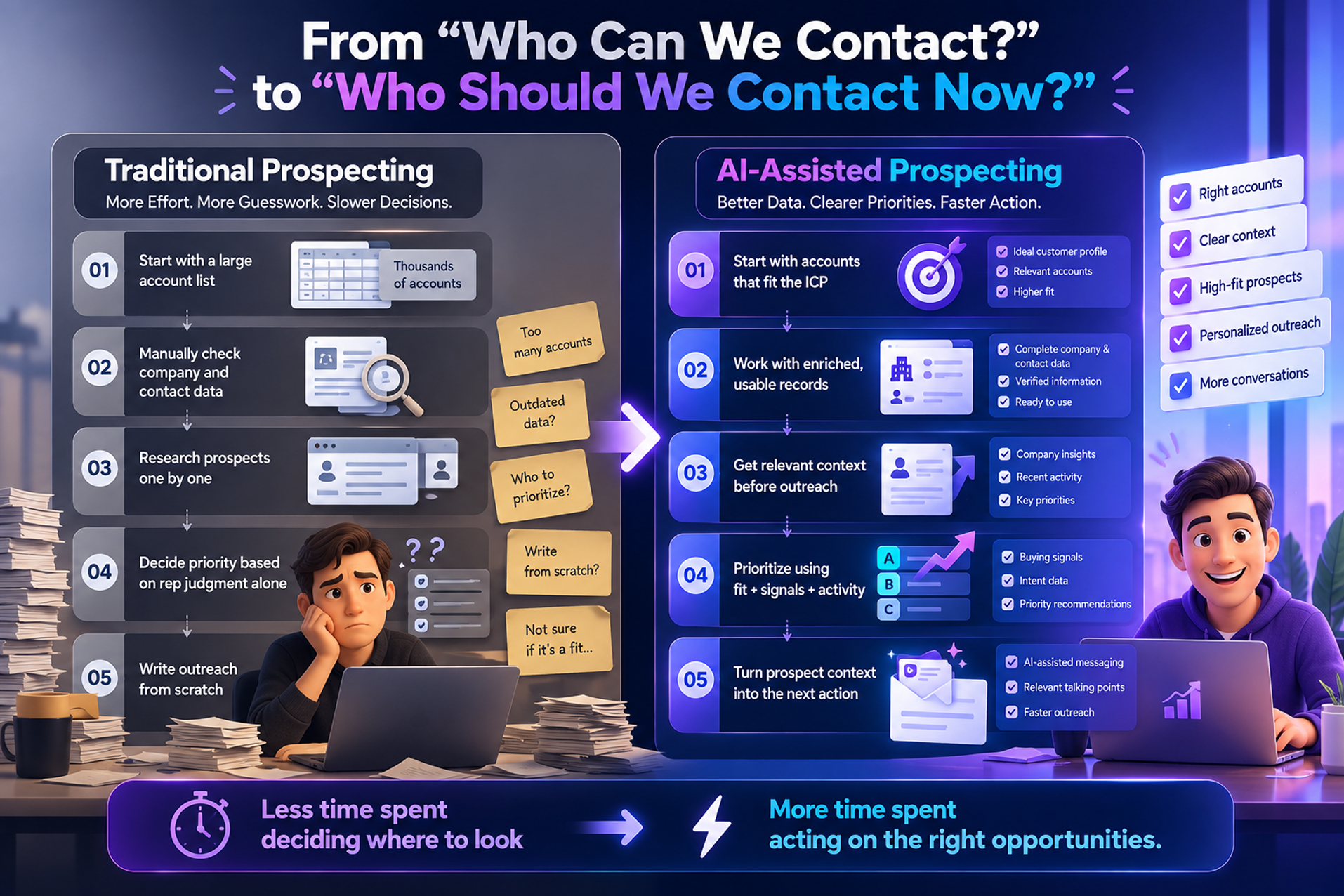
AI can reduce the manual work involved in sales prospecting, from finding potential accounts to preparing them for outreach. The exact capabilities vary by platform, but most AI prospecting workflows support five key areas.
Find Accounts That Fit Your ICP
AI can help sales teams turn ICP criteria into account searches and identify companies that match factors such as industry, company size, location, technology, and business model.
The goal is not to find more accounts. It surfaces accounts more likely to fit your target market, so reps spend less time filtering out irrelevant companies.
Find and Enrich Contacts
Once an account is identified, AI can help find the people most relevant to the sale based on job title, seniority, department, or buyer role.
It can also enrich incomplete records with company and contact information and help verify whether the available data is usable. This connects account targeting with the people a sales team actually needs to reach.
Research Prospects
AI can bring together information that reps would otherwise have to collect manually from multiple sources. It can summarize companies and prospects and surface useful context such as:
- Job changes
- Hiring activity
- Funding
- Technology changes
- Company activity
- Intent signals
The value is not simply having more data. It is turning scattered information into usable sales context before a rep reaches out.
Prioritize the Accounts That Matter
Finding potential prospects is only part of the job. AI can help determine which accounts deserve attention first by analyzing factors such as intent, buying signals, account fit, and other business activity.
This helps sales teams move from “Who could we contact?” to “Who should we contact first?”
Turn Prospect Intelligence Into Outreach
AI can also help sales teams act on the information they collect. Depending on the platform, this can include generating personalized messaging, preparing follow-ups, creating sequences, and automating parts of sales engagement.
This creates a connection between prospecting and execution: instead of handing reps a list of prospects and leaving them to start the research process again, AI can help turn prospect intelligence into the next sales action.
10 Best AI Sales Prospecting Tools in 2026
1. ReachGen
Best For: ICP-driven account and contact discovery
ReachGen is an AI agent for outbound reach generation. It helps teams identify accounts and contacts that fit their ICP, prioritize prospects using intent signals, enrich and verify data, and prepare personalized outreach.
Key Capabilities:
- ICP-based account and contact discovery
- Firmographic and technographic enrichment
- Segmentation and verification
- Intent-based prioritization
- Personalized prospecting
- Salesforce and HubSpot integrations
Buyer Consideration: ReachGen is built around targeted prospecting and account intelligence rather than simply providing access to a large contact database.
2. Apollo
Best For: All-in-one prospecting and sales engagement
Apollo combines prospect data with AI research, enrichment, personalization, sequencing, and outreach. Its AI capabilities can help teams find ICP-matched prospects, qualify leads, summarize prospect information, and prioritize accounts.
Key Capabilities:
- Company and contact discovery
- AI-assisted prospect research
- Data enrichment
- Personalization and sequencing
- Lead scoring and buying signals
- Sales engagement
Buyer Consideration: Apollo makes sense for teams that want prospecting and engagement in one platform rather than a specialized tool for a single part of the workflow.
3. Clay
Best For: Custom prospecting, enrichment, and research
Clay gives teams more control over how prospecting and enrichment workflows are built. It brings together multiple data providers, enrichment, AI research, signals, and custom workflows.
Key Capabilities:
- Multi-source data enrichment
- Waterfall enrichment workflows
- AI-powered research
- Custom prospecting workflows
- Company and contact enrichment
- Personalized GTM workflows
Buyer Consideration: Its flexibility is useful for teams with complex requirements, but it can require more setup and workflow expertise than a simpler prospecting platform.
4. ZoomInfo
Best For: Enterprise sales intelligence
ZoomInfo provides broad B2B sales intelligence, including company and contact data, enrichment, intent, and account information.
Key Capabilities:
- Company and contact intelligence
- Data enrichment
- Intent signals
- Account insights
- Sales intelligence
- Enterprise GTM data
Buyer Consideration: ZoomInfo is better suited to organizations that need broad sales intelligence across a larger GTM operation rather than a narrowly focused prospecting solution.
5. 6sense
Best For: Intent and account prioritization
6sense focuses on intent data, predictive intelligence, buying stages, and account prioritization. It helps teams understand which accounts are showing buying activity and where they may be in the buying process.
Key Capabilities:
- Intent data
- Predictive intelligence
- Buying-stage insights
- Account prioritization
- AI-powered sales research
- ABM activation
Buyer Consideration: 6sense is most relevant when identifying which accounts are ready for sales attention is more important than simply finding more prospects.
6. Cognism
Best For: B2B contact and company intelligence
Cognism focuses on B2B contact and company data, phone-verified information, international coverage, compliance, and sales signals.
Key Capabilities:
- Contact and company data
- Phone-verified information
- Data enrichment
- International coverage
- Sales signals
- Compliance-focused data practices
Buyer Consideration: Teams should evaluate Cognism against the specific countries, industries, and job functions they target, particularly when contact-data quality and phone prospecting are important.
7. LinkedIn Sales Navigator
Best For: LinkedIn-led prospecting and relationship intelligence
LinkedIn Sales Navigator uses LinkedIn’s professional network to help sales teams find prospects, research accounts, monitor changes, and understand relationships.
Key Capabilities:
- Account and lead search
- Professional and relationship context
- Job and company change alerts
- Shared connection insights
- LinkedIn activity
- Account research
Buyer Consideration: Sales Navigator is particularly valuable for relationship-driven prospecting but may need complementary tools for enrichment, verification, or sales engagement.
8. Amplemarket
Best For: Prospecting and outbound engagement
Amplemarket connects prospect discovery, signals, research, personalization, sequencing, and sales engagement in one workflow.
Key Capabilities:
- Prospect discovery
- Buying and business signals
- AI prospect research
- Personalization
- Sequencing
- Sales engagement
Buyer Consideration: Amplemarket is a stronger fit when teams want discovery and outbound execution to be connected, rather than using a dedicated data or intelligence platform.
9. HubSpot Breeze Prospecting Agent
Best For: CRM-native AI prospecting
HubSpot Breeze Prospecting Agent brings AI prospecting into the HubSpot environment. It can research prospects, source and enrich contacts, monitor buying signals, personalize outreach, and automate parts of the lead follow-up process.
Key Capabilities:
- AI prospect research
- Prospect and contact sourcing
- Contact enrichment
- Buying-signal monitoring
- Personalized outreach
- Automated follow-up
Buyer Consideration: Its biggest advantage is the context available within HubSpot, making it particularly relevant for teams that already use the CRM as a central source of sales information.
10. Salesforce Agentforce
Best For: Agent-led sales prospecting
Salesforce Agentforce takes an agent-driven approach to sales prospecting. Its Prospecting Agent can research accounts and contacts, identify and prioritize prospects, and use CRM and connected data to support prospecting.
Key Capabilities:
- AI prospect research
- Account and contact identification
- Prospect prioritization
- CRM-connected workflows
- AI sales agents
- Automated sales tasks
Buyer Consideration: Agentforce goes beyond conventional prospecting software, so it is most relevant to Salesforce-centric organizations exploring AI across a broader sales workflow.
How These AI Prospecting Tools Differ
The biggest difference is where each platform puts its emphasis. Some are built to improve targeting and data, while others focus on intent, relationship intelligence, or connecting prospecting with execution.
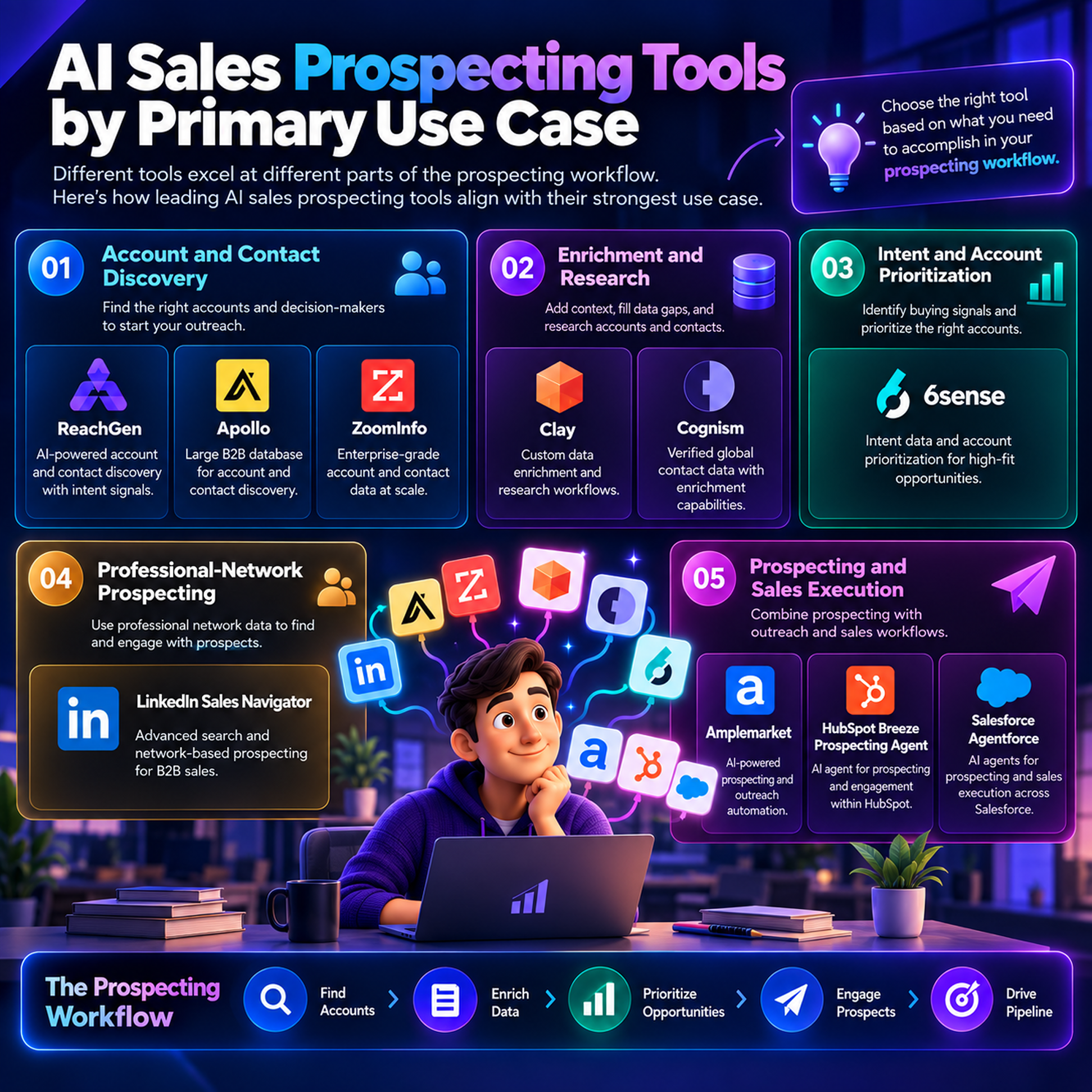
| Prospecting approach | Tools that stand out | What makes them different |
|---|---|---|
| ICP-driven targeting | ReachGen | Starts with account fit and connects discovery, enrichment, intent, and prospecting around the ICP. |
| Broad prospect data | Apollo, ZoomInfo, Cognism | Prioritize access to company and contact intelligence at broader scale. |
| Flexible research and enrichment | Clay | Gives teams more control over data sources, enrichment logic, and custom workflows. |
| Intent and prioritization | 6sense | Focuses on identifying accounts showing buying activity and determining where sales should focus. |
| Professional-network discovery | LinkedIn Sales Navigator | Uses professional relationships, connections, and LinkedIn activity as part of prospect research. |
| Prospecting + engagement | Apollo, Amplemarket | Connect prospect discovery with personalization, sequencing, and outbound execution. |
| AI-led sales workflows | HubSpot Breeze Prospecting Agent, Salesforce Agentforce | Uses AI agents within the CRM to handle more of the research, qualification, and sales workflow. |
How to Choose the Right AI Sales Prospecting Tool
Start with the problem, not the feature list.
If Your Problem is Poor Account Targeting
Look for:
- ICP-based account discovery
- Account intelligence
- Segmentation
- Firmographic and technographic data
If Your Problem is Unreliable Contact Data
Look for:
- Contact coverage
- Enrichment
- Verification
- Data freshness
- Geographic coverage
If Your Problem is Account Prioritization
Look for:
- Intent data
- Buying signals
- Account scoring
- Predictive intelligence
- Buying-stage information
If Your Reps Spend Too Much Time Researching
Look for:
- AI research
- Account summaries
- Prospect context
- Automated research
If Prospecting and Outreach Are Disconnected
Look for:
- Prospect discovery
- Personalization
- Sequencing
- Follow-up
- Sales engagement
If You Want AI to Handle More of the Process
Look for:
- AI sales agents
- Prospect research
- Qualification
- Engagement
- Workflow execution
[ADD INFOGRAPHIC HERE] Suggested topic: How to Choose the Right AI Sales Prospecting Tool
What to Check Before Buying
Test the Tool With Your Real ICP
Do not judge a prospecting platform using a vendor’s sample account. Give it a real version of your ICP and see whether the accounts it finds are companies your sales team would actually pursue.
Check the Data Against Known Accounts
Take a sample of existing accounts and check:
- Contact accuracy
- Job titles
- Company information
- Data freshness
- Geographic coverage
A large database is not useful if it has poor coverage in your target market.
Run the Same Prospecting Task Across Vendors
If you are comparing several tools, give each one the same prospecting assignment.
For example, ask each platform to find suitable accounts, identify relevant contacts, enrich those contacts, and prepare the information a rep would need for outreach.
Then compare the amount of manual work left for the sales team.
Pro Tip- Apply the same account criteria and job-title requirements to every tool, then manually compare the first 20–50 results. This shows whether differences in prospect quality come from the platform or from how the search was configured.
Check How it Fits Your Existing Stack
Review the tool’s connection with your:
- CRM
- Sales engagement platform
- Data providers
- Existing workflows
- Other GTM tools
The goal is to remove manual work, not create another place for reps to update information.
Measure the Result
Track outcomes such as:
- Time saved per rep
- Qualified accounts identified
- Usable contacts found
- Meetings generated
- Conversion rates
- Pipeline contribution
Pro Tip- When comparing vendors, test them on the same 20–50 target accounts. Do not compare the number of records returned. Compare how many of those records your reps would actually use. That gives you a much clearer picture of data quality and account fit.
Common Mistakes to Avoid
Choosing the right platform is not just about comparing features. Teams can still end up with the wrong solution if they evaluate it against the wrong criteria or fail to validate how it works in their actual sales process.
1. Choosing the Tool Before Defining the Prospecting Problem
Start with the bottleneck, not the vendor.
If the problem is poor account targeting, an outreach-focused platform may not help. If reps already have good prospects but spend too much time researching them, a better research and enrichment workflow may be more valuable.
2. Choosing Database Size Over Prospect Quality
A larger database does not automatically mean better prospecting.
Evaluate whether the platform can consistently surface accounts and contacts that match your ICP, rather than simply comparing the number of records available.
3. Evaluating Features Instead of the Full Workflow
A platform may have impressive AI features but still leave your reps doing most of the manual work.
Test the actual process:
Find account → identify contact → enrich → research → prioritize → prepare for outreach
The better tool is the one that meaningfully reduces work across the steps your team actually struggles with.
4. Trusting Vendor Data Without Testing It
Do not assume that database size or data coverage guarantees usable information.
Test shortlisted platforms against real accounts and contacts to evaluate accuracy, freshness, job titles, contact details, and coverage in your target markets.
5. Assuming More Automation Means Better Prospecting
AI can reduce repetitive work, but sales teams still need to review account fit, validate context, and decide how to approach a prospect.
The goal should be less manual work and better decisions, not maximum automation for its own sake.
6. Measuring the Tool by Activity Instead of Business Impact
More contacts, searches, or emails do not necessarily mean the platform is improving prospecting.
After implementation, measure outcomes such as:
- Qualified accounts identified
- Rep time saved
- Usable contacts found
- Qualified meetings
- Conversion rates
- Pipeline contribution
Conclusion
Choosing an AI sales prospecting tool starts with identifying what your team needs to improve. If the main challenge is finding ICP-fit accounts and contacts, prioritize account intelligence, discovery, enrichment, and verification. If the problem is poor data, focus on coverage, accuracy, freshness, and geographic fit.
Teams struggling with account prioritization should look for intent and predictive signals, while those losing time to research should prioritize AI-powered research and prospect intelligence. If prospecting and outreach are disconnected, an integrated sales engagement platform may be a better fit.
Once you have a shortlist, evaluate each tool using your actual ICP, target accounts, and sales workflow. Test the quality of the accounts and contacts it surfaces, how much manual work it removes, how well it fits your existing stack, and whether it improves measurable outcomes such as rep productivity, qualified meetings, or pipeline.
Ready to Get Started? Talk to Us!
For teams focused on ICP-based prospecting, ReachGen is worth considering for its combination of account and contact discovery, enrichment, verification, segmentation, intent signals, and personalized prospecting. To discuss whether it fits your workflow, reach out to info@diggrowth.com.
Ready to get started?
Increase your marketing ROI by 30% with custom dashboards & reports that present a clear picture of marketing effectiveness
Start Free Trial
Experience Premium Marketing Analytics At Budget-Friendly Pricing.

Learn how you can accurately measure return on marketing investment.
You’re Targeting Your Ideal Customer. So Why Aren’t They Buying?
Your best customers reveal the traits associated with success. Your lost opportunities reveal where fit breaks...
Read full post post
How Predictive AI Will Transform Paid Media Strategy in 2026
Paid media isn’t a channel game anymore, it’s a chessboard. Search, social, programmatic, video, influencer, native,...
Read full post post
Don’t Let AI Break Your Brand: What Every CMO Should Know
AI isn’t just another marketing tool. It’s changing how we connect with customers, personalize content, and...
Read full post post