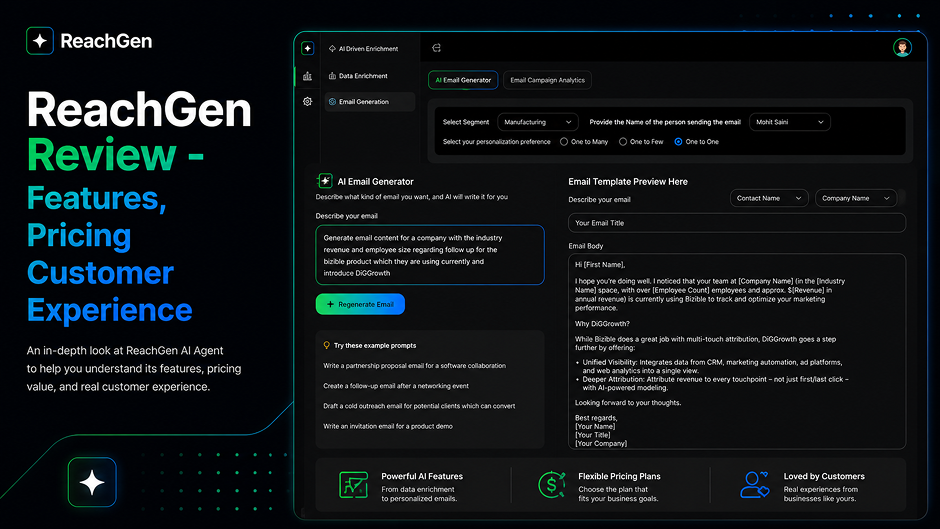
ReachGen Review: Features, Pricing, Data Quality, and Customer Experience
B2B prospecting becomes more effective when account data, targeting, and outreach work together in a connected workflow. This ReachGen review examines its features, pricing, data quality, AI outreach, CRM fit, and customer experience to help teams assess whether ReachGen suits their sales process.
Choosing an AI prospecting platform based on its feature list can be misleading. A platform may look impressive and still create friction in your sales workflow.
ReachGen brings account intelligence, contact enrichment, data verification, ICP-based prospecting, and AI-assisted outreach together within a single workflow. But having these capabilities in one place does not automatically make it the right choice for every B2B team.
The more important questions focus on real-world use: How accurate and reliable is the data? How does the platform fit into existing CRM workflows? How Does ReachGen Pricing Scale With Prospecting Volume? And does the customer experience justify adding another tool to your stack?
This ReachGen review looks at those questions to help you decide if the platform fits your prospecting needs. Let’s dive in.
Key Takeaways
- ReachGen combines account discovery, enrichment, verification, ICP targeting, and AI-assisted outreach in one prospecting workflow.
- ICP-based prospecting can help B2B teams narrow account and contact searches around specific business criteria.
- ReachGen offers limited free contact enrichment, while higher usage and premium capabilities require evaluation of advanced tiers.
- The overall experience depends on data quality, CRM setup, AI output, workflow continuity, and the amount of manual review required.
How Does ReachGen Support B2B Prospecting?
ReachGen connects account research, prospect data enrichment, verification, audience segmentation, and AI-supported messaging within the same outbound process. This lets B2B teams handle multiple prospect research tasks within one workflow instead of moving between different tools.
The platform covers the core areas teams typically evaluate in a prospecting workflow: finding relevant accounts, enriching contact records, verifying data, building targeted segments, and preparing personalized outreach.
ReachGen supports ICP-based account discovery, helping teams filter potential prospects according to the characteristics of their ideal customer profile. Dynamic segmentation can then help organize accounts and contacts for specific campaigns or sales activities.
Pricing and scalability remain separate evaluation factors. Teams should weigh their expected enrichment volume, user needs, and overall prospecting activity before selecting a plan.
ReachGen At a Glance
| Evaluation Area | ReachGen |
|---|---|
| Primary use | B2B prospecting and account intelligence |
| Account discovery | Yes |
| Contact enrichment | Yes |
| Data verification | Yes |
| ICP discovery | Yes |
| Dynamic segmentation | Yes |
| AI-assisted outreach | Yes |
| CRM integrations | Salesforce, HubSpot |
| AI assistant | DiGGi-GPT |
| Free access | Limited monthly enrichment |
| Best fit | B2B sales and GTM teams |
What Are the Key ReachGen Features?
ReachGen brings several prospecting capabilities into one workflow, but each feature serves a different stage of account selection and outreach. For a review, the useful question is not simply what ReachGen includes, but how those capabilities support the decisions sales teams make during prospecting.
Which ReachGen Features Matter Most for Prospecting?
| Capability | What It Supports | What Buyers Should Evaluate |
|---|---|---|
| Account discovery | Finding companies that match target criteria | Search flexibility and account coverage |
| Data enrichment | Building fuller account and contact records | Data depth and relevance |
| Verification | Checking prospect information | Accuracy and freshness |
| ICP targeting | Filtering accounts against ideal customer criteria | Precision of targeting |
| Dynamic lists | Organizing changing prospect segments | Segmentation flexibility |
| AI outreach | Preparing context-based messaging | Relevance and editing control |
| CRM connectivity | Moving prospect data into existing workflows | Integration and data synchronization |
| DiGGi-GPT | Working with account and marketing intelligence | Quality and usefulness of responses |
Pro Tip : The combination matters because prospecting rarely ends after finding a company. Teams still need to identify the right people, validate their information, organize accounts, and prepare the next sales action.
Which Features Should Teams Test First?
A practical evaluation should start with the capabilities closest to revenue impact:
1. Account discovery: Check whether the accounts surfaced align with your defined ICP criteria.
2. Data enrichment: Check several records against information your team already trusts.
3. Verification: Look for accuracy across job titles, company details, and contact information.
4. AI outreach: Review generated messages for relevance, specificity, and the amount of editing they require.
5. CRM connectivity: Check how smoothly prospect data transfers into your existing Salesforce or HubSpot processes.
How Good Is ReachGen for Data Quality and Account Intelligence?
ReachGen combines account and contact enrichment with verification to give sales teams more context before they begin outreach. Its data workflow can include company details, contact information, technology usage, funding data, and other relevant account-level signals.
Data Quality
- Coverage : Builds account and contact records from multiple data sources
- Freshness: Uses ongoing verification to reduce outdated records
- Accuracy: Cross-checks available information before adding it to profiles
- Completeness: Combines company and contact details to create richer records
- Market Variation: Data depth can differ by industry, geography, and company size
Account Intelligence
- Firmographic Signals : Company size, industry, location, and business attributes
- Contact Intelligence : Identifies relevant people and their roles
- Company Insights : Brings multiple account-level data points together
- Prospecting Context : Gives sales teams more information for account research
- ICP Fit : Supports evaluating whether an account matches target criteria
How to Evaluate ReachGen Data
1. Check Accuracy: Compare a sample of records against your CRM and trusted first-party sources.
2. Check Freshness: Test recently changed companies, job roles, and contact information.
3. Check Coverage: Measure how well ReachGen performs across your target industries and markets.
4. Check Account Relevance: Assess whether the intelligence actually improves account prioritization.
How Well Does ReachGen Support ICP-Based Prospecting?
ReachGen applies ICP criteria to narrow account and contact searches, supporting more targeted outbound and ABM campaigns. The practical value depends on how precisely teams can define their target accounts and turn those criteria into usable prospect lists.
Consider a B2B SaaS company targeting businesses with 200+ employees, a specific technology stack, selected industries, and VP-level marketing contacts. Instead of searching for each requirement separately, the team can use these criteria to narrow its account and contact pool.
The resulting workflow looks like this:
ICP criteria → Matching accounts → Relevant decision-makers → Segmented prospects → CRM-ready data
This approach shifts prospecting from broad list building toward account selection based on the characteristics that matter to the business.
ReachGen ICP Evaluation Checklist
Before using ReachGen for ICP-based prospecting, check:
- ICP Criteria: Can the team combine multiple account and contact requirements?
- Firmographic Signals: Can teams use factors such as company size and industry?
- Technographic Signals: Can technology usage influence account selection?
- Decision-maker Targeting: Can teams filter contacts by role or seniority?
- Dynamic Segmentation: Can prospect lists reflect changing account criteria?
- CRM Workflow: Can selected account and contact data move into the existing CRM?
Pro Tip : For teams running ABM or highly targeted outbound campaigns, these checks can reveal how closely ReachGen fits the way they define and prioritize accounts.
How Much Does ReachGen Cost?
ReachGen is free to use for a limited number of contact enrichments each month, with no payment information required. ReachGen also has higher-tier options with increased usage and additional capabilities, although its public product page does not currently disclose specific pricing for these plans.
That means teams can test the platform without committing to a paid plan upfront. Teams with higher enrichment requirements will need to evaluate the available advanced tiers based on their expected usage and feature needs.
Is There a Free ReachGen Plan?
Yes. ReachGen offers limited contact enrichment for free each month, and users do not need to provide payment information to access it.
The free access can give teams an opportunity to test the platform before considering an advanced tier. Higher-volume usage and premium features are available through those advanced tiers.
What Should You Consider Before Comparing ReachGen Pricing?
The subscription price alone does not show the full cost of a prospecting workflow. Teams should also consider how much data they need, how many people will use the platform, and how much manual research the workflow replaces.
A simple Total Prospecting Cost Framework can help:
| Cost Factor | Question to Ask |
|---|---|
| Platform cost | What subscription tier fits the team? |
| Data usage | How many records will the team enrich? |
| User seats | How many people need access? |
| CRM usage | Does the workflow require additional tools? |
| Outreach volume | How much personalization will the team generate? |
| Research time | How much manual prospecting can the team reduce? |
How Good Is ReachGen’s AI-Powered Outreach?
ReachGen draws on account details, industry context, company updates, and recent events to help create tailored email drafts. The real test is not whether the platform can generate a message, but whether the output contains useful context without creating extra editing work for sales teams.
What Makes the Outreach Personalization Useful?
The quality of a generated message depends on the context available to the system and how that information is applied. Buyers should assess whether the outreach feels relevant to the recipient rather than simply mentioning details about the company.
Look for:
- Does the message address concerns connected to the recipient’s position?
- Does it use relevant company news or events appropriately?
- Does the message reflect challenges relevant to the prospect’s market?
- Can users edit the draft before it reaches the prospect?
- Can teams maintain their preferred tone and messaging style?
Where Human Review Still Matters
AI-generated outreach still needs a human check before sending. Even accurate account information can produce a weak message if the context is interpreted incorrectly or pushed too far.
Sales teams should review for:
- Incorrect Assumptions: Check that the message does not infer facts that the available data does not support.
- Over-Personalization: Remove details that feel intrusive or unrelated to the sales conversation.
- Generic AI Language: Edit phrases that could apply to almost any prospect.
- Sensitive Information: Avoid using private or inappropriate company details in outreach.
- Brand Consistency: Make sure the final message matches the company’s tone and communication standards.
What Can B2B Teams Expect From the ReachGen Customer Experience?
ReachGen’s customer experience depends on how smoothly teams can move from account selection to usable prospect data and outreach. Key factors include the learning curve, number of manual steps, data quality, AI interaction, CRM connectivity, and how well the workflow fits existing sales processes.
The experience is therefore less about individual features and more about how those features connect during day-to-day prospecting.
How Easy Is ReachGen to Use?
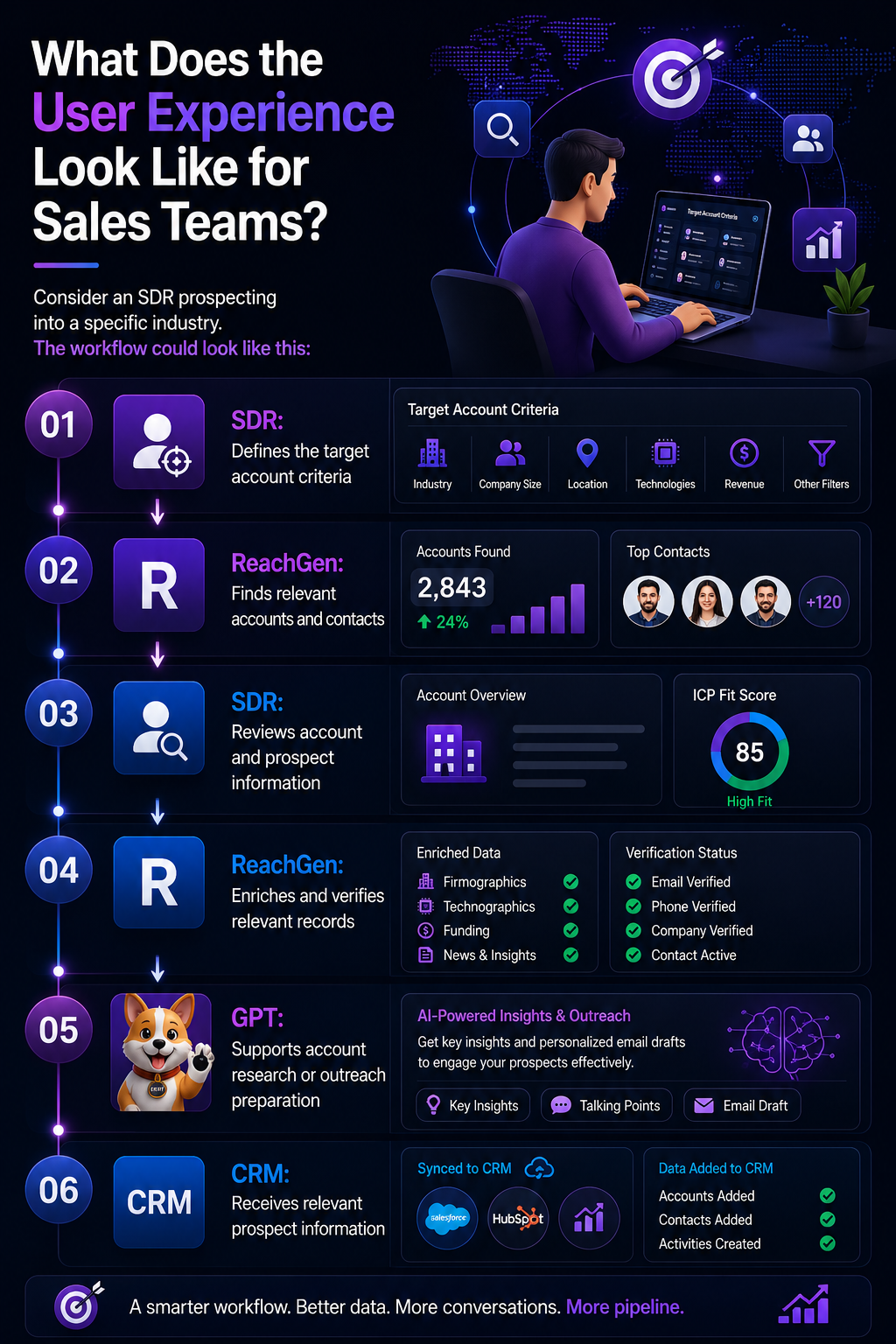
A typical workflow can follow this path:
Define target → Find accounts → Review contacts → Enrich → Segment → Generate outreach → Push to CRM
A straightforward workflow can reduce the back-and-forth involved in prospect research. Teams should still evaluate how much manual review each stage requires, particularly when validating prospect data or editing AI-generated outreach.
The main usability factors to assess are:
- Manual steps: How much work remains between each stage?
- Learning curve: How quickly can a new sales user become productive?
- Prospect discovery: How easily can users find accounts that match their criteria?
- AI editing: How much adjustment do generated messages require?
- Workflow continuity: Can users move between research, enrichment, segmentation, and CRM activity without unnecessary friction?
What Can Affect the ReachGen Customer Experience?
The user experience may differ across teams because existing sales workflows shape how ReachGen is adopted and used. Data accuracy, CRM configuration, ICP complexity, and the amount of human review required can all affect the workflow.
Teams should consider:
- Data accuracy: Incomplete information may require additional verification.
- CRM setup: Existing Salesforce or HubSpot workflows can affect implementation.
- ICP complexity: More detailed targeting criteria may require additional configuration.
- Outreach review: AI-generated messages may need human editing before use.
- Team adoption: Sales users need a clear role for ReachGen within their existing process.
- Existing GTM workflow: Established prospecting and handoff processes can influence adoption.
ReachGen vs. Traditional Prospecting: What Changes?
The main difference is how the prospecting workflow is organized. A fragmented process may require separate steps for account research, data enrichment, verification, list building, and outreach preparation. ReachGen brings several of these activities into a connected workflow.
| Typical Prospecting Workflow | ReachGen Approach |
|---|---|
| Search for target accounts | Define ICP criteria and identify matching accounts |
| Research companies separately | Enrich account information within the workflow |
| Verify prospect data separately | Verify relevant records within the process |
| Build and update lists manually | Create dynamic prospect segments |
| Research before writing outreach | Use account context for AI-assisted outreach |
| Move data between systems | Connect prospect data with supported CRM workflows |
ReachGen Review: Final Verdict
ReachGen is worth considering for B2B teams that want to connect account discovery, enrichment, verification, ICP targeting, and AI-assisted outreach in one prospecting workflow.
Its biggest advantage is the way these capabilities work together. Teams can move from identifying target accounts to researching contacts, enriching records, and preparing outreach within a connected process.
The right choice still depends on data quality, workflow requirements, CRM setup, and expected usage. Testing real prospecting scenarios before committing can give teams a clearer view of the platform’s fit.
Ready to test ReachGen? Get Started Free and see how it fits your prospecting workflow.
Ready to get started?
Increase your marketing ROI by 30% with custom dashboards & reports that present a clear picture of marketing effectiveness
Start Free Trial
Experience Premium Marketing Analytics At Budget-Friendly Pricing.

Learn how you can accurately measure return on marketing investment.
You’re Targeting Your Ideal Customer. So Why Aren’t They Buying?
Your best customers reveal the traits associated with success. Your lost opportunities reveal where fit breaks...
Read full post post
How Predictive AI Will Transform Paid Media Strategy in 2026
Paid media isn’t a channel game anymore, it’s a chessboard. Search, social, programmatic, video, influencer, native,...
Read full post post
Don’t Let AI Break Your Brand: What Every CMO Should Know
AI isn’t just another marketing tool. It’s changing how we connect with customers, personalize content, and...
Read full post postFAQs
ReachGen can suit smaller B2B teams that need structured prospect discovery and enrichment but do not want to manage several separate prospecting tools. The right fit depends on the team’s data requirements, prospecting volume, and existing sales workflow.
Yes. ReachGen can support ABM workflows by helping teams identify accounts using ICP criteria, find relevant contacts, enrich records, and organize prospects for targeted outreach.
Yes. ReachGen supports AI-assisted outreach, but sales teams should review generated messages before sending them. Human review can catch inaccurate assumptions, unnecessary personalization, or wording that does not match the brand.
Teams should test a sample of accounts and contacts against trusted records before adopting the platform at scale. Check fields such as company details, job titles, contact information, technology data, and recently changed roles to assess accuracy and freshness.
ReachGen supports B2B prospecting by helping teams identify target accounts, enrich and verify contact data, segment prospects, and prepare personalized outreach.
Yes. ReachGen offers limited contact enrichment at no cost each month without requiring payment information. Higher usage and additional capabilities are available through advanced tiers.