Sales Intelligence Platforms Compared: Finding a Cognism Alternative for B2B Prospecting
A Cognism alternative for B2B prospecting can offer a different approach when contact data alone does not address targeting, research, intent, enrichment, or workflow needs. The right platform depends on how sales teams identify and prioritize potential buyers. See how leading options differ across data, AI research, automation, and enterprise use cases.
73% of B2B buyers complete most of their research before speaking with a vendor. And a mid-market B2B purchase can involve 9+ stakeholders.
That changes what good prospecting looks like. Finding a contact is no longer enough. Sales teams need to identify the right accounts, understand who matters inside them, and spot signals that suggest a conversation could be timely.
Cognism can support that process with B2B contact and company data. But data access does not automatically tell your team which accounts deserve attention first or how much research each prospect requires.
That is where a Cognism alternative can make sense.
Some teams need richer enrichment. Others need stronger ICP-based targeting, buying signals, AI-powered research, or a more connected prospecting workflow.
The better choice depends less on database size and more on how your sales team actually finds and prioritizes opportunities. Let’s see which platform fits that job best.
Key Takeaways
- Cognism is a strong choice for teams that primarily need reliable contact data, company intelligence, and prospect discovery.
- A Cognism alternative becomes more valuable when sales teams need stronger ICP targeting, account intelligence, buying signals, or AI-assisted research.
- ReachGen takes a more intelligence-led approach by connecting ICP fit, account context, buying signals, and prospect research.
- Enterprise teams should evaluate alternatives based on data quality, scalability, integrations, intelligence, security, and expected business value rather than feature count.
Why Businesses Need to Go Beyond Cognism
Cognism can give sales teams the contact and company data they need to start prospecting. But prospecting gets harder when the job moves beyond finding people and into deciding which accounts deserve attention.
A growing sales team may need to connect ICP targeting, account research, buying signals, enrichment, and outreach preparation within the same process. A contact database alone may not cover all of those needs.
Manual research can become another bottleneck. Reps may spend time checking company information, finding relevant stakeholders, validating prospects, and piecing together context before they can start a conversation.
Teams also differ in how they sell. An SDR team running high-volume outbound campaigns may prioritize speed and contact coverage. An enterprise team may care more about account intelligence, buying intent, and stakeholder mapping.
That is why businesses may look beyond Cognism as their prospecting requirements evolve. The right alternative should fit the way the team identifies, researches, prioritizes, and acts on potential buyers.
How to Compare Cognism Alternatives for B2B Prospecting
Start with the prospecting workflow rather than the feature list. The right platform should address the specific gaps between finding a prospect and turning that prospect into a qualified sales opportunity.
| Evaluation Factor | What to Check |
|---|---|
| Contact Data | Accuracy, job titles, emails, direct dials, coverage |
| Company Data | Industry, size, revenue, location, technology |
| ICP Targeting | Account filters, buyer criteria, fit signals |
| Data Enrichment | Firmographic, technographic, and contact information |
| Intent Signals | Buying activity, engagement, and account signals |
| AI-Powered Research | Account research, prospect insights, and prioritization |
| Automation | Research, enrichment, list building, and workflow execution |
| Integrations | CRM, sales engagement, marketing, and RevOps tools |
| Global Coverage | Availability across target markets |
| Pricing | Cost based on users, usage, and required capabilities |
Cognism vs ReachGen: Which Is Better for B2B Prospecting?
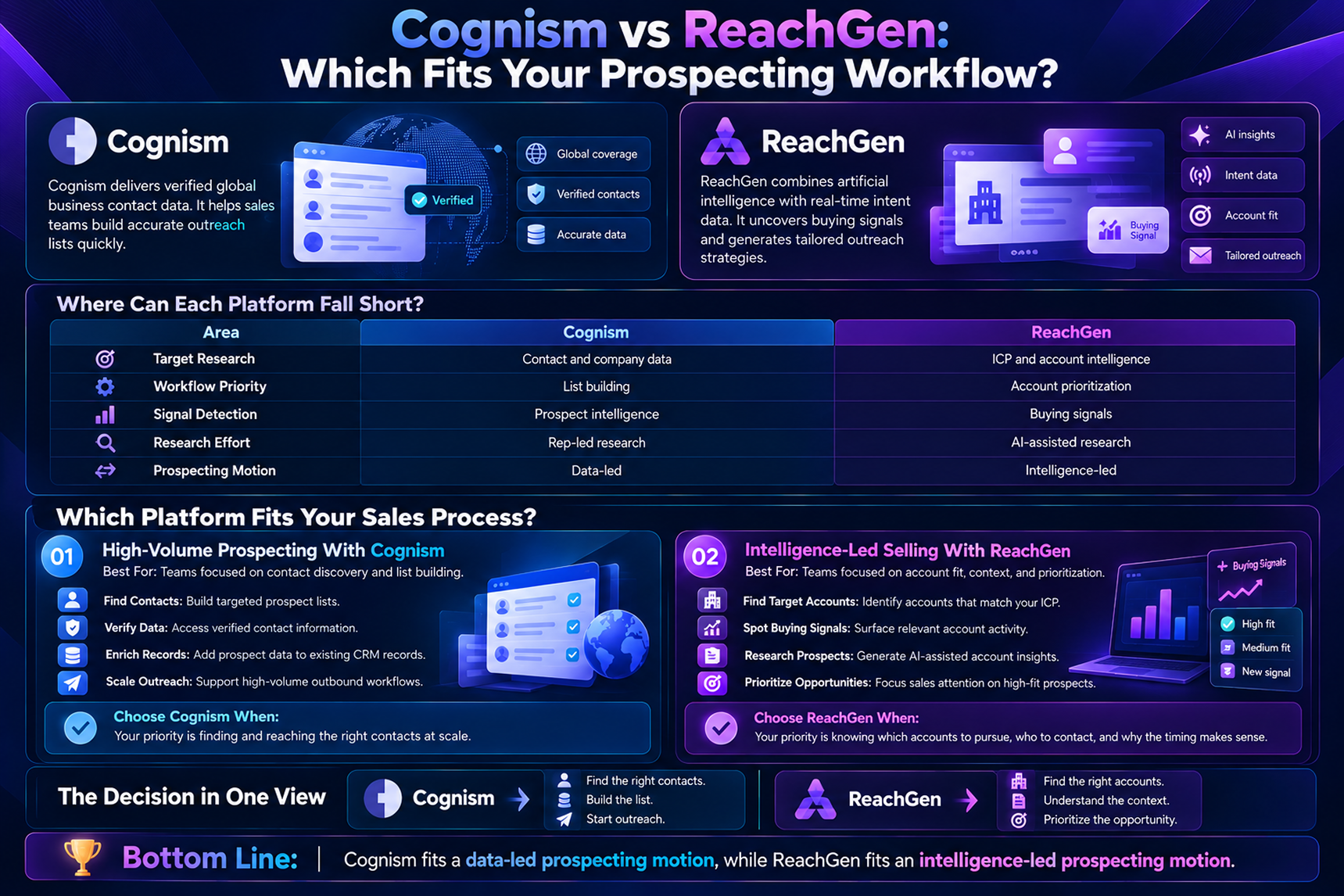
Cognism and ReachGen take different approaches to B2B prospecting. Cognism centers on sales intelligence and contact data, while ReachGen focuses on using ICP signals, account intelligence, and AI-led research to help teams identify and prioritize relevant prospects.
The better fit depends on where your team needs more support: accessing prospect data or turning prospecting criteria into prioritized opportunities.
How Cognism and ReachGen Approach Prospecting Differently
Cognism gives sales teams access to company and contact information they can use to build targeted prospect lists. Reps can filter accounts and contacts, research prospects, and use the resulting data within their outbound process.
ReachGen takes a more intelligence-led approach. It can use an organization’s ICP to identify relevant accounts, analyze account information, surface potential buying signals, and help sales teams focus their research on prospects that fit their targeting criteria.
The distinction becomes clearer when prospecting moves from “Who can I contact?” to “Which accounts should I prioritize?”
What Changes for a Sales Rep Using Each Platform?
The difference can affect several stages of a rep’s workflow:
- Finding the Right Accounts: Cognism supports account and contact discovery, while ReachGen emphasizes ICP-based account identification.
- Deciding Who to Contact First: ReachGen can bring fit and account signals into prioritization, while Cognism primarily gives reps the underlying prospect and company data.
- Preparing for Outreach: Cognism gives reps contact and company information for research. ReachGen can add AI-assisted account and prospect context to that process.
- Moving From Research to Action: Teams can use Cognism as a data source within their outbound workflow, while ReachGen focuses more heavily on reducing the research and prioritization work before outreach.
Cognism vs Apollo: Which Is Better for B2B Prospecting?
Apollo can be a stronger fit for teams that want prospect data and sales engagement in one workflow, while Cognism may suit teams with specific data coverage and prospect intelligence requirements. The better choice depends on how your team finds prospects, engages them, and manages the workflow after discovery.
| Capability | Cognism | Apollo |
|---|---|---|
| Contact Database | B2B contact and company data | Contact and company database |
| Prospect Search | Targeted contact and account searches | Contact and account searches |
| Sales Engagement | Supports outbound workflows | Built into the platform |
| Email Sequencing | Supports outreach workflows | Multi-step email sequences |
| CRM Integrations | Connects with sales and CRM systems | Connects with major CRM systems |
| Enrichment | Contact and company enrichment | Contact and company enrichment |
| Intent Capabilities | Prospect and company intelligence | Buying intent and engagement signals |
| Workflow Automation | Prospecting and data workflows | Prospecting and engagement workflows |
| Pricing Model | Usage and plan-based | Tiered plans and usage limits |
| Ideal Customer Profile | Teams prioritizing data coverage and prospect intelligence | Teams seeking prospecting and engagement in one platform |
When Is Cognism a Better Fit?
Cognism can make more sense for teams that place greater emphasis on contact data, company intelligence, and specific geographic or role-based coverage. Sales teams can use the data to identify relevant contacts, build lists, and support account research.
This approach can work well when prospect discovery remains the main requirement and the team already has a separate sales engagement stack.
When Is Apollo a Better Fit?
Apollo can be a stronger option for teams that want to connect prospect discovery with sales engagement in the same platform. Instead of moving prospect data into a separate tool for every outreach step, teams can use its prospecting and engagement capabilities within one workflow.
This can appeal to SDR and BDR teams that need to build lists, create email sequences, manage outreach, and track engagement without maintaining as many separate tools.
Which Platform Fits Your Prospecting Workflow?
Choose Cognism when data coverage and contact intelligence are the main priorities.
Choose Apollo when your team wants prospecting and sales engagement closely connected in one workflow.
Takeaway: The practical difference is less about choosing a universal winner and more about identifying where your team spends the most time. A data-focused sales team may favor Cognism, while a team looking to combine prospecting and outbound engagement may find Apollo more suitable.
Cognism vs ZoomInfo: Which Is Better for B2B Prospecting?
Cognism and ZoomInfo both give B2B teams access to company and contact intelligence, but they support different levels of the revenue workflow. Cognism centers more closely on sales intelligence and prospecting, while ZoomInfo combines prospect data with broader go-to-market capabilities.
Cognism: Key Features
- B2B contact and company data
- Prospect search and filtering
- Phone-verified contact data
- Buyer intent signals
- CRM enrichment
- Sales and CRM integrations
- International prospecting
ZoomInfo: Key Features
- Contact and company intelligence
- Buyer intent data
- Account intelligence
- CRM enrichment
- Workflow automation
- Sales and marketing intelligence
- Revenue operations capabilities
Which Platform Fits Your Prospecting Workflow?
Choose Cognism when your main requirement is contact discovery, company intelligence, and international B2B prospecting.
Choose ZoomInfo when you need broader go-to-market intelligence that supports sales, marketing, and revenue operations.
The better choice depends on the role you expect the platform to play. Cognism can fit a focused prospecting workflow, while ZoomInfo can make more sense when prospect intelligence needs to extend across the wider revenue organization.
Cognism vs Clay: Database or Data Orchestration?
Cognism and Clay solve different prospecting problems. Cognism centers on B2B sales intelligence and contact data, while Clay focuses on combining data sources, enrichment, research, and workflow automation into customized prospecting processes.
Single-Source Database vs Multi-Source Enrichment
Cognism gives sales teams a centralized source for company and contact intelligence. Reps can search for prospects, apply filters, and use available information to build targeted lists.
Clay takes a different approach by connecting multiple data providers and using them within enrichment workflows. This gives teams more flexibility when one source does not contain every field they need.
Data Enrichment Workflows
Cognism can support CRM and prospect enrichment using its available contact and company data.
Clay puts enrichment at the center of the workflow. Teams can combine providers, enrich records sequentially, and create rules for how data gets collected and processed.
Custom Research
Cognism works well for standardized prospect research based on its available company and contact intelligence.
Clay gives teams more control over research workflows. Users can define specific fields, sources, and research steps for different ICPs, industries, or account segments.
API and Provider Integrations
Cognism fits into sales and CRM workflows through its available integrations and data connections.
Clay is built around a broader data ecosystem. Teams can connect different data providers and use APIs to create workflows tailored to their prospecting requirements.
Workflow Automation
Cognism supports prospect discovery and data workflows within a sales intelligence environment.
Clay gives teams greater control over data orchestration. A workflow can identify an account, enrich its records, research additional information, and pass the results to another step automatically.
ICP Research
Cognism can help teams find contacts and companies that match defined search criteria.
Clay can support more customized ICP research by combining multiple data points and enrichment sources. This can be useful when an ICP depends on information that is not available from a single database.
Pro Tip- If your sales reps need to search for a prospect and start outreach quickly, Cognism keeps the process relatively straightforward. If your RevOps team needs to combine data sources, enrich records conditionally, or build custom research workflows, Clay offers more flexibility.
The Deciding Factor is Control: Choose Cognism for a more ready-to-use prospecting experience, and Clay when your team needs to control how prospect data is sourced, enriched, and routed.
Cognism vs 6sense: Prospect Discovery or Account Prioritization?
Cognism and 6sense approach B2B prospecting from different angles. Cognism focuses on contact and company intelligence, while 6sense emphasizes account intelligence, buying intent, predictive analytics, and ABM.
Cognism
Cognism is a B2B sales intelligence platform that helps sales teams find contacts, research companies, build prospect lists, and support outbound prospecting.
Key Features
- Contact and company data
- Prospect search and filtering
- Phone-verified contact data
- Account and prospect intelligence
- Intent signals
- CRM enrichment
- International prospecting
Best Use Case: Cognism suits sales teams that need to find relevant contacts quickly and build targeted lists for outbound sales.
| Pros | Cons |
|---|---|
| Strong contact discovery | Less focused on predictive account prioritization |
| Useful for international prospecting | ABM is not its primary focus |
| Supports account and prospect research | May require additional tools for deeper revenue intelligence |
| Fits outbound sales workflows |
6sense
6sense is a B2B revenue intelligence and ABM platform that helps sales and marketing teams identify accounts showing buying activity and prioritize them using intent and predictive signals.
Key Features
- Account identification
- Buying intent data
- Predictive analytics
- ABM capabilities
- Account prioritization
- Buyer and account intelligence
- Sales activation
Best Use Case: 6sense suits revenue teams that want to prioritize target accounts based on buying behavior, intent signals, and predicted purchase readiness.
| Pros | Cons |
|---|---|
| Strong account-based approach | More focused on accounts than direct contact discovery |
| Deep focus on buying intent | May be more than smaller teams need for basic prospecting |
| Supports predictive account prioritization | Requires a stronger ABM process |
| Connects sales and marketing around target accounts | Can be less suited to contact-first prospecting |
Which Platform Fits Your Prospecting Needs?
- Choose Cognism when your priority is finding contacts, researching companies, and building targeted prospect lists.
- Choose 6sense when your priority is identifying high-value accounts and prioritizing them using intent, predictive analytics, and ABM signals.
The Starting Point Differs: Cognism supports prospect discovery, while 6sense focuses more on account prioritization.
Conclusion
Choosing a Cognism alternative should come down to how your sales team wants to work, not simply which platform has the largest database or longest feature list. Prospecting becomes more valuable when technology can reduce the distance between identifying a potential buyer and understanding why that account deserves sales attention.
For some teams, dependable contact data and fast list building will remain the priority. Others may need a deeper layer of intelligence that brings ICP fit, account context, buying activity, and research into the prospecting process. That distinction can shape everything from rep productivity to how efficiently sales teams allocate their time.
The right platform should fit naturally into your existing revenue motion while giving your team better information for making sales decisions. If your current prospecting process still leaves reps spending too much time researching accounts and deciding where to focus, it may be worth looking beyond a traditional data-first approach.
Ready to Get Started? Talk to Us!
See how ReachGen can sharpen your prospecting strategy. Get a free demo or contact info@diggrowth.com.
Ready to get started?
Increase your marketing ROI by 30% with custom dashboards & reports that present a clear picture of marketing effectiveness
Start Free Trial
Experience Premium Marketing Analytics At Budget-Friendly Pricing.

Learn how you can accurately measure return on marketing investment.
You’re Targeting Your Ideal Customer. So Why Aren’t They Buying?
Your best customers reveal the traits associated with success. Your lost opportunities reveal where fit breaks...
Read full post post
How Predictive AI Will Transform Paid Media Strategy in 2026
Paid media isn’t a channel game anymore, it’s a chessboard. Search, social, programmatic, video, influencer, native,...
Read full post post
Don’t Let AI Break Your Brand: What Every CMO Should Know
AI isn’t just another marketing tool. It’s changing how we connect with customers, personalize content, and...
Read full post post