ReachGen AI Agent: Features, Benefits & Use Cases
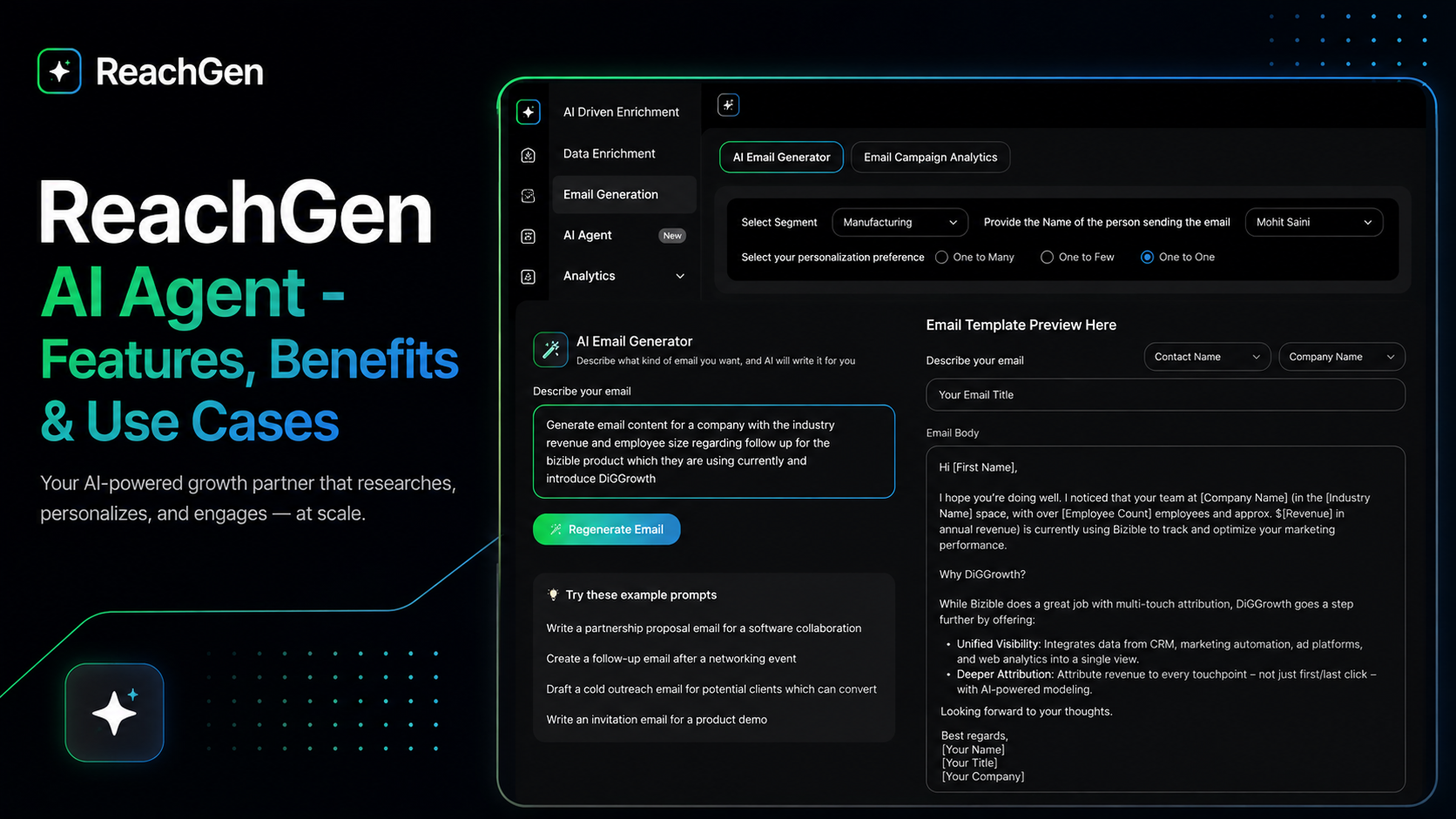
The ReachGen AI Agent helps B2B sales and marketing teams connect account research with prospecting and outreach. It brings together ICP-based targeting, account and contact enrichment, data verification, segmentation, personalized messaging, and CRM workflows. Read on.
A prospect list tells you who exists. It does not tell you who deserves your sales team’s attention.
That distinction becomes critical as B2B teams scale outbound programs. Sales reps may spend hours checking company details, researching decision-makers, updating missing contact information, qualifying accounts against an ICP, and then writing messages that reflect what they found.
The ReachGen AI Agent brings these prospecting activities into a unified workflow. It can help teams identify relevant accounts and contacts, enrich and verify their data, create targeted segments, and turn account context into personalized outreach. Instead of treating prospect data as a static list, teams can use it as a foundation for more informed GTM decisions.
What Is the ReachGen AI Agent?
The ReachGen AI Agent is an AI-powered account intelligence and outreach agent from DiGGrowth that helps GTM teams find high-fit accounts and contacts, enrich and verify prospect data, segment audiences, and create more relevant outreach.
ReachGen focuses on the research and data work that typically sits between defining an Ideal Customer Profile (ICP) and launching an outreach campaign. Teams can apply ICP criteria to find suitable companies, identify relevant contacts, and gather the account details needed to evaluate prospect fit.
The agent also supports prospect segmentation and personalized outreach. Instead of treating every contact in a target list the same way, teams can organize prospects around relevant account characteristics and use that context when preparing messages.
This makes ReachGen useful across several parts of the GTM workflow, including account-based marketing, outbound prospecting, demand generation, and CRM data enrichment. The goal is not simply to generate a larger prospect list. It is to give teams more useful information for deciding which accounts to pursue, who to engage, and how to approach them.
ReachGen AI Agent vs. Traditional Lead Generation: What Is the Difference?
| Area | Traditional Lead Generation | ReachGen AI Agent |
|---|---|---|
| Account research | Manual | AI-assisted |
| Contact data | Often static | Enriched and verified |
| ICP targeting | Manually defined lists | AI-powered account discovery |
| Segmentation | Static lists | Dynamic lists |
| Outreach | Generic or template-based | Context-aware drafts |
| Account intelligence | Spread across tools | Centralized within workflow |
| CRM updates | Often manual | Integrated workflow |
| Prospect research | Time-intensive | Automated |
How Does ReachGen Work?
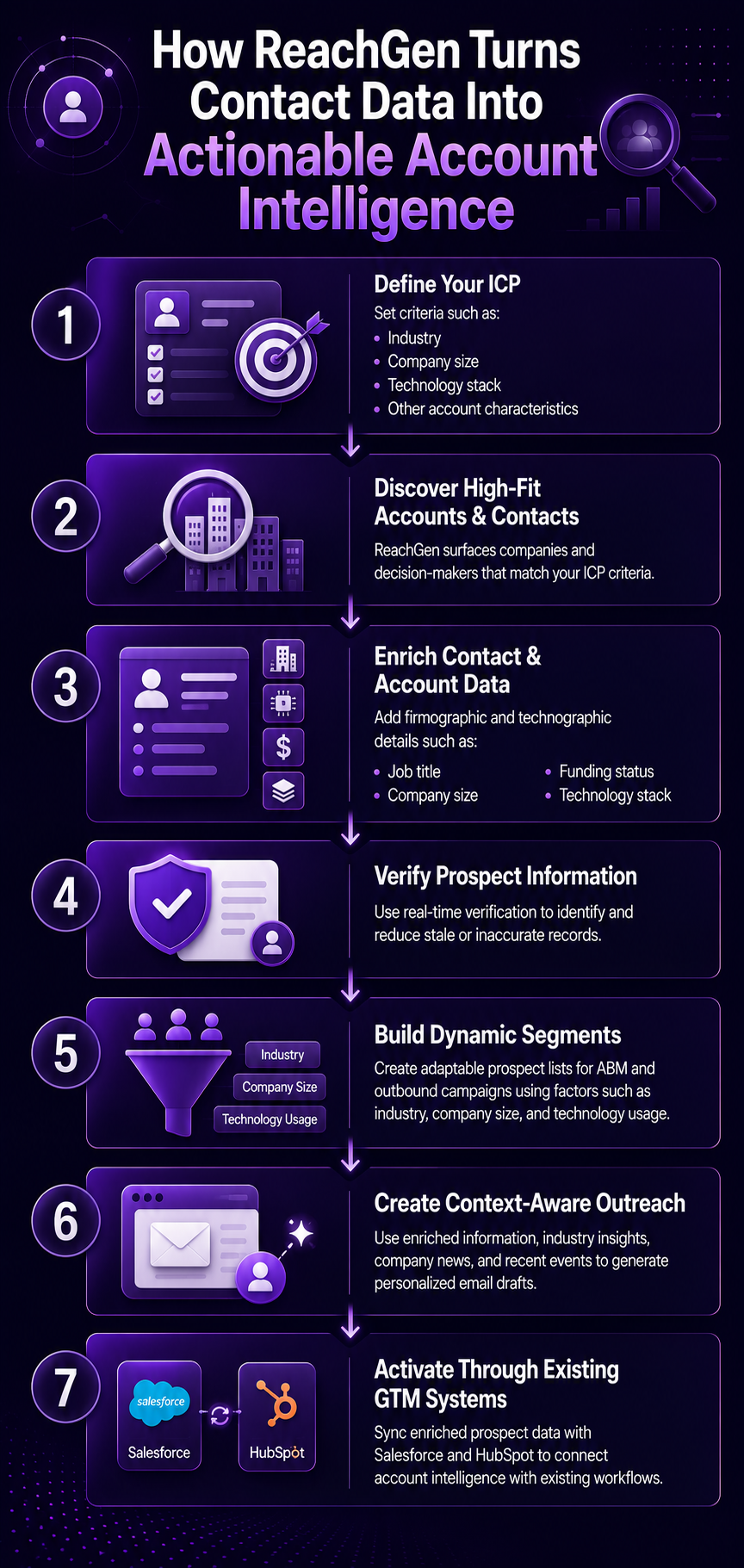
The ReachGen AI Agent streamlines prospecting by starting with ICP criteria, identifying suitable accounts and contacts, enriching their records, and organizing the resulting data for targeted outreach.
Key Features of the ReachGen AI Agent
The ReachGen AI Agent combines account discovery, prospect data management, segmentation, outreach, and account intelligence within one GTM workflow.
Automated Contact And Account Enrichment
ReachGen enriches basic prospect records with additional company and contact information. This can include job title, industry, company size, funding status, and technology stack.
By combining contact details with account-level information, teams can evaluate whether a prospect fits their ICP and gather the context needed for further research or outreach.
Real-Time Data Verification
ReachGen verifies prospect information to help teams identify outdated or inaccurate records. This is different from enrichment: enrichment adds information, while verification checks its reliability.
Verified records give sales and marketing teams a stronger data foundation for prospecting and CRM activities.
DiGGi-GPT For Account Intelligence
DiGGi-GPT lets users query ReachGen’s account and contact data using natural-language prompts. Instead of reviewing individual fields manually, sales representatives can ask questions and get relevant information in a conversational format.
For example, a representative could ask:
- Which decision-makers are relevant to this account?
- Which contacts match our target role?
- Create an outreach draft using the available account context.
This makes prospect research more actionable. Sales teams can move from finding information to deciding what to do with it without manually connecting details across multiple records.
AI-Powered ICP Discovery
ReachGen uses defined Ideal Customer Profile (ICP) criteria to identify relevant accounts and contacts. Teams can filter their target market using criteria such as industry, company size, and technology needs.
For example, an enterprise SaaS company targeting large financial institutions can use its ICP criteria to identify suitable accounts and the relevant decision-makers within them.
CRM And Marketing Automation Integration
ReachGen integrates with Salesforce and HubSpot, connecting prospect intelligence with existing GTM workflows.
This can help teams carry enriched information into activities such as lead routing, segmentation, scoring, and campaign execution without manually moving data between systems.
What Are the Benefits of Using the ReachGen AI Agent?
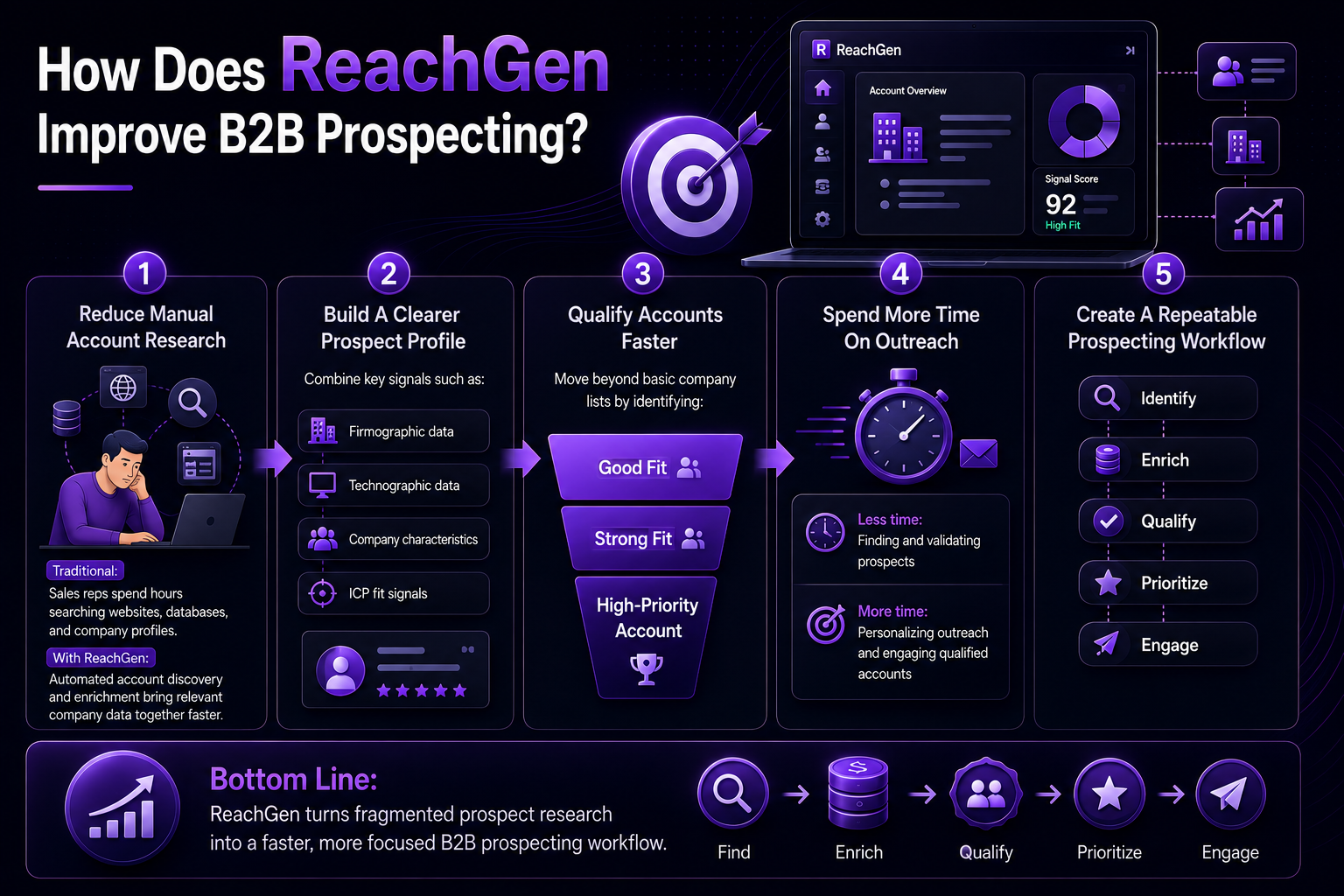
The ReachGen AI Agent can improve the efficiency and consistency of B2B prospecting by connecting research, account intelligence, outreach, and GTM data workflows. Its value comes from reducing the gaps between these activities.
Accelerate Sales Prospecting
ReachGen can shorten the path between finding a potential account and preparing it for outreach. Automated account discovery and enrichment reduce the amount of manual research sales reps need to complete before evaluating a prospect.
Instead of spending significant time collecting basic company and contact details, reps can start with richer prospect information and focus their effort on qualification and conversation planning.
Improve Outreach Relevance
Better outreach starts with better context. ReachGen gives teams access to account and contact information that can inform messaging, helping reps move beyond basic personalization such as inserting a prospect’s name or company.
The result is an outreach process where the message can reflect relevant account circumstances, industry information, or recent company developments rather than relying entirely on generic templates.
Align Sales And Marketing Around the Same Account Data
Shared account intelligence gives sales and marketing teams a common view of their target accounts. Marketing can use account information for ABM and campaign targeting, while sales can use the same context during lead handoffs and follow-up.
This reduces the disconnect that can occur when marketing builds audiences from one set of criteria while sales researches accounts using another.
Get More Value From CRM And Marketing Automation Platforms
Richer prospect information becomes more useful when it reaches the systems that manage GTM execution. ReachGen connects with Salesforce and HubSpot, allowing enriched data to support processes such as scoring, routing, segmentation, campaign management, and attribution.
Instead of keeping prospect intelligence isolated in a prospecting tool, teams can carry relevant data into the workflows they already use.
What Are the Best Use Cases for ReachGen?
ReachGen is most useful when teams need to turn account and contact data into a specific GTM action. The strongest use cases include targeted account selection, campaign audience creation, sales prospecting, CRM cleanup, and cross-team account planning.
| Use Case | How ReachGen Can Be Applied | Teams That Benefit |
|---|---|---|
| ABM Campaign Planning | Build a target account universe around a defined ICP before launching an account-based campaign. | ABM, Marketing, Sales |
| Outbound Market Expansion | Identify potential accounts and contacts when entering a new industry, company segment, or market. | Sales, SDR, GTM |
| Campaign Audience Building | Create focused audiences using account attributes relevant to a particular campaign. | Demand Generation, Marketing |
| Sales Territory Research | Research accounts within a territory and identify relevant contacts for sales coverage. | Sales, SDRs |
| New Market Identification | Find companies that fit a desired customer profile when testing a new market opportunity. | GTM, Sales, Marketing |
| Account Research Before Outreach | Give reps additional company and contact context before they begin a sales conversation. | Sales, SDRs |
| Cross-Team Account Planning | Give marketing, sales, and RevOps teams a shared view of target accounts and relevant prospect information. | Sales, Marketing, RevOps |
Case Study: ReachGen In Action – Helping a Networking Company Build a Target Account Pipeline
The Challenge
A networking company wanted to grow its enterprise pipeline but spent considerable time researching potential accounts. Reps had to identify companies that matched their target profile, find the right decision-makers, verify contact details, and gather enough company context before starting outreach.
The Approach
The team used ReachGen to structure this process around its ICP. It identified relevant accounts and contacts, enriched and verified prospect records, and grouped accounts based on factors such as industry, company size, and technology. Reps could then use the available account context to prepare outreach for each segment.
The Execution
The workflow moved through three key stages:
- Target: Identify companies and decision-makers that matched the ICP.
- Qualify: Enrich and verify account information before outreach.
- Engage: Use account context to prepare personalized messages and activate prospects through existing GTM workflows.
The Outcome
The team moved from manually assembling prospect information to working from a more organized account intelligence workflow. Sales reps spent less time gathering basic account details and more time assessing prospects and preparing relevant conversations.
Who Should Use the ReachGen AI Agent?
The ReachGen AI Agent is suited to B2B teams that rely on account intelligence for prospecting, targeting, and outreach. Its usefulness varies by team, depending on where prospect data fits into the GTM process.
B2B Sales Teams
Sales teams can use ReachGen to identify relevant accounts and contacts, qualify prospects against ICP criteria, and prepare more informed outreach. Enriched account information gives reps additional context before they contact a prospect.
Marketing And Demand Generation Teams
Marketing teams can use ReachGen to build targeted audiences for ABM and demand generation campaigns. Account characteristics and segmentation criteria can help marketers create campaign lists that align with specific targeting requirements.
RevOps Teams
RevOps teams can use ReachGen for CRM enrichment, data verification, and workflow consistency. Connecting prospect intelligence with existing GTM systems can also support better coordination between sales and marketing.
Growth And GTM Leaders
Growth and GTM leaders can use ReachGen to bring prospecting, account research, and outreach into a more connected process. This can give leadership teams greater visibility into how account intelligence supports their broader GTM strategy.
Conclusion
Strong GTM execution starts with knowing where to focus before the first message is sent. When account research, prospect data, and outreach decisions remain scattered across tools, teams spend valuable time connecting information that should already be within reach.
For organizations looking to make every sales and marketing effort more targeted, connected, and informed, it can become a valuable part of the GTM stack.
Give your team better context before the next prospecting decision: info@diggrowth.com
Ready to get started?
Increase your marketing ROI by 30% with custom dashboards & reports that present a clear picture of marketing effectiveness
Start Free Trial
Experience Premium Marketing Analytics At Budget-Friendly Pricing.

Learn how you can accurately measure return on marketing investment.

How Predictive AI Will Transform Paid Media Strategy in 2026
Paid media isn’t a channel game anymore, it’s a chessboard. Search, social, programmatic, video, influencer, native,...
Read full post post
Don’t Let AI Break Your Brand: What Every CMO Should Know
AI isn’t just another marketing tool. It’s changing how we connect with customers, personalize content, and...
Read full post post
From Demos to Deployment: Why MCP Is the Foundation of Agentic AI
A quiet revolution is unfolding in AI. And it’s not happening inside research labs. For decades,...
Read full post postFAQs
ReachGen addresses common prospecting challenges such as incomplete account data, manual research, scattered prospect information, and broad targeting.
ReachGen can help ABM teams identify accounts that fit their ICP, find relevant contacts, enrich account information, and organize prospects into targeted segments for account-level campaigns.
Yes. ReachGen can use account and contact information, along with relevant company and industry context, to support personalized outreach drafts that sales representatives can review before sending.
ReachGen integrates with Salesforce and HubSpot, allowing teams to connect enriched prospect information with their existing sales and marketing workflows.
B2B sales, marketing, demand generation, RevOps, and GTM teams can benefit from ReachGen when they need better account intelligence for prospecting, targeting, segmentation, and outreach.