Lead Generation Process: A Complete Guide to Building a Scalable Pipeline
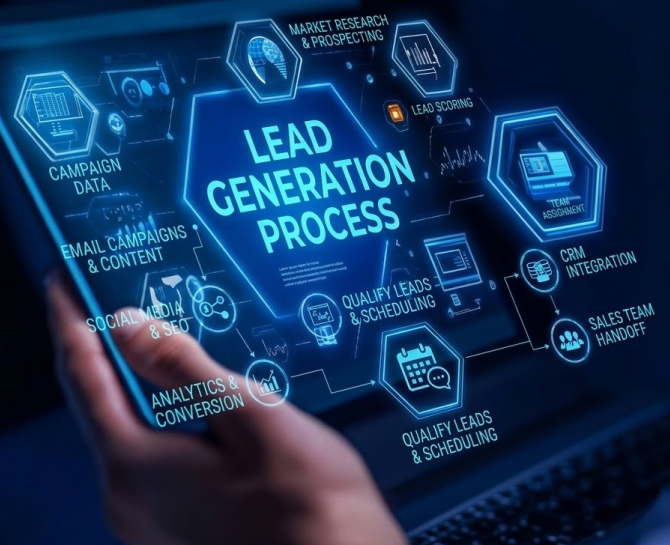
The lead generation process is the series of steps that takes a prospect from first awareness to sales-ready. It is not a single campaign or channel. It is a repeatable system that connects marketing activity to a qualified pipeline, and the difference between one that drives revenue and one that just drives reports comes down to how well each stage is defined, measured, and optimized.
61% of marketers say generating quality leads is their top challenge (Hubspot). Not quantity. Quality. Most teams have figured out how to fill a funnel. What they haven’t figured out is how to fill it with people who are actually going to buy.
That’s the distinction between a lead generation process that produces revenue and one that just produces reports.
Key Takeaways
- 61% of marketers say generating quality leads is their top challenge, not quantity. Most teams know how to fill a funnel. The harder problem is filling it with people who are actually going to buy.
- A structured process gives marketing and sales a shared definition of what a good lead looks like. Without it, misalignment is almost always the outcome, and it rarely traces back to a talent problem.
- 79% of leads never convert, largely because of poor qualification and nurturing. Lead scoring separates the contacts worth passing to sales from the ones still in early research mode.
- Most leads are not ready to buy when they first convert. The average B2B purchase cycle is over 10 months. Nurturing is what keeps your brand relevant throughout that window without requiring manual follow-up at every stage.
- AI is changing every step of the process, from predictive lead scoring to 24/7 chatbot qualification. Teams treating it as optional are competing at a structural disadvantage.
What Is the Lead Generation Process?
Definition and Core Objective
The lead generation process is the series of steps that takes a stranger from first awareness of your brand to a point where they’re ready for a sales conversation. It’s not a single campaign or a single channel. It’s a system that connects marketing activity to a qualified pipeline in a repeatable way.
Lead Generation vs Demand Generation
These two terms often get used interchangeably, but they’re doing different jobs. Demand generation builds awareness and shapes how a market thinks about a problem. Lead generation captures that interest and converts it into a trackable, workable contact. One without the other creates bottlenecks. Strong demand gen with weak lead capture means interest that goes nowhere. Strong lead capture without demand gen means chasing people who weren’t ready.
Why a Structured Lead Generation Process Matters
Without a defined process, lead generation is essentially a series of disconnected experiments. Some work, but nobody knows why. Others fail, and the same mistakes get repeated the next quarter.
A structured process creates consistency. It gives marketing and sales a shared vocabulary, a shared set of expectations, and a shared definition of what a good lead actually looks like. 41% of B2B marketers report difficulty aligning marketing-generated leads with sales expectations. That misalignment almost always traces back to an undefined process rather than a talent problem.
It also makes improvement measurable. When each stage of the funnel has a defined input, output, and conversion rate, underperforming stages become visible and fixable rather than hidden inside aggregate numbers.
Step 1: Define Your Ideal Customer Profile
Before any campaign goes live, the team needs agreement on who they’re targeting. An Ideal Customer Profile (ICP) defines the firmographic and behavioral characteristics of the accounts most likely to buy and most likely to stay. Industry, company size, tech stack, growth signals, and buying triggers all feed into it.
92% of buyers begin their research already thinking about at least one specific vendor. That means the competition for a prospect’s attention starts before your first ad is served. A sharp ICP determines whether your brand shows up in that early shortlist or gets discovered too late to matter.
Step 2: Attract the Right Audience
Once you know who you’re targeting, the next step is getting in front of them. The channels that work best depend on your audience, but the data in 2026 is fairly clear on direction.
89% of B2B marketers use LinkedIn for lead generation, and 62% confirm it produces quality leads. Businesses that publish blogs consistently generate 13x more leads than those that don’t. Webinars convert 73% of attendees into leads on average. Paid search captures high-intent traffic at the moment of active research.
The goal at this stage is high-intent traffic, not just high volume. A thousand visitors with no buying intent are harder to work with than a hundred who are actively evaluating solutions in your category.
Step 3: Capture Leads Effectively
Traffic that doesn’t convert to a contact is invisible to your process. Capture mechanisms, landing pages, forms, gated content, demo requests, and chatbots turn anonymous interest into trackable leads.
The value exchange is important here. When the offer on the other end is compelling, someone will provide their contact information. When you give a clear, high-value offer on a dedicated landing page, such as an ebook, ROI calculator, or webinar, you can get far more leads than with a normal B2B website. The offer should correspond to the stage of purpose. Early-stage material for browsers; high-commitment incentives for active evaluators.
Step 4: Qualify Leads
Volume means very little without qualification. 79% of leads never convert into sales, largely due to poor nurturing and qualification processes. Passing every captured contact directly to sales wastes rep time on people who aren’t ready and erodes trust between teams over time.
Lead scoring solves this by assigning weighted values to behaviors and attributes. Time on site, content consumed, job title, company size, intent signals, all of these feed a score that separates marketing-qualified leads (MQLs) from contacts still in early research mode. Only about 25% of generated leads typically have enough quality to move directly toward sales. The scoring process identifies which ones those are.
Step 5: Nurture Leads Through the Funnel
The majority of leads are not ready to buy when they initially convert. The average B2B purchase cycle lasts 10.1 months. Nurturing is what keeps your brand relevant throughout that time frame without requiring manual follow-up at each stage.
Email sequences, retargeting campaigns, and content tracks tailored to the funnel stage all serve this function. 65% of marketers haven’t implemented lead nurturing, which helps explain why so many pipelines stall between MQL and SQL. The payoff for doing it well is concrete: nurtured leads make purchases that are 47% larger on average than non-nurtured ones.
Step 6: Convert Leads into Customers
When a lead reaches SQL status, the handoff to sales needs to be fast and warm.In comparison to delayed responses, promptly responding to qualified leads—ideally within minutes—can boost conversion rates multiple times. Generic sequences are routinely outperformed by personalized outreach that makes reference to the particular content a lead interacted with or the particular issue their firmographic profile indicates they are resolving.
At this stage, the lead has done significant self-directed research. The job isn’t to educate from scratch. It’s to confirm fit, address the remaining objections, and create the conditions for a decision.
Step 7: Measure and Optimize
Every stage in the process should have a defined conversion rate and a target. Visitor to lead. Lead to MQL. MQL to SQL. SQL to close the deal. When a stage underperforms, the process surfaces it clearly rather than hiding it inside a blended number.
Cost Per Lead and Customer Acquisition Cost follow efficiency. Funnel drop-off rates identify where attention is needed. Without this feedback loop, the process continues, but never improves. Each cycle results in a slightly crisper version of the previous one.
Lead Generation Channels That Drive Results
Not every channel deserves equal investment. The channels with the clearest performance data in B2B right now:
- Organic search and content marketing reward long-term investment. High-ranking content captures intent-based traffic continuously without ongoing spend.
- LinkedIn is the dominant B2B social platform by conversion, with a 2.74% visitor-to-lead rate that significantly outperforms Facebook and X.
- Email continues to be one of the most effective outbound channels for B2B teams, especially when outreach is thoughtfully targeted and personalized.
- Referral and partner channels tend to produce shorter sales cycles and higher close rates. Leads that arrive with existing credibility rarely need the same volume of nurture touchpoints.
Common Challenges in the Lead Generation Process
1. Poor lead quality happens when targeting is too broad or the offer attracts the wrong audience. High MQL volume with low SQL conversion is the clearest symptom.
2. Sales and marketing misalignment creates a handoff problem. When each team defines lead quality differently, qualified leads either stall or get rejected by sales.
3. Low conversion rates through the funnel usually point to a nurturing gap. Leads that don’t receive relevant, timely content during the consideration phase disengage rather than progress.
4. Lack of data and tracking makes improvement impossible. Without visibility into where leads drop out, teams keep investing in the wrong stages and repeat the same mistakes each quarter.
How to Improve Your Lead Generation Process
- Use data to refine targeting: Regular analysis of which leads actually closed, and what they had in common, continuously sharpens the ICP and improves campaign quality at the source.
- Implement marketing automation: CRM-connected workflows remove manual steps from nurturing and follow-up, and ensure no lead falls through a gap in the process.
- Personalize the customer journey: Behavior-based content tracks that respond to what a lead has actually done, rather than where a campaign assumed they’d be, drive significantly higher engagement and faster movement through the funnel.
- Align sales and marketing on shared KPIs: When both teams are measured against the same pipeline and revenue outcomes rather than separate activity metrics, the incentives align, and the process runs more smoothly.
The Role of AI in Lead Generation
Every step of the process is being transformed by AI. Businesses that use AI-driven scoring models claim notable increases in conversion rates. Predictive lead scoring analyzes both behavioral and firmographic information to determine which leads are most likely to convert. Personalized content is delivered at scale via automated campaigns without the need for manual segmentation. By instantaneously engaging visitors and directing high-intent prospects to sales or booking processes, chatbots qualify leads around-the-clock, greatly increasing speed-to-lead and decreasing response times.
92% of marketers say AI has already had an impact on their role. The teams treating it as optional are running a different race.
Final Thoughts
Lead generation in 2026 is not a volume problem. Most organizations already have enough activity in their funnel. What they’re missing is a process that turns that activity into a predictable, qualified pipeline.
A well-built lead generation process defines who you’re targeting, attracts them through the right channels, qualifies them consistently, and delivers them to sales at the right moment with the right context. Each stage connects to the next. Each stage is measurable. And each iteration of the process is a little better than the one before it.
That’s how lead generation becomes a growth engine rather than a quarterly gamble.
Ready to get started?
Increase your marketing ROI by 30% with custom dashboards & reports that present a clear picture of marketing effectiveness
Start Free Trial
Experience Premium Marketing Analytics At Budget-Friendly Pricing.

Learn how you can accurately measure return on marketing investment.
How Predictive AI Will Transform Paid Media Strategy in 2026
Paid media isn’t a channel game anymore, it’s a chessboard. Search, social, programmatic, video, influencer, native,...
Read full post post
Don’t Let AI Break Your Brand: What Every CMO Should Know
AI isn’t just another marketing tool. It’s changing how we connect with customers, personalize content, and...
Read full post post
From Demos to Deployment: Why MCP Is the Foundation of Agentic AI
A quiet revolution is unfolding in AI. And it’s not happening inside research labs. For decades,...
Read full post postFAQ's
It is a step-by-step system that moves a prospect from first awareness to sales-ready. It connects marketing activity to a qualified pipeline in a repeatable, measurable way across channels and funnel stages.
Demand generation builds awareness and shapes how a market thinks about a problem. Lead generation captures that interest and converts it into a trackable contact. Both are needed. One without the other creates bottlenecks.
Primarily because of poor qualifications and lack of nurturing. Leads that do not receive relevant content during the consideration phase disengage. Only around 25% of generated leads typically have enough quality to move directly toward a sales conversation.
LinkedIn, organic search, email, and referral channels consistently perform well in B2B. LinkedIn alone produces a 2.74% visitor-to-lead rate. Content marketing compounds over time, capturing intent-based traffic without ongoing spend.
AI-driven scoring surfaces the leads most likely to convert by analyzing behavioral and firmographic signals. Chatbots qualify prospects around the clock, reducing response times. Automated campaigns deliver personalized content at scale without manual segmentation.